#BTC

Посты

--Рост
Crypto Guide News
·
--
РостI spent some time going through the TermMax documentation, and the fixed-rate model started to make more sense to me.
At first, I assumed TermMax was simply another lending protocol. However, the more I explored it, the more I understood that its broader approach is about representing borrowing, lending, and leverage through tokenized transactions.
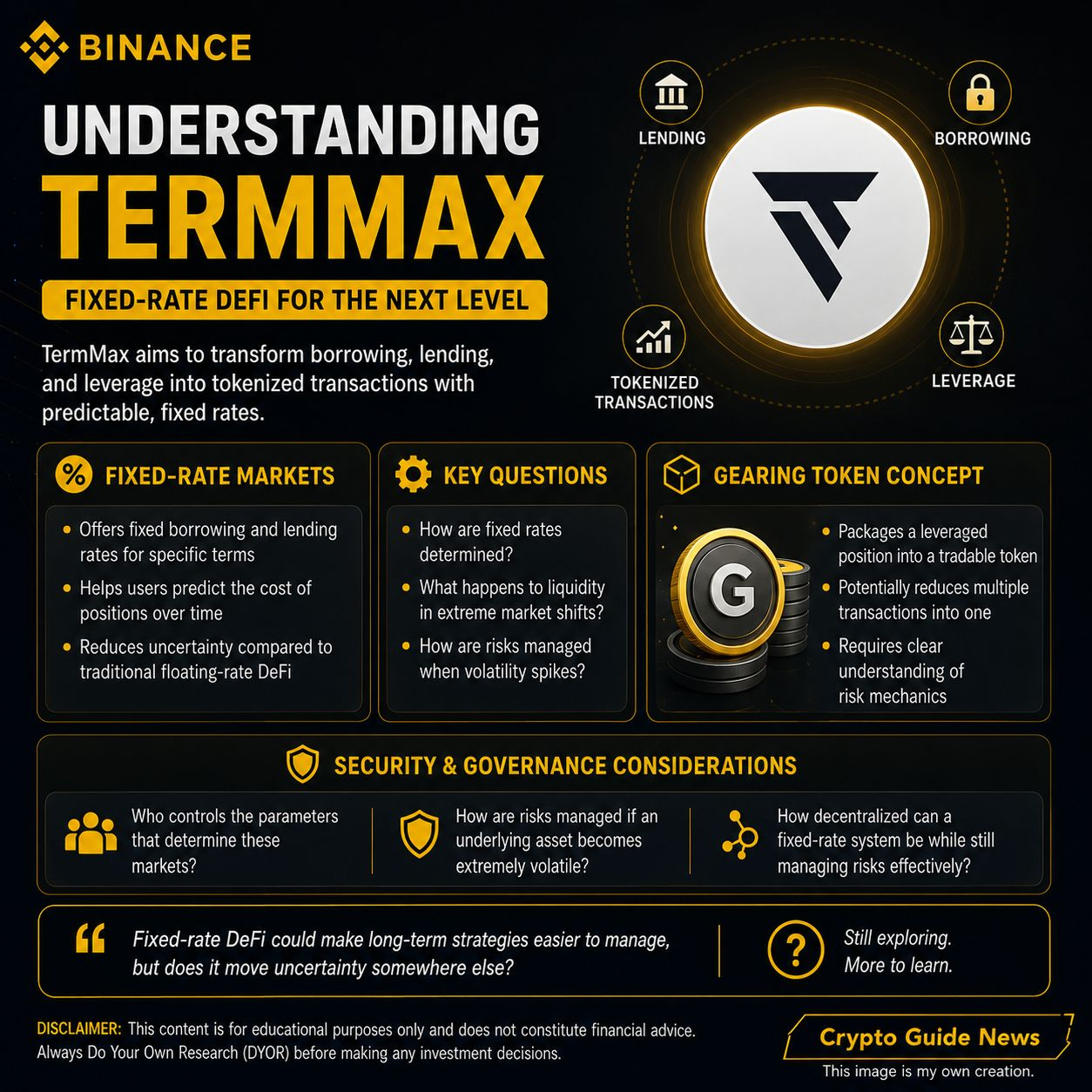
What caught my attention most was the separation between floating-rate lending and fixed-term markets. In traditional DeFi, borrowing costs can change rapidly, making it difficult to estimate the actual cost of maintaining a position over time. TermMax appears to address this by providing fixed borrowing and lending rates for specific terms.
The concept sounds simple, but it raises some important questions. How exactly are these fixed rates determined? What happens to liquidity when market conditions move significantly away from the assumptions used to price a term?
I also found the gearing-token concept particularly interesting. My understanding is that it packages a leveraged position into a tradable token, potentially simplifying what would otherwise require multiple transactions. However, I think the underlying risk mechanics need to be understood carefully before considering this a major advantage.
There are also broader questions around security and governance. Who controls the parameters of these markets? How are risks handled when an underlying asset becomes extremely volatile or liquidity suddenly disappears? And how decentralized can a fixed-rate financial system realistically become while still maintaining effective risk management?
I’m still exploring these areas rather than assuming the model is perfect.
For those who have studied TermMax more deeply, what am I missing about its fixed-rate and gearing-token architecture?
Does fixed-rate DeFi genuinely make long-term strategies easier to manage, or does it simply shift the uncertainty to another part of the system?#TermMax❤️❤️ #Crypto
At first, I assumed TermMax was simply another lending protocol. However, the more I explored it, the more I understood that its broader approach is about representing borrowing, lending, and leverage through tokenized transactions.
What caught my attention most was the separation between floating-rate lending and fixed-term markets. In traditional DeFi, borrowing costs can change rapidly, making it difficult to estimate the actual cost of maintaining a position over time. TermMax appears to address this by providing fixed borrowing and lending rates for specific terms.
The concept sounds simple, but it raises some important questions. How exactly are these fixed rates determined? What happens to liquidity when market conditions move significantly away from the assumptions used to price a term?
I also found the gearing-token concept particularly interesting. My understanding is that it packages a leveraged position into a tradable token, potentially simplifying what would otherwise require multiple transactions. However, I think the underlying risk mechanics need to be understood carefully before considering this a major advantage.
There are also broader questions around security and governance. Who controls the parameters of these markets? How are risks handled when an underlying asset becomes extremely volatile or liquidity suddenly disappears? And how decentralized can a fixed-rate financial system realistically become while still maintaining effective risk management?
I’m still exploring these areas rather than assuming the model is perfect.
For those who have studied TermMax more deeply, what am I missing about its fixed-rate and gearing-token architecture?
Does fixed-rate DeFi genuinely make long-term strategies easier to manage, or does it simply shift the uncertainty to another part of the system?#TermMax❤️❤️ #Crypto
Отказ от ответственности. Содержит мнения третьих сторон. Не является рекомендацией. Binance AI не предоставляет гарантий. См. Правила и условия.