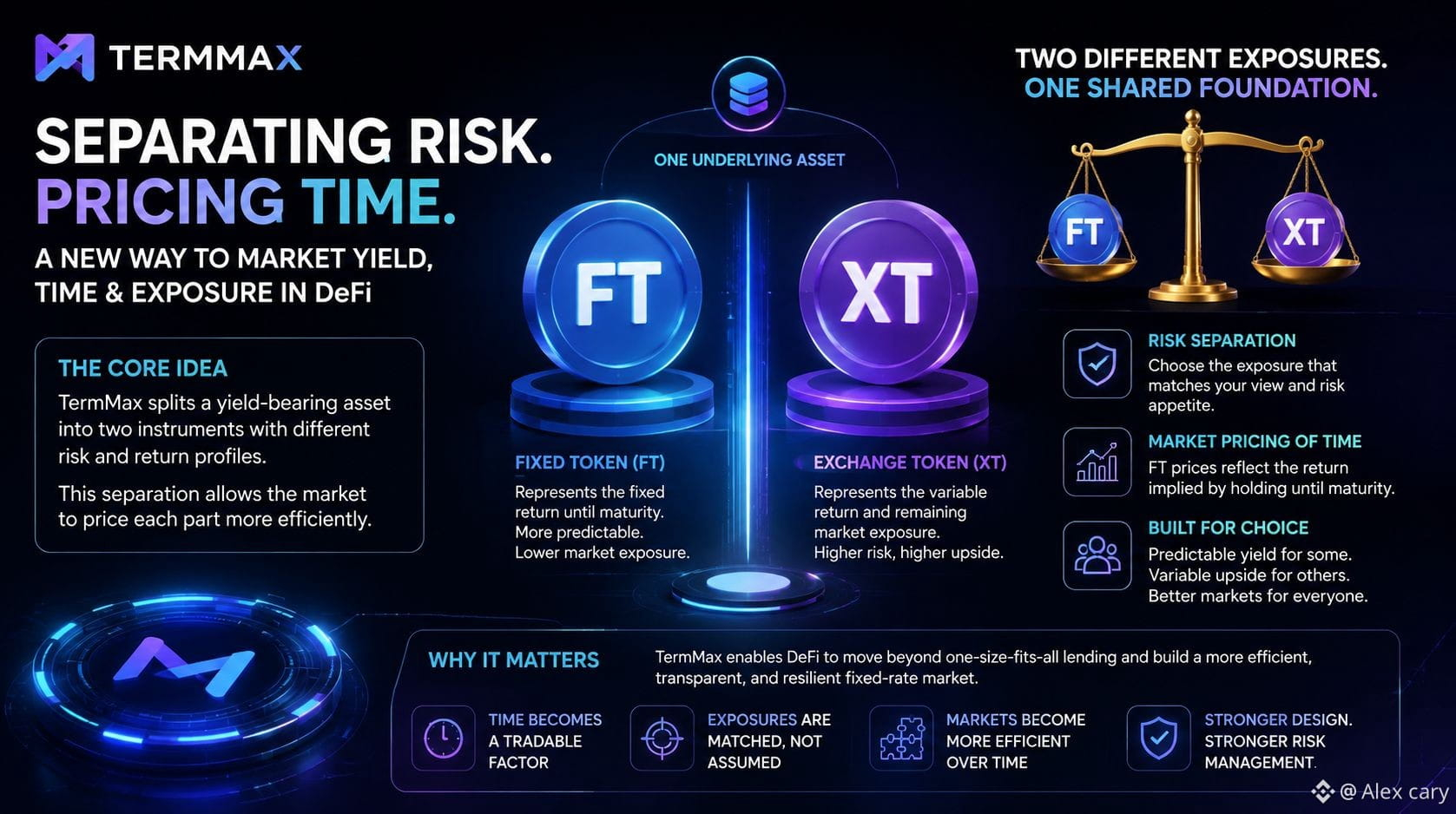
The more I look at TermMax, the more I think liquidity may be the real product being tested.
The FT/XT structure makes sense conceptually because it separates fixed and variable exposure.
But creating two different exposures is only useful if the market can actually price them efficiently.
That’s where things get interesting.
An FT isn’t valuable simply because it has a defined maturity claim.
Its real usefulness depends on whether someone can enter, hold, and eventually exit that position without paying too much for illiquidity.
The same applies to XT.
If one side of the market becomes difficult to trade, the theoretical separation of risk becomes much less useful in practice.
This is why I think TermMax is testing something deeper than fixed-rate DeFi.
It is testing whether different types of risk can develop their own liquidity and price discovery.
In traditional markets, duration, credit, and market exposure can be separated into instruments that different participants trade according to their preferences.
DeFi has often bundled these risks together.
TermMax is interesting because it is trying to make that separation native to the protocol.
But the real proof won’t come from the mechanism itself.
It will come when markets become volatile.
If FT and XT can continue discovering reasonable prices when conditions get difficult, that would be a much stronger validation of the design.
For me, that’s the metric worth watching:
not just whether TermMax can separate risk,
but whether the market can actually price each piece of that risk efficiently.
@TermMax #termmax
The FT/XT structure makes sense conceptually because it separates fixed and variable exposure.
But creating two different exposures is only useful if the market can actually price them efficiently.
That’s where things get interesting.
An FT isn’t valuable simply because it has a defined maturity claim.
Its real usefulness depends on whether someone can enter, hold, and eventually exit that position without paying too much for illiquidity.
The same applies to XT.
If one side of the market becomes difficult to trade, the theoretical separation of risk becomes much less useful in practice.
This is why I think TermMax is testing something deeper than fixed-rate DeFi.
It is testing whether different types of risk can develop their own liquidity and price discovery.
In traditional markets, duration, credit, and market exposure can be separated into instruments that different participants trade according to their preferences.
DeFi has often bundled these risks together.
TermMax is interesting because it is trying to make that separation native to the protocol.
But the real proof won’t come from the mechanism itself.
It will come when markets become volatile.
If FT and XT can continue discovering reasonable prices when conditions get difficult, that would be a much stronger validation of the design.
For me, that’s the metric worth watching:
not just whether TermMax can separate risk,
but whether the market can actually price each piece of that risk efficiently.
@TermMax #termmax