I went back through DuskEVM today because I wanted to understand what EVM compatibility actually changes beyond the headline.
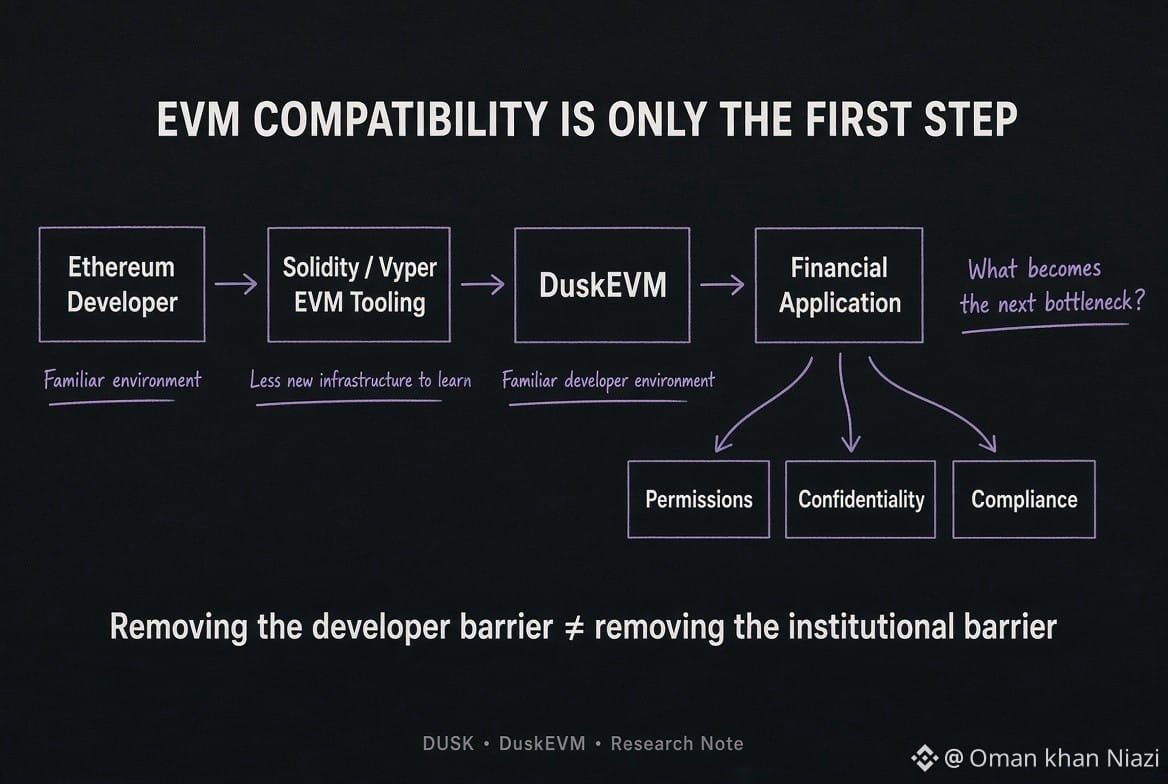
One detail that stood out is that DuskEVM is built to work with familiar Ethereum development languages and tooling, including Solidity and Vyper.
That matters because developers don’t necessarily have to learn an entirely different smart-contract environment just to start building on Dusk.
But then I started thinking about what happens after that first step.
If deploying an application becomes easier, the harder questions for financial applications don’t disappear.
Who is allowed to interact with it?
What information needs to remain confidential?
How are compliance requirements enforced?
And how does the application connect to the rest of the financial workflow?
So I don’t think EVM compatibility is the interesting part by itself.
The interesting part is whether familiar developer infrastructure can actually lead to applications that work under real institutional constraints.
If DuskEVM removes the developer barrier, what becomes the next bottleneck for getting financial applications into real-world use?
@Dusk $DUSK #dusk
One detail that stood out is that DuskEVM is built to work with familiar Ethereum development languages and tooling, including Solidity and Vyper.
That matters because developers don’t necessarily have to learn an entirely different smart-contract environment just to start building on Dusk.
But then I started thinking about what happens after that first step.
If deploying an application becomes easier, the harder questions for financial applications don’t disappear.
Who is allowed to interact with it?
What information needs to remain confidential?
How are compliance requirements enforced?
And how does the application connect to the rest of the financial workflow?
So I don’t think EVM compatibility is the interesting part by itself.
The interesting part is whether familiar developer infrastructure can actually lead to applications that work under real institutional constraints.
If DuskEVM removes the developer barrier, what becomes the next bottleneck for getting financial applications into real-world use?
@Dusk $DUSK #dusk