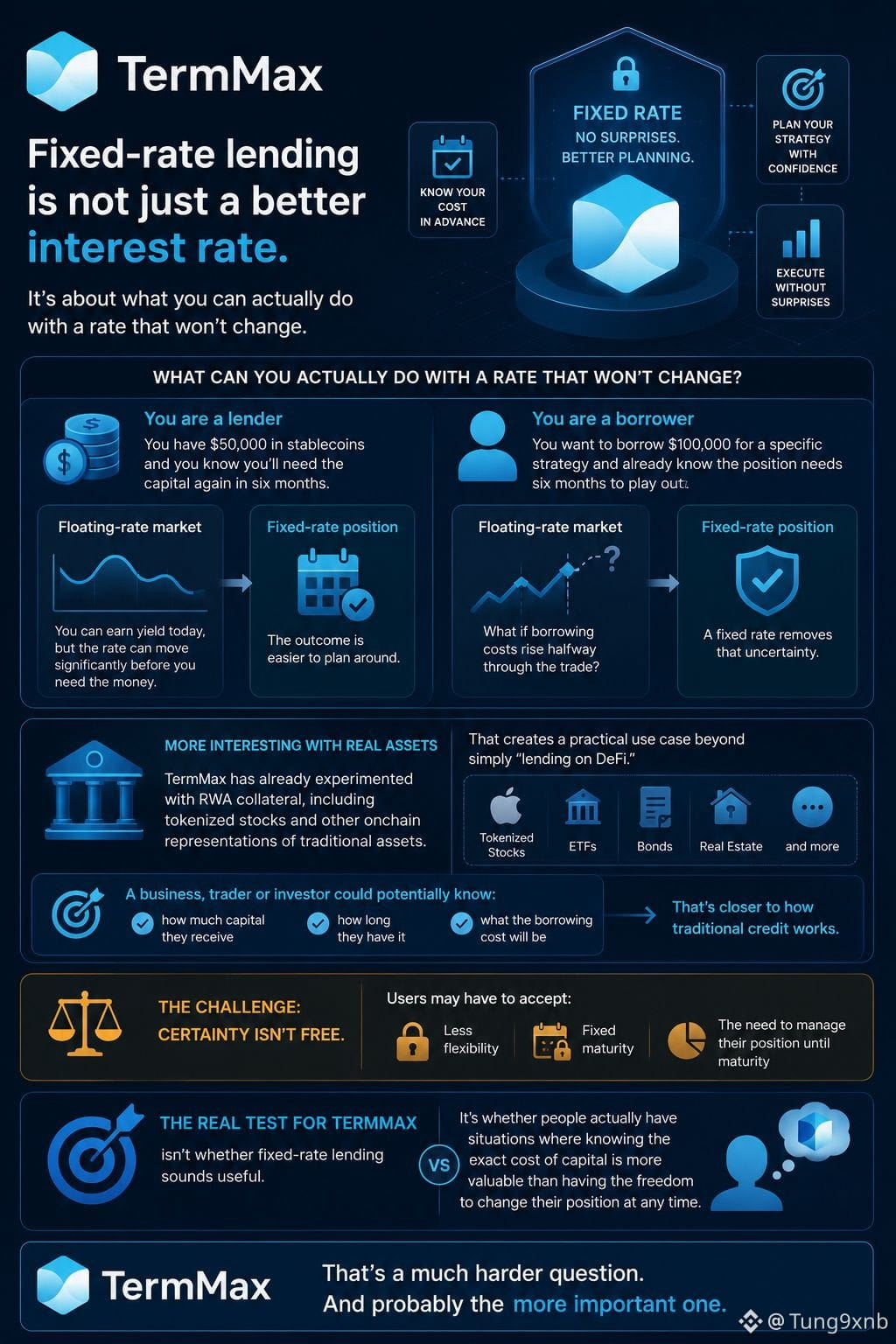
I started looking at TermMax differently when I stopped thinking about fixed-rate lending as just a “better interest rate.”
The more practical question is:
What can you actually do with a rate that won't change?
Imagine you have $50,000 in stablecoins and you know you'll need the capital again in six months.
With a floating-rate market, you can earn yield today, but the rate can move significantly before you need the money.
With a fixed-rate position, the outcome is easier to plan around.
The same idea works on the borrowing side.
Suppose a trader wants to borrow $100,000 for a specific strategy and already knows the position needs six months to play out.
A floating rate creates another variable:
What if borrowing costs rise halfway through the trade?
A fixed rate removes that uncertainty.
And this becomes more interesting with real assets.
TermMax has already experimented with RWA collateral, including tokenized stocks and other onchain representations of traditional assets.
That creates a practical use case beyond simply “lending on DeFi.”
A business, trader or investor could potentially know:
how much capital they receive,
how long they have it,
and what the borrowing cost will be.
That's closer to how traditional credit works.
The challenge is that certainty isn't free.
Users may have to accept less flexibility, fixed maturity and the need to manage their position until maturity.
So the real test for TermMax isn't whether fixed-rate lending sounds useful.
It's whether people actually have situations where knowing the exact cost of capital is more valuable than having the freedom to change their position at any time.
That's a much harder question.
And probably the more important one.
#termmax @TermMax
The more practical question is:
What can you actually do with a rate that won't change?
Imagine you have $50,000 in stablecoins and you know you'll need the capital again in six months.
With a floating-rate market, you can earn yield today, but the rate can move significantly before you need the money.
With a fixed-rate position, the outcome is easier to plan around.
The same idea works on the borrowing side.
Suppose a trader wants to borrow $100,000 for a specific strategy and already knows the position needs six months to play out.
A floating rate creates another variable:
What if borrowing costs rise halfway through the trade?
A fixed rate removes that uncertainty.
And this becomes more interesting with real assets.
TermMax has already experimented with RWA collateral, including tokenized stocks and other onchain representations of traditional assets.
That creates a practical use case beyond simply “lending on DeFi.”
A business, trader or investor could potentially know:
how much capital they receive,
how long they have it,
and what the borrowing cost will be.
That's closer to how traditional credit works.
The challenge is that certainty isn't free.
Users may have to accept less flexibility, fixed maturity and the need to manage their position until maturity.
So the real test for TermMax isn't whether fixed-rate lending sounds useful.
It's whether people actually have situations where knowing the exact cost of capital is more valuable than having the freedom to change their position at any time.
That's a much harder question.
And probably the more important one.
#termmax @TermMax