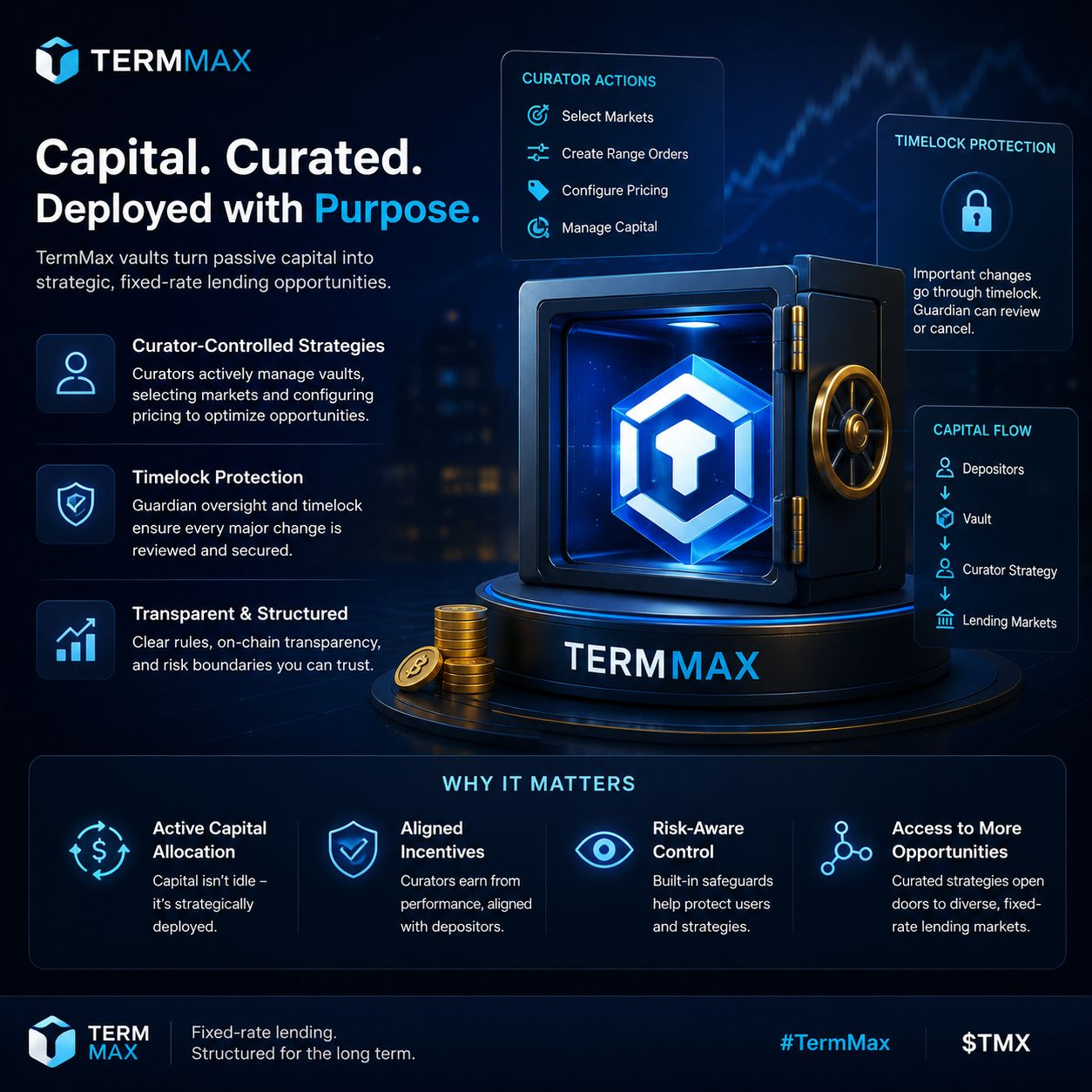
I used to think a DeFi vault was mostly about putting capital somewhere and waiting for the yield to come back. Looking closer at @TermMax , the vault model feels more like an active capital-allocation system.
The interesting part is the Curator. Depositors provide assets to a vault, but the capital does not simply sit there. Curators can decide which whitelisted markets to use, create range orders, configure pricing parameters, and manage how the capital is deployed.
TS Finance Docs +1
What caught my attention is that TermMax also puts boundaries around that flexibility. Important vault changes can go through a timelock, giving the Guardian an opportunity to review or cancel a pending change.
TS Finance Docs
That creates an interesting balance: strategy flexibility on one side, controlled permissions on the other.
For me, this is more meaningful than simply calling TermMax a fixed-rate lending protocol. The vault layer is trying to turn capital management into a structured process where users can access strategies without having to manage every market themselves.
And that’s one reason I find #TermMax worth watching beyond the usual “DeFi lending” narrative. $TMX aside, the underlying architecture is where the more interesting questions are.
#termmax @TermMax
The interesting part is the Curator. Depositors provide assets to a vault, but the capital does not simply sit there. Curators can decide which whitelisted markets to use, create range orders, configure pricing parameters, and manage how the capital is deployed.
TS Finance Docs +1
What caught my attention is that TermMax also puts boundaries around that flexibility. Important vault changes can go through a timelock, giving the Guardian an opportunity to review or cancel a pending change.
TS Finance Docs
That creates an interesting balance: strategy flexibility on one side, controlled permissions on the other.
For me, this is more meaningful than simply calling TermMax a fixed-rate lending protocol. The vault layer is trying to turn capital management into a structured process where users can access strategies without having to manage every market themselves.
And that’s one reason I find #TermMax worth watching beyond the usual “DeFi lending” narrative. $TMX aside, the underlying architecture is where the more interesting questions are.
#termmax @TermMax