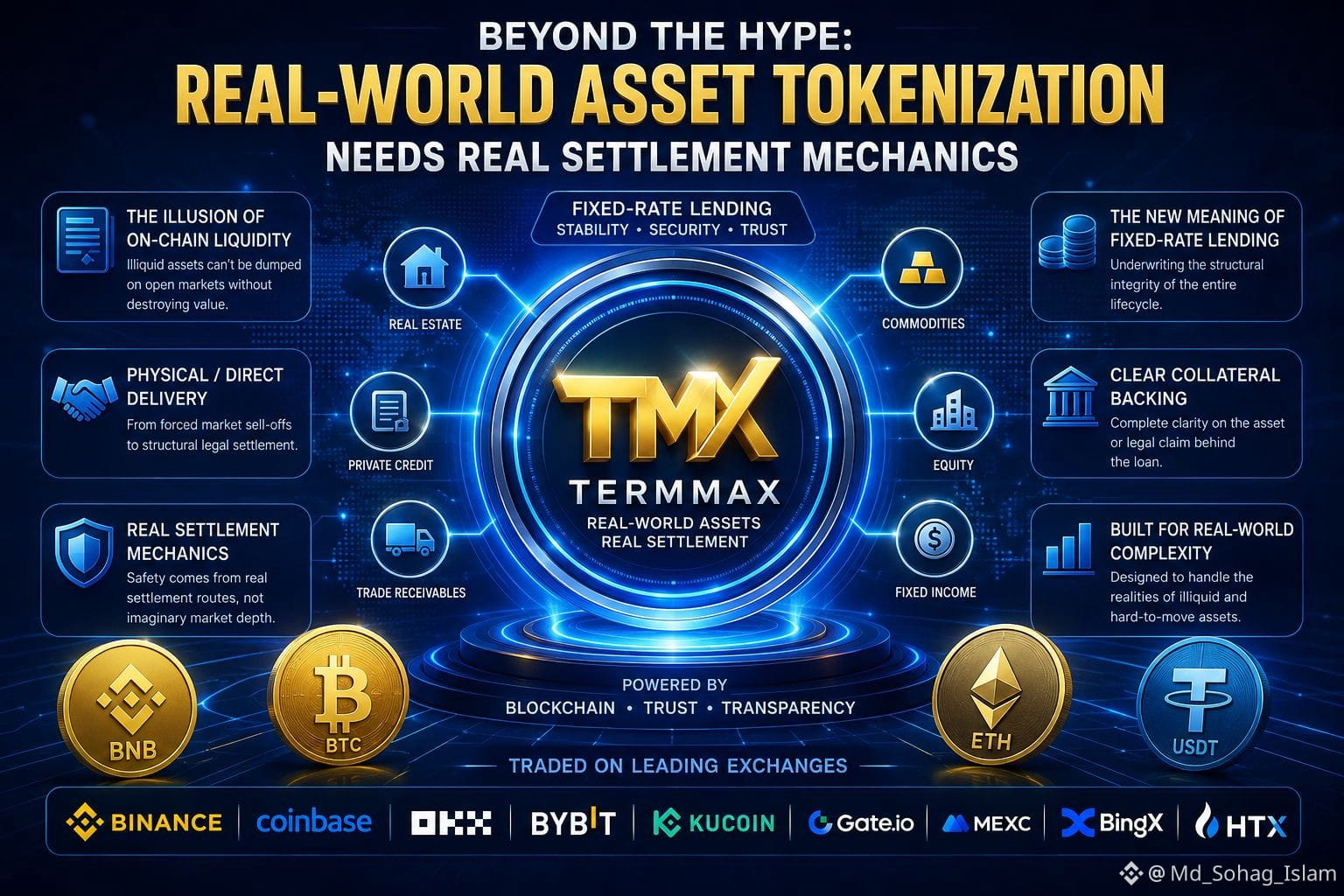
#termmax @TermMax Tokenizing real-world assets (RWA) is generally a straightforward process. But what happens if the borrower does not repay the loan?The RWA narrative is considered one of the most promising developments in the DeFi space.
The typical process involves taking real-world assets and bringing them onto the blockchain, then tokenizing those assets, and finally using them within DeFi platforms.However, there is a key question that remains unanswered: what occurs in the case of a default?
Unlike cryptocurrencies such as Bitcoin or Ethereum, which can be continuously valued and quickly liquidated through market mechanisms, RWA typically lacks this level of liquidity and market depth.
RWA can include various types of assets, such as private credits, tokenized stocks, commodities, and receivables.These assets often do not have the same ease of valuation or the ability to be swiftly sold in a liquid market.
Just having a digital representation of an asset on the blockchain does not guarantee that it can be easily liquidated.
Tokenization alone does not equal liquidity.
@TermMax is building fixed-rate, fixed-term lending platforms, including RWA markets that already support tokenized stocks and commodity-related collateral.
However, the main challenge remains the settlement process.
In the case of a default, if the asset cannot be easily liquidated through an order book, the protocol must have a clear process for handling the situation.
This might involve physical delivery, custody arrangements, authorized intermediaries, or adherence to transfer regulations.
A fixed-rate lender should consider several key factors:
- What is the expected rate of return?
- What type of collateral is involved in the deal?
- What happens at the end of the term?
- How is the situation handled in case of a default?
- Most importantly, how can the collateral be recovered?
This area of RWA in DeFi requires much more careful attention.
The first wave of RWA infrastructure focused on bringing real-world assets onto the blockchain. The next phase must tackle more complex issues.