Parameter updates in protocol governance are generally assumed to execute under uniform timelock delays regardless of their risk profile.
TermMax tokenizes positions into FT, XT, and GT. Order execution operates on range-order pricing curves, and FT is tradable before maturity.
That shifted my perspective on parameter governance.
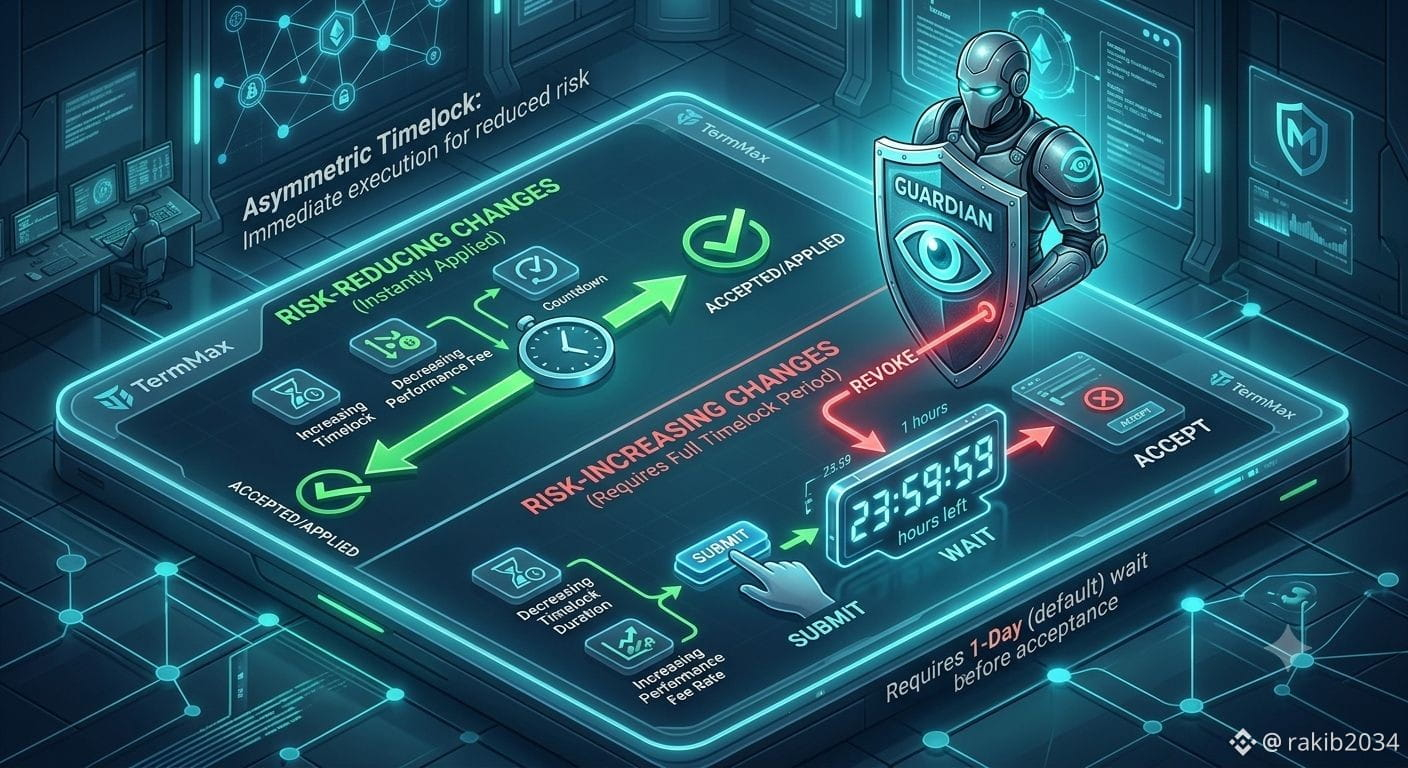
The protocol uses an asymmetric timelock design where risk-reducing changes apply immediately without a timelock, while risk-increasing changes—such as decreasing timelock duration, increasing performance fee rates, or adding market whitelists—require a full timelock period (default: 1 day). Proposals undergo a structured Submit, Wait, and Accept process, during which the Guardian role holds explicit authority to review and potentially revoke pending changes.
How Guardian oversight and the asymmetric timelock mechanism perform when curators need to adjust parameters during sudden market dislocations remains an execution variable.
Eager to observe this execution live on-chain.
#termmax @TermMax
TermMax tokenizes positions into FT, XT, and GT. Order execution operates on range-order pricing curves, and FT is tradable before maturity.
That shifted my perspective on parameter governance.
The protocol uses an asymmetric timelock design where risk-reducing changes apply immediately without a timelock, while risk-increasing changes—such as decreasing timelock duration, increasing performance fee rates, or adding market whitelists—require a full timelock period (default: 1 day). Proposals undergo a structured Submit, Wait, and Accept process, during which the Guardian role holds explicit authority to review and potentially revoke pending changes.
How Guardian oversight and the asymmetric timelock mechanism perform when curators need to adjust parameters during sudden market dislocations remains an execution variable.
Eager to observe this execution live on-chain.
#termmax @TermMax