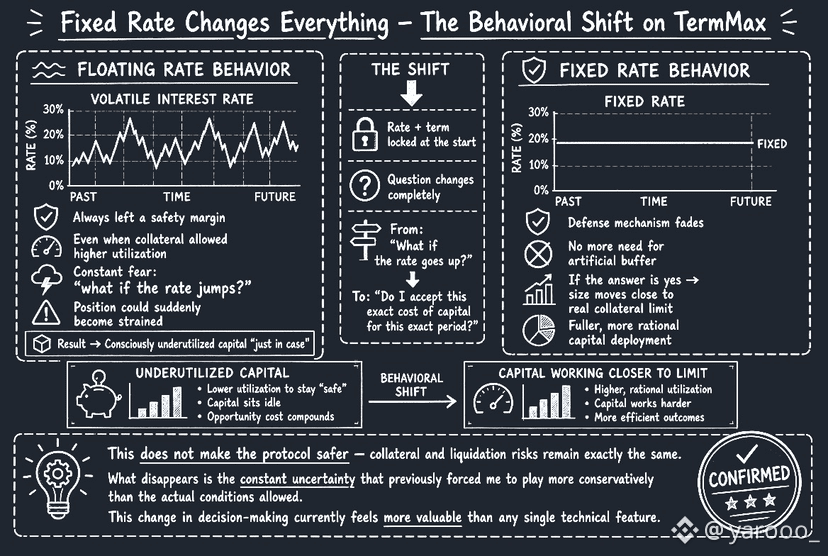
One of the least obvious effects of fixed rates on @TermMax I noticed not in the numbers, but in my own behavior.
Before, when working with floating rates, I almost always left a safety margin. Even when the collateral allowed more. The reason was simple: the rate could change and a comfortable position could suddenly become stressful. So I deliberately underused capital “just in case.”
When the rate and term are fixed in advance, this protective mechanism starts to weaken. The question changes. It is no longer “what if the rate goes up,” but “do I accept this specific cost of capital for this period.” And if the answer is yes, the position size moves closer to the real collateral limit.
This does not make the protocol safer. Collateral and liquidity risks remain. But one constant source of uncertainty disappears, the one that used to force me to play more conservatively than the conditions allowed. And right now this shift in decision-making feels more valuable to me than any single feature. 📊
#termmax @TermMax
Before, when working with floating rates, I almost always left a safety margin. Even when the collateral allowed more. The reason was simple: the rate could change and a comfortable position could suddenly become stressful. So I deliberately underused capital “just in case.”
When the rate and term are fixed in advance, this protective mechanism starts to weaken. The question changes. It is no longer “what if the rate goes up,” but “do I accept this specific cost of capital for this period.” And if the answer is yes, the position size moves closer to the real collateral limit.
This does not make the protocol safer. Collateral and liquidity risks remain. But one constant source of uncertainty disappears, the one that used to force me to play more conservatively than the conditions allowed. And right now this shift in decision-making feels more valuable to me than any single feature. 📊
#termmax @TermMax