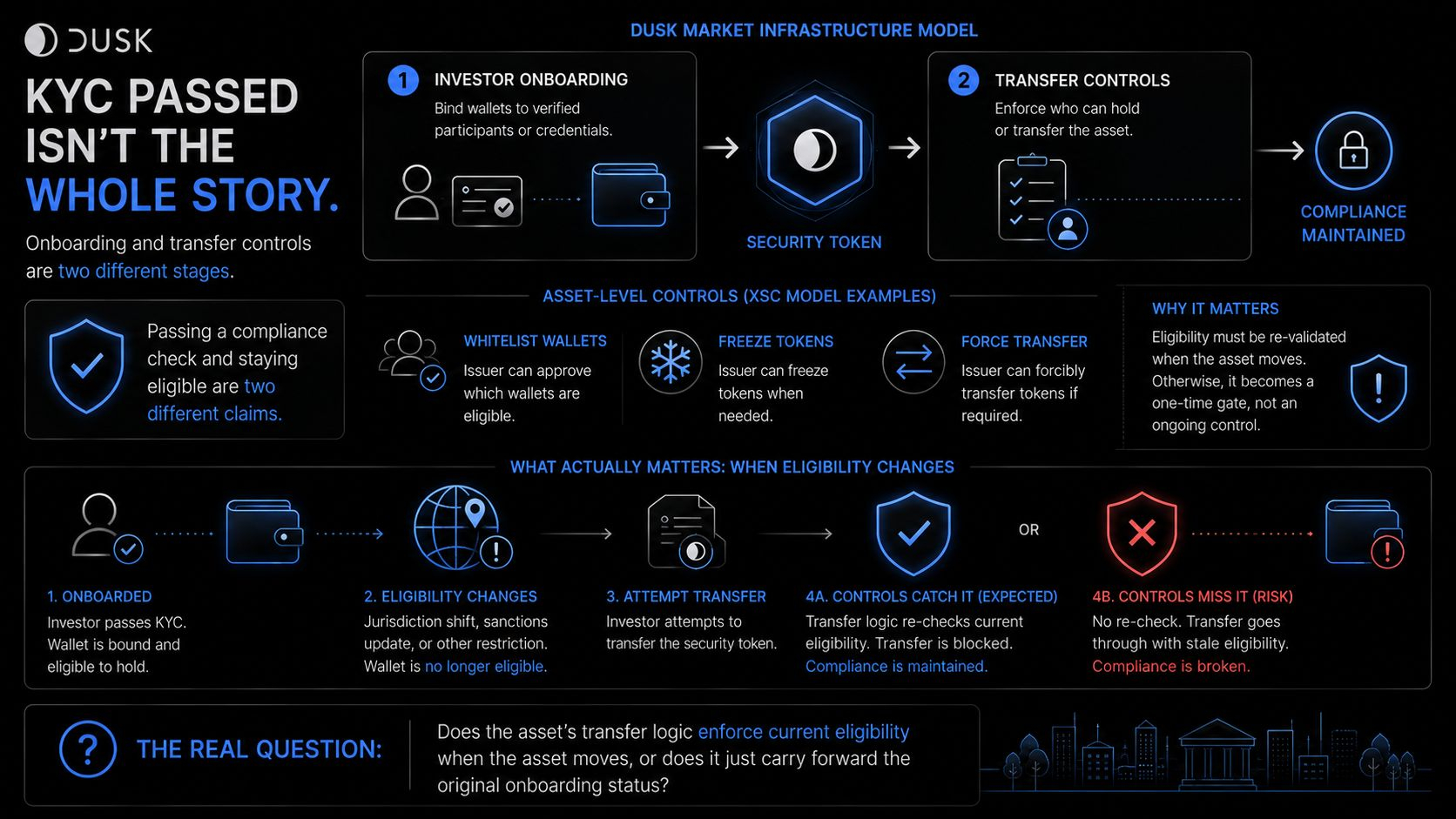
KYC answers who qualified at onboarding. Transfer controls answer who is still eligible when the asset moves. Dusk's own market-infrastructure model treats those as separate stages, and that gap is the interesting part.
Dusk lists investor onboarding, "bind wallets to verified participants or credentials," separately from transfer controls, "enforce who can hold or transfer the asset." One establishes an initial eligibility state. The other is what makes that state enforceable when the asset actually moves.
The older XSC material goes further than onboarding: issuers can whitelist wallets and retain asset-level controls such as freezing or force-transfer. That matters because eligibility isn't only established once. It has to remain enforceable after the initial decision.
Which means "KYC passed" and "eligible to hold this asset" are two different claims that can quietly diverge. A wallet can stay verified in the identity sense while no longer being the kind of holder this specific asset is allowed to have. Compliance enforcement doesn't end at onboarding, it has to continue into the asset's transfer lifecycle.
"Passing a compliance check and staying eligible are two different claims."
That changes the actual evaluation question. Not "does this asset have eligibility checks." The real question is whether the current eligibility state is enforced when the asset moves, or whether the original onboarding status simply carries forward.
What I'd actually want to see: a wallet whose eligibility changes after onboarding, say a jurisdiction shift, while it still holds the asset, then an attempted transfer, and whether the asset's transfer logic catches that change.
#dusk $DUSK @Dusk
Dusk lists investor onboarding, "bind wallets to verified participants or credentials," separately from transfer controls, "enforce who can hold or transfer the asset." One establishes an initial eligibility state. The other is what makes that state enforceable when the asset actually moves.
The older XSC material goes further than onboarding: issuers can whitelist wallets and retain asset-level controls such as freezing or force-transfer. That matters because eligibility isn't only established once. It has to remain enforceable after the initial decision.
Which means "KYC passed" and "eligible to hold this asset" are two different claims that can quietly diverge. A wallet can stay verified in the identity sense while no longer being the kind of holder this specific asset is allowed to have. Compliance enforcement doesn't end at onboarding, it has to continue into the asset's transfer lifecycle.
"Passing a compliance check and staying eligible are two different claims."
That changes the actual evaluation question. Not "does this asset have eligibility checks." The real question is whether the current eligibility state is enforced when the asset moves, or whether the original onboarding status simply carries forward.
What I'd actually want to see: a wallet whose eligibility changes after onboarding, say a jurisdiction shift, while it still holds the asset, then an attempted transfer, and whether the asset's transfer logic catches that change.
#dusk $DUSK @Dusk