I still think most RWA conversations treat tokenization like the finish line.
Put an existing asset onchain, give it a digital representation, and suddenly it sounds like the financial asset itself has moved onchain.
But the more I look at Dusk’s approach to native issuance, the more I think there’s an important distinction.
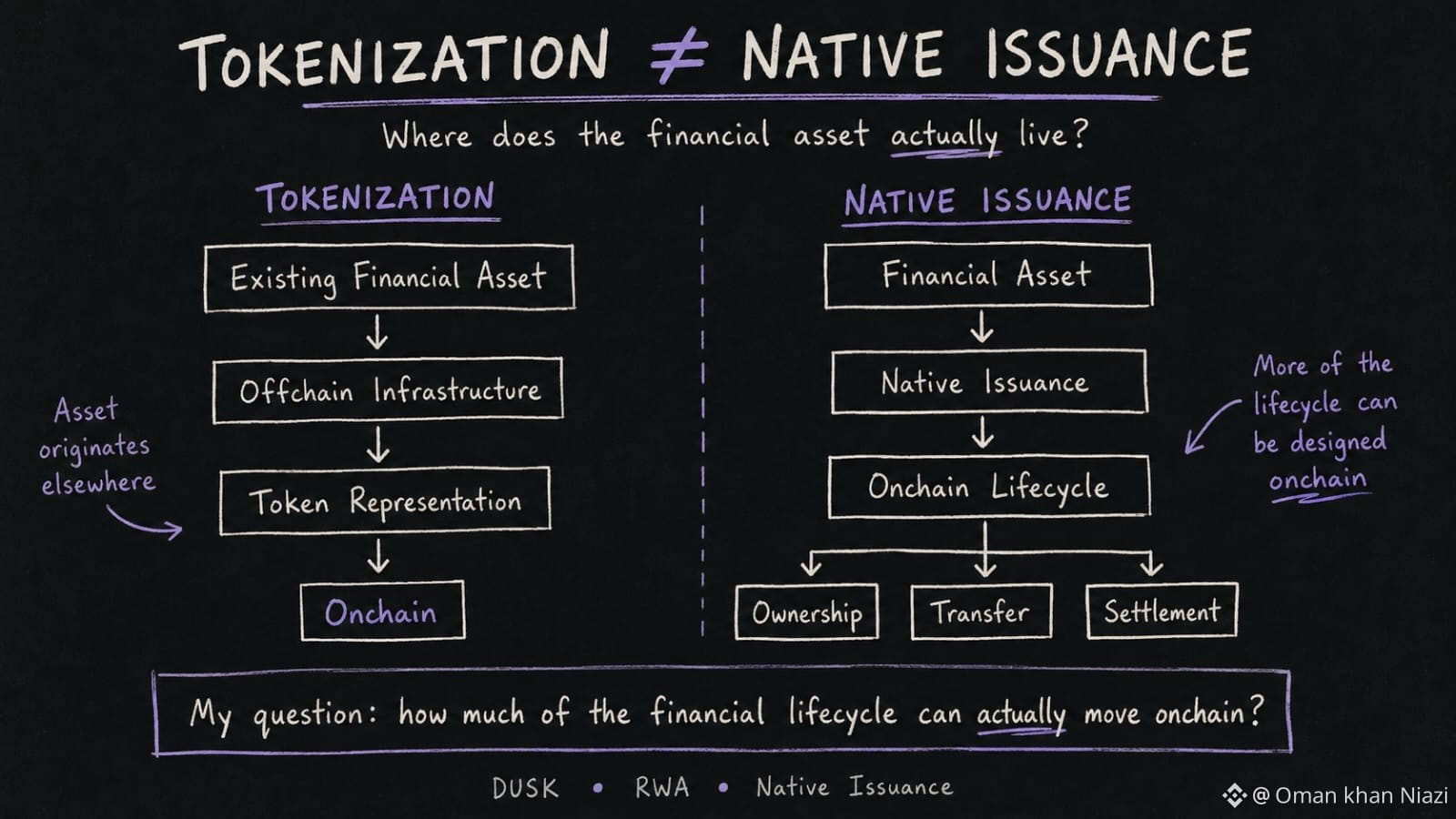
Tokenization can represent an asset that already exists elsewhere. Native issuance starts from a different point: the infrastructure can be designed to carry more of the asset’s lifecycle onchain, depending on the legal and product setup.
That difference caught my attention.
Because if issuance happens in one system, ownership is tracked somewhere else, and transfers or settlement still depend on separate records, putting a token onchain doesn’t necessarily remove the underlying infrastructure problem.
So to me, the interesting part of native issuance isn’t simply creating another token.
It’s the possibility of reducing the gap between the digital asset and the financial infrastructure responsible for it.
I’m still cautious about how far that can actually go in regulated markets. Legal ownership, authorized intermediaries and operational responsibilities don’t disappear just because an asset is represented onchain.
So the real test for me isn’t how many RWAs can be tokenized.
If native issuance can move more of an asset’s lifecycle onto the ledger, what part of the traditional financial infrastructure becomes hardest to replace?
@Dusk $DUSK #dusk
Put an existing asset onchain, give it a digital representation, and suddenly it sounds like the financial asset itself has moved onchain.
But the more I look at Dusk’s approach to native issuance, the more I think there’s an important distinction.
Tokenization can represent an asset that already exists elsewhere. Native issuance starts from a different point: the infrastructure can be designed to carry more of the asset’s lifecycle onchain, depending on the legal and product setup.
That difference caught my attention.
Because if issuance happens in one system, ownership is tracked somewhere else, and transfers or settlement still depend on separate records, putting a token onchain doesn’t necessarily remove the underlying infrastructure problem.
So to me, the interesting part of native issuance isn’t simply creating another token.
It’s the possibility of reducing the gap between the digital asset and the financial infrastructure responsible for it.
I’m still cautious about how far that can actually go in regulated markets. Legal ownership, authorized intermediaries and operational responsibilities don’t disappear just because an asset is represented onchain.
So the real test for me isn’t how many RWAs can be tokenized.
If native issuance can move more of an asset’s lifecycle onto the ledger, what part of the traditional financial infrastructure becomes hardest to replace?
@Dusk $DUSK #dusk