#dusk $DUSK @Dusk
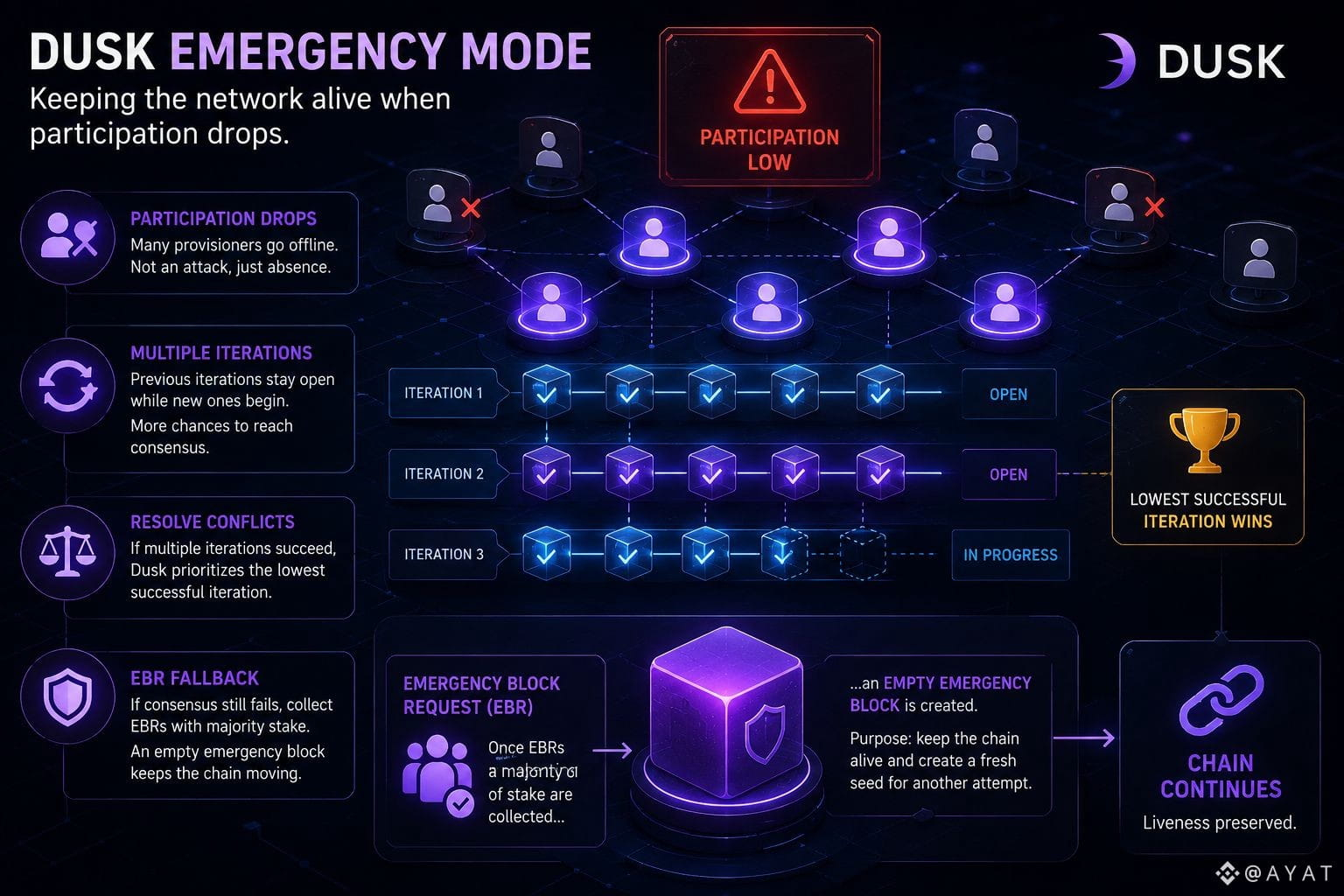
One thing I find interesting about @Dusk is how it thinks about the moments when a network simply stops getting enough participation. Imagine most of the people needed for consensus suddenly going offline. No attack, no bad actors, just fewer participants. A lot of systems would struggle with that, but Dusk has a recovery path through Emergency Mode. When one consensus iteration doesn’t get enough participation, the network can keep previous iterations open while starting new ones. That gives the provisioners who are still online more chances to reach agreement instead of letting the whole chain stall.
There’s obviously a trade-off here. Multiple iterations could potentially produce competing blocks, so Dusk gives priority to the lowest successful iteration. And if normal consensus still can’t recover, the Emergency Block Request, or EBR, provides another fallback. Once EBRs representing a majority of stake are collected, Dusk can create an empty emergency block. I like that the block isn’t pretending to solve everything. Its job is simply to keep the chain moving and create a fresh seed for another consensus attempt. For me, that’s the interesting part: Dusk isn’t designing only for perfect conditions. It’s also thinking about what happens when participation breaks down. The bigger question is how smoothly this recovery works if degraded participation continues for a long time.
One thing I find interesting about @Dusk is how it thinks about the moments when a network simply stops getting enough participation. Imagine most of the people needed for consensus suddenly going offline. No attack, no bad actors, just fewer participants. A lot of systems would struggle with that, but Dusk has a recovery path through Emergency Mode. When one consensus iteration doesn’t get enough participation, the network can keep previous iterations open while starting new ones. That gives the provisioners who are still online more chances to reach agreement instead of letting the whole chain stall.
There’s obviously a trade-off here. Multiple iterations could potentially produce competing blocks, so Dusk gives priority to the lowest successful iteration. And if normal consensus still can’t recover, the Emergency Block Request, or EBR, provides another fallback. Once EBRs representing a majority of stake are collected, Dusk can create an empty emergency block. I like that the block isn’t pretending to solve everything. Its job is simply to keep the chain moving and create a fresh seed for another consensus attempt. For me, that’s the interesting part: Dusk isn’t designing only for perfect conditions. It’s also thinking about what happens when participation breaks down. The bigger question is how smoothly this recovery works if degraded participation continues for a long time.