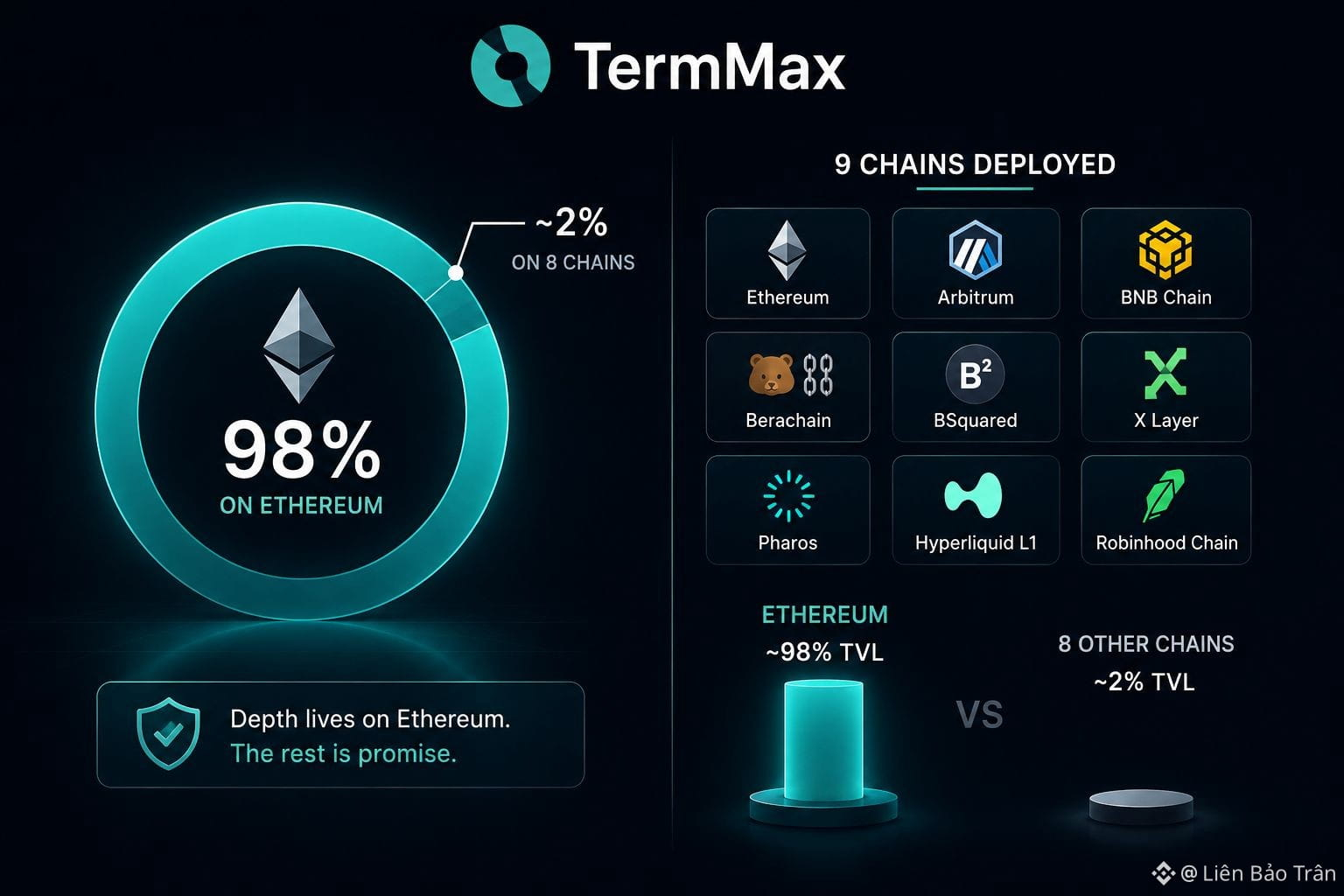
TermMax lists deployments across nine chains: Ethereum, Arbitrum, BNB Chain, Berachain, BSquared, X Layer, Pharos, Hyperliquid L1, and Robinhood Chain. Read that list fast and TermMax looks like it's everywhere, a protocol that chased liquidity into every corner of the modular blockchain landscape. Read the on-chain numbers slower and a different picture shows up: roughly 98% of TermMax's total value sits on Ethereum alone. Eight chains, combined, hold the leftover slice. I don't say this to dismiss the expansion. Deploying to nine chains is real engineering work, and it positions TermMax to catch liquidity if any of those ecosystems grow later. But there's a gap between the theory of multi-chain presence, where more chains signals more reach and more resilience, and the reality of where capital actually decided to sit. Users didn't distribute themselves the way the deployment map did. They picked Ethereum, the chain with the deepest liquidity and the longest track record, and mostly left the rest alone. Liquidity depth is the practical version of this problem. A borrower filling a range order on Ethereum chooses from a market with real depth and several competing makers. The same borrower on Pharos or Robinhood Chain might be filling the only order available, at whatever rate that single maker decided to post, with no second quote anywhere nearby to compare it against. That's worth sitting with before reading "nine chains" as a strength on its own. A chain list is a map of where TermMax can be used, not a map of where TermMax is being used. That second question matters more to a lender deciding whether their fixed-rate position on, say, X Layer or BSquared will have enough counterpart liquidity to fill at a fair rate, versus sitting in a thin book with a handful of range orders and little real competition. Expansion is a bet on future liquidity. Right now TermMax's own numbers say the bet hasn't paid off much outside of Ethereum.
@TermMax #TermMax $BTW $PORTAL $HEMI
@TermMax #TermMax $BTW $PORTAL $HEMI