
#dusk $DUSK @Dusk
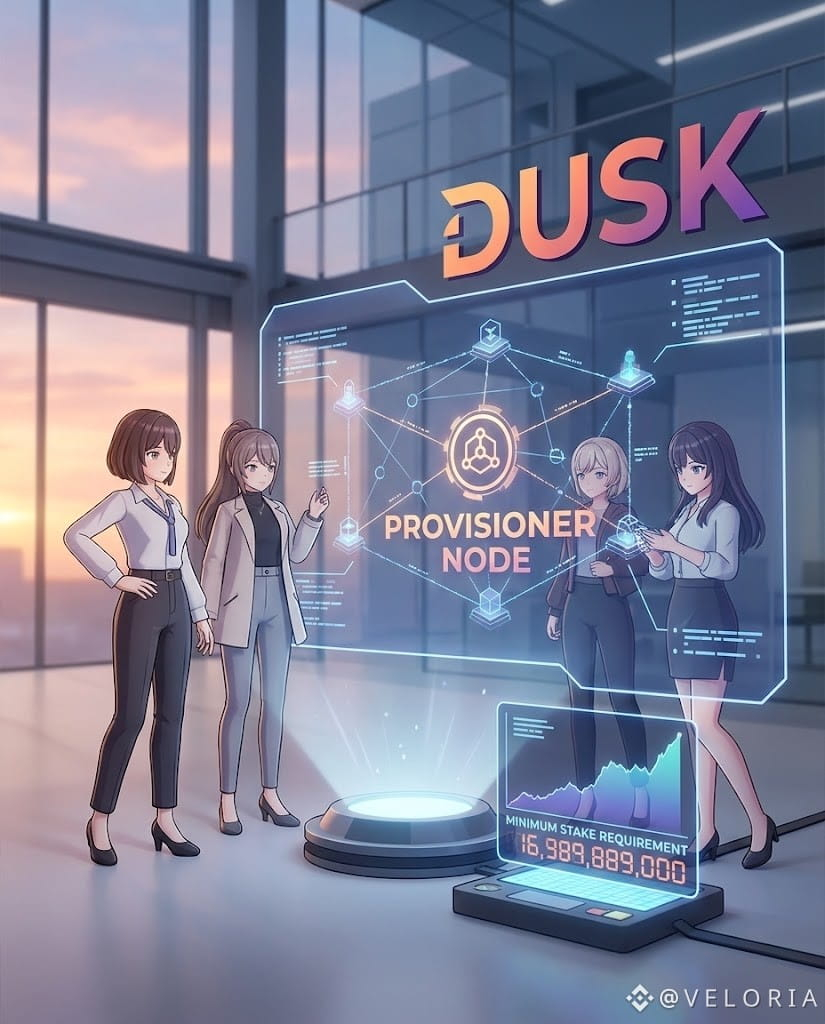
Really,... what stopped me was the minimum stake required to become a Provisioner on Dusk - it's high enough that it changes who actually shows up to secure the network.
Most proof-of-stake chains keep the validator bar low on purpose. Cheap entry means more participants, more decentralization on paper. Dusk went the other way, setting a stake threshold that filters out casual operators before they even start.
At first that reads like a flaw - fewer validators sounds like more centralization.
But underneath it, the logic fits everything else Dusk is building. A chain settling regulated securities can't have its consensus run by whoever happened to buy a cheap VPS and some tokens. It needs operators with enough capital at risk that cutting corners costs something real.
That's the quiet trade Dusk keeps making across the whole system: fewer, more committed participants over a larger, looser crowd. The private leader extraction process only matters if the pool of potential leaders is made up of people who have something to lose by acting badly. High stake requirements are what give that assumption teeth.
The obvious counterpoint is concentration risk — a smaller validator set is, mechanically, a smaller attack surface to capture if enough capital wants in.
But I keep coming back to what Dusk is actually optimizing for. Not censorship-resistance as an ideology. Reliability as a service. Institutions don't need a thousand anonymous validators. They need a network where whoever's securing it can be held accountable if something goes wrong.
That's a narrower definition of decentralization. It might also be the more honest one.
Really,... what stopped me was the minimum stake required to become a Provisioner on Dusk - it's high enough that it changes who actually shows up to secure the network.
Most proof-of-stake chains keep the validator bar low on purpose. Cheap entry means more participants, more decentralization on paper. Dusk went the other way, setting a stake threshold that filters out casual operators before they even start.
At first that reads like a flaw - fewer validators sounds like more centralization.
But underneath it, the logic fits everything else Dusk is building. A chain settling regulated securities can't have its consensus run by whoever happened to buy a cheap VPS and some tokens. It needs operators with enough capital at risk that cutting corners costs something real.
That's the quiet trade Dusk keeps making across the whole system: fewer, more committed participants over a larger, looser crowd. The private leader extraction process only matters if the pool of potential leaders is made up of people who have something to lose by acting badly. High stake requirements are what give that assumption teeth.
The obvious counterpoint is concentration risk — a smaller validator set is, mechanically, a smaller attack surface to capture if enough capital wants in.
But I keep coming back to what Dusk is actually optimizing for. Not censorship-resistance as an ideology. Reliability as a service. Institutions don't need a thousand anonymous validators. They need a network where whoever's securing it can be held accountable if something goes wrong.
That's a narrower definition of decentralization. It might also be the more honest one.