
jinxfi
279 Публикации

jinxfi
Отправить жалобу
Заблокировать пользователя
I'm always with you, even when we're worlds apart.
3 подписок(и/а)
4.9K+ подписчиков(а)
312 понравилось
Посты
·
--
I keep thinking scalability gets described too narrowly in blockchain.
A chain can process more transactions and still be awkward for financial applications if execution becomes unpredictable as activity grows.
What interested me in Dusk is that scalability is treated as a systems problem rather than just a bigger throughput number. The architecture separates concerns across consensus, networking and execution, which gives each layer a more specific job.
That sounds cleaner than simply chasing a headline TPS figure.
But there’s a question underneath it. Financial applications dont just need capacity when demand is low. They need the system to remain predictable when multiple workflows compete for resources at the same time.
Higher theoretical capacity is useful. Predictable capacity is harder.
So is Dusk's layered approach actually a better path toward scalable financial infrastructure, or does separating the system into more specialized components just create more complexity to manage??
#dusk @Dusk_Foundation $DUSK
I keep thinking scalability gets described too narrowly in blockchain.
A chain can process more transactions and still be awkward for financial applications if execution becomes unpredictable as activity grows.
What interested me in Dusk is that scalability is treated as a systems problem rather than just a bigger throughput number. The architecture separates concerns across consensus, networking and execution, which gives each layer a more specific job.
That sounds cleaner than simply chasing a headline TPS figure.
But there’s a question underneath it. Financial applications dont just need capacity when demand is low. They need the system to remain predictable when multiple workflows compete for resources at the same time.
Higher theoretical capacity is useful. Predictable capacity is harder.
So is Dusk's layered approach actually a better path toward scalable financial infrastructure, or does separating the system into more specialized components just create more complexity to manage??
#dusk @Dusk $DUSK
A chain can process more transactions and still be awkward for financial applications if execution becomes unpredictable as activity grows.
What interested me in Dusk is that scalability is treated as a systems problem rather than just a bigger throughput number. The architecture separates concerns across consensus, networking and execution, which gives each layer a more specific job.
That sounds cleaner than simply chasing a headline TPS figure.
But there’s a question underneath it. Financial applications dont just need capacity when demand is low. They need the system to remain predictable when multiple workflows compete for resources at the same time.
Higher theoretical capacity is useful. Predictable capacity is harder.
So is Dusk's layered approach actually a better path toward scalable financial infrastructure, or does separating the system into more specialized components just create more complexity to manage??
#dusk @Dusk $DUSK
Better scalability
0%
More complexity
0%
Depends on execution
0%
Too early to tell
0%
0 проголосовали • Голосование закрыто
1
1
99
·
--
I spent some time looking at @Dusk_Foundation networking layer and found myself paying more attention to something most users never see: how blocks actually move through the network.
Kadcast uses a structured peer-to-peer design built around Kademlia-style routing rather than simply pushing every message to every connected peer. The idea is to make propagation more targeted and reduce the amount of redundant communication happening across the network.
That sounds like a backend detail.
It probably isnt.
For a chain dealing with financial activity, network efficiency eventually becomes part of the user experience. If nodes spend less effort passing around the same information repeatedly, there’s more room for the network to handle useful work instead of communication overhead.
The part I’m less certain about is the tradeoff. A more structured propagation system can reduce waste, but it also introduces more assumptions about how the network is organized and how nodes reach each other.
So does smarter block propagation meaningfully improve the foundation for financial settlement, or does the added network structure create complexity that becomes harder to manage at scale??
#dusk @Dusk_Foundation $DUSK
I spent some time looking at @Dusk networking layer and found myself paying more attention to something most users never see: how blocks actually move through the network.
Kadcast uses a structured peer-to-peer design built around Kademlia-style routing rather than simply pushing every message to every connected peer. The idea is to make propagation more targeted and reduce the amount of redundant communication happening across the network.
That sounds like a backend detail.
It probably isnt.
For a chain dealing with financial activity, network efficiency eventually becomes part of the user experience. If nodes spend less effort passing around the same information repeatedly, there’s more room for the network to handle useful work instead of communication overhead.
The part I’m less certain about is the tradeoff. A more structured propagation system can reduce waste, but it also introduces more assumptions about how the network is organized and how nodes reach each other.
So does smarter block propagation meaningfully improve the foundation for financial settlement, or does the added network structure create complexity that becomes harder to manage at scale??
#dusk @Dusk $DUSK
Kadcast uses a structured peer-to-peer design built around Kademlia-style routing rather than simply pushing every message to every connected peer. The idea is to make propagation more targeted and reduce the amount of redundant communication happening across the network.
That sounds like a backend detail.
It probably isnt.
For a chain dealing with financial activity, network efficiency eventually becomes part of the user experience. If nodes spend less effort passing around the same information repeatedly, there’s more room for the network to handle useful work instead of communication overhead.
The part I’m less certain about is the tradeoff. A more structured propagation system can reduce waste, but it also introduces more assumptions about how the network is organized and how nodes reach each other.
So does smarter block propagation meaningfully improve the foundation for financial settlement, or does the added network structure create complexity that becomes harder to manage at scale??
#dusk @Dusk $DUSK
Better efficiency
0%
Stronger settlement
0%
Complexity risk
0%
Both matter
0%
0 проголосовали • Голосование закрыто
3
2
123
·
--
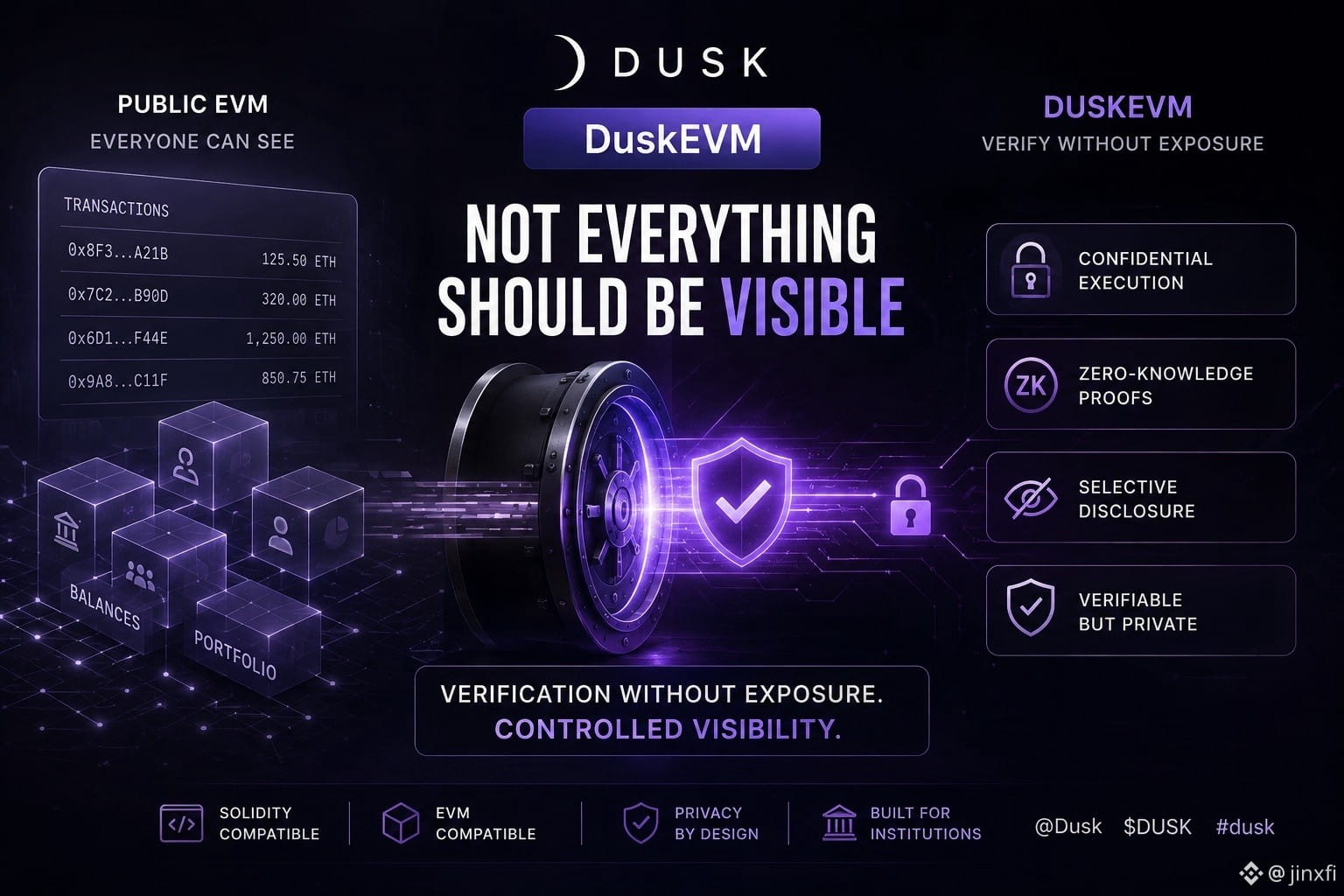
Most EVM applications treat transparency as a feature. But in institutional finance, that assumption starts to break down.
DeFi works well with public balances and transactions. Institutions often need something different: proving a trade is valid without exposing the entire portfolio, balance sheet, or counterparties.
That’s where DuskEVM gets interesting.
Dusk keeps the familiar Solidity and EVM environment while using confidential execution, encryption, and zero-knowledge proofs to separate verification from visibility.
The network can verify that the rules were followed without forcing everyone to see the underlying data.
That distinction matters.
Privacy doesn’t have to mean sacrificing verification. It can mean controlling who sees what while keeping the state provable.
The real challenge is making proof generation, performance, integration, and selective disclosure work reliably at scale.
As tokenized assets and institutional blockchain adoption grow, the question may not be whether financial data should be onchain.
It may be how much of that data actually needs to be visible.
The next EVM design problem might not be execution.
It might be controlled visibility.
@Dusk_Foundation $DUSK #dusk
Most EVM applications treat transparency as a feature. But in institutional finance, that assumption starts to break down.
DeFi works well with public balances and transactions. Institutions often need something different: proving a trade is valid without exposing the entire portfolio, balance sheet, or counterparties.
That’s where DuskEVM gets interesting.
Dusk keeps the familiar Solidity and EVM environment while using confidential execution, encryption, and zero-knowledge proofs to separate verification from visibility.
The network can verify that the rules were followed without forcing everyone to see the underlying data.
That distinction matters.
Privacy doesn’t have to mean sacrificing verification. It can mean controlling who sees what while keeping the state provable.
The real challenge is making proof generation, performance, integration, and selective disclosure work reliably at scale.
As tokenized assets and institutional blockchain adoption grow, the question may not be whether financial data should be onchain.
It may be how much of that data actually needs to be visible.
The next EVM design problem might not be execution.
It might be controlled visibility.
@Dusk $DUSK #dusk
DeFi works well with public balances and transactions. Institutions often need something different: proving a trade is valid without exposing the entire portfolio, balance sheet, or counterparties.
That’s where DuskEVM gets interesting.
Dusk keeps the familiar Solidity and EVM environment while using confidential execution, encryption, and zero-knowledge proofs to separate verification from visibility.
The network can verify that the rules were followed without forcing everyone to see the underlying data.
That distinction matters.
Privacy doesn’t have to mean sacrificing verification. It can mean controlling who sees what while keeping the state provable.
The real challenge is making proof generation, performance, integration, and selective disclosure work reliably at scale.
As tokenized assets and institutional blockchain adoption grow, the question may not be whether financial data should be onchain.
It may be how much of that data actually needs to be visible.
The next EVM design problem might not be execution.
It might be controlled visibility.
@Dusk $DUSK #dusk
2
111
·
--
I was digging through @Dusk_Foundation consensus docs today, and the part that caught me wasn't the privacy side.
It was how much emphasis Dusk puts on what happens after a transaction is accepted.
Succinct Attestation is designed to give Dusk deterministic finality once a block is ratified. That means the transaction isn't just becoming “more likely” to stay there as more blocks arrive. It reaches a defined final state.
That sounds like a technical detail until you think about financial assets.
If you're settling a tokenized security or a delivery-versus-payment transaction, uncertainty around whether the ledger state can still change becomes an operational problem.
So I started looking at Dusk less as a privacy chain and more as a settlement system.
The interesting question for me is whether deterministic finality actually becomes more important than privacy once real financial assets start moving onchain.
Because hiding a transaction is useful.
But knowing exactly when that transaction is final may be just as important.
#dusk $DUSK @Dusk_Foundation
I was digging through @Dusk consensus docs today, and the part that caught me wasn't the privacy side.
It was how much emphasis Dusk puts on what happens after a transaction is accepted.
Succinct Attestation is designed to give Dusk deterministic finality once a block is ratified. That means the transaction isn't just becoming “more likely” to stay there as more blocks arrive. It reaches a defined final state.
That sounds like a technical detail until you think about financial assets.
If you're settling a tokenized security or a delivery-versus-payment transaction, uncertainty around whether the ledger state can still change becomes an operational problem.
So I started looking at Dusk less as a privacy chain and more as a settlement system.
The interesting question for me is whether deterministic finality actually becomes more important than privacy once real financial assets start moving onchain.
Because hiding a transaction is useful.
But knowing exactly when that transaction is final may be just as important.
#dusk $DUSK @Dusk
It was how much emphasis Dusk puts on what happens after a transaction is accepted.
Succinct Attestation is designed to give Dusk deterministic finality once a block is ratified. That means the transaction isn't just becoming “more likely” to stay there as more blocks arrive. It reaches a defined final state.
That sounds like a technical detail until you think about financial assets.
If you're settling a tokenized security or a delivery-versus-payment transaction, uncertainty around whether the ledger state can still change becomes an operational problem.
So I started looking at Dusk less as a privacy chain and more as a settlement system.
The interesting question for me is whether deterministic finality actually becomes more important than privacy once real financial assets start moving onchain.
Because hiding a transaction is useful.
But knowing exactly when that transaction is final may be just as important.
#dusk $DUSK @Dusk
Deterministic finality
0%
Privacy
0%
Both equally
0%
Fast settlement
0%
0 проголосовали • Голосование закрыто
1
103
·
--
Spent some time going through Dusk’s transaction docs and the part that made me stop wasn't the ZK proof itself.
It was what happens after the transaction becomes private.
Phoenix hides the amount, sender and specific notes from public observers, but Dusk also supports viewing keys and selective disclosure when an authorized party actually needs evidence.
That creates a more interesting model than “privacy = nobody can see anything.”
A regulator, auditor or issuer may need to see something without the rest of the market seeing it.
So the real design problem isn't hiding the transaction.
It's deciding who gets to see the hidden information, and for what reason.
That's where privacy starts looking less like a binary switch and more like an access-control problem.
Makes me wonder how much institutional privacy ultimately depends on the cryptography itself versus the rules governing disclosure.
#dusk $DUSK @Dusk_Foundation
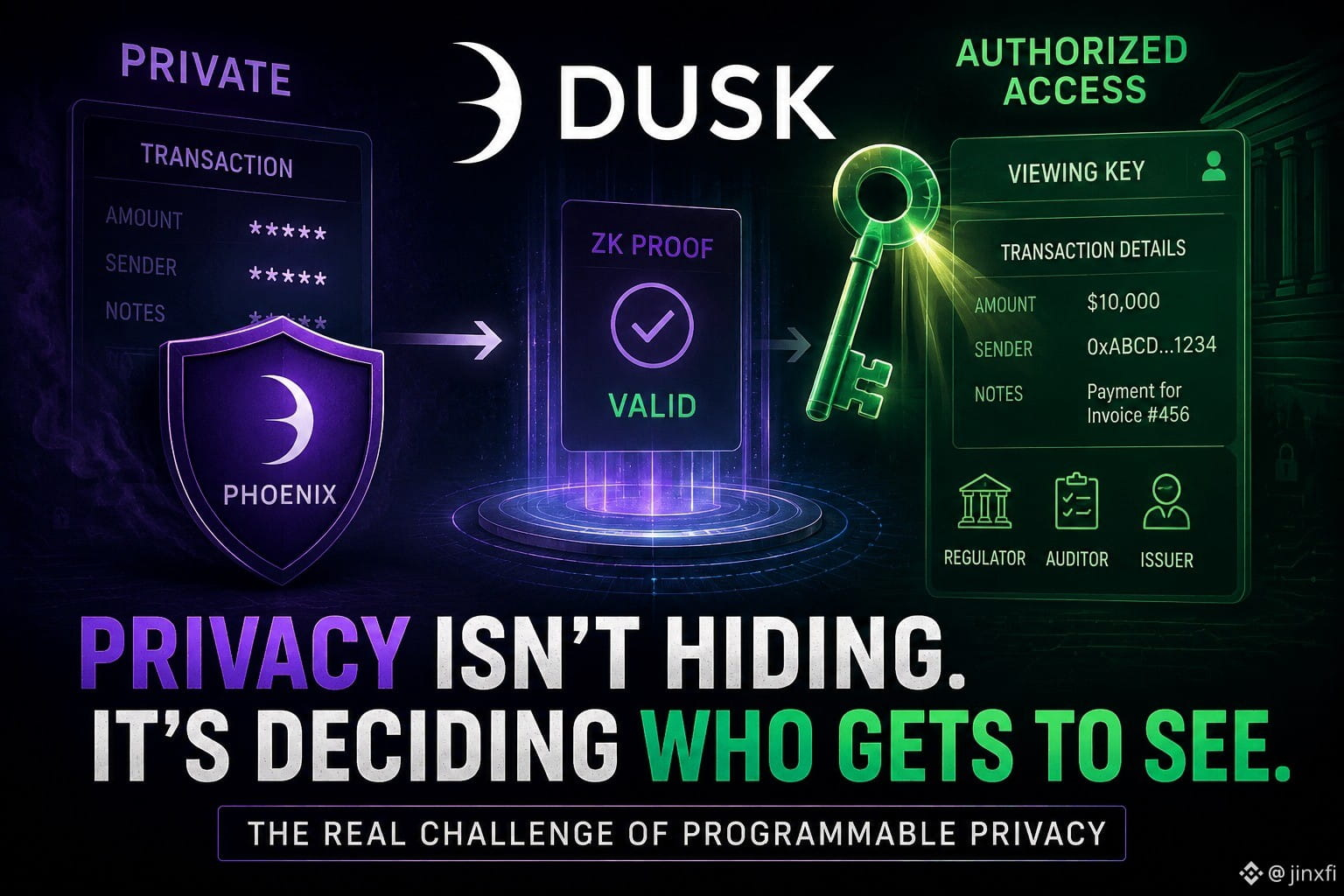
Spent some time going through Dusk’s transaction docs and the part that made me stop wasn't the ZK proof itself.
It was what happens after the transaction becomes private.
Phoenix hides the amount, sender and specific notes from public observers, but Dusk also supports viewing keys and selective disclosure when an authorized party actually needs evidence.
That creates a more interesting model than “privacy = nobody can see anything.”
A regulator, auditor or issuer may need to see something without the rest of the market seeing it.
So the real design problem isn't hiding the transaction.
It's deciding who gets to see the hidden information, and for what reason.
That's where privacy starts looking less like a binary switch and more like an access-control problem.
Makes me wonder how much institutional privacy ultimately depends on the cryptography itself versus the rules governing disclosure.
#dusk $DUSK @Dusk
It was what happens after the transaction becomes private.
Phoenix hides the amount, sender and specific notes from public observers, but Dusk also supports viewing keys and selective disclosure when an authorized party actually needs evidence.
That creates a more interesting model than “privacy = nobody can see anything.”
A regulator, auditor or issuer may need to see something without the rest of the market seeing it.
So the real design problem isn't hiding the transaction.
It's deciding who gets to see the hidden information, and for what reason.
That's where privacy starts looking less like a binary switch and more like an access-control problem.
Makes me wonder how much institutional privacy ultimately depends on the cryptography itself versus the rules governing disclosure.
#dusk $DUSK @Dusk
1
78
Войдите, чтобы посмотреть больше материала
Присоединяйтесь к пользователям криптовалют по всему миру на Binance Square
⚡️ Получайте новейшую и полезную информацию о криптоактивах.
💬 Нам доверяет крупнейшая в мире криптобиржа.
👍 Получите достоверные аналитические данные от верифицированных создателей контента.
Эл. почта/номер телефона
В тренде
USAugustPPIRisesLessThanExpected
Просмотров: 23,267
535 обсуждают
🚨 US AUG PPI: Rises LESS Than Expected! Bullish for Crypto? 🚀
PPI +0.4% MoM as expected, but CORE PPI only +0.2% vs +0.3% expected - cooling!
What it means:
• Wholesale inflation softer than feared
• Fed rate hike chance now 62% - but dovish signals coming
• Core PCE revisions expected downward - bullish
• BTC usually pumps on softer PPI
Fed meeting Sep 15-16 - Market now expects pause, not hike?
Is this the green light for Q4 rally?
#Bitcoin #PPI #Fed #CryptoNews #BTC#usaugustppiriseslessthanexpected
True News
·Лайков: 1
·Просмотров: 1.2k
SECApprovesNasdaqTexasCommodityTrustRule
Просмотров: 16,108
431 обсуждают
ECBRaisesRatesSecondTimeTo2.5%
Просмотров: 12,912
309 обсуждают