#dusk $DUSK @Dusk
One thing I find more interesting about Dusk isn’t another privacy feature.
It’s what happened when the infrastructure around the protocol was tested by a real security incident.
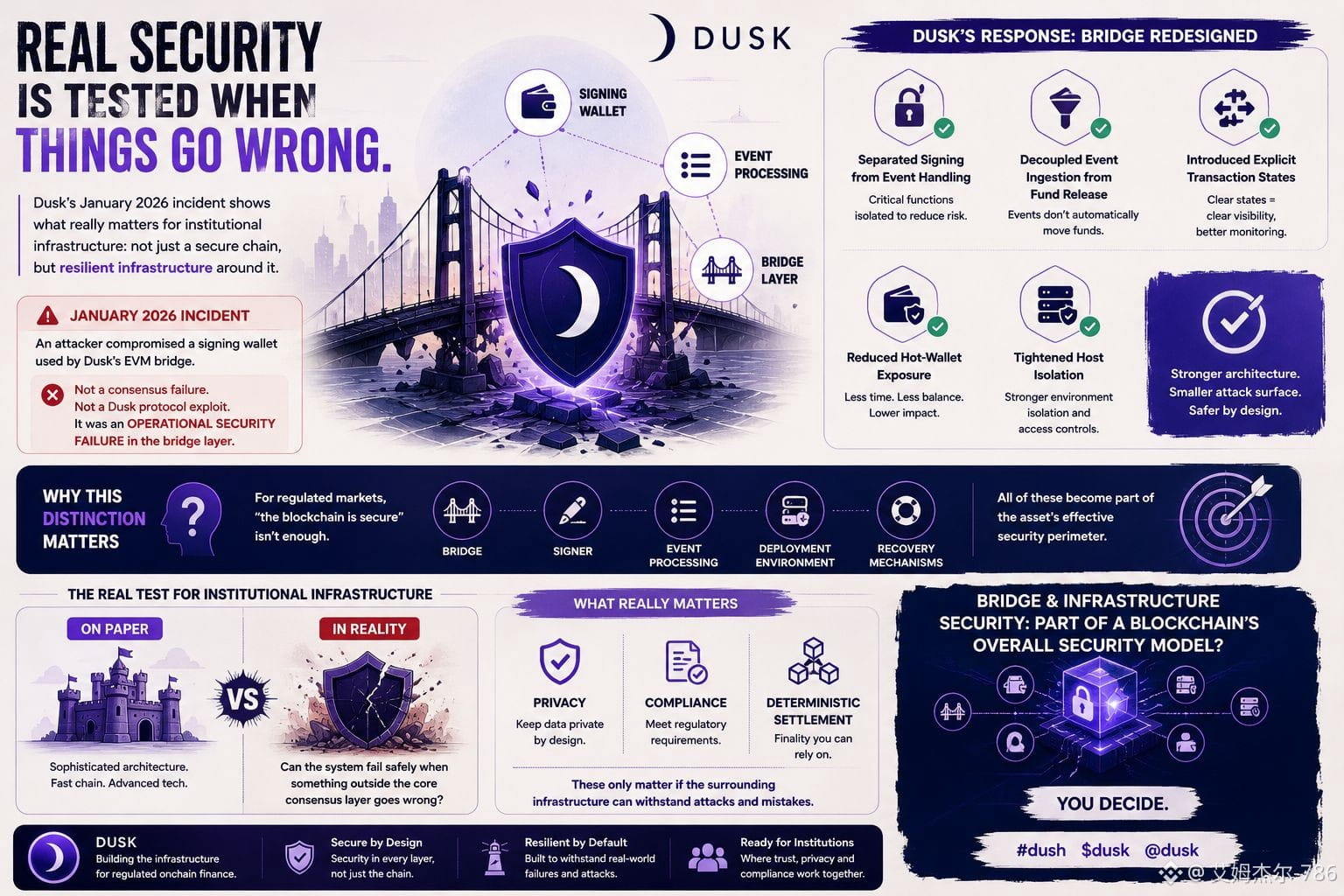
In January 2026 an attacker compromised a signing wallet used by Dusk’s EVM bridge. Dusk’s own post-mortem makes an important distinction this wasn’t a consensus failure or a Dusk protocol exploit. It was an operational security failure in the bridge layer.
That distinction matters.
Because if you’re building infrastructure for regulated financial markets saying “the blockchain itself is secure” isn’t enough.
The bridge signer event processing, deployment environment and recovery mechanisms can all become part of the asset’s effective security perimeter.
Dusk’s response is actually the part worth watching.
The redesigned bridge separated signing from event handling decoupled event ingestion from fund release introduced explicit transaction states reduced hot-wallet exposure and tightened host isolation.
That changes how I look at Dusk.
The real test for institutional infrastructure isn’t whether the architecture looks sophisticated on paper.
It’s whether the system can fail safely when something outside the core consensus layer goes wrong.
Dusk is building toward regulated onchain finance where privacy compliance and deterministic settlement are central. But those properties only matter if the surrounding infrastructure can withstand operational mistakes and attacks too.
That’s a much harder standard than simply having a fast chain.
And honestly it’s the standard institutional blockchain projects should be judged against.
Do you think bridge and infrastructure security should be considered part of a blockchain’s overall security model?
$BTW
$HEMI
One thing I find more interesting about Dusk isn’t another privacy feature.
It’s what happened when the infrastructure around the protocol was tested by a real security incident.
In January 2026 an attacker compromised a signing wallet used by Dusk’s EVM bridge. Dusk’s own post-mortem makes an important distinction this wasn’t a consensus failure or a Dusk protocol exploit. It was an operational security failure in the bridge layer.
That distinction matters.
Because if you’re building infrastructure for regulated financial markets saying “the blockchain itself is secure” isn’t enough.
The bridge signer event processing, deployment environment and recovery mechanisms can all become part of the asset’s effective security perimeter.
Dusk’s response is actually the part worth watching.
The redesigned bridge separated signing from event handling decoupled event ingestion from fund release introduced explicit transaction states reduced hot-wallet exposure and tightened host isolation.
That changes how I look at Dusk.
The real test for institutional infrastructure isn’t whether the architecture looks sophisticated on paper.
It’s whether the system can fail safely when something outside the core consensus layer goes wrong.
Dusk is building toward regulated onchain finance where privacy compliance and deterministic settlement are central. But those properties only matter if the surrounding infrastructure can withstand operational mistakes and attacks too.
That’s a much harder standard than simply having a fast chain.
And honestly it’s the standard institutional blockchain projects should be judged against.
Do you think bridge and infrastructure security should be considered part of a blockchain’s overall security model?
$BTW
$HEMI