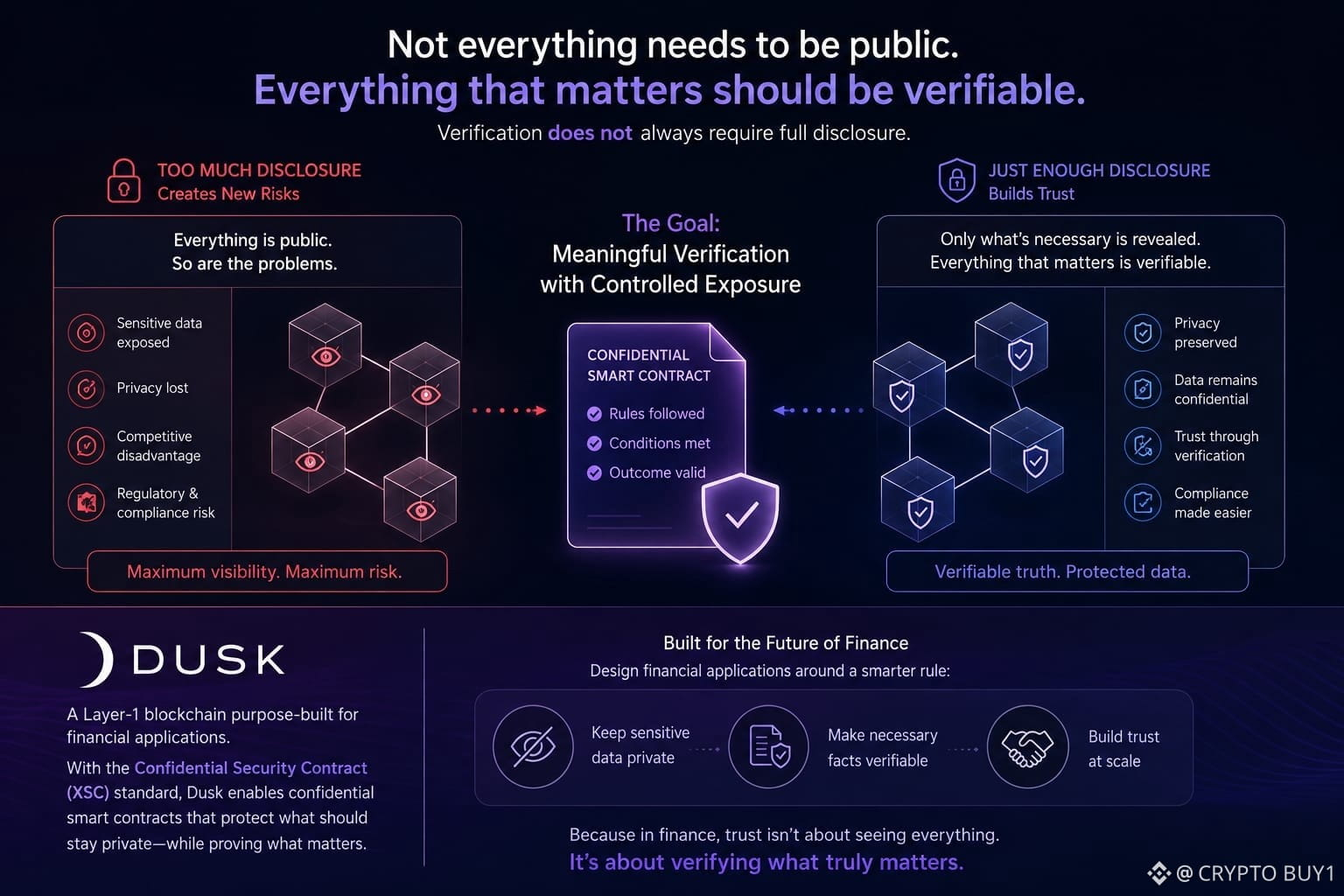
A financial smart contract may need to prove something without revealing everything behind it.
That sounds like a small distinction.
It isn’t.
Imagine a financial application where participants need confidence that the rules were followed, but the information being handled is sensitive.
Making everything public can solve one problem by creating another.
And that’s where blockchain finance needs a more precise idea of transparency:
Verification does not always require full disclosure.
A financial smart contract shouldn’t be judged only by whether it can execute logic on-chain. There’s another question:
What should that application actually reveal while it operates?
This is what makes Dusk interesting to me.
Dusk is a Layer-1 blockchain built for financial applications, with the Confidential Security Contract (XSC) standard supporting confidential smart contracts.
The interesting part isn’t simply “put finance on a private blockchain.”
It’s the idea of designing financial applications around a more nuanced rule:
make the necessary facts verifiable without making every sensitive detail visible.
If blockchain is going to become part of real financial workflows, maybe the goal was never maximum visibility.
Maybe the smarter goal is meaningful verification with controlled exposure.
#dusk $DUSK @Dusk
$DUSK
That sounds like a small distinction.
It isn’t.
Imagine a financial application where participants need confidence that the rules were followed, but the information being handled is sensitive.
Making everything public can solve one problem by creating another.
And that’s where blockchain finance needs a more precise idea of transparency:
Verification does not always require full disclosure.
A financial smart contract shouldn’t be judged only by whether it can execute logic on-chain. There’s another question:
What should that application actually reveal while it operates?
This is what makes Dusk interesting to me.
Dusk is a Layer-1 blockchain built for financial applications, with the Confidential Security Contract (XSC) standard supporting confidential smart contracts.
The interesting part isn’t simply “put finance on a private blockchain.”
It’s the idea of designing financial applications around a more nuanced rule:
make the necessary facts verifiable without making every sensitive detail visible.
If blockchain is going to become part of real financial workflows, maybe the goal was never maximum visibility.
Maybe the smarter goal is meaningful verification with controlled exposure.
#dusk $DUSK @Dusk
$DUSK