#termmax @TermMax TermMax and the Return of Predictable Markets in DeFi
The last few years of DeFi have been built around flexibility. Variable yields, floating borrowing costs, and constantly shifting liquidity created an environment where capital could move quickly, but planning became increasingly difficult.
@TermMax enters this discussion from a different direction. Instead of treating unpredictability as a feature, it introduces fixed-rate borrowing and lending alongside options trading, suggesting that DeFi may be entering a phase where financial certainty becomes as valuable as capital efficiency itself.
The first principle behind this model is simple. Traditional financial markets evolved because participants needed to know the cost of capital before making long-term decisions. Early crypto lending protocols prioritized open liquidity pools and dynamic interest rates because they were easier to bootstrap. The hidden cost was uncertainty. Borrowers couldn't accurately estimate future obligations, while lenders struggled to predict returns. Fixed-rate markets attempt to solve this structural limitation by exchanging some flexibility for greater predictability.
This trade-off isn't unique to crypto. Web2 cloud infrastructure followed a similar path.$ACE ... Early systems emphasized elasticity above everything else, but mature businesses eventually demanded predictable pricing models to manage operations. TermMax appears to be exploring a comparable transition within decentralized finance. The question isn't whether fixed-rate markets are technically possible. The real question is whether users value stability enough to accept a less fluid environment.$BTW
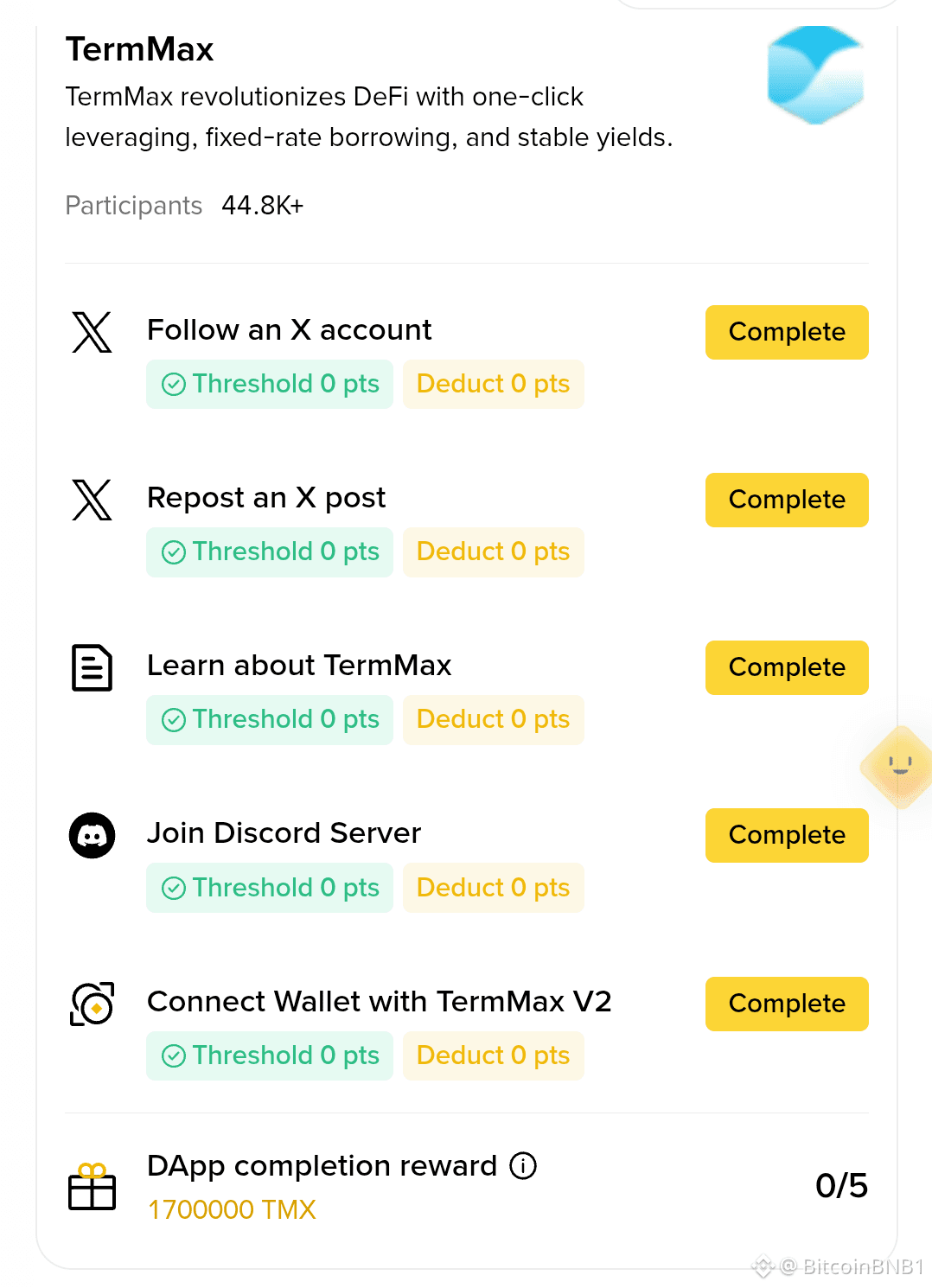
The current Booster Leaderboard Campaign, which attracted more than 44,000 participants and allocated 300,000 TMX in rewards, offers an interesting signal. Participation suggests growing curiosity, but curiosity alone doesn't guarantee long-term adoption. The real test will be whether predictable borrowing becomes an essential layer of DeFi rather than a specialized product.
#TermMax #TMX $CLO
The last few years of DeFi have been built around flexibility. Variable yields, floating borrowing costs, and constantly shifting liquidity created an environment where capital could move quickly, but planning became increasingly difficult.
@TermMax enters this discussion from a different direction. Instead of treating unpredictability as a feature, it introduces fixed-rate borrowing and lending alongside options trading, suggesting that DeFi may be entering a phase where financial certainty becomes as valuable as capital efficiency itself.
The first principle behind this model is simple. Traditional financial markets evolved because participants needed to know the cost of capital before making long-term decisions. Early crypto lending protocols prioritized open liquidity pools and dynamic interest rates because they were easier to bootstrap. The hidden cost was uncertainty. Borrowers couldn't accurately estimate future obligations, while lenders struggled to predict returns. Fixed-rate markets attempt to solve this structural limitation by exchanging some flexibility for greater predictability.
This trade-off isn't unique to crypto. Web2 cloud infrastructure followed a similar path.$ACE ... Early systems emphasized elasticity above everything else, but mature businesses eventually demanded predictable pricing models to manage operations. TermMax appears to be exploring a comparable transition within decentralized finance. The question isn't whether fixed-rate markets are technically possible. The real question is whether users value stability enough to accept a less fluid environment.$BTW
The current Booster Leaderboard Campaign, which attracted more than 44,000 participants and allocated 300,000 TMX in rewards, offers an interesting signal. Participation suggests growing curiosity, but curiosity alone doesn't guarantee long-term adoption. The real test will be whether predictable borrowing becomes an essential layer of DeFi rather than a specialized product.
#TermMax #TMX $CLO