#dusk $DUSK @Dusk I used to think the main promise of RWA tokenization was removing intermediaries.
But looking deeper at @Dusk made me question that idea.
There is a small detail I find more interesting than the token itself: the “what remains” part.
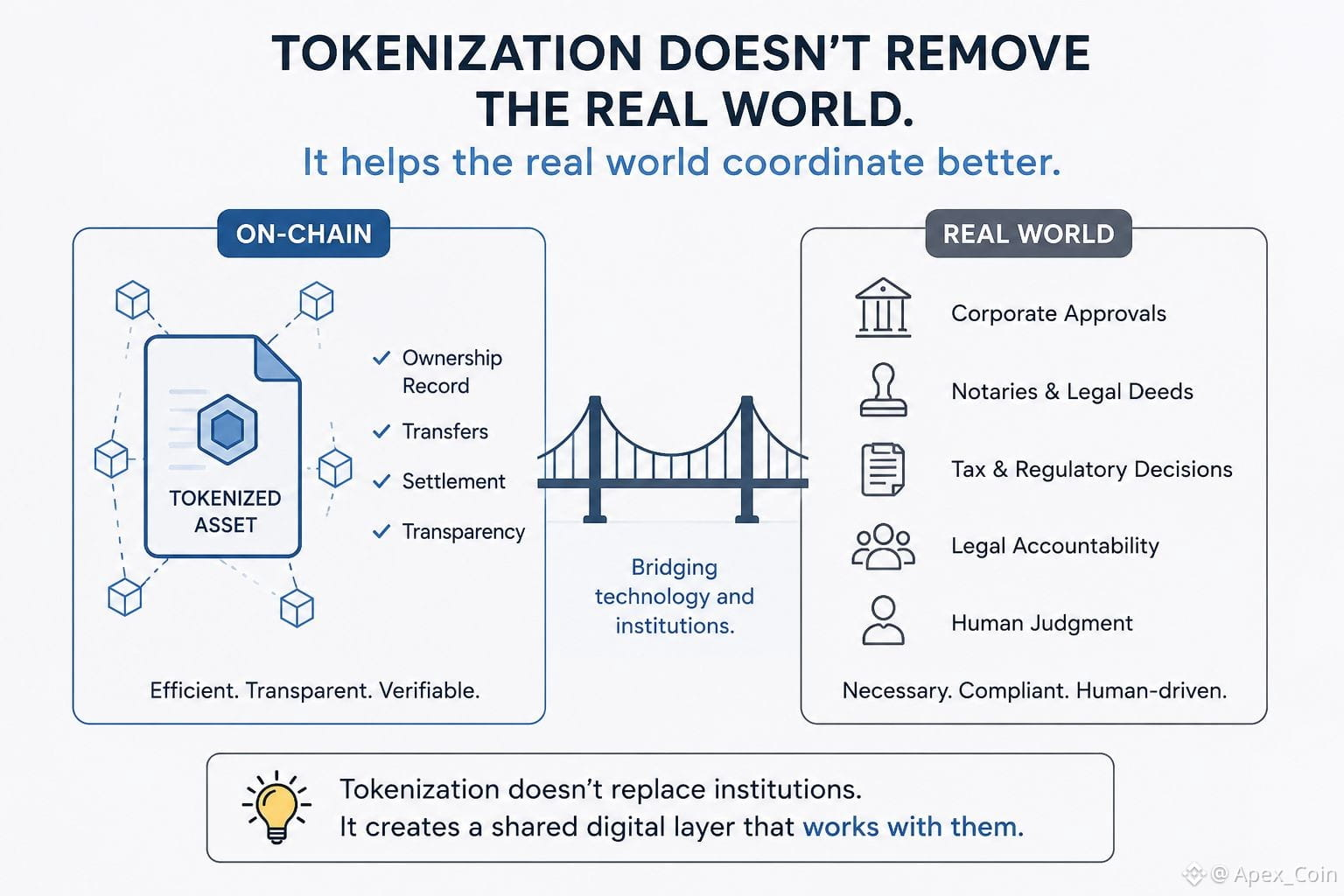
Even after an SME asset is put on-chain, you can still have notaries, corporate approvals, tax decisions, legal checks and human judgement sitting around it.
So maybe tokenization is not really about deleting the old financial system.
Maybe it is about making the coordination between all those systems less painful.
Issuers, investors, lawyers, registrars, custodians and settlement systems can all end up maintaining different versions of the same reality. A shared on-chain record could reduce some of that reconciliation, manual checking and settlement friction.
But there is an important catch.
A token being transferable does not automatically mean the underlying asset is legally transferable. And putting something on-chain doesn't magically create liquidity or buyers.
I also found Dusk’s recent incident discussion interesting for the same reason.
The question isn't only what happened technically. It is also about disclosure, accountability, governance and which information becomes the trusted version of events.
To me, both stories point to the same boundary:
code can automate a lot, but institutions still decide what the code is allowed to represent.
Maybe the real future of tokenization isn't “blockchain replaces the real world.”
Maybe it is blockchain making the real world coordinate a little better.
That feels less flashy, but probably more realistic.
What do you think?
But looking deeper at @Dusk made me question that idea.
There is a small detail I find more interesting than the token itself: the “what remains” part.
Even after an SME asset is put on-chain, you can still have notaries, corporate approvals, tax decisions, legal checks and human judgement sitting around it.
So maybe tokenization is not really about deleting the old financial system.
Maybe it is about making the coordination between all those systems less painful.
Issuers, investors, lawyers, registrars, custodians and settlement systems can all end up maintaining different versions of the same reality. A shared on-chain record could reduce some of that reconciliation, manual checking and settlement friction.
But there is an important catch.
A token being transferable does not automatically mean the underlying asset is legally transferable. And putting something on-chain doesn't magically create liquidity or buyers.
I also found Dusk’s recent incident discussion interesting for the same reason.
The question isn't only what happened technically. It is also about disclosure, accountability, governance and which information becomes the trusted version of events.
To me, both stories point to the same boundary:
code can automate a lot, but institutions still decide what the code is allowed to represent.
Maybe the real future of tokenization isn't “blockchain replaces the real world.”
Maybe it is blockchain making the real world coordinate a little better.
That feels less flashy, but probably more realistic.
What do you think?