I assumed fixed-rate lending was mainly about fixing the interest rate.
Looking closer at XT, I realized @TermMax is doing something more specific.
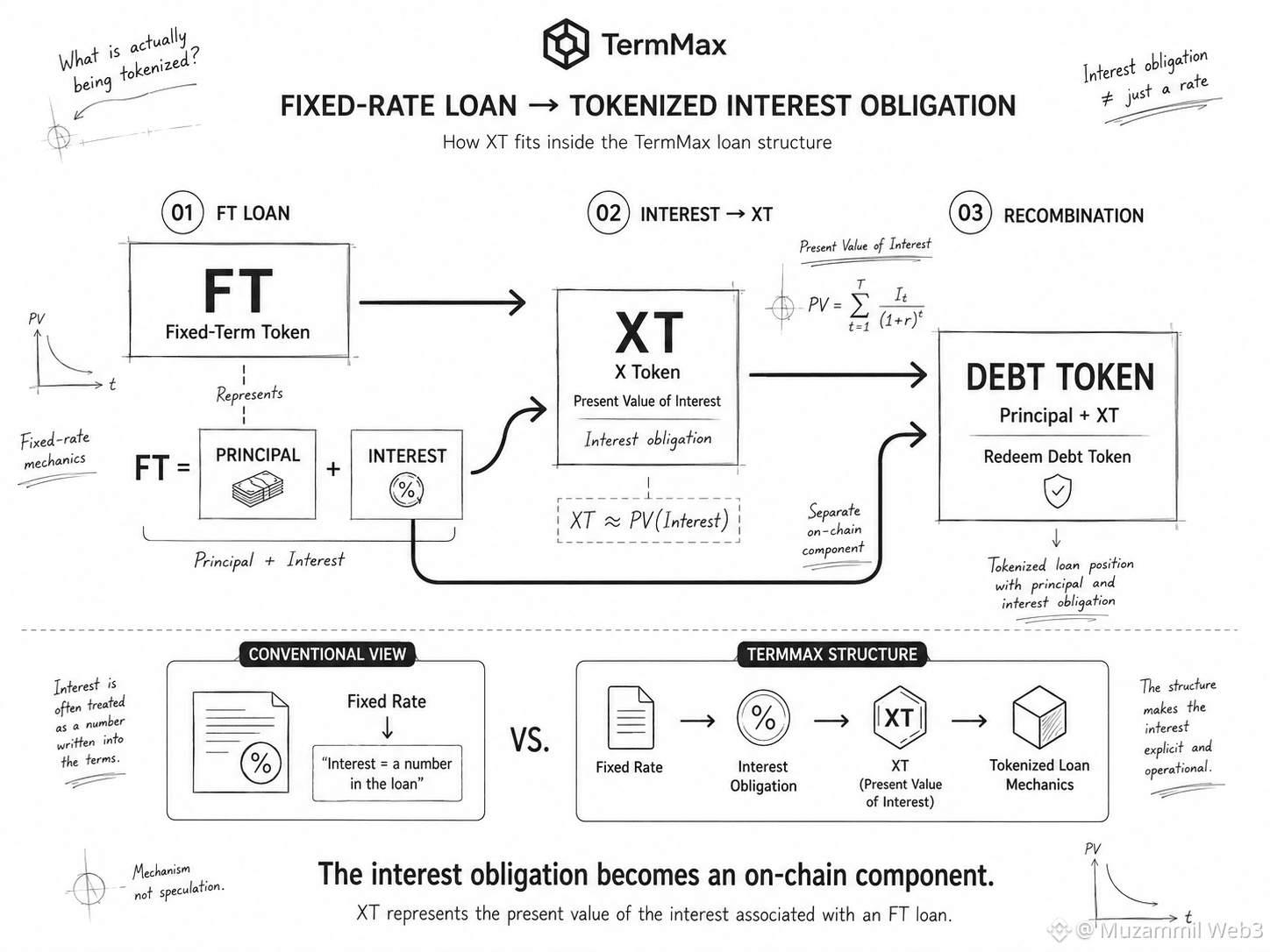
TermMax's documentation describes XT as an ERC-20 token representing the interest obligation associated with an FT loan — specifically, the present value of the interest the borrower will pay.
What I found more interesting is what happens when the loan is created.
The FT is split into principal and interest parts.
The interest part is exchanged for XT, and that XT is then combined with the principal part to redeem the debt token.
That changed how I think about TermMax's fixed-rate design.
The interest isn't just a number written into the loan terms. It becomes a separate on-chain component of the borrowing mechanism, represented through XT and used in the process of turning the loan structure into the liquidity the borrower actually receives.
I don't think that alone proves the system is better. But it does make the architecture more interesting to me: TermMax is not only fixing the borrowing rate, it's making the interest obligation itself part of the tokenized mechanics.
The question I keep coming back to is whether this separation creates useful flexibility that a conventional fixed-rate loan structure would not.
#termmax @TermMax
Looking closer at XT, I realized @TermMax is doing something more specific.
TermMax's documentation describes XT as an ERC-20 token representing the interest obligation associated with an FT loan — specifically, the present value of the interest the borrower will pay.
What I found more interesting is what happens when the loan is created.
The FT is split into principal and interest parts.
The interest part is exchanged for XT, and that XT is then combined with the principal part to redeem the debt token.
That changed how I think about TermMax's fixed-rate design.
The interest isn't just a number written into the loan terms. It becomes a separate on-chain component of the borrowing mechanism, represented through XT and used in the process of turning the loan structure into the liquidity the borrower actually receives.
I don't think that alone proves the system is better. But it does make the architecture more interesting to me: TermMax is not only fixing the borrowing rate, it's making the interest obligation itself part of the tokenized mechanics.
The question I keep coming back to is whether this separation creates useful flexibility that a conventional fixed-rate loan structure would not.
#termmax @TermMax