I looked past TermMax's "fixed-rate lending" label to see what's actually happening underneath.
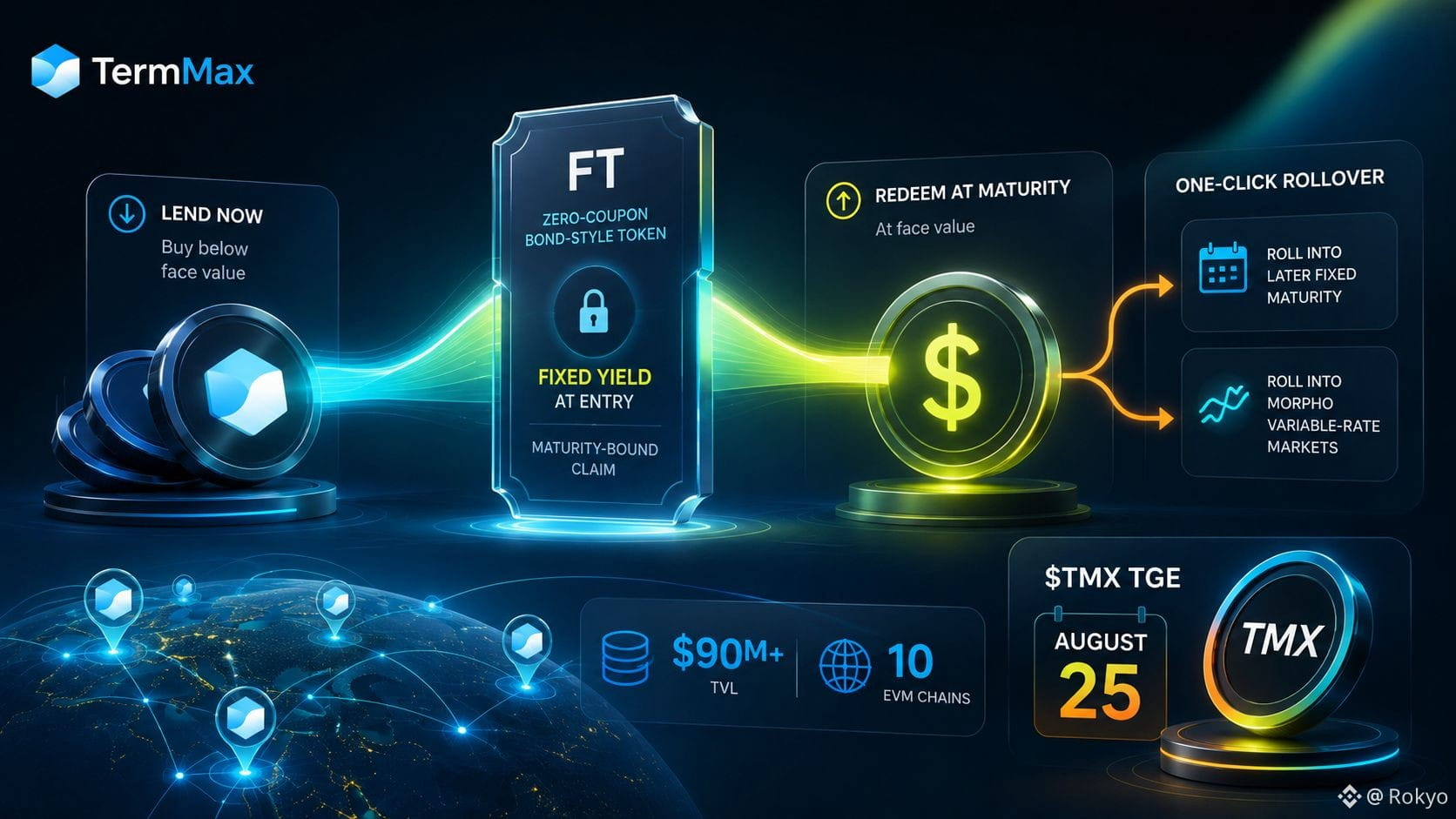
The primitive looks less like a lending pool with a fixed APY and more like an onchain fixed-income market. Its FT is a zero-coupon bond-style token: lenders buy it below face value and redeem it at par at maturity, with yield fixed at entry. That changes how I think about the product: the fixed rate isn't just a parameter on a lending pool. It's embedded in a maturity-bound claim.
In January, the same fixed-rate model extended beyond crypto-native collateral into tokenized securities, launching fixed-rate borrowing against Ondo Global Markets' tokenized stocks.
A fixed rate removes rate uncertainty for the term. It doesn't remove the need to refinance when the term ends. TermMax already has one-click rollover, into a later fixed maturity or into Morpho's variable-rate markets, so the protocol has explicitly designed for that refinancing step. What's documented well is the architecture; what's scarce is data on how that path performs when many positions need to roll at once under stress.
With $90M+ TVL across 10 EVM chains and the $TMX TGE set for August 25, that's the part I'd watch next.
#termmax @TermMax
The primitive looks less like a lending pool with a fixed APY and more like an onchain fixed-income market. Its FT is a zero-coupon bond-style token: lenders buy it below face value and redeem it at par at maturity, with yield fixed at entry. That changes how I think about the product: the fixed rate isn't just a parameter on a lending pool. It's embedded in a maturity-bound claim.
In January, the same fixed-rate model extended beyond crypto-native collateral into tokenized securities, launching fixed-rate borrowing against Ondo Global Markets' tokenized stocks.
A fixed rate removes rate uncertainty for the term. It doesn't remove the need to refinance when the term ends. TermMax already has one-click rollover, into a later fixed maturity or into Morpho's variable-rate markets, so the protocol has explicitly designed for that refinancing step. What's documented well is the architecture; what's scarce is data on how that path performs when many positions need to roll at once under stress.
With $90M+ TVL across 10 EVM chains and the $TMX TGE set for August 25, that's the part I'd watch next.
#termmax @TermMax