I expected the "eligibility checks" behind Dusk Trade to be something built specifically for trading. A compliance module bolted onto the exchange layer, the way most brokers build KYC into the platform itself.
That's not what's underneath it.
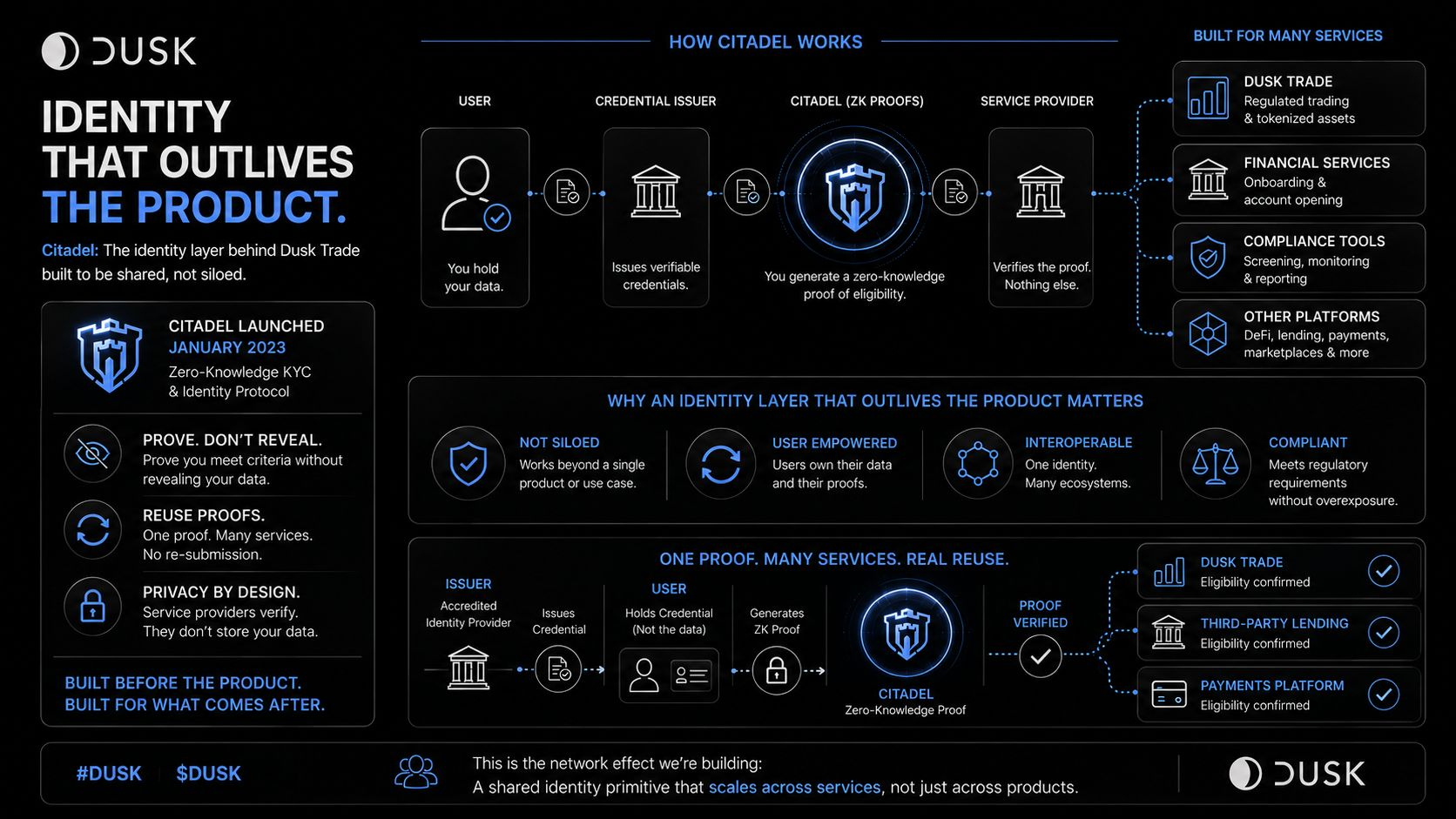
The identity layer Dusk Trade relies on is called Citadel, and it didn't start as a trading feature. Dusk launched it in January 2023 as a zero-knowledge KYC/identity protocol: prove you hold a valid credential without revealing what's in it, then reuse that proof across services instead of re-submitting your data every time.
That timing changes how I read "eligibility checks" in the docs. It looks less like bespoke compliance built for one product and more like an identity primitive that predates the product using it.
The interesting part is that Citadel was designed for service providers beyond a single trading workflow. Dusk described it as an identity layer that companies could tap into to verify whether someone meets their criteria without taking custody of all the underlying identity data.
"An eligibility check built for one product and an identity layer built to outlive the product are two different kinds of infrastructure, even when users experience both as 'proving who you are.'"
What I'd actually want to see: one credential proven through Citadel and accepted by another service provider outside Dusk Trade, the evidence that turns "shared identity primitive" from an architectural description into demonstrated cross-service reuse.
#dusk $DUSK @Dusk
That's not what's underneath it.
The identity layer Dusk Trade relies on is called Citadel, and it didn't start as a trading feature. Dusk launched it in January 2023 as a zero-knowledge KYC/identity protocol: prove you hold a valid credential without revealing what's in it, then reuse that proof across services instead of re-submitting your data every time.
That timing changes how I read "eligibility checks" in the docs. It looks less like bespoke compliance built for one product and more like an identity primitive that predates the product using it.
The interesting part is that Citadel was designed for service providers beyond a single trading workflow. Dusk described it as an identity layer that companies could tap into to verify whether someone meets their criteria without taking custody of all the underlying identity data.
"An eligibility check built for one product and an identity layer built to outlive the product are two different kinds of infrastructure, even when users experience both as 'proving who you are.'"
What I'd actually want to see: one credential proven through Citadel and accepted by another service provider outside Dusk Trade, the evidence that turns "shared identity primitive" from an architectural description into demonstrated cross-service reuse.
#dusk $DUSK @Dusk