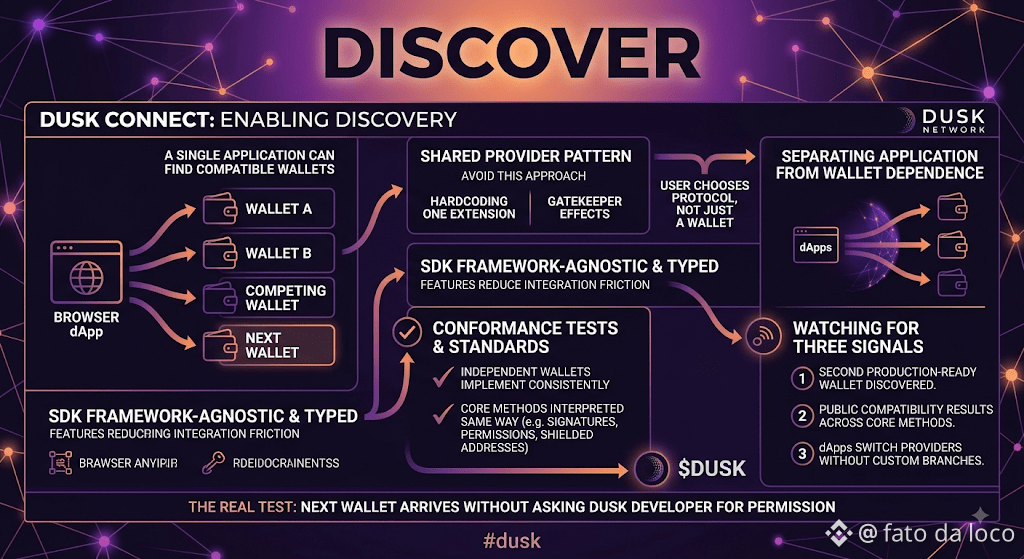
I think the most important word in Dusk Connect may be "discover."
Dusk Network opened the SDK in developer preview so a browser dApp can find compatible wallets, request profile access, track the selected network, and send user-approved transactions. It follows a shared provider pattern instead of hardcoding one extension.
That sounds like front-end plumbing. I think it is an ecosystem decision.
When every application integrates one wallet directly, that wallet becomes an unofficial gatekeeper. A competing wallet can support the protocol and still remain invisible to users because each dApp needs custom work. Dusk Connect moves that choice into a discovery layer. The application asks what providers are available, and the user chooses.
The SDK is framework-agnostic, typed, and has no runtime dependencies. Those details reduce integration friction. They do not guarantee that two wallets interpret permissions, shielded addresses, signatures, and network changes in exactly the same way.
That is why the conformance tests matter more to me than a polished connect button.
Dusk can publish a common interface, but an interface becomes a standard only when independent wallets implement it consistently. A provider that connects successfully and then handles profile changes differently can create failures that look like application bugs.
I am watching for three signals: a second production-ready wallet discovered through the same flow, public compatibility results across core methods, and dApps that switch providers without custom branches.
If those appear, Dusk Connect will have done more than simplify wallet access. It will have separated the Dusk application layer from dependence on a single wallet implementation.
The real test is not whether the first-party wallet connects. It is whether the next wallet can arrive without asking every Dusk developer for permission.
#dusk $DUSK @Dusk
Dusk Network opened the SDK in developer preview so a browser dApp can find compatible wallets, request profile access, track the selected network, and send user-approved transactions. It follows a shared provider pattern instead of hardcoding one extension.
That sounds like front-end plumbing. I think it is an ecosystem decision.
When every application integrates one wallet directly, that wallet becomes an unofficial gatekeeper. A competing wallet can support the protocol and still remain invisible to users because each dApp needs custom work. Dusk Connect moves that choice into a discovery layer. The application asks what providers are available, and the user chooses.
The SDK is framework-agnostic, typed, and has no runtime dependencies. Those details reduce integration friction. They do not guarantee that two wallets interpret permissions, shielded addresses, signatures, and network changes in exactly the same way.
That is why the conformance tests matter more to me than a polished connect button.
Dusk can publish a common interface, but an interface becomes a standard only when independent wallets implement it consistently. A provider that connects successfully and then handles profile changes differently can create failures that look like application bugs.
I am watching for three signals: a second production-ready wallet discovered through the same flow, public compatibility results across core methods, and dApps that switch providers without custom branches.
If those appear, Dusk Connect will have done more than simplify wallet access. It will have separated the Dusk application layer from dependence on a single wallet implementation.
The real test is not whether the first-party wallet connects. It is whether the next wallet can arrive without asking every Dusk developer for permission.
#dusk $DUSK @Dusk