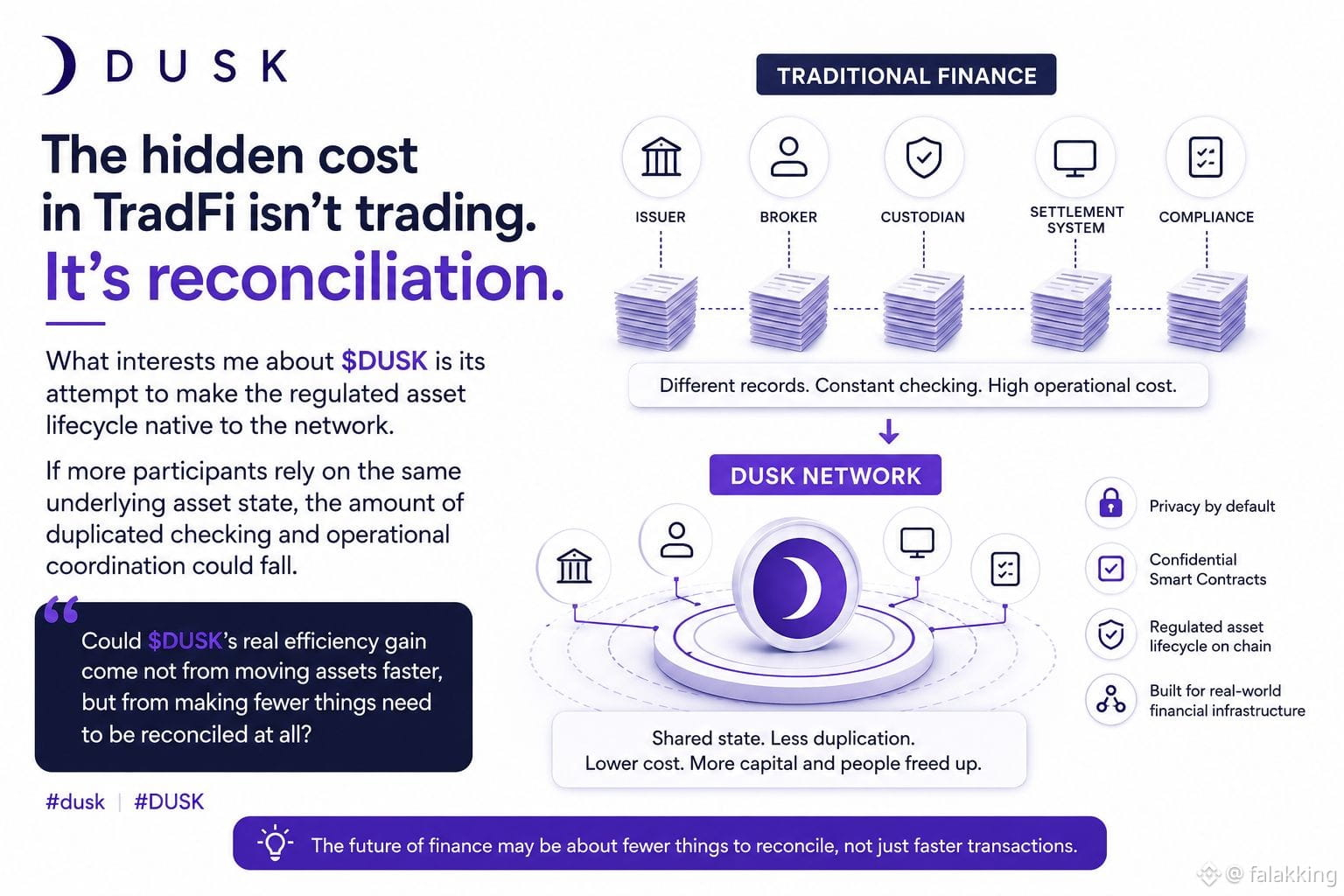
The more I look into @DuskFoundation, the more I realize that one of the biggest hidden costs in traditional finance may not be trading or settlement itself.
It’s reconciliation.
The same asset can create records across issuers, brokers, custodians and settlement systems. When all those systems maintain separate records, someone has to constantly make sure they still match.
That sounds like a boring operational problem, but at institutional scale, boring problems can become very expensive.
What interests me about $DUSK is the idea of making the regulated asset lifecycle more native to the network — from issuance and eligibility to transfers, settlement and compliance.
I don’t think blockchain magically removes reconciliation. External systems, legal frameworks and interoperability will still matter.
But if more participants can work from a shared and verifiable asset state, there may be less duplicated checking and operational coordination.
And that could free up both capital and human resources currently locked into back-office processes.
So the question I keep coming back to is:
Could $DUSK
@Dusk ’s biggest efficiency gain come not from moving assets faster, but from making fewer things need to be reconciled in the first place?
#dusk #dusk
It’s reconciliation.
The same asset can create records across issuers, brokers, custodians and settlement systems. When all those systems maintain separate records, someone has to constantly make sure they still match.
That sounds like a boring operational problem, but at institutional scale, boring problems can become very expensive.
What interests me about $DUSK is the idea of making the regulated asset lifecycle more native to the network — from issuance and eligibility to transfers, settlement and compliance.
I don’t think blockchain magically removes reconciliation. External systems, legal frameworks and interoperability will still matter.
But if more participants can work from a shared and verifiable asset state, there may be less duplicated checking and operational coordination.
And that could free up both capital and human resources currently locked into back-office processes.
So the question I keep coming back to is:
Could $DUSK
@Dusk ’s biggest efficiency gain come not from moving assets faster, but from making fewer things need to be reconciled in the first place?
#dusk #dusk