
#dusk $DUSK
I keep coming back to a contradiction in @Dusk: the more useful privacy becomes for institutions, the more valuable controlled visibility becomes.
DUSK is around $0.0648, up 6.75%, but the price move is not really the part I care about.
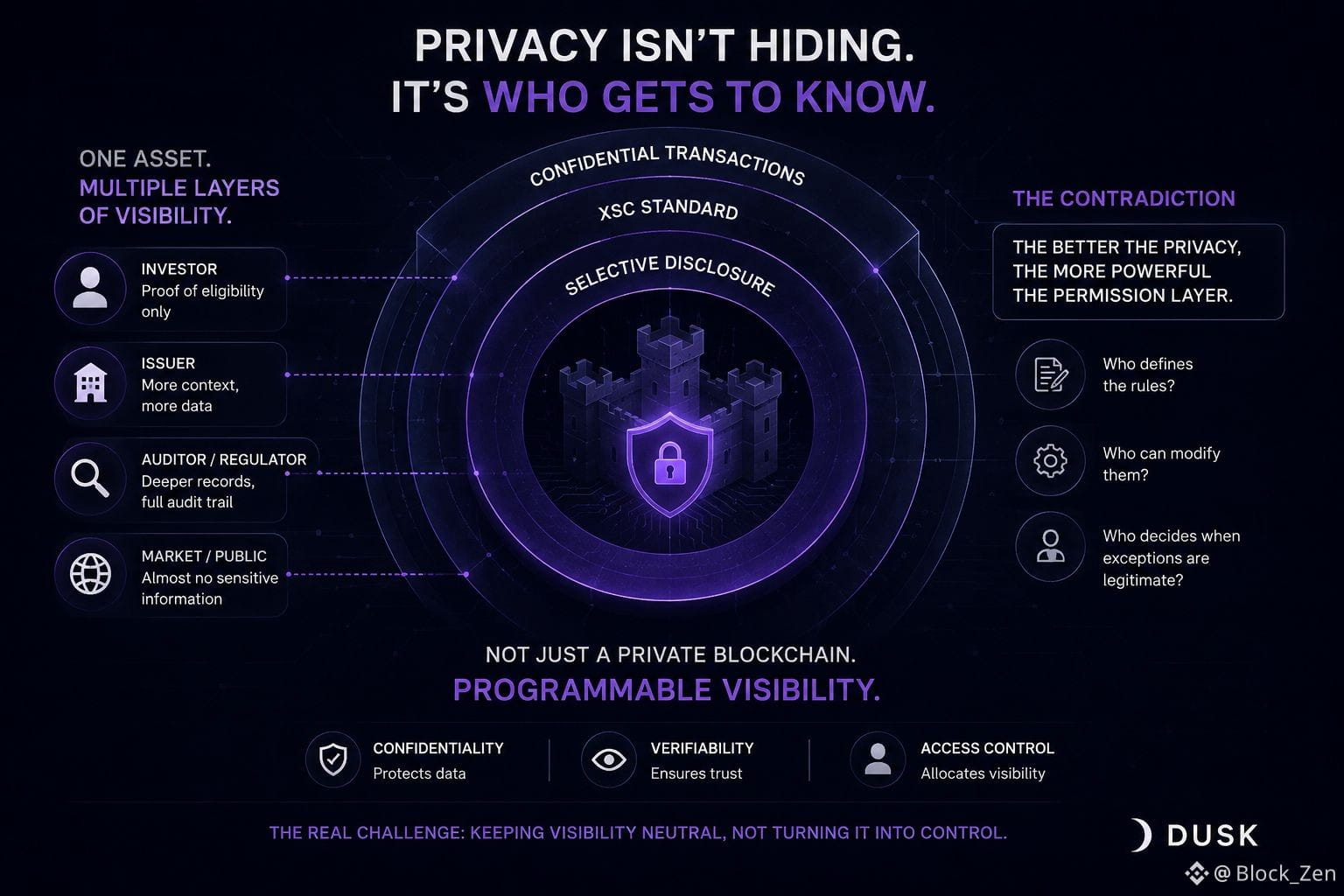
What caught my attention is the architecture around confidential transactions, XSC, and selective disclosure. The idea is not simply to hide financial information. It's to let different participants access different layers of it when the situation requires.
An investor may only need proof of eligibility.
An issuer may need more context.
An auditor or regulator could require deeper records.
The wider market may need almost nothing.
That changes privacy from a hiding problem into an access-allocation problem.
And this is where the contradiction gets interesting.
The better programmable disclosure becomes, the more important the permission layer becomes too.
Who defines those rules?
Who can modify them?
Who decides when an exception is legitimate?
Because a system can protect sensitive information while still concentrating power over who is allowed to see it.
That's the boundary I find more interesting than private blockchain.
Dusk may be testing whether financial markets can have confidentiality without losing verifiability.
But the harder test could be whether programmable visibility stays neutral or slowly becomes programmable control.
That's what I'm watching beyond the price chart.
@Dusk #dusk $DUSK
I keep coming back to a contradiction in @Dusk: the more useful privacy becomes for institutions, the more valuable controlled visibility becomes.
DUSK is around $0.0648, up 6.75%, but the price move is not really the part I care about.
What caught my attention is the architecture around confidential transactions, XSC, and selective disclosure. The idea is not simply to hide financial information. It's to let different participants access different layers of it when the situation requires.
An investor may only need proof of eligibility.
An issuer may need more context.
An auditor or regulator could require deeper records.
The wider market may need almost nothing.
That changes privacy from a hiding problem into an access-allocation problem.
And this is where the contradiction gets interesting.
The better programmable disclosure becomes, the more important the permission layer becomes too.
Who defines those rules?
Who can modify them?
Who decides when an exception is legitimate?
Because a system can protect sensitive information while still concentrating power over who is allowed to see it.
That's the boundary I find more interesting than private blockchain.
Dusk may be testing whether financial markets can have confidentiality without losing verifiability.
But the harder test could be whether programmable visibility stays neutral or slowly becomes programmable control.
That's what I'm watching beyond the price chart.
@Dusk #dusk $DUSK