
I spent a bit of time looking at the VM side of Dusk, and honestly, that’s where the project gets interesting.
Everyone talks about Dusk for privacy.
I kept coming back to the thing underneath:
how does the chain actually run code without letting that code become a problem?
That’s where Piecrust comes in.
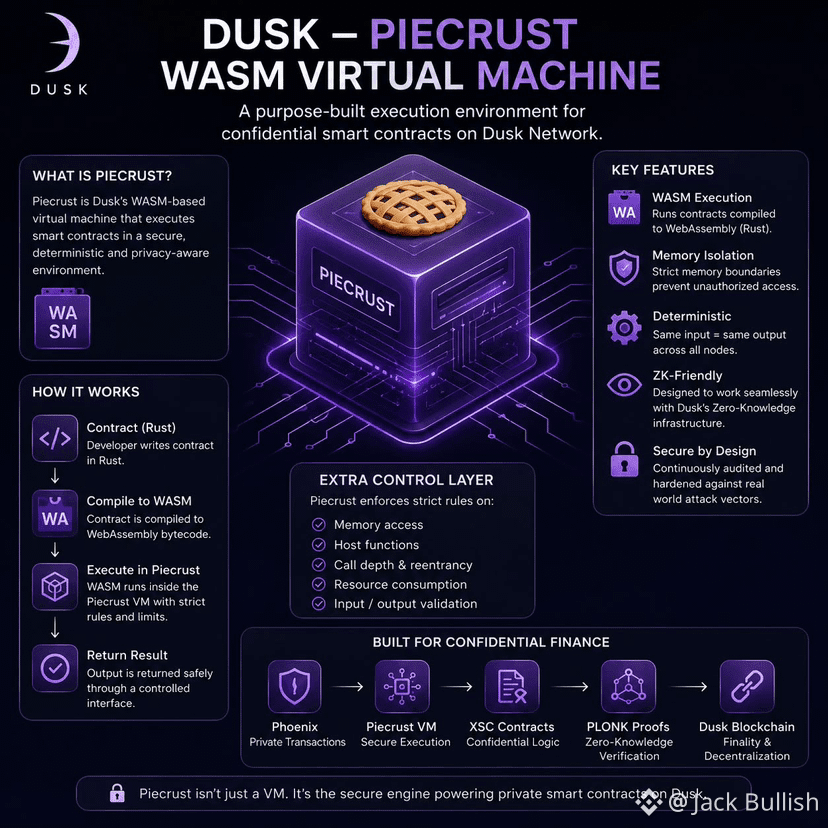
It’s a WASM execution environment built around one simple idea: smart contracts should live inside a very controlled box.
Sounds boring.
Until you remember that every contract is code you don’t fully trust.
It can be buggy.
It can be malicious.
It can do something the developer never imagined.
So the VM has to be strict.
Memory boundaries matter.
Calls matter.
What a contract can access matters.
Dusk has had to harden those pieces over time too, with fixes around out-of-bounds memory, sandboxing, aliasing, reentrancy and other deep execution-layer issues.
Not the kind of stuff that makes a good crypto headline.
But it’s the stuff I actually pay attention to.
Because privacy is only as strong as the machinery underneath it.
What I like about Dusk is that the execution environment wasn’t designed separately from the privacy stack.
Contracts run in WASM.
The VM controls the environment.
The rest of the stack handles the confidential transaction and proving side.
Different pieces, but they have to behave like one system.
And there’s a detail here that gets missed:
Dusk doesn’t feel like it’s simply rebuilding Ethereum with privacy on top.
The execution model is different.
Even the way contract memory and state are handled feels more like a purpose-built machine than the usual EVM model.
That’s why Piecrust caught my attention.
Not because “WASM” sounds cool.
Because the boring part is usually where the real engineering lives.
If Dusk becomes a serious financial network, people will notice the private transactions first.
Very few will notice the VM quietly making sure everything underneath behaves exactly as it should.
#dusk $DUSK @Dusk
Everyone talks about Dusk for privacy.
I kept coming back to the thing underneath:
how does the chain actually run code without letting that code become a problem?
That’s where Piecrust comes in.
It’s a WASM execution environment built around one simple idea: smart contracts should live inside a very controlled box.
Sounds boring.
Until you remember that every contract is code you don’t fully trust.
It can be buggy.
It can be malicious.
It can do something the developer never imagined.
So the VM has to be strict.
Memory boundaries matter.
Calls matter.
What a contract can access matters.
Dusk has had to harden those pieces over time too, with fixes around out-of-bounds memory, sandboxing, aliasing, reentrancy and other deep execution-layer issues.
Not the kind of stuff that makes a good crypto headline.
But it’s the stuff I actually pay attention to.
Because privacy is only as strong as the machinery underneath it.
What I like about Dusk is that the execution environment wasn’t designed separately from the privacy stack.
Contracts run in WASM.
The VM controls the environment.
The rest of the stack handles the confidential transaction and proving side.
Different pieces, but they have to behave like one system.
And there’s a detail here that gets missed:
Dusk doesn’t feel like it’s simply rebuilding Ethereum with privacy on top.
The execution model is different.
Even the way contract memory and state are handled feels more like a purpose-built machine than the usual EVM model.
That’s why Piecrust caught my attention.
Not because “WASM” sounds cool.
Because the boring part is usually where the real engineering lives.
If Dusk becomes a serious financial network, people will notice the private transactions first.
Very few will notice the VM quietly making sure everything underneath behaves exactly as it should.
#dusk $DUSK @Dusk