#dusk $DUSK @Dusk
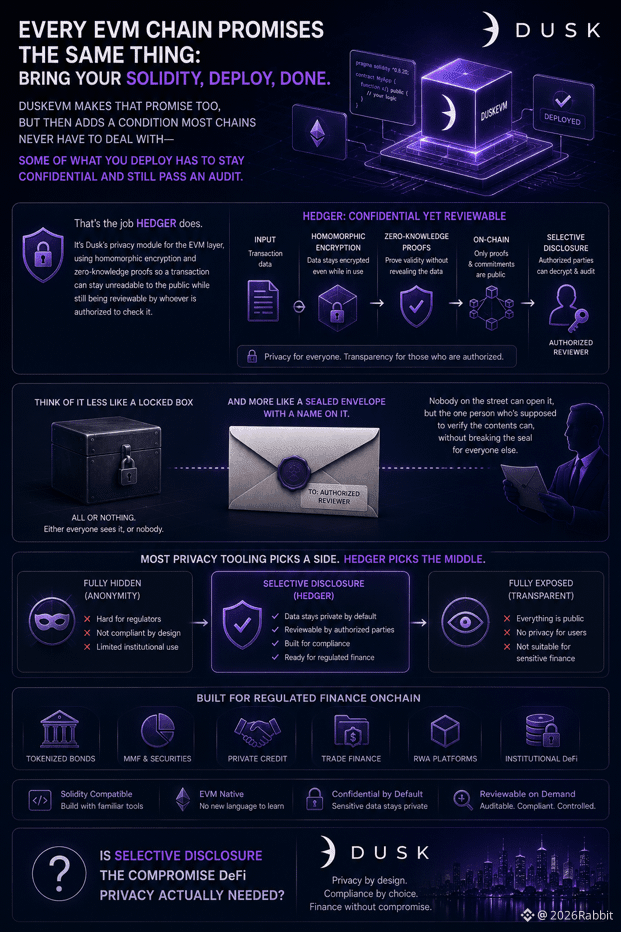
Every EVM chain promises the same thing: bring your Solidity, deploy, done. DuskEVM makes that promise too, but then adds a condition most chains never have to deal with — some of what you deploy has to stay confidential and still pass an audit.
That's the job Hedger does. It's Dusk's privacy module for the EVM layer, using homomorphic encryption and zero-knowledge proofs so a transaction can stay unreadable to the public while still being reviewable by whoever is authorized to check it.
Think of it less like a locked box and more like a sealed envelope with a name on it. Nobody on the street can open it, but the one person who's supposed to verify the contents can, without breaking the seal for everyone else.
Most privacy tooling picks a side: either fully hidden or fully exposed. Hedger is betting institutions need something in between, and that "in between" is exactly what regulated finance has been missing on EVM chains.
Is selective disclosure the compromise DeFi privacy actually needed?
Every EVM chain promises the same thing: bring your Solidity, deploy, done. DuskEVM makes that promise too, but then adds a condition most chains never have to deal with — some of what you deploy has to stay confidential and still pass an audit.
That's the job Hedger does. It's Dusk's privacy module for the EVM layer, using homomorphic encryption and zero-knowledge proofs so a transaction can stay unreadable to the public while still being reviewable by whoever is authorized to check it.
Think of it less like a locked box and more like a sealed envelope with a name on it. Nobody on the street can open it, but the one person who's supposed to verify the contents can, without breaking the seal for everyone else.
Most privacy tooling picks a side: either fully hidden or fully exposed. Hedger is betting institutions need something in between, and that "in between" is exactly what regulated finance has been missing on EVM chains.
Is selective disclosure the compromise DeFi privacy actually needed?