I went back to Dusk’s whitepaper expecting block rewards to be a minor implementation detail. Instead, the reward machinery sits close to the heart of how consensus participants are paid for producing and finalizing blocks.
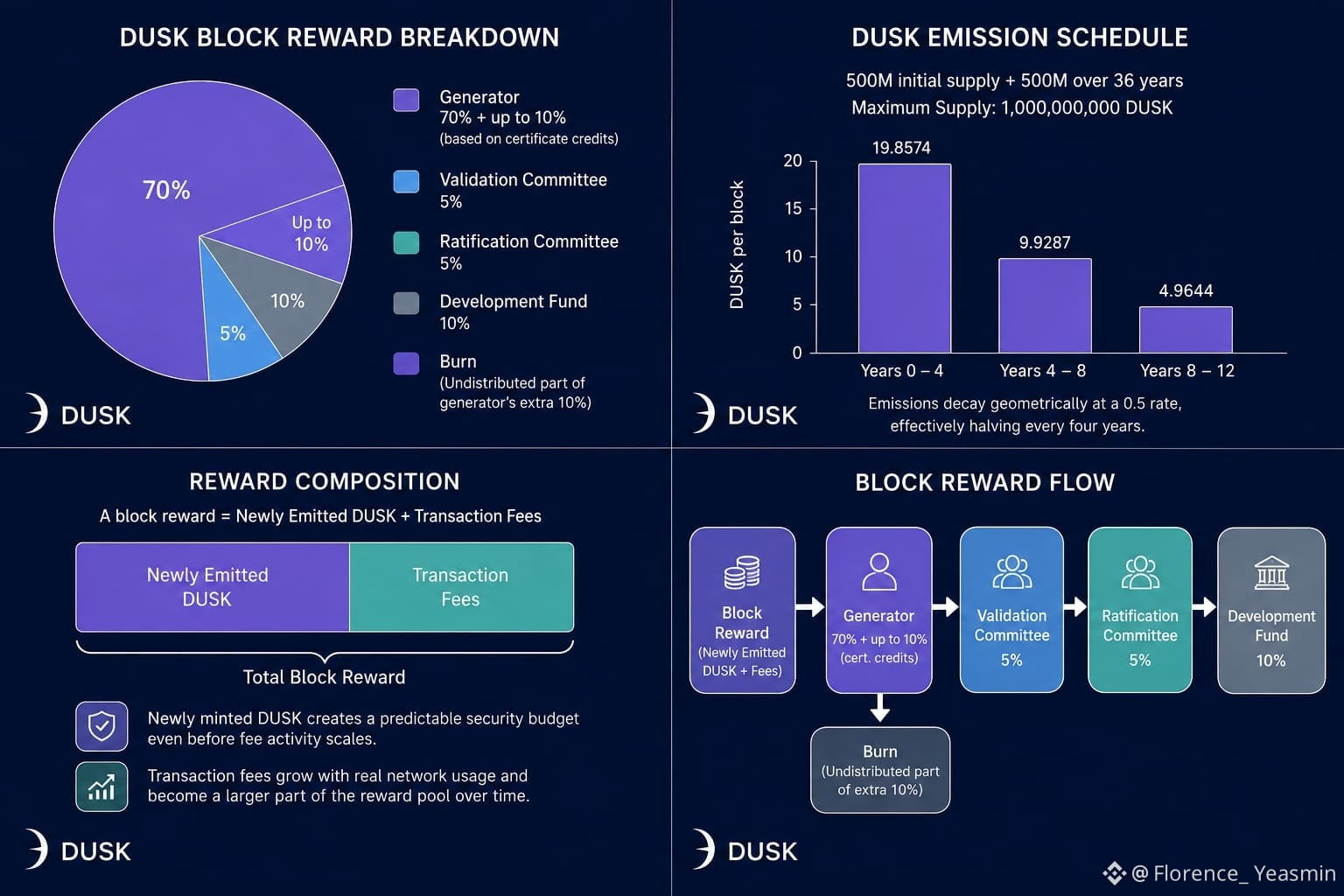
The useful distinction is that @Dusk s current economics define a block reward as newly emitted $DUSK plus all transaction fees collected in that block. I think the emphasis on newly minted DUSK matters because issuance creates a predictable security budget even before fee activity becomes large enough to carry that burden on its own.
The numbers make that design visible. Dusk has a 500 million DUSK initial supply and schedules another 500 million over 36 years, setting a maximum of 1 billion. Emissions decay geometrically at a 0.5 rate, effectively halving every four years: 19.8574 DUSK per block in years 0–4, 9.9287 in years 4–8, and 4.9644 in years 8–12.
That reward is tied directly to consensus work. The generator receives 70% plus up to another 10% based on certificate credits; validation and ratification committees receive 5% each; the development fund receives 10%. Any undistributed part of the generator’s extra 10% is burned.
So newly minted DUSK is not just “inflation” in isolation. I read it as a declining, protocol-defined subsidy for security, while transaction fees remain part of the same reward pool as real network usage grows.
Do you think that transition toward fee-backed rewards is the right long term balance for Dusk’s regulated, privacy focused financial network? #dusk $ACE $AKE
The useful distinction is that @Dusk s current economics define a block reward as newly emitted $DUSK plus all transaction fees collected in that block. I think the emphasis on newly minted DUSK matters because issuance creates a predictable security budget even before fee activity becomes large enough to carry that burden on its own.
The numbers make that design visible. Dusk has a 500 million DUSK initial supply and schedules another 500 million over 36 years, setting a maximum of 1 billion. Emissions decay geometrically at a 0.5 rate, effectively halving every four years: 19.8574 DUSK per block in years 0–4, 9.9287 in years 4–8, and 4.9644 in years 8–12.
That reward is tied directly to consensus work. The generator receives 70% plus up to another 10% based on certificate credits; validation and ratification committees receive 5% each; the development fund receives 10%. Any undistributed part of the generator’s extra 10% is burned.
So newly minted DUSK is not just “inflation” in isolation. I read it as a declining, protocol-defined subsidy for security, while transaction fees remain part of the same reward pool as real network usage grows.
Do you think that transition toward fee-backed rewards is the right long term balance for Dusk’s regulated, privacy focused financial network? #dusk $ACE $AKE