I started looking at DUSK’s private state from the wrong metric first total notes created. It sounds like the obvious storage story, but it only shows one curve. @Dusk
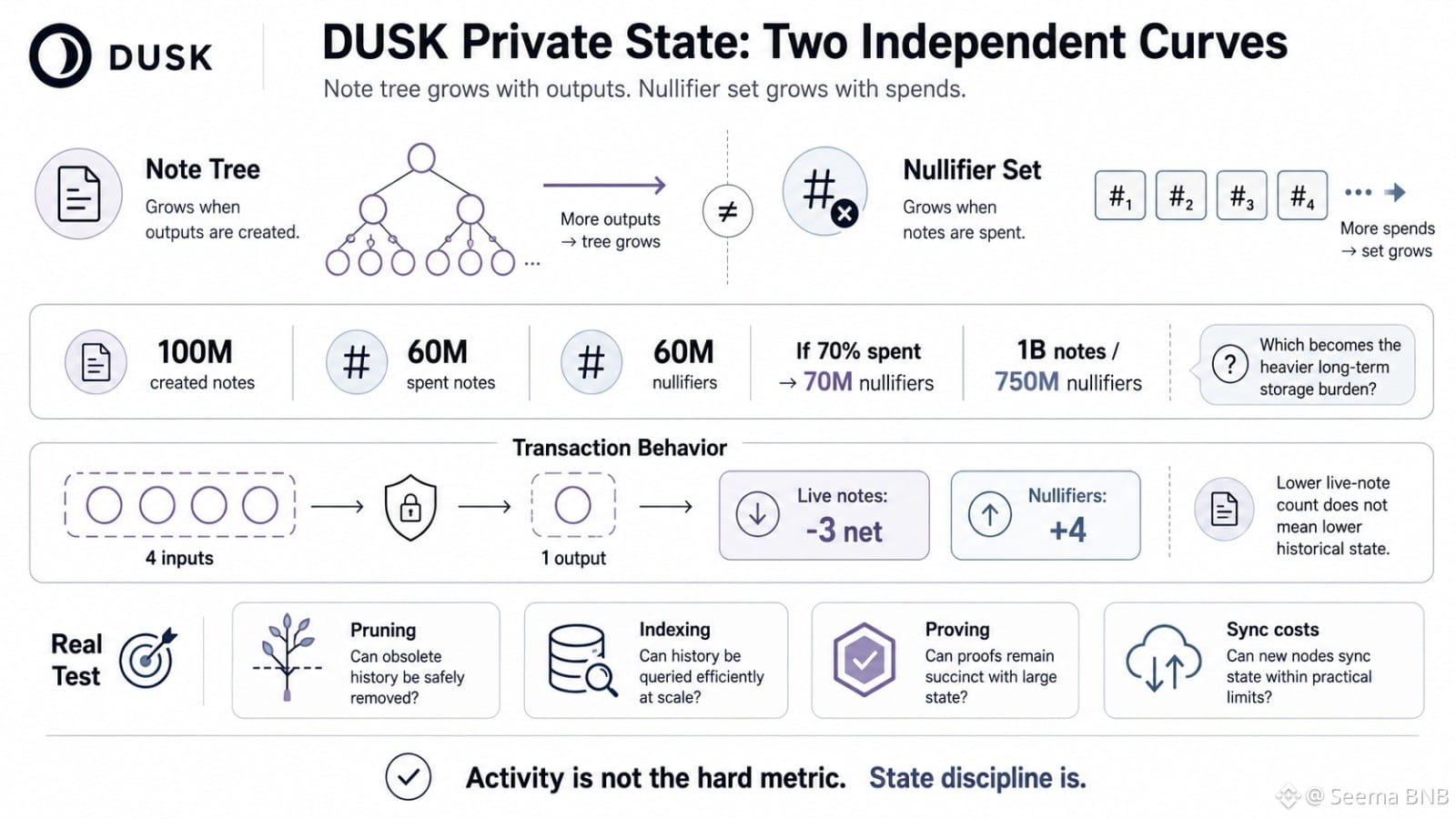
The note tree grows when outputs are created. The nullifier set grows when notes are spent. Those are related, but not the same behavior.
Take 100M Phoenix notes with 60M already spent. DUSK still carries the history of created notes, while the nullifier side has already reached 60M entries. If 70% are eventually spent, that becomes 70M nullifiers. At 1B notes and 750M nullifiers, the question gets less comfortable: which structure becomes the heavier long-term state burden?
A 4-in/1-out transaction makes this clearer. Live notes fall by three net, yet four new nullifiers are added. Lower live-note count does not mean lower historical state.
Some growth is normal. Private systems need commitments and spent-note protection.
The real test is whether DUSK can keep both curves efficient as usage compounds. Can pruning, indexing, proving and sync costs stay manageable? Or does privacy slowly become an infrastructure tax?
For DUSK activity is not the hard metric. State discipline is.
#dusk $DUSK