#dusk $DUSK @Dusk
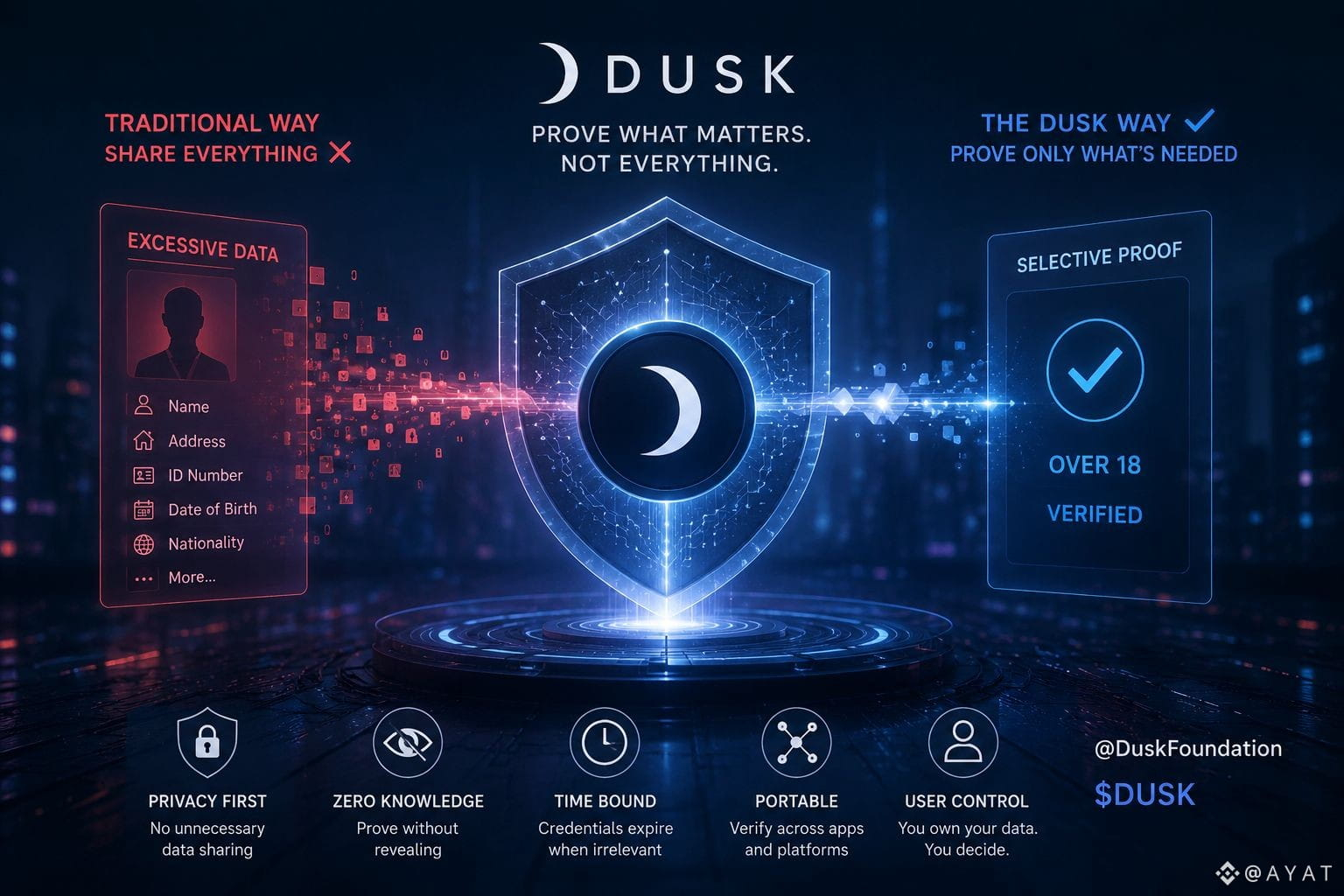
At first, I looked at Citadel and thought, “Okay, another identity layer.” But the more I understood the idea, the more I realized the interesting part isn’t collecting identity data. It’s proving something without exposing everything.
That difference matters.
Imagine needing to prove you’re eligible for something without handing over your entire personal history every time. You provide the proof that actually matters, the claim gets checked, and the unnecessary details don’t need to follow you around.
That feels much more practical to me than building another giant database of personal information.
I also like the idea that credentials don’t have to remain useful forever. If a claim changes or expires, the verification should reflect that instead of becoming a permanent digital asset.
But there’s a bigger question here.
Why would people keep using a verification network?
For me, the strongest answer isn’t simply convenience. It’s portability. If @Dusk can make verification private, reusable, and reliable across different applications, users may have less reason to repeat the same checks everywhere.
That’s where $DUSK gets interesting.
I’m watching whether this becomes infrastructure people actually rely on, rather than another feature that sounds good on paper.
Would you rather prove one specific fact about yourself, or keep handing over your entire identity?
At first, I looked at Citadel and thought, “Okay, another identity layer.” But the more I understood the idea, the more I realized the interesting part isn’t collecting identity data. It’s proving something without exposing everything.
That difference matters.
Imagine needing to prove you’re eligible for something without handing over your entire personal history every time. You provide the proof that actually matters, the claim gets checked, and the unnecessary details don’t need to follow you around.
That feels much more practical to me than building another giant database of personal information.
I also like the idea that credentials don’t have to remain useful forever. If a claim changes or expires, the verification should reflect that instead of becoming a permanent digital asset.
But there’s a bigger question here.
Why would people keep using a verification network?
For me, the strongest answer isn’t simply convenience. It’s portability. If @Dusk can make verification private, reusable, and reliable across different applications, users may have less reason to repeat the same checks everywhere.
That’s where $DUSK gets interesting.
I’m watching whether this becomes infrastructure people actually rely on, rather than another feature that sounds good on paper.
Would you rather prove one specific fact about yourself, or keep handing over your entire identity?