I'm looking at @Dusk and I keep getting stuck on the same thing: everyone's bucketing it as "another privacy coin," and that's the laziest possible read of what it's actually doing.
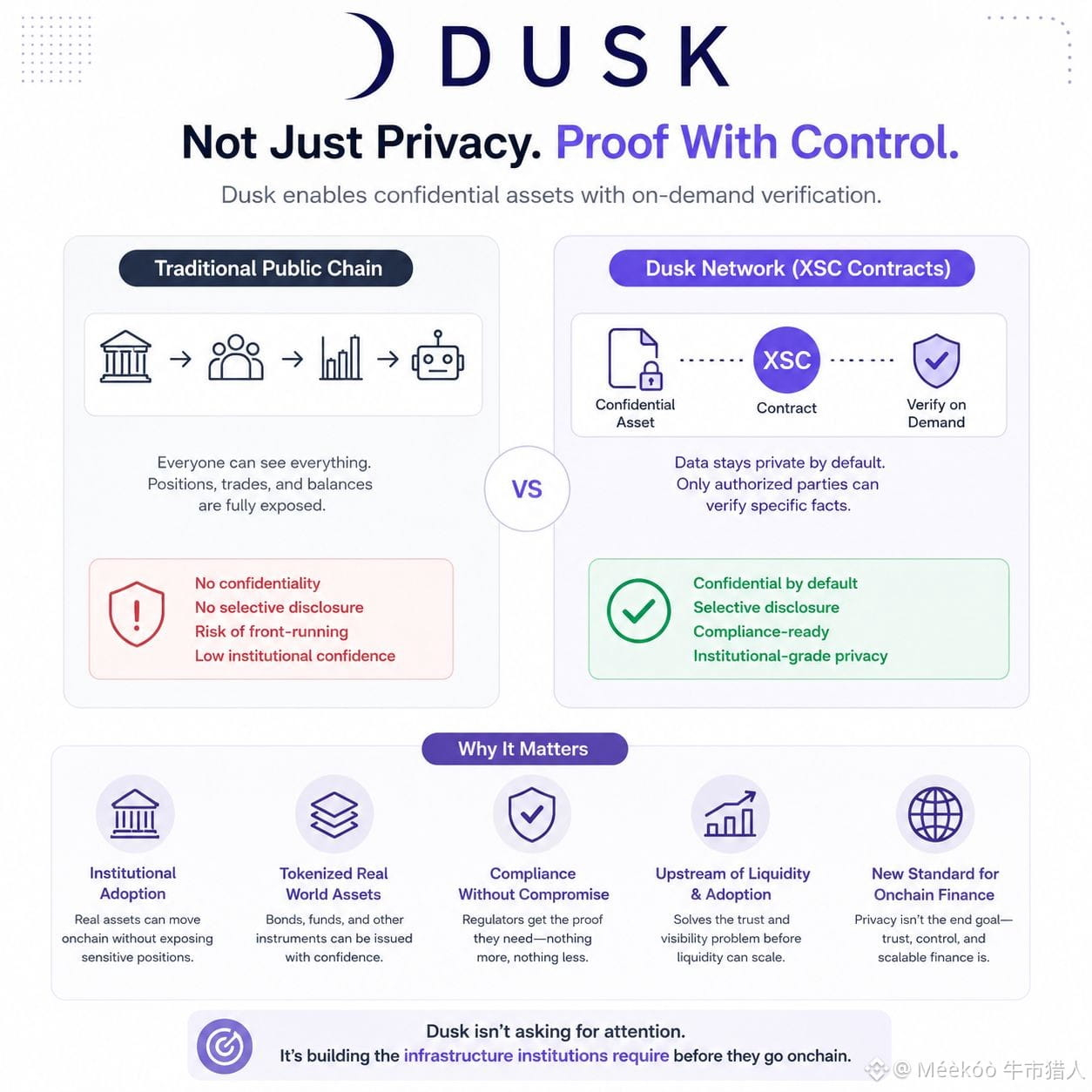
Privacy coins sell secrecy. Dusk isn't selling secrecy — it's selling the ability to prove something is true without showing everything else. XSC contracts let an asset stay confidential by default but still let a regulator or auditor confirm a specific fact on demand — ownership, solvency, whatever's required — without exposing the whole position to the rest of the chain. That's not a privacy toggle, that's a completely different design decision, and I don't think the market has priced that distinction in yet.
Here's my actual take: nobody serious is going to tokenize a bond or a fund share on a fully transparent chain, because that means every desk, every competitor, every bot can watch your book in real time. That's not a compliance issue, it's a "why would I ever move size here" issue. So the thing Dusk is quietly solving isn't privacy at all — it's whether institutions are even willing to let real assets touch a public ledger in the first place. That's upstream of liquidity. It's upstream of adoption. It's the gate before the gate.
So when I see Dusk trading like a niche privacy play, I think the market's asking the wrong question. It's asking "does anyone want anonymous transactions" when the real question is "does anyone want to issue real financial assets onchain without broadcasting their position to the world." Almost nobody's asking that second question loudly right now — but the people who eventually do are the ones who actually move capital, not narratives.
That gap between what the market's pricing and what's actually being built is where I think the mispricing lives.
#dusk $DUSK @Dusk
Privacy coins sell secrecy. Dusk isn't selling secrecy — it's selling the ability to prove something is true without showing everything else. XSC contracts let an asset stay confidential by default but still let a regulator or auditor confirm a specific fact on demand — ownership, solvency, whatever's required — without exposing the whole position to the rest of the chain. That's not a privacy toggle, that's a completely different design decision, and I don't think the market has priced that distinction in yet.
Here's my actual take: nobody serious is going to tokenize a bond or a fund share on a fully transparent chain, because that means every desk, every competitor, every bot can watch your book in real time. That's not a compliance issue, it's a "why would I ever move size here" issue. So the thing Dusk is quietly solving isn't privacy at all — it's whether institutions are even willing to let real assets touch a public ledger in the first place. That's upstream of liquidity. It's upstream of adoption. It's the gate before the gate.
So when I see Dusk trading like a niche privacy play, I think the market's asking the wrong question. It's asking "does anyone want anonymous transactions" when the real question is "does anyone want to issue real financial assets onchain without broadcasting their position to the world." Almost nobody's asking that second question loudly right now — but the people who eventually do are the ones who actually move capital, not narratives.
That gap between what the market's pricing and what's actually being built is where I think the mispricing lives.
#dusk $DUSK @Dusk