
#dusk $DUSK @Dusk
The more I read about Dusk, the more I think the real problem in bringing financial markets on-chain is not simply blockchain adoption.
It is privacy.
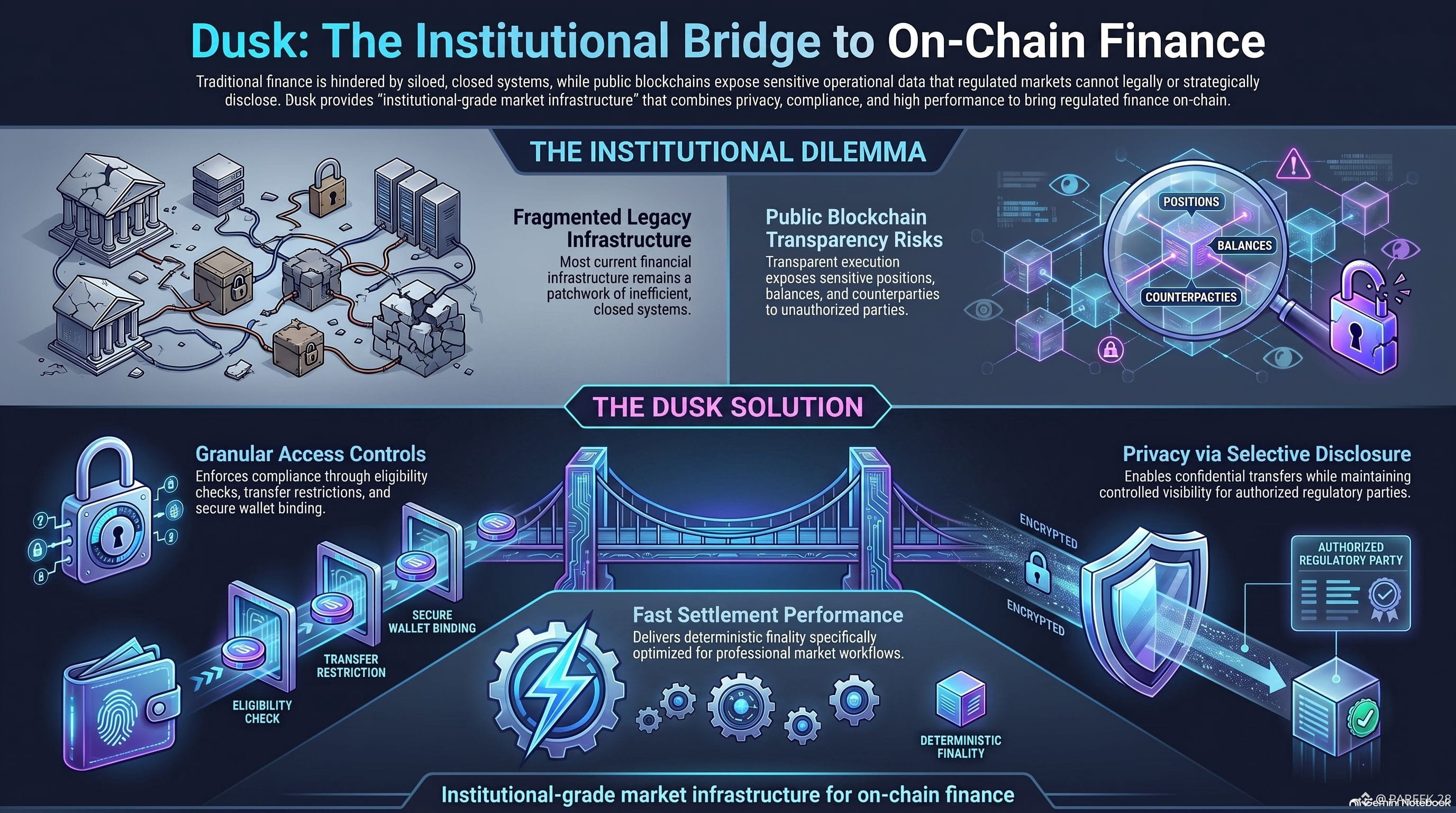
Think about how financial markets work today. A lot of information is sensitive by nature. Positions, balances, counterparties and other operational details cannot simply be exposed to everyone.
Now take that environment and put it on a public blockchain where everything is designed to be visible. That creates an interesting conflict.
Blockchain gives us transparency and verifiability, but financial markets also need confidentiality and controlled access.This is where I started looking at @Dusk differently.
$DUSK is not trying to solve the problem by saying that everything should be private. Instead, the architecture is built around regulated markets where access controls, privacy with selective disclosure and settlement performance can work together.
The idea of selective disclosure is particularly interesting to me.
A transaction can remain confidential where necessary, while authorised parties can still get the visibility they are supposed to have.
That sounds much closer to how real financial systems need to work.
Because privacy does not have to mean hiding everything.
Sometimes privacy simply means the information is available, but only to the people who are allowed to see it.
And I think this distinction becomes very important if real-world financial assets and regulated markets are going to move on-chain.
The question I am taking away from Dusk is not:
“Should blockchain be transparent or private?”
It is:
“Can we build financial infrastructure where transparency is controlled instead of absolute?”
That is a much harder problem.
And honestly, it is also a much more interesting one.
The more I read about Dusk, the more I think the real problem in bringing financial markets on-chain is not simply blockchain adoption.
It is privacy.
Think about how financial markets work today. A lot of information is sensitive by nature. Positions, balances, counterparties and other operational details cannot simply be exposed to everyone.
Now take that environment and put it on a public blockchain where everything is designed to be visible. That creates an interesting conflict.
Blockchain gives us transparency and verifiability, but financial markets also need confidentiality and controlled access.This is where I started looking at @Dusk differently.
$DUSK is not trying to solve the problem by saying that everything should be private. Instead, the architecture is built around regulated markets where access controls, privacy with selective disclosure and settlement performance can work together.
The idea of selective disclosure is particularly interesting to me.
A transaction can remain confidential where necessary, while authorised parties can still get the visibility they are supposed to have.
That sounds much closer to how real financial systems need to work.
Because privacy does not have to mean hiding everything.
Sometimes privacy simply means the information is available, but only to the people who are allowed to see it.
And I think this distinction becomes very important if real-world financial assets and regulated markets are going to move on-chain.
The question I am taking away from Dusk is not:
“Should blockchain be transparent or private?”
It is:
“Can we build financial infrastructure where transparency is controlled instead of absolute?”
That is a much harder problem.
And honestly, it is also a much more interesting one.