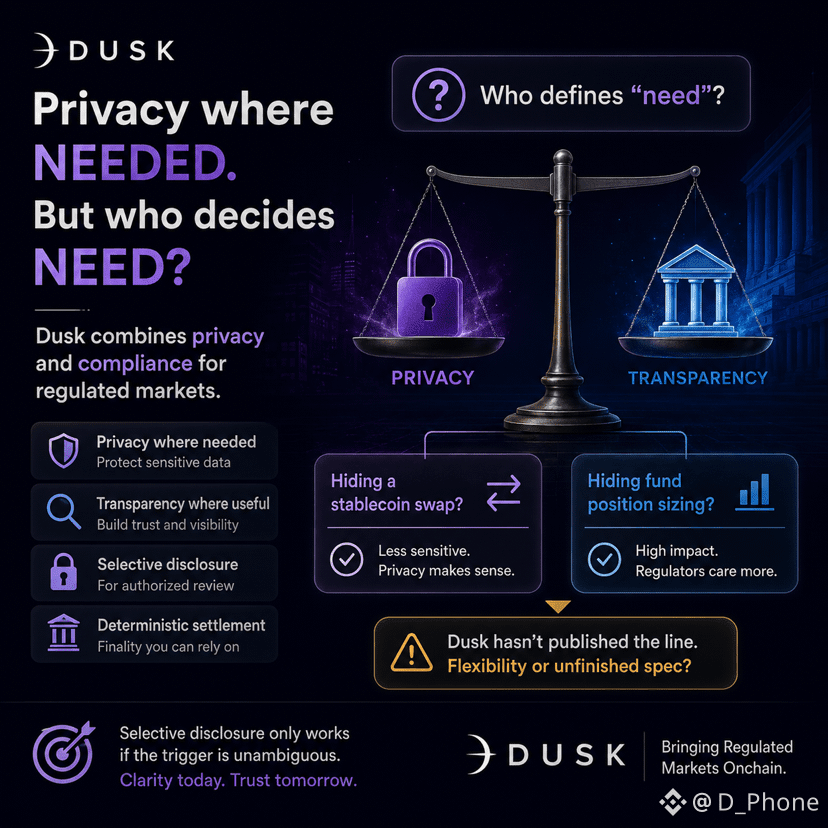
Dusk is a Layer 1 blockchain for regulated financial markets, pairing programmable privacy with compliance: privacy where needed, transparency where useful, selective disclosure for authorized review, and deterministic settlement, fit for tokenized real-world assets and regulated securities, with DUSK as its native token. DuskEVM mainnet is coming as the EVM-compatible application layer of the Dusk stack, giving builders a familiar Solidity path into Dusk, and it supports confidential EVM workflows through Hedger, Dusk's privacy module built on homomorphic encryption and zero-knowledge proofs. Dusk Trade functions as a neobroker, the application layer for tokenized financial assets on DuskEVM, bringing MMFs, ETFs, bonds, and RWAs onchain with real ownership and instant settlement, structured to operate as a regulated MTF and investment platform under EU rules. Through partnerships with Chainlink and EU-licensed institutions, Dusk is bringing financial markets onchain, including NPEX, an AFM-regulated exchange licensed as an MTF, Broker, and ECSP, planning to bring more than 300M EUR in assets onchain via Dusk. Tokenization wraps an existing asset, while native issuance moves more of that asset's lifecycle onchain, and Dusk's infrastructure is built to carry native issuance workflows for regulated securities once institutions hold the required authorization.
Here's what I keep circling back to with Dusk: the phrase 'privacy where needed' sounds elegant until you ask who defines need. Hiding a stablecoin swap is different from a fund hiding position sizing from competitors, and regulators care far more about the second. Dusk hasn't published a granular breakdown of which transaction types default to private versus public, and that gap might be intentional flexibility or an unfinished spec. I'd want that line drawn explicitly before institutions commit real capital. Selective disclosure only works if the trigger is unambiguous, not left to judgment.
@Dusk #dusk $BTW $AKE $DUSK
Here's what I keep circling back to with Dusk: the phrase 'privacy where needed' sounds elegant until you ask who defines need. Hiding a stablecoin swap is different from a fund hiding position sizing from competitors, and regulators care far more about the second. Dusk hasn't published a granular breakdown of which transaction types default to private versus public, and that gap might be intentional flexibility or an unfinished spec. I'd want that line drawn explicitly before institutions commit real capital. Selective disclosure only works if the trigger is unambiguous, not left to judgment.
@Dusk #dusk $BTW $AKE $DUSK