#dusk $DUSK @Dusk
I noticed something while looking into DUSK that changed the way I think about blockchain privacy.
At first, I treated privacy as a fairly simple idea: keep transaction details away from public view. But financial markets made me question that assumption. If a company, investor, or institution puts an asset on-chain, should every balance, transfer, and financial relationship really become visible to everyone just because the underlying system is decentralized?
That is where Dusk started to make more sense to me.
Dusk is a Layer-1 focused on financial applications, with privacy and compliance built into the infrastructure rather than added as an afterthought. What interests me is the attempt to create a middle ground: sensitive information can remain confidential, while the system can still provide the verification needed for legitimate participants and regulators.
The Confidential Security Contract standard, or XSC, is probably the part I find most interesting. Tokenized securities sound straightforward until you think about the information attached to them. Ownership, transfers, compliance conditions, and corporate actions can all carry details that shouldn't necessarily sit in plain sight. XSC is designed around that problem.
Then there is DUSK, the network's native token. It is used for transaction fees and staking, with a maximum supply of 1 billion DUSK. The protocol also requires 1,000 DUSK for direct staking.
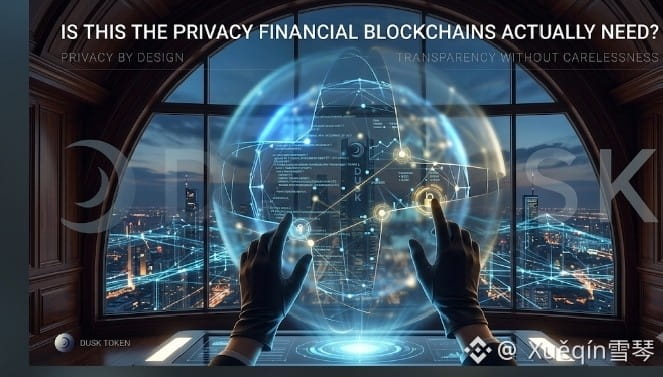
I don't see Dusk as simply another privacy chain. What stayed with me is the design question behind it: can a decentralized system be transparent about what needs to be verified without being careless about what needs to remain private?
That question feels increasingly relevant as tokenized assets, AI agents, and financial automation become more connected.
Maybe good privacy isn't about hiding everything.
Maybe it's about having control over what gets revealed, to whom, and why.
@Dusk
#dusk
$DUSK
I noticed something while looking into DUSK that changed the way I think about blockchain privacy.
At first, I treated privacy as a fairly simple idea: keep transaction details away from public view. But financial markets made me question that assumption. If a company, investor, or institution puts an asset on-chain, should every balance, transfer, and financial relationship really become visible to everyone just because the underlying system is decentralized?
That is where Dusk started to make more sense to me.
Dusk is a Layer-1 focused on financial applications, with privacy and compliance built into the infrastructure rather than added as an afterthought. What interests me is the attempt to create a middle ground: sensitive information can remain confidential, while the system can still provide the verification needed for legitimate participants and regulators.
The Confidential Security Contract standard, or XSC, is probably the part I find most interesting. Tokenized securities sound straightforward until you think about the information attached to them. Ownership, transfers, compliance conditions, and corporate actions can all carry details that shouldn't necessarily sit in plain sight. XSC is designed around that problem.
Then there is DUSK, the network's native token. It is used for transaction fees and staking, with a maximum supply of 1 billion DUSK. The protocol also requires 1,000 DUSK for direct staking.
I don't see Dusk as simply another privacy chain. What stayed with me is the design question behind it: can a decentralized system be transparent about what needs to be verified without being careless about what needs to remain private?
That question feels increasingly relevant as tokenized assets, AI agents, and financial automation become more connected.
Maybe good privacy isn't about hiding everything.
Maybe it's about having control over what gets revealed, to whom, and why.
@Dusk
#dusk
$DUSK