Parfin’s 1.07B $RLS lock is more interesting than the number
Parfin moved its entire 1,070,493,535 $RLS allocation from custody on Ethereum to a smart contract on the @Rayls Public Chain.
That’s roughly 11% of the initial 10B supply.
But the important part isn’t just that the tokens are locked.
It’s how the lock is enforced.
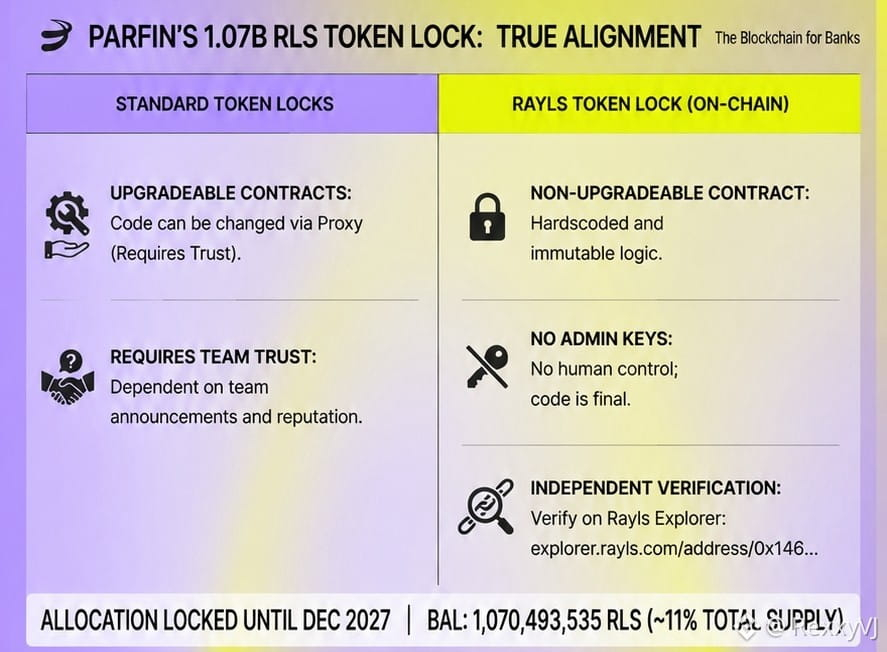
The unlock was voluntarily extended from December 2026 to December 2027, and the allocation now sits in a non-upgradeable contract with no admin keys.
That means the lock’s rules are enforced by the contract itself rather than depending on someone maintaining the promise off-chain.
The contract balance and its code can also be checked publicly.
The address shown in the image is:
0x1463889D3a5EAAEE3f066d1CF438A8957F7Db98E
So instead of simply saying “Parfin locked 1.07B RLS,” anyone can verify where the tokens are, how much is there, and how the lock is implemented.
That distinction matters.
A token lock is stronger when the commitment is not only announced, but also enforced by code that cannot simply be upgraded or changed by an admin.
For me, the interesting part of this move is the shift from a promise you read about to a commitment you can inspect on-chain.
That’s exactly the kind of transparency I want to see around a large team allocation.
Parfin moved its entire 1,070,493,535 $RLS allocation from custody on Ethereum to a smart contract on the @Rayls Public Chain.
That’s roughly 11% of the initial 10B supply.
But the important part isn’t just that the tokens are locked.
It’s how the lock is enforced.
The unlock was voluntarily extended from December 2026 to December 2027, and the allocation now sits in a non-upgradeable contract with no admin keys.
That means the lock’s rules are enforced by the contract itself rather than depending on someone maintaining the promise off-chain.
The contract balance and its code can also be checked publicly.
The address shown in the image is:
0x1463889D3a5EAAEE3f066d1CF438A8957F7Db98E
So instead of simply saying “Parfin locked 1.07B RLS,” anyone can verify where the tokens are, how much is there, and how the lock is implemented.
That distinction matters.
A token lock is stronger when the commitment is not only announced, but also enforced by code that cannot simply be upgraded or changed by an admin.
For me, the interesting part of this move is the shift from a promise you read about to a commitment you can inspect on-chain.
That’s exactly the kind of transparency I want to see around a large team allocation.