
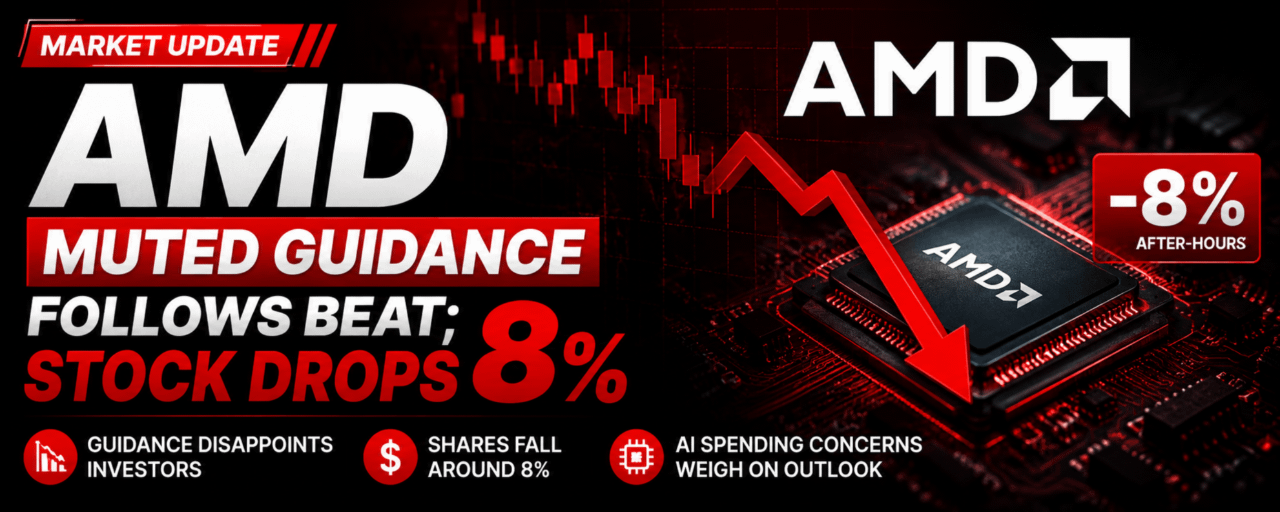
Advanced Micro Devices (NASDAQ: AMD) delivered stronger-than-expected quarterly earnings, but investors focused on the company's cautious forward guidance instead of the earnings beat. As a result, AMD shares fell around 8% in after-hours trading, highlighting growing concerns about slowing AI infrastructure spending and a more competitive semiconductor market.
The market reaction shows that in today's AI-driven environment, simply beating earnings estimates is no longer enough. Investors increasingly expect chipmakers to deliver strong future growth projections alongside solid financial results.
Earnings Beat Expectations
AMD reported quarterly revenue and earnings that exceeded Wall Street forecasts, supported by healthy demand across its data center, client PC, and AI accelerator businesses.
Key highlights included:
Revenue exceeded analyst estimates.
Earnings per share came in above expectations.
Data Center revenue remained a major growth driver.
AI-related products continued gaining customer adoption.
The company also pointed to continued demand for its EPYC server processors and Instinct AI accelerators, both of which remain central to AMD's long-term strategy.
Why Investors Sold the Stock
Despite the earnings beat, AMD issued more conservative guidance for upcoming quarters than many investors expected.
Several concerns weighed on market sentiment:
Slower projected revenue growth.
Signs that AI infrastructure spending may be moderating after rapid expansion.
Continued competitive pressure from larger AI chip manufacturers.
Investor expectations had become extremely high following the semiconductor sector's strong rally.
The cautious outlook overshadowed otherwise solid quarterly performance.
AI Spending Remains the Biggest Question
Over the past two years, AI-related capital expenditures have fueled massive growth across the semiconductor industry.
However, investors are becoming increasingly selective, questioning whether hyperscale cloud companies will maintain their current pace of AI investment.
Although AMD continues to benefit from enterprise AI adoption, management suggested growth could become more balanced rather than accelerating rapidly.
This shift in expectations triggered profit-taking among investors.
Long-Term Outlook Still Intact
Despite the short-term decline, AMD continues expanding its position in several high-growth markets:
AI accelerators
Cloud computing
Enterprise servers
High-performance computing
Next-generation PCs
Its expanding product lineup positions the company to compete for additional market share as AI workloads continue growing worldwide.
Market Impact
AMD's decline also pressured broader semiconductor stocks, reminding investors that future guidance now carries as much weight as quarterly earnings.
The AI investment cycle remains healthy, but markets appear increasingly focused on sustainability rather than explosive growth.
AMD's latest results demonstrate that the company continues executing well operationally. However, cautious forward guidance disappointed investors who had priced in stronger growth expectations.
While the 8% share decline reflects short-term concerns, AMD remains one of the semiconductor industry's leading innovators with significant long-term opportunities in AI, data centers, and advanced computing.
For investors, the coming quarters will likely depend less on beating earnings estimates and more on whether AMD can demonstrate accelerating AI revenue growth and restore confidence in its future outlook.