before Trustless Bitcoin Vaults (TBV), Babylon needed to answer a harder question.
n0t "can native Bitcoin be used in DeFi without wrapping"
that was the engineering problem. the harder question
was "do Bitcoin holders actually want this." because you can build the most technically elegant system in crypto and it means nothing if the people who hold Bitcoin decide they would rathr leave it in cold storage than interact with a new protocol they don't fully understand yet.
Babylon launched the Bitcoin Staking Protocol in 2025 to answer that question. the protocol let Bitcoin holders stake their native BTC to provide economic security to other networks again.
without wrapping.
without bridging. without giving up custody. the design premise was the same as TBV: native Bitcoin,
underyour keys, doing something productive.
the answer from Bitcoin holders was $7.2 billion in TVL at peak.
i've been in crypto long enough to know that TVL
numbers can be gamed. but $7.2 billion in native Bitcoin not wrappedtokens, not yield-bearing derivatives, actual BTC sitting in a staking protocol is not a number that appears through incentive..
manipulation alone. it requires real Bitcoin holders making a deliberate decision to participate. that is demand signal, not marketing.
what thats number proves for TBV is that the trust barrier is crossable.
Bitcoin holders who care deeply about self-custody and trustlessness were wiling to put real capital into a Babylon protocol when the design respected their values. TBV is the next application of the same design philosophy...
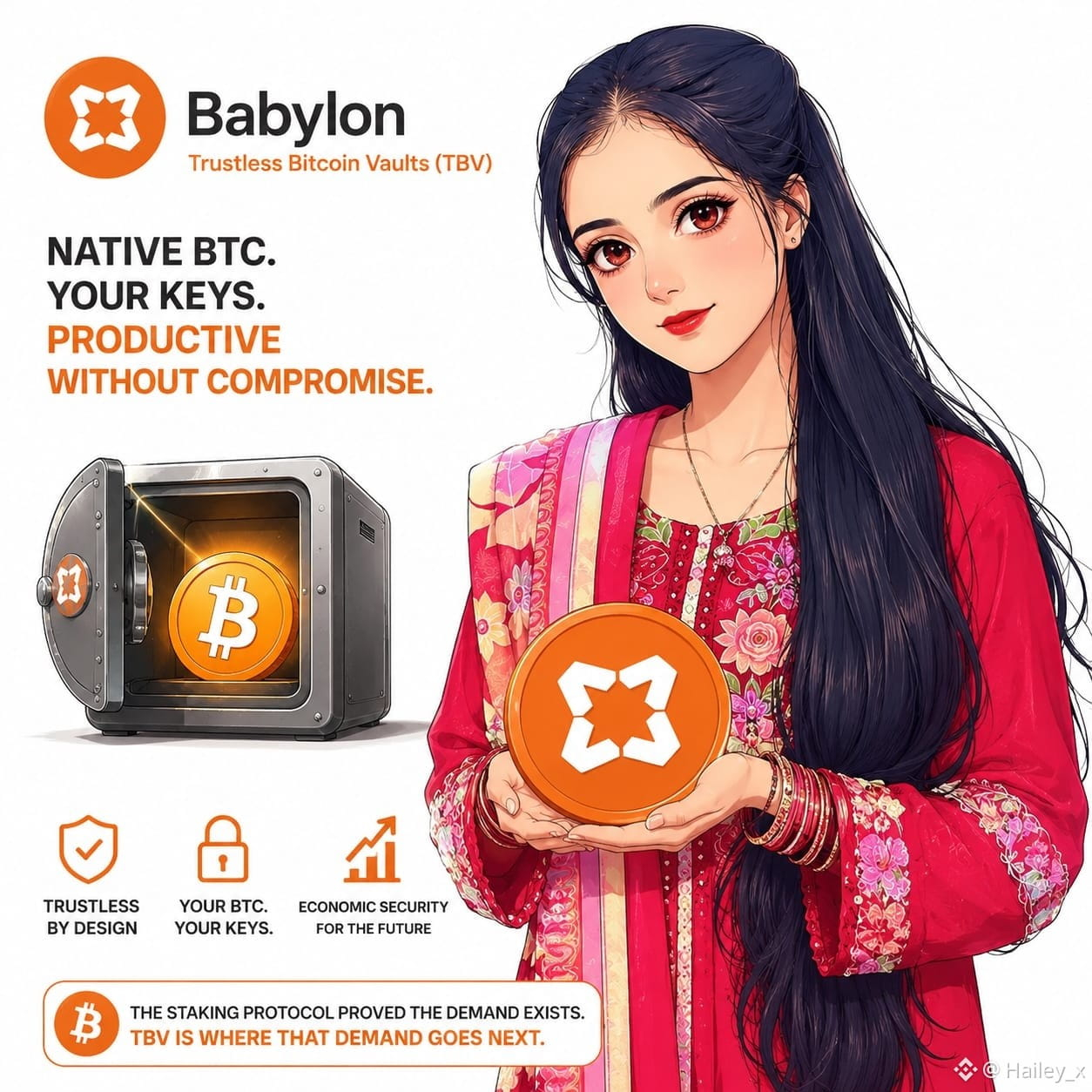
native BTC, your keys, productive without compromise.
the staking prot0col proved the demand exists. TBV is where that demand goes next??
#baby @BabylonLabs_io $BABY
n0t "can native Bitcoin be used in DeFi without wrapping"
that was the engineering problem. the harder question
was "do Bitcoin holders actually want this." because you can build the most technically elegant system in crypto and it means nothing if the people who hold Bitcoin decide they would rathr leave it in cold storage than interact with a new protocol they don't fully understand yet.
Babylon launched the Bitcoin Staking Protocol in 2025 to answer that question. the protocol let Bitcoin holders stake their native BTC to provide economic security to other networks again.
without wrapping.
without bridging. without giving up custody. the design premise was the same as TBV: native Bitcoin,
underyour keys, doing something productive.
the answer from Bitcoin holders was $7.2 billion in TVL at peak.
i've been in crypto long enough to know that TVL
numbers can be gamed. but $7.2 billion in native Bitcoin not wrappedtokens, not yield-bearing derivatives, actual BTC sitting in a staking protocol is not a number that appears through incentive..
manipulation alone. it requires real Bitcoin holders making a deliberate decision to participate. that is demand signal, not marketing.
what thats number proves for TBV is that the trust barrier is crossable.
Bitcoin holders who care deeply about self-custody and trustlessness were wiling to put real capital into a Babylon protocol when the design respected their values. TBV is the next application of the same design philosophy...
native BTC, your keys, productive without compromise.
the staking prot0col proved the demand exists. TBV is where that demand goes next??
#baby @BabylonLabs_io $BABY