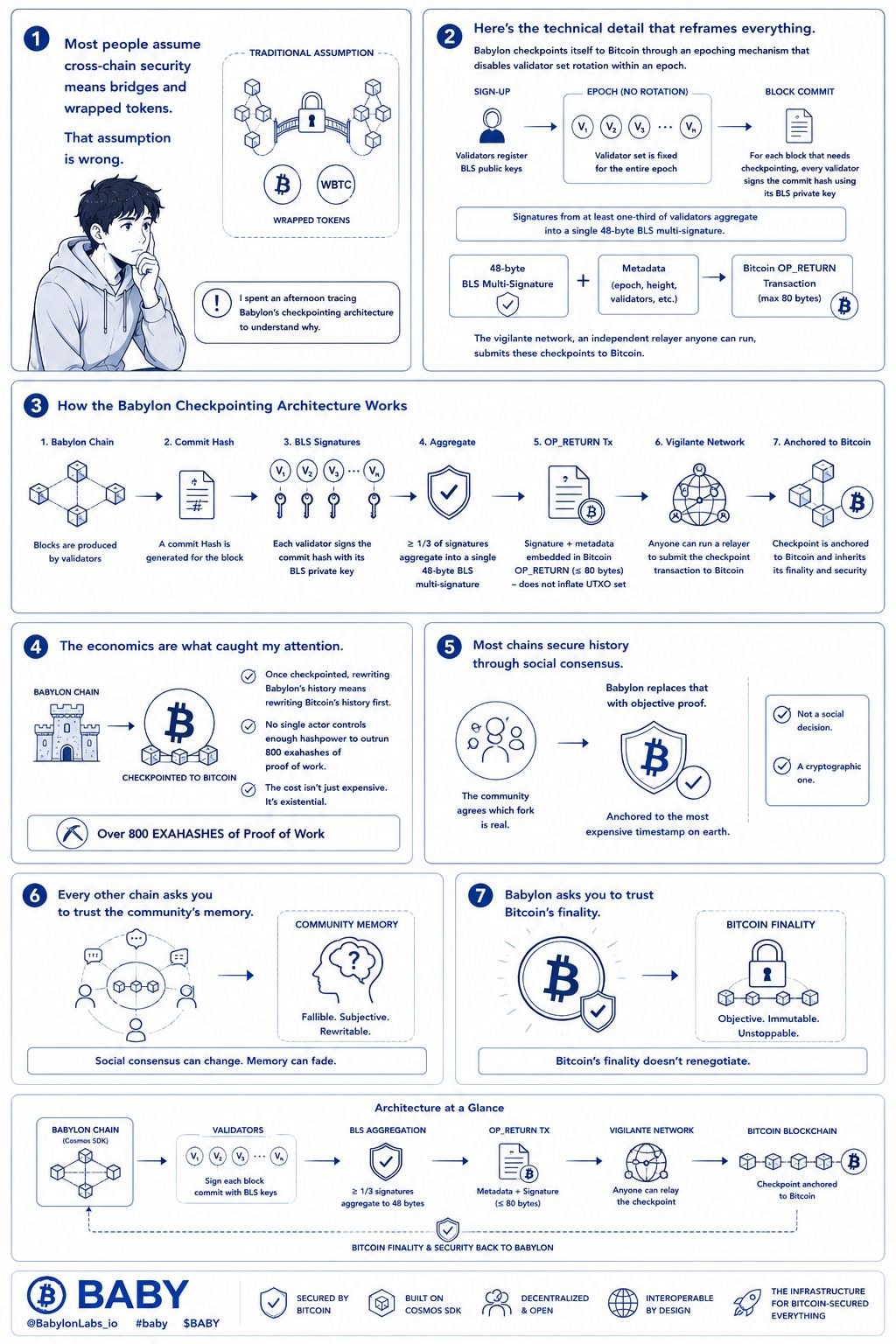
Most people assume cross-chain security means bridges and wrapped tokens. That assumption is wrong.
I spent an afternoon tracing Babylon's checkpointing architecture to understand why. Traditional checkpoints like block hashes are useless against long-range attacks — they don't support detection because malicious validators can generate private forks. Babylon's solution is more elegant than I expected.
Here's the technical detail that reframes everything. Babylon checkpoints itself to Bitcoin through an epoching mechanism that disables validator set rotation within an epoch. Validators register BLS public keys at sign-up, and for each block that needs checkpointing, every validator uses its BLS private key to sign the commit hash. Signatures from at least one-third of validators aggregate into a single 48-byte BLS multi-signature. That signature, plus metadata, fits inside Bitcoin's OP_RETURN transaction — a special output with a maximum size of 80 bytes that never inflates the UTXO set. The vigilante network, an independent relayer anyone can run, submits these checkpoints to Bitcoin.
The economics are what caught my attention. Once checkpointed, rewriting Babylon's history means rewriting Bitcoin's history first. No single actor controls enough hashpower to outrun 800 exahashes of proof of work. The cost isn't just expensive. It's existential.
Most chains secure history through social consensus — the community agreeing which fork is real. Babylon replaces that with objective proof anchored to the most expensive timestamp on earth. Not a social decision. A cryptographic one.
Every other chain asks you to trust the community's memory. Babylon asks you to trust Bitcoin's finality. And Bitcoin's finality doesn't renegotiate.
@BabylonLabs_io #baby $BABY $HEI $BTC
I spent an afternoon tracing Babylon's checkpointing architecture to understand why. Traditional checkpoints like block hashes are useless against long-range attacks — they don't support detection because malicious validators can generate private forks. Babylon's solution is more elegant than I expected.
Here's the technical detail that reframes everything. Babylon checkpoints itself to Bitcoin through an epoching mechanism that disables validator set rotation within an epoch. Validators register BLS public keys at sign-up, and for each block that needs checkpointing, every validator uses its BLS private key to sign the commit hash. Signatures from at least one-third of validators aggregate into a single 48-byte BLS multi-signature. That signature, plus metadata, fits inside Bitcoin's OP_RETURN transaction — a special output with a maximum size of 80 bytes that never inflates the UTXO set. The vigilante network, an independent relayer anyone can run, submits these checkpoints to Bitcoin.
The economics are what caught my attention. Once checkpointed, rewriting Babylon's history means rewriting Bitcoin's history first. No single actor controls enough hashpower to outrun 800 exahashes of proof of work. The cost isn't just expensive. It's existential.
Most chains secure history through social consensus — the community agreeing which fork is real. Babylon replaces that with objective proof anchored to the most expensive timestamp on earth. Not a social decision. A cryptographic one.
Every other chain asks you to trust the community's memory. Babylon asks you to trust Bitcoin's finality. And Bitcoin's finality doesn't renegotiate.
@BabylonLabs_io #baby $BABY $HEI $BTC