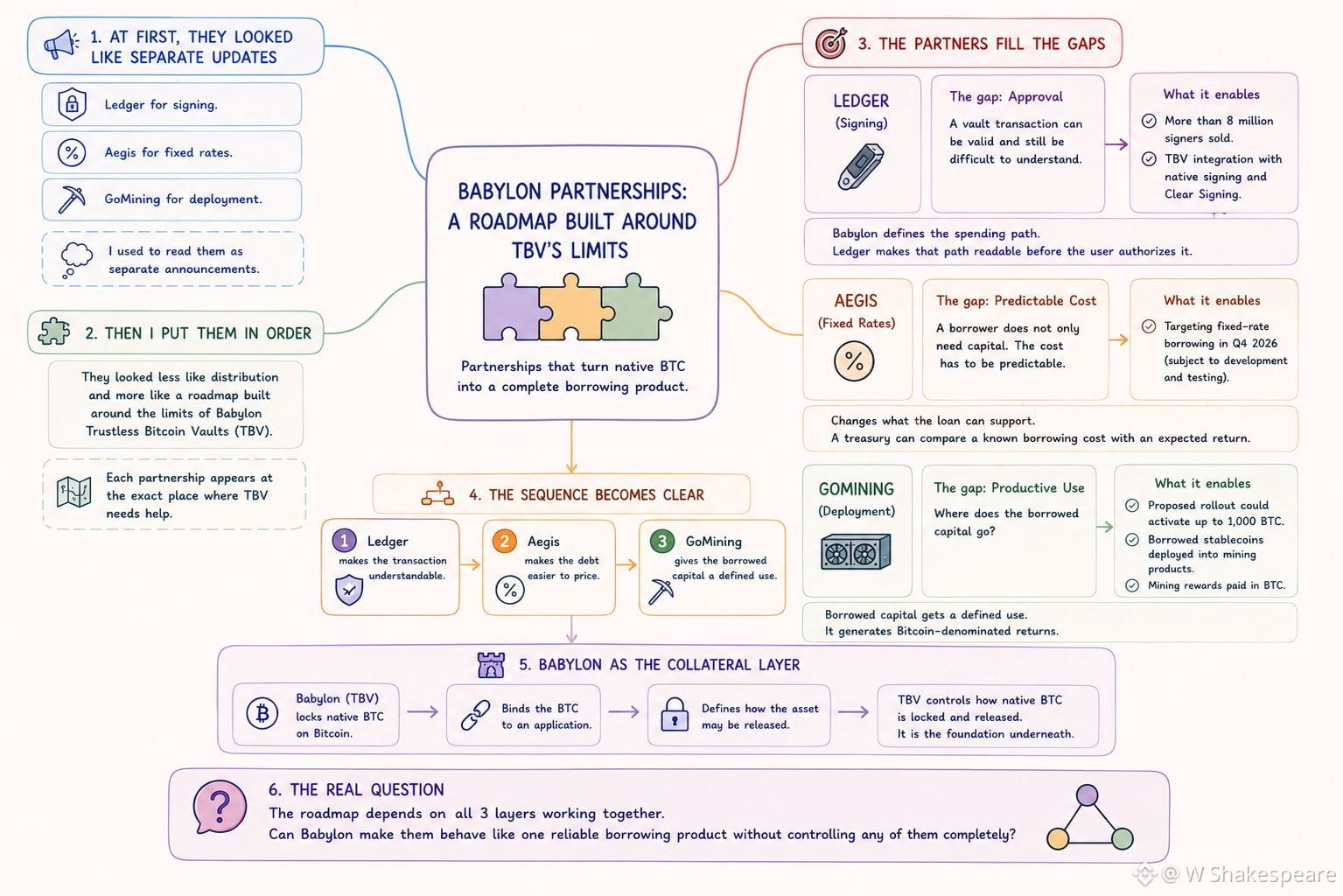
I used to read Babylon’s partnership announcements as separate updates. Ledger for signing. Aegis for fixed rates. GoMining for deployment.
Then I placed them in order.
They looked like a roadmap built around the limits of Babylon Trustless Bitcoin Vaults (TBV).
TBV solves the collateral problem first. Native BTC can remain on Bitcoin while being committed to a financial application. That creates a borrowing position. It does not make that position understandable, predictable or useful.
The first limit appears before approval.
A vault transaction can be valid while still being difficult to read. Ledger enters here. It has sold over 8 million signers, and its TBV integration adds native signing with Clear Signing.
Babylon can define the transaction correctly. Ledger reduces the gap between what the transaction does and what the user thinks they are approving.
The next limit appears after capital becomes available.
A borrower may access liquidity and still be unable to plan around it. Variable costs can change after the position is opened. Babylon can secure the collateral, but it cannot make the cost of the loan predictable.
Aegis addresses that gap with fixed-rate borrowing targeted for Q4 2026, subject to development and testing. Fixing the rate gives borrowers a known funding cost. A treasury can compare that cost with the return expected from using the capital.
GoMining addresses the limit that follows financing.
Babylon can unlock stablecoin liquidity against BTC. It cannot decide where that capital should go or whether it will justify the debt.
GoMining gives the capital a defined use. Its proposed rollout could activate up to 1,000 BTC. Borrowed stablecoins would be deployed into mining products, while rewards would be paid in BTC. It connects the loan to an operating strategy with a measurable return.
Taken together, the partnerships show how Babylon’s roadmap grows out of TBV’s limits.
Each limit reveals what must be built around TBV and which partner is needed to address it.
@BabylonLabs_io
$BANK $BABY #baby ✨
Then I placed them in order.
They looked like a roadmap built around the limits of Babylon Trustless Bitcoin Vaults (TBV).
TBV solves the collateral problem first. Native BTC can remain on Bitcoin while being committed to a financial application. That creates a borrowing position. It does not make that position understandable, predictable or useful.
The first limit appears before approval.
A vault transaction can be valid while still being difficult to read. Ledger enters here. It has sold over 8 million signers, and its TBV integration adds native signing with Clear Signing.
Babylon can define the transaction correctly. Ledger reduces the gap between what the transaction does and what the user thinks they are approving.
The next limit appears after capital becomes available.
A borrower may access liquidity and still be unable to plan around it. Variable costs can change after the position is opened. Babylon can secure the collateral, but it cannot make the cost of the loan predictable.
Aegis addresses that gap with fixed-rate borrowing targeted for Q4 2026, subject to development and testing. Fixing the rate gives borrowers a known funding cost. A treasury can compare that cost with the return expected from using the capital.
GoMining addresses the limit that follows financing.
Babylon can unlock stablecoin liquidity against BTC. It cannot decide where that capital should go or whether it will justify the debt.
GoMining gives the capital a defined use. Its proposed rollout could activate up to 1,000 BTC. Borrowed stablecoins would be deployed into mining products, while rewards would be paid in BTC. It connects the loan to an operating strategy with a measurable return.
Taken together, the partnerships show how Babylon’s roadmap grows out of TBV’s limits.
Each limit reveals what must be built around TBV and which partner is needed to address it.
@BabylonLabs_io
$BANK $BABY #baby ✨