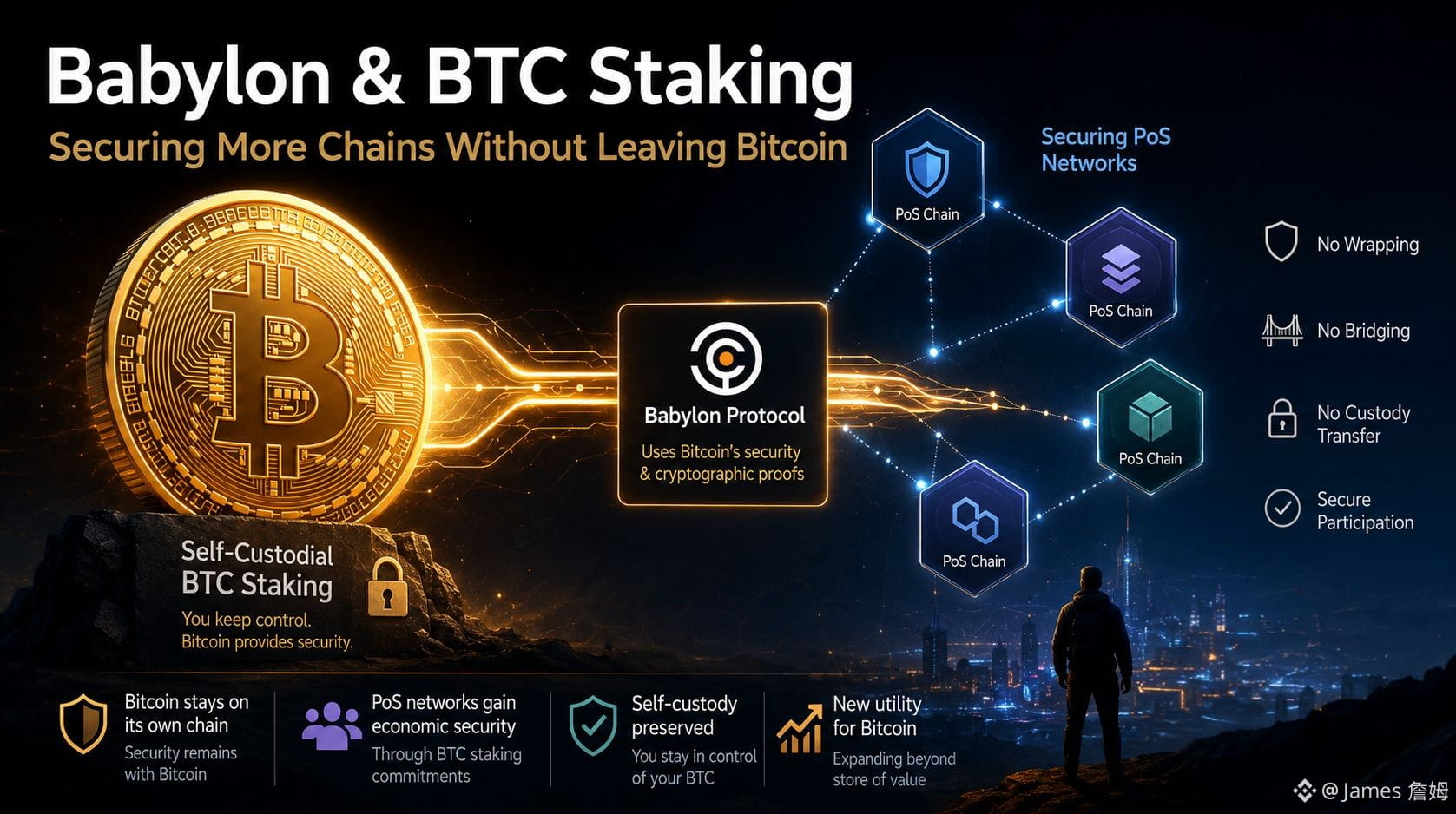

I keep noticing that some of the most interesting ideas in blockchain are not about replacing Bitcoin, but finding new ways for it to participate in a broader ecosystem. Babylon made me pause because it asks a simple question: can Bitcoin help secure other networks without ever leaving its own chain?
The protocol introduces self-custodial BTC staking, allowing Bitcoin holders to lock coins while keeping control of their assets instead of wrapping or bridging them elsewhere. Rather than moving BTC onto a PoS chain, Babylon uses Bitcoin's own security and cryptographic proofs to let participating PoS networks recognize staking commitments. That architectural choice reduces reliance on cross-chain custody, but it also shifts attention toward how reliably those proofs are interpreted and enforced.
What interests me most is the trade-off. Babylon avoids one familiar risk while introducing another layer of coordination between independent networks. The model depends on PoS chains adopting the system, validators behaving honestly, and the protocol continuing to operate as intended under real economic pressure.
It feels less like turning Bitcoin into a different asset and more like giving it another role. Whether that role becomes a lasting piece of blockchain infrastructure probably depends less on the idea itself and more on how it performs when theory meets reality.
@BabylonLabs_io #baby $BABY
The protocol introduces self-custodial BTC staking, allowing Bitcoin holders to lock coins while keeping control of their assets instead of wrapping or bridging them elsewhere. Rather than moving BTC onto a PoS chain, Babylon uses Bitcoin's own security and cryptographic proofs to let participating PoS networks recognize staking commitments. That architectural choice reduces reliance on cross-chain custody, but it also shifts attention toward how reliably those proofs are interpreted and enforced.
What interests me most is the trade-off. Babylon avoids one familiar risk while introducing another layer of coordination between independent networks. The model depends on PoS chains adopting the system, validators behaving honestly, and the protocol continuing to operate as intended under real economic pressure.
It feels less like turning Bitcoin into a different asset and more like giving it another role. Whether that role becomes a lasting piece of blockchain infrastructure probably depends less on the idea itself and more on how it performs when theory meets reality.
@BabylonLabs_io #baby $BABY