
Yè xian 夜仙
2.6k Публикации

Yè xian 夜仙
405 подписок(и/а)
16.7K+ подписчиков(а)
14.7K+ понравилось
Посты
Все
Цитирования
Активно
GOOD MORNING 🌄
A new day means new opportunities, new lessons, and another reason to keep going. ✨
#movr $MOVR
A new day means new opportunities, new lessons, and another reason to keep going. ✨
#movr $MOVR

#dusk $DUSK @Dusk
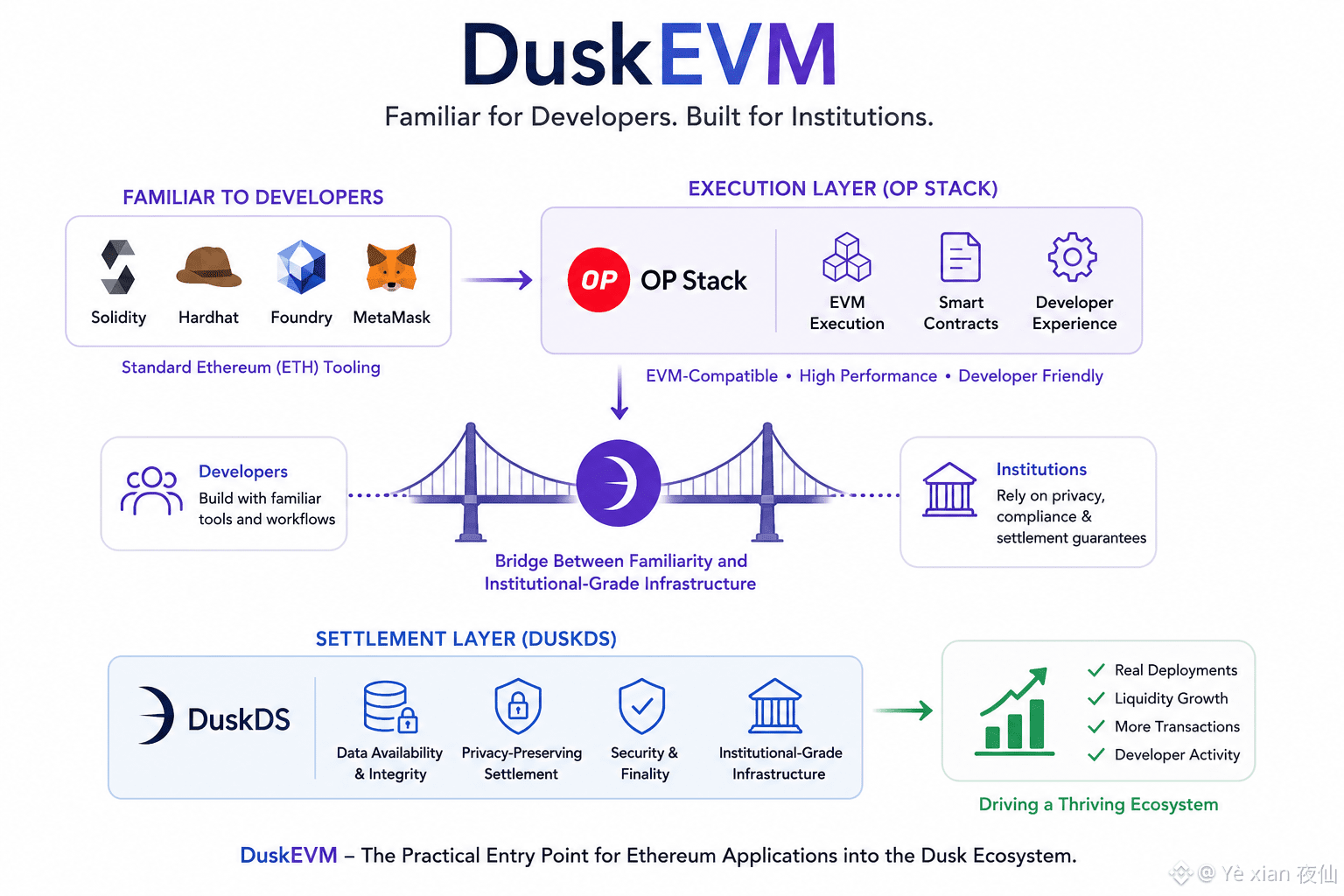
I first started looking at DuskEVM from the developer side and the story quickly became more interesting.
Instead of asking Solidity developers actually learn an entirely new environment, Dusk brings familiar Ethereum (ETH) tooling through an OP Stack-based execution layer. Which means applications can use standard Solidity workflows while connecting to the the Dusk’s broader ecosystem.
The most important part, though, is what happens underneath. Execution can remain EVM-friendly while state commitments settle into DuskDS giving applications access to the core network’s data availability and settlement guarantees. To me it looks like creates a compelling bridge between developer familiarity and institutional-grade infrastructure.
If Dusk can turn this architecture into real deployments, liquidity, transactions and sustained developer activity, DuskEVM could become a practical entry point for bringing the Ethereum applications into the Dusk ecosystem.
@Dusk $DUSK
I first started looking at DuskEVM from the developer side and the story quickly became more interesting.
Instead of asking Solidity developers actually learn an entirely new environment, Dusk brings familiar Ethereum (ETH) tooling through an OP Stack-based execution layer. Which means applications can use standard Solidity workflows while connecting to the the Dusk’s broader ecosystem.
The most important part, though, is what happens underneath. Execution can remain EVM-friendly while state commitments settle into DuskDS giving applications access to the core network’s data availability and settlement guarantees. To me it looks like creates a compelling bridge between developer familiarity and institutional-grade infrastructure.
If Dusk can turn this architecture into real deployments, liquidity, transactions and sustained developer activity, DuskEVM could become a practical entry point for bringing the Ethereum applications into the Dusk ecosystem.
@Dusk $DUSK
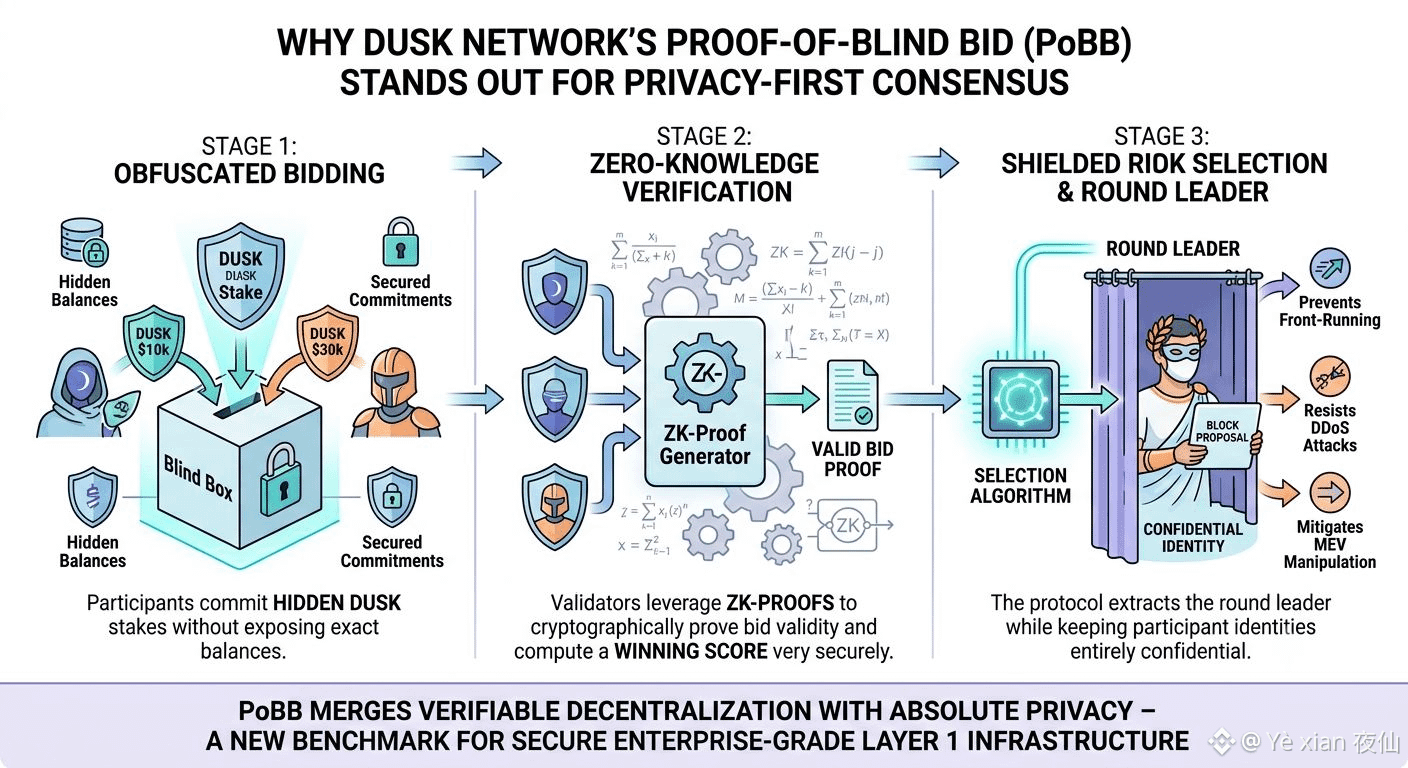
#dusk I have been closely analyzing how blockchain consensus handles block selection and traditional Proof-of-Stake models still have a major blind spot: transparent leader extraction leaves validators vulnerable to front-running, targeted DDoS attacks and aggressive MEV manipulation.
That is why Dusk Network’s Proof-of-Blind Bid (PoBB) mechanism is such a game-changer for privacy preserving consensus.
The question is " Why PoBB Stands Out "
Obfuscated Bidding: Participants commit hidden DUSK stakes to compete for consensus rounds without exposing their exact balances to the public.
Zero-Knowledge Verification: Validators leverage ZK-proofs to cryptographically prove bid validity and compute a winning score very securely.
Shielded Selection: The protocol extracts the round leader while keeping participant identities entirely confidential.
By merging verifiable decentralization with absolute privacy PoBB sets a new benchmark for secure enterprise-grade Layer 1 infrastructure..
So guys if you think privacy-first consensus will impact the future of institutional adoption? Come let’s discuss & write down your opinion below 👇
@Dusk $DUSK
That is why Dusk Network’s Proof-of-Blind Bid (PoBB) mechanism is such a game-changer for privacy preserving consensus.
The question is " Why PoBB Stands Out "
Obfuscated Bidding: Participants commit hidden DUSK stakes to compete for consensus rounds without exposing their exact balances to the public.
Zero-Knowledge Verification: Validators leverage ZK-proofs to cryptographically prove bid validity and compute a winning score very securely.
Shielded Selection: The protocol extracts the round leader while keeping participant identities entirely confidential.
By merging verifiable decentralization with absolute privacy PoBB sets a new benchmark for secure enterprise-grade Layer 1 infrastructure..
So guys if you think privacy-first consensus will impact the future of institutional adoption? Come let’s discuss & write down your opinion below 👇
@Dusk $DUSK
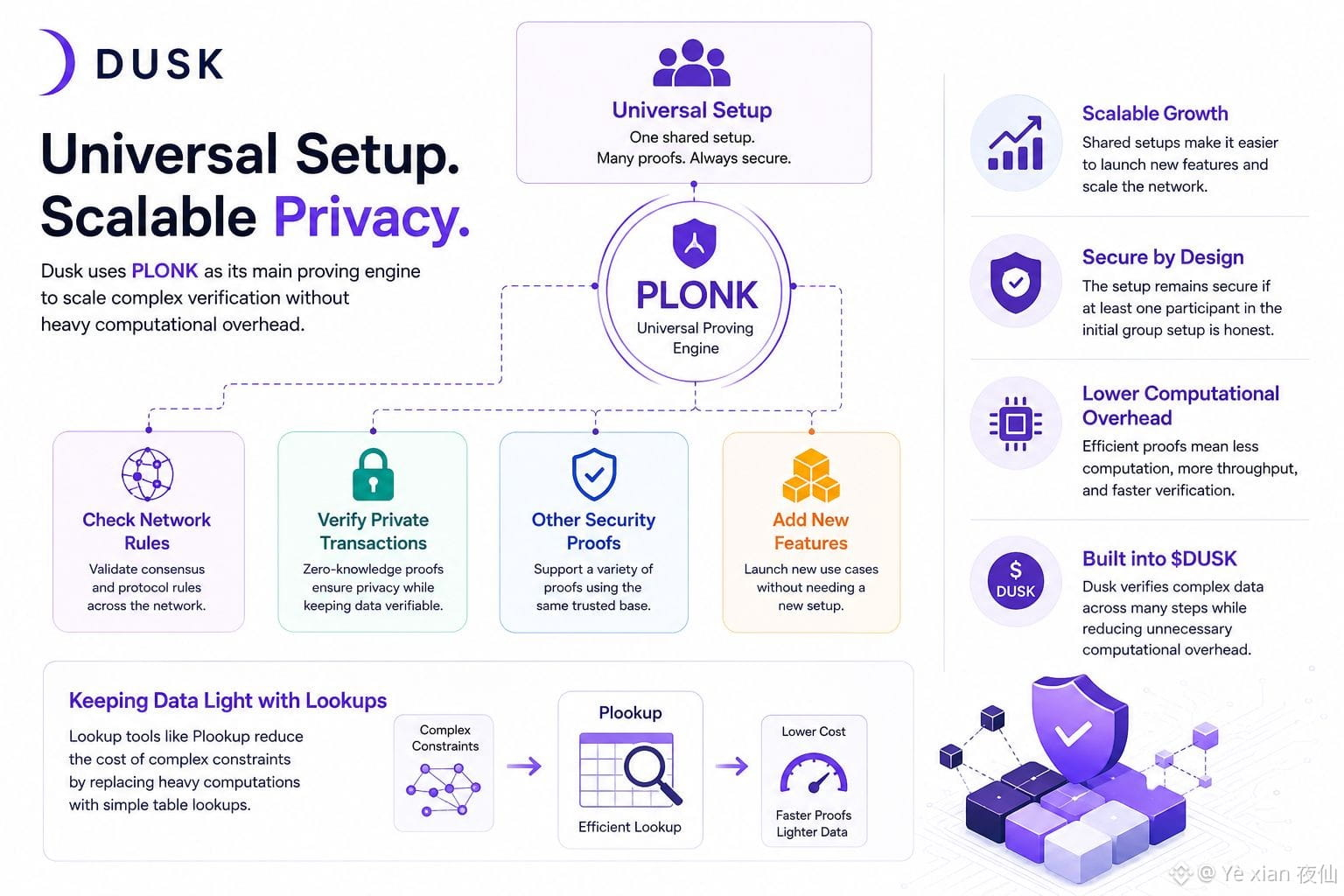
#dusk I keep thinking about how networks manage to grow and check complex data without drowning in heavy computational requirements.
What caught my attention is how Dusk addresses this challenge by using PLONK as its main proving engine....
Instead of forcing a custom setup for every separate feature, PLONK uses one shared setup. this lets the network handle different security proofs— from checking network rules to verifying private transactions— using the same base.
The main benefit is scalability. Shared setups make it easier to launch new features. The setup remains secure if at least one participant in the initial group setup is honest.
By building this in to $DUSK the network checks data across many steps while reducing unnecessary computational overhead.
To keep data light while staying flexible, modern systems use lookup tools such as Plookup to reduce the cost of complex constraints.
Are you watching how universal setups are changing blockchain privacy?
$DUSK @Dusk
What caught my attention is how Dusk addresses this challenge by using PLONK as its main proving engine....
Instead of forcing a custom setup for every separate feature, PLONK uses one shared setup. this lets the network handle different security proofs— from checking network rules to verifying private transactions— using the same base.
The main benefit is scalability. Shared setups make it easier to launch new features. The setup remains secure if at least one participant in the initial group setup is honest.
By building this in to $DUSK the network checks data across many steps while reducing unnecessary computational overhead.
To keep data light while staying flexible, modern systems use lookup tools such as Plookup to reduce the cost of complex constraints.
Are you watching how universal setups are changing blockchain privacy?
$DUSK @Dusk
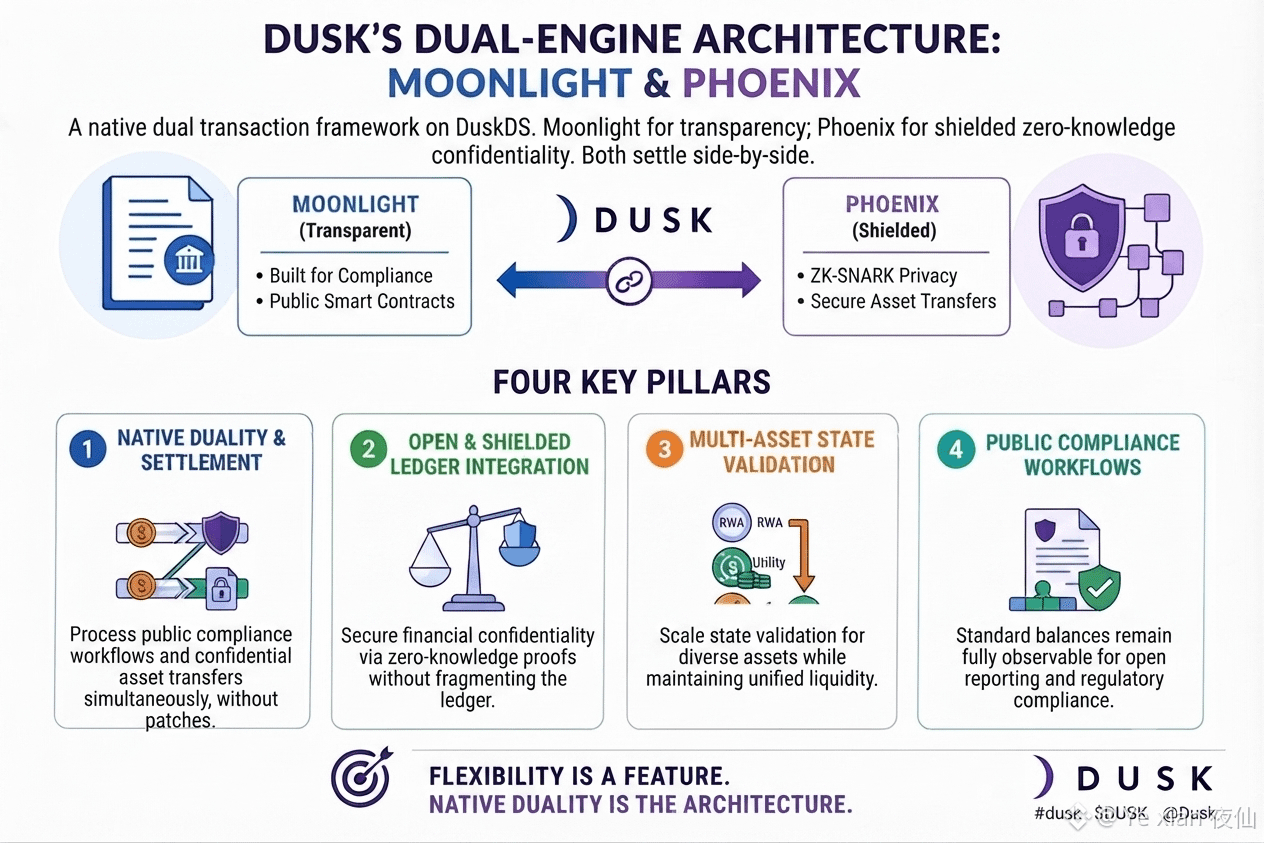
#dusk $DUSK @Dusk
I keep looking at how networks force a rigid choice between total transparency and complete opacity
What caught my attention is how @Dusk bypasses this design bottleneck at the settlement layer. Instead of imposing a single execution rule the protocol integrates a native dual transaction framework on DuskDS.
Moonlight operates as a transparent account-based system where standard balances remain fully observable for open reporting. and Phoenix uses a shielded UTXO model with zero-knowledge proofs to keep transactions private while staying on the same underlying ledger
The architectural advantage here is profound. Rather than treating privacy as an external patch both paradigms settle directly side-by-side. This native duality allows applications to coordinate public compliance workflows and confidential asset transfers simultaneously, all secured natively by $DUSK
The question is how can multi-asset settlement layers scale state validation without creating liquidity silos?
@Dusk #dusk $DUSK
I keep looking at how networks force a rigid choice between total transparency and complete opacity
What caught my attention is how @Dusk bypasses this design bottleneck at the settlement layer. Instead of imposing a single execution rule the protocol integrates a native dual transaction framework on DuskDS.
Moonlight operates as a transparent account-based system where standard balances remain fully observable for open reporting. and Phoenix uses a shielded UTXO model with zero-knowledge proofs to keep transactions private while staying on the same underlying ledger
The architectural advantage here is profound. Rather than treating privacy as an external patch both paradigms settle directly side-by-side. This native duality allows applications to coordinate public compliance workflows and confidential asset transfers simultaneously, all secured natively by $DUSK
The question is how can multi-asset settlement layers scale state validation without creating liquidity silos?
@Dusk #dusk $DUSK
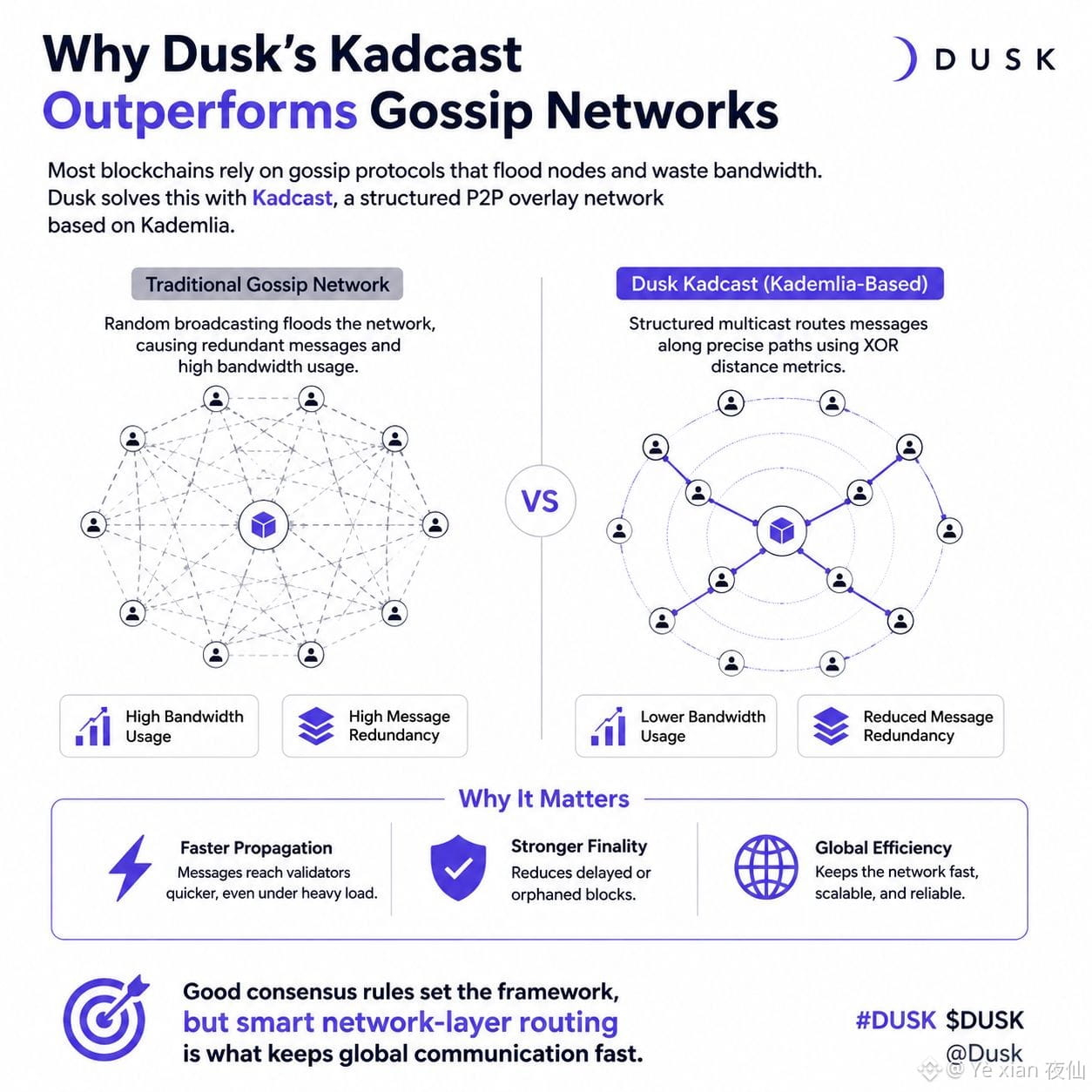
#dusk I keep looking at how blockchains talk to each other, and most networks rely on messy gossip protocols that flood nodes and waste valuable bandwidth.
@Dusk solves this cleanly with Kadcast, a structured peer-to-peer overlay network based on Kademlia. instead of random broadcasting, Kadcast routes blocks, votes and transactions along precise multicast paths using XOR distance metrics...
The structural advantage is measurable: research shows Kadcast achieves lower bandwidth usage and reduces message redundancy compared to standard gossip designs... For fast settlement layer, fast message propagation directly protects finality stability and cuts down delayed or orphaned blocks.
Good consensus rules set the framework, but smart network-layer routing is what actually keeps global communication fast under heavy loads.
How much do you value efficient network layers when evaluating L1 performance???
$DUSK @Dusk
@Dusk solves this cleanly with Kadcast, a structured peer-to-peer overlay network based on Kademlia. instead of random broadcasting, Kadcast routes blocks, votes and transactions along precise multicast paths using XOR distance metrics...
The structural advantage is measurable: research shows Kadcast achieves lower bandwidth usage and reduces message redundancy compared to standard gossip designs... For fast settlement layer, fast message propagation directly protects finality stability and cuts down delayed or orphaned blocks.
Good consensus rules set the framework, but smart network-layer routing is what actually keeps global communication fast under heavy loads.
How much do you value efficient network layers when evaluating L1 performance???
$DUSK @Dusk
Проверено
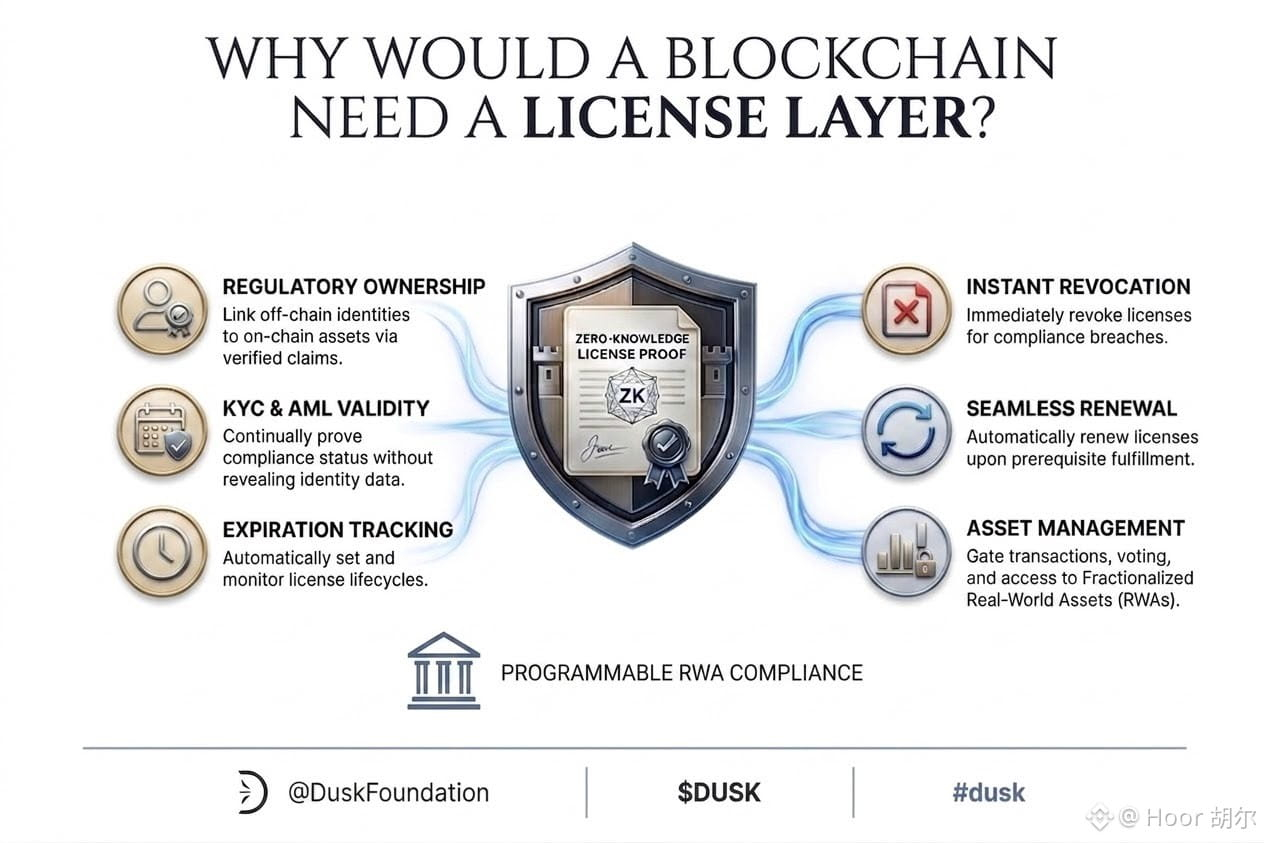
#dusk One detail in Dusk’s Citadel protocol makes this more interesting. Instead of standard blockchains where access relies solely on holding a private key, Citadel introduces zero-knowledge license contracts. In a traditional setup, anyone with funds can execute a smart contract. In Dusk, regulated financial dApps can require a cryptographic license—proving valid KYC or jurisdiction—without exposing the user’s underlying personal data...
I think the useful idea here is programmable access control. $DUSK did not build a financial free-for-all, because regulated institutions legally cannot interact with fully anonymous infrastructure...
There is even a practical trade-off: requiring verifiable licenses adds a layer of onboarding friction, but it natively filters out non-compliant capital at the protocol level. That helps build a legally viable environment for Real-world assets (RWAs)...
So the better question isnt “is the network fully open?” It is how do we enforce compliance without sacrificing privacy??? @Dusk $DUSK
I think the useful idea here is programmable access control. $DUSK did not build a financial free-for-all, because regulated institutions legally cannot interact with fully anonymous infrastructure...
There is even a practical trade-off: requiring verifiable licenses adds a layer of onboarding friction, but it natively filters out non-compliant capital at the protocol level. That helps build a legally viable environment for Real-world assets (RWAs)...
So the better question isnt “is the network fully open?” It is how do we enforce compliance without sacrificing privacy??? @Dusk $DUSK
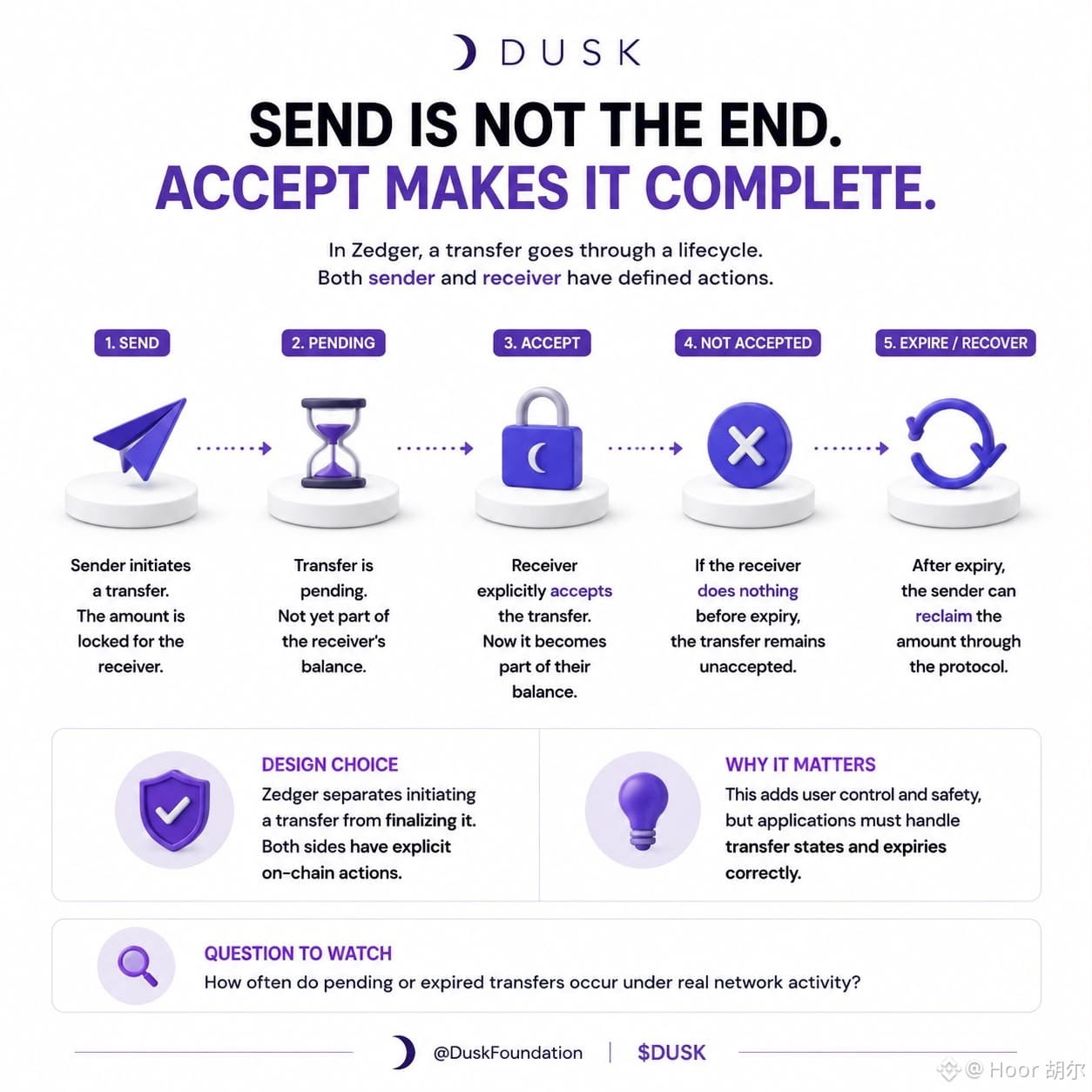
#dusk $DUSK @Dusk A Zedger transfer is not finished when you press “send” — the receiver still has a role to complete.
In Dusk’s Zedger design, a SEND operation does not immediately finalize the asset transfer for the receiver. The receiver must explicitly ACCEPT the transfer before it becomes part of their usable balance.
This creates an interesting design choice: ownership movement is not a single action, but a controlled lifecycle.
SEND creates the pending transfer. ACCEPT completes the receiver’s side. if acceptance never happens, the protocol has a defined expiry path instead of leaving the transfer state unresolved.
The important implication is that Zedger separates “initiating a transfer” from “finalizing a transfer.” This adds control, but it also means users and applications must handle transfer states carefully.
The mechanism is clear.
What interests me next is how often these pending states appear during real network activity?
@Dusk $DUSK
In Dusk’s Zedger design, a SEND operation does not immediately finalize the asset transfer for the receiver. The receiver must explicitly ACCEPT the transfer before it becomes part of their usable balance.
This creates an interesting design choice: ownership movement is not a single action, but a controlled lifecycle.
SEND creates the pending transfer. ACCEPT completes the receiver’s side. if acceptance never happens, the protocol has a defined expiry path instead of leaving the transfer state unresolved.
The important implication is that Zedger separates “initiating a transfer” from “finalizing a transfer.” This adds control, but it also means users and applications must handle transfer states carefully.
The mechanism is clear.
What interests me next is how often these pending states appear during real network activity?
@Dusk $DUSK
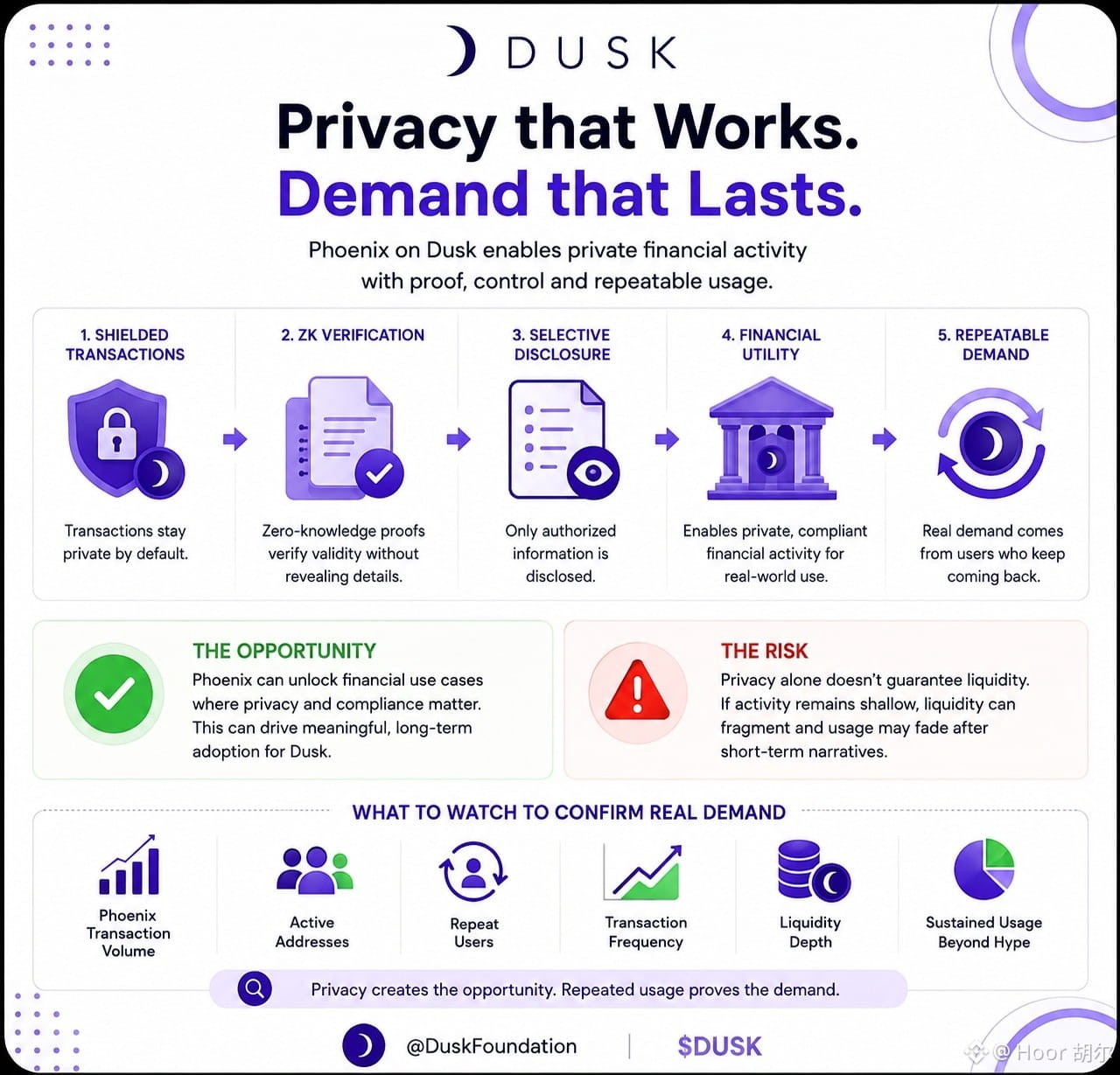
#dusk I keep coming back to one question about transaction privacy: can it create lasting demand, or does it mainly attract attention during strong narratives?
Phoenix gives Dusk shielded transactions with ZK verification and selective disclosure. In simple terms, users can keep sensitive financial activity private while still allowing the network to verify that transactions are valid. That could be important for financial applications, but privacy alone does not guarantee deep liquidity or regular usage.
The part I would watch is whether people actually keep coming back.
Phoenix transaction volume, active addresses, repeat users, transaction frequency, and liquidity depth would tell me whether usage is becoming consistent rather than following short-term privacy narratives.
Privacy can create the opportunity. Repeated usage is what would prove the demand.
@Dusk $DUSK @Dusk
Phoenix gives Dusk shielded transactions with ZK verification and selective disclosure. In simple terms, users can keep sensitive financial activity private while still allowing the network to verify that transactions are valid. That could be important for financial applications, but privacy alone does not guarantee deep liquidity or regular usage.
The part I would watch is whether people actually keep coming back.
Phoenix transaction volume, active addresses, repeat users, transaction frequency, and liquidity depth would tell me whether usage is becoming consistent rather than following short-term privacy narratives.
Privacy can create the opportunity. Repeated usage is what would prove the demand.
@Dusk $DUSK @Dusk
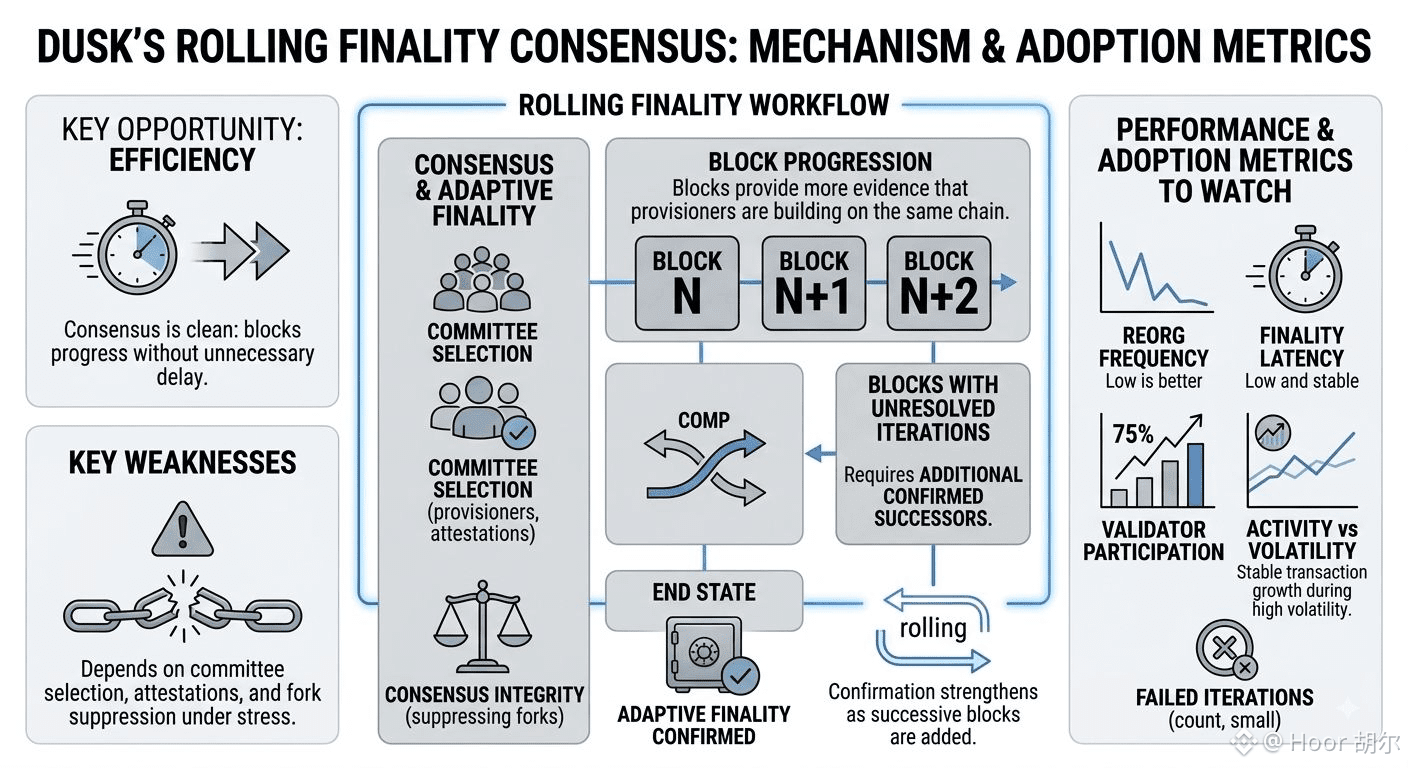
#dusk $DUSK @Dusk I have noticed that markets often price blockchain infrastructure before users actually prove its value, so I pay close attention to how consensus translates into real network behavior.
Dusk’s rolling finality is interesting because confirmation strengthens as successive blocks provide more evidence that provisioners are building on the same chain. Unresolved iterations require additional confirmed successors, making finality adaptive rather than fixed....
The opportunity is efficiency: clean consensus can reduce unnecessary delays. The weakness is that the model still depends on committee selection, attestations and the network’s ability to suppress competing forks under stress.
I would watch reorg frequency, finality latency, failed iterations, validator participation, transaction growth and whether network activity remains stable during periods of high volatility before becoming more confident.
What matters more in proving Dusk’s consensus design: low finality latency under normal conditions or how reliably it holds up when network activity and volatility spike?
#dusk @Dusk $DUSK @Dusk
Dusk’s rolling finality is interesting because confirmation strengthens as successive blocks provide more evidence that provisioners are building on the same chain. Unresolved iterations require additional confirmed successors, making finality adaptive rather than fixed....
The opportunity is efficiency: clean consensus can reduce unnecessary delays. The weakness is that the model still depends on committee selection, attestations and the network’s ability to suppress competing forks under stress.
I would watch reorg frequency, finality latency, failed iterations, validator participation, transaction growth and whether network activity remains stable during periods of high volatility before becoming more confident.
What matters more in proving Dusk’s consensus design: low finality latency under normal conditions or how reliably it holds up when network activity and volatility spike?
#dusk @Dusk $DUSK @Dusk
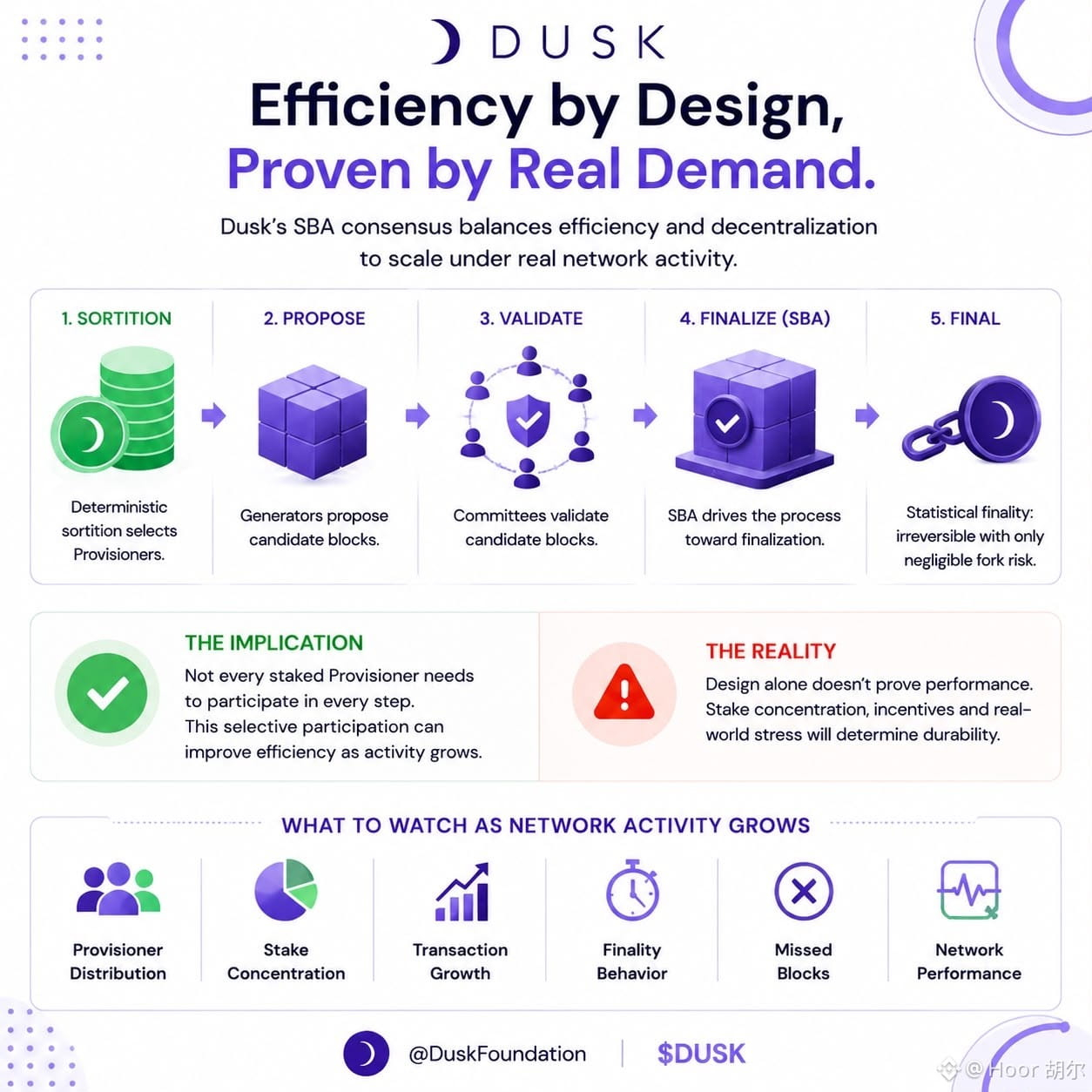
#dusk I keep coming back to one question about Dusk's consensus: efficiency looks good on paper, but what happens when network activity actually starts pushing the system?
Dusk’s Segregated Byzantine Agreement (SBA) separates consensus responsibilities. Generators propose candidate blocks, while Provisioners are selected into committees through deterministic sortition to validate and finalize them. The protocol targets statistical finality, meaning a finalized block is designed to become irreversible with only a negligible probability of a fork.
The interesting implication is that Dusk does not require every staked Provisioner to participate in every committee step. That could matter as activity grows, although the design alone cannot prove how efficiently the network will perform under sustained real-world demand.
That is the part I would watch rather than assume.
Provisioner distribution, stake concentration, finality behavior, missed blocks, and performance during heavy activity would tell us far more about the durability of DUSK’s consensus than theoretical efficiency alone.
Good architecture sets the conditions. Real network pressure provides the evidence.
@Dusk $DUSK
Dusk’s Segregated Byzantine Agreement (SBA) separates consensus responsibilities. Generators propose candidate blocks, while Provisioners are selected into committees through deterministic sortition to validate and finalize them. The protocol targets statistical finality, meaning a finalized block is designed to become irreversible with only a negligible probability of a fork.
The interesting implication is that Dusk does not require every staked Provisioner to participate in every committee step. That could matter as activity grows, although the design alone cannot prove how efficiently the network will perform under sustained real-world demand.
That is the part I would watch rather than assume.
Provisioner distribution, stake concentration, finality behavior, missed blocks, and performance during heavy activity would tell us far more about the durability of DUSK’s consensus than theoretical efficiency alone.
Good architecture sets the conditions. Real network pressure provides the evidence.
@Dusk $DUSK
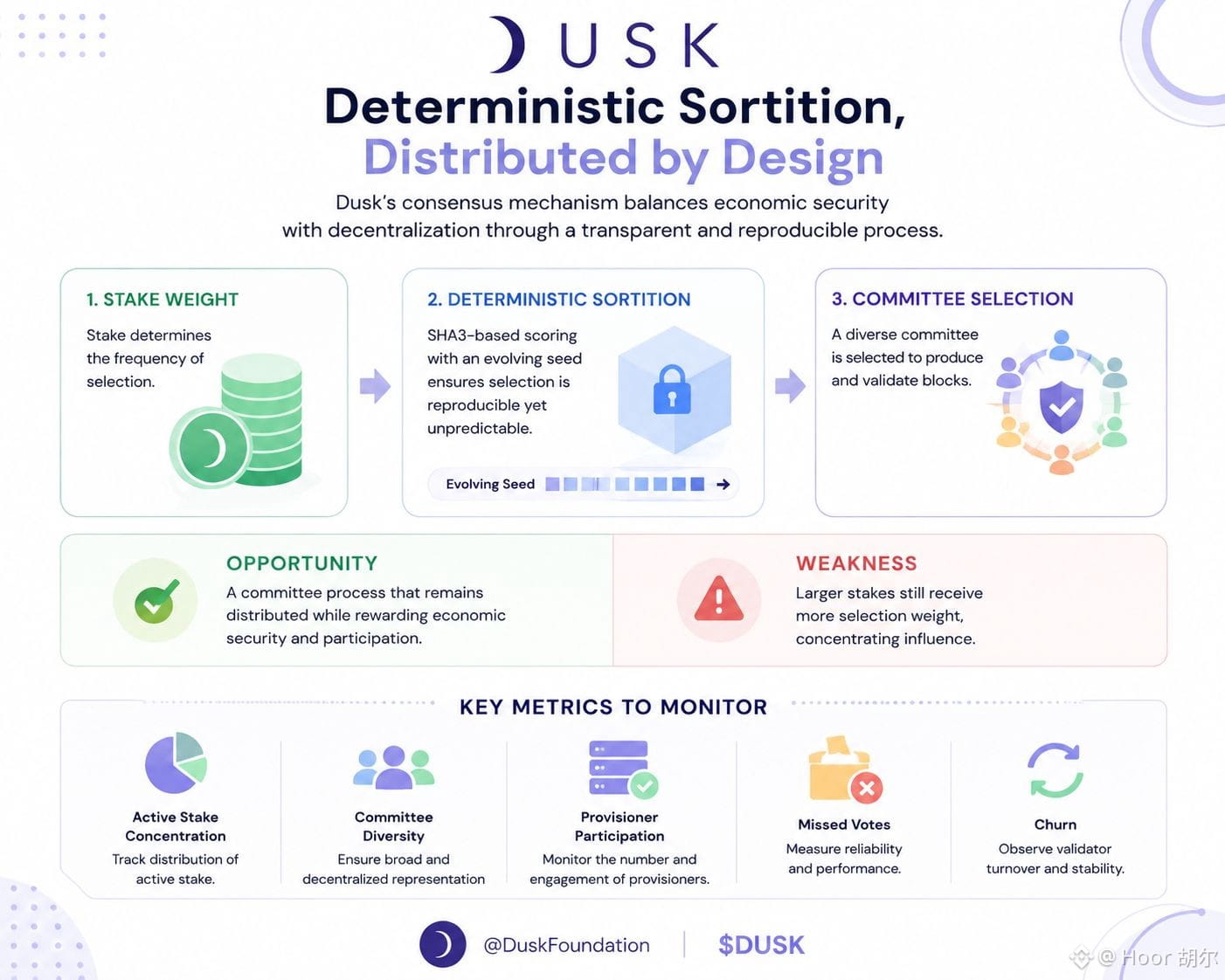
#dusk One thing I keep watching with Dusk is how stake concentration translates in to actual consensus influence.
I have been looking at its Deterministic Sortition as a market-structure mechanism, not just a technical feature. Stake affects selection frequency while SHA3-based scoring and the evolving seed make committee selection reproducible without making future assignments obvious.
I have been looking at whether this balance holds as participation changes. The opportunity is a committee process that remains distributed while rewarding economic security. the weakness is straightforward: larger stakes still receive more selection weight.
I'd monitor active stake concentration, committee diversity, provisioner participation, missed votes and churn before becoming more confident in the thesis.
@Dusk $DUSK
I have been looking at its Deterministic Sortition as a market-structure mechanism, not just a technical feature. Stake affects selection frequency while SHA3-based scoring and the evolving seed make committee selection reproducible without making future assignments obvious.
I have been looking at whether this balance holds as participation changes. The opportunity is a committee process that remains distributed while rewarding economic security. the weakness is straightforward: larger stakes still receive more selection weight.
I'd monitor active stake concentration, committee diversity, provisioner participation, missed votes and churn before becoming more confident in the thesis.
@Dusk $DUSK
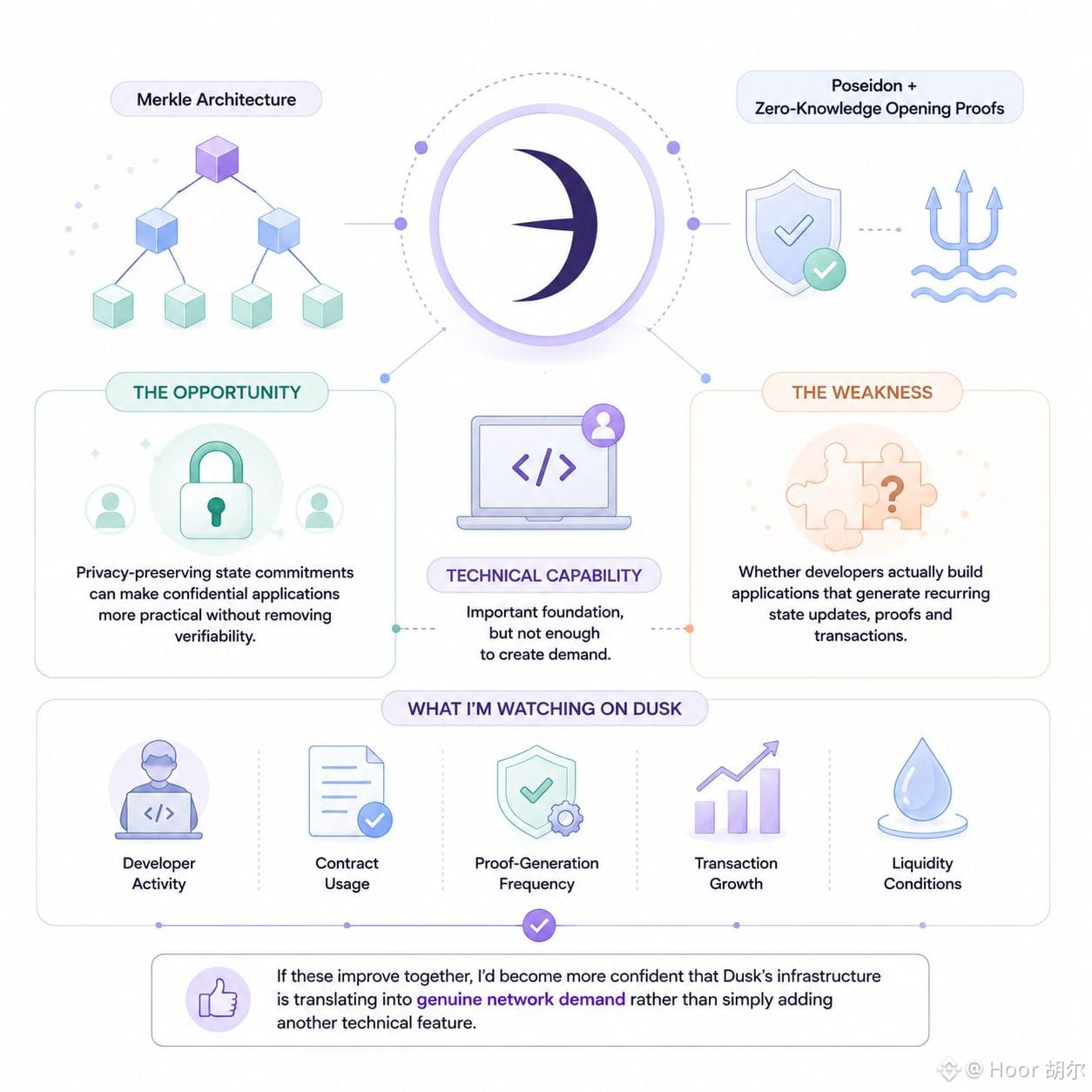
#dusk I have been looking at $DUSK from that angle especially its Merkle architecture and the use of Poseidon with zero-knowledge opening proofs.
The opportunity is interesting: privacy-preserving state commitments could make confidentiall applications more practical without removing verifiabillity.
But technical capabillity alone does not create demand. The the weakness is whether developers actually build applications that generate recurring state updates, proofs and transactions.
I have been looking at @Dusk ’s developer activity, contract usage, proof-generation frequency, transaction growth and liquidity conditions. If those improve together I’d become more confident that the infrastructure is translating in to genuine network demand rather than simply adding an other technical feature.
#dusk $DUSK @Dusk
The opportunity is interesting: privacy-preserving state commitments could make confidentiall applications more practical without removing verifiabillity.
But technical capabillity alone does not create demand. The the weakness is whether developers actually build applications that generate recurring state updates, proofs and transactions.
I have been looking at @Dusk ’s developer activity, contract usage, proof-generation frequency, transaction growth and liquidity conditions. If those improve together I’d become more confident that the infrastructure is translating in to genuine network demand rather than simply adding an other technical feature.
#dusk $DUSK @Dusk
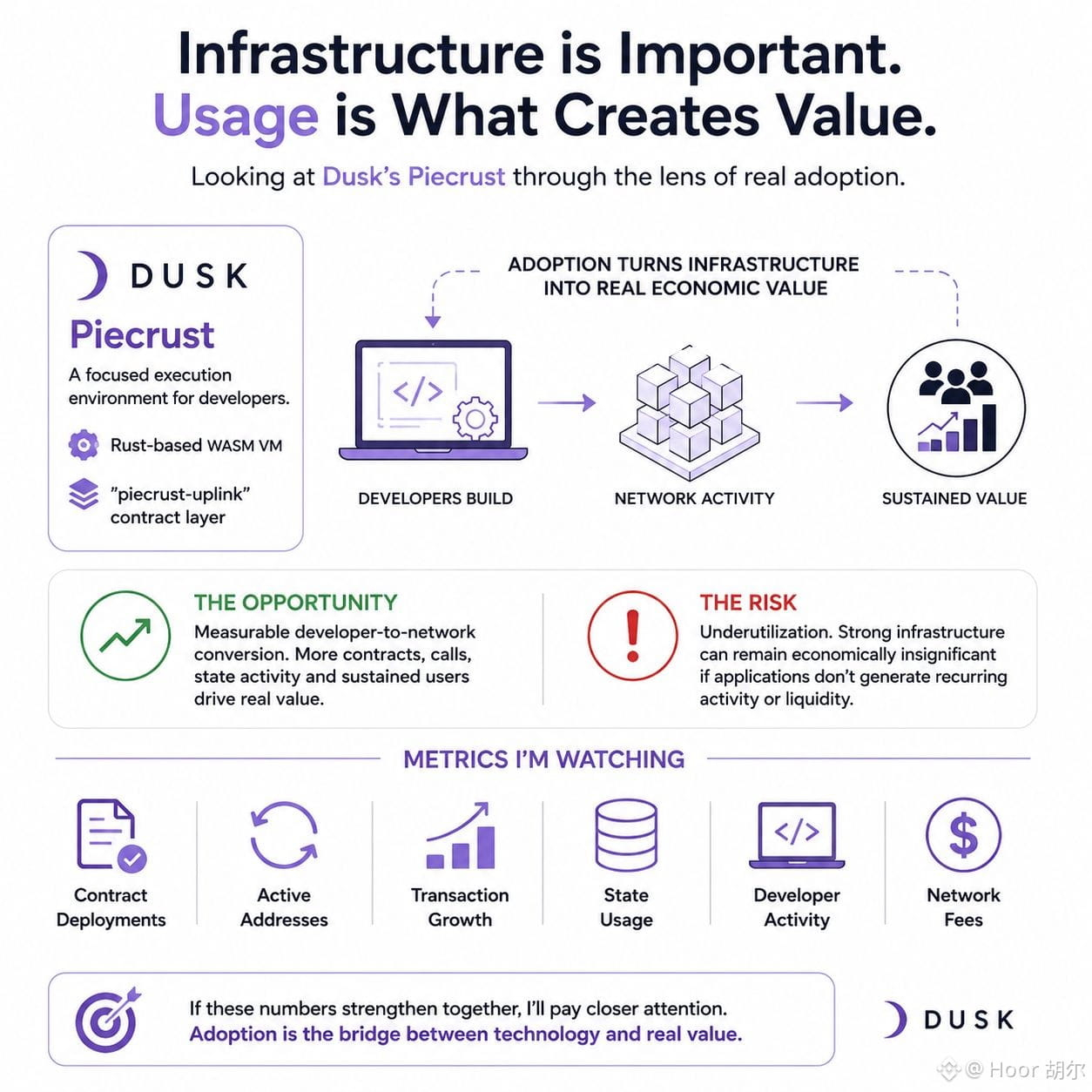
#dusk One pattern I keep coming back to is that markets eventually separate technical progress from actual usage.
I have been looking at Dusk’s Piecrust from that angle. A Rust based WASM VM and its piecrust uplink contract layer give developers a focused execution environment but the market still needs evidence that builders are using it.
The opportunity is measurable developer-to-network conversion. More contracts, calls, state activity and sustained users would matter more to me than announcements.
The risk is underutilization. Strong infrastructure can remain economically insignificant if applications do not generate recurring activity or liquidity.
I am watching contract deployments, active addresses, transaction growth, state usage, developer activity and network fees. If those numbers strengthen together I will pay closer attention.
@Dusk $DUSK
I have been looking at Dusk’s Piecrust from that angle. A Rust based WASM VM and its piecrust uplink contract layer give developers a focused execution environment but the market still needs evidence that builders are using it.
The opportunity is measurable developer-to-network conversion. More contracts, calls, state activity and sustained users would matter more to me than announcements.
The risk is underutilization. Strong infrastructure can remain economically insignificant if applications do not generate recurring activity or liquidity.
I am watching contract deployments, active addresses, transaction growth, state usage, developer activity and network fees. If those numbers strengthen together I will pay closer attention.
@Dusk $DUSK
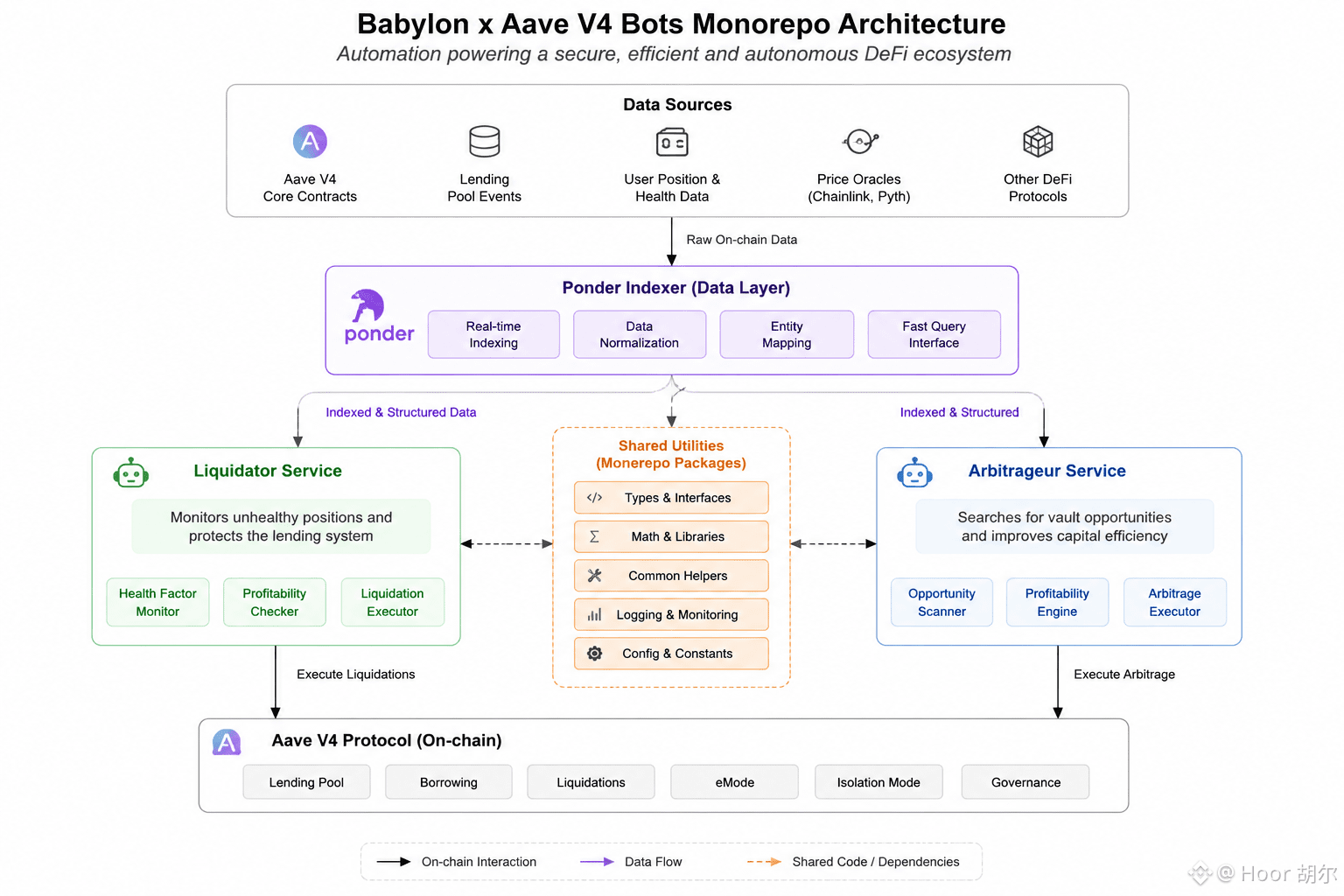
#baby I noticed that the strongest DeFi systems are not built only with smart contracts but also with the infrastructure running behind them.
Babylon’s Aave V4 Bots Monorepo shows how automation becomes a critical part of decentralized finance. The liquidator monitors unhealthy positions and protects the lending system while the arbitrageur searches for vault opportunities and improves efficiency.
What stands out is the clean monorepo design shared utilities, unified indexing and separate execution services working together. The ponder indexer acts as the data layer feeding real time information to bots that can respond quickly.
Behind every smooth DeFi experience there is complex infrastructure making decisions in the background.
Do you think automation infrastructure like liquidators, arbitrage bots and indexers will become the foundation of every mature DeFi ecosystem??? Drop your comments below 👇
@BabylonLabs_io $BABY
Babylon’s Aave V4 Bots Monorepo shows how automation becomes a critical part of decentralized finance. The liquidator monitors unhealthy positions and protects the lending system while the arbitrageur searches for vault opportunities and improves efficiency.
What stands out is the clean monorepo design shared utilities, unified indexing and separate execution services working together. The ponder indexer acts as the data layer feeding real time information to bots that can respond quickly.
Behind every smooth DeFi experience there is complex infrastructure making decisions in the background.
Do you think automation infrastructure like liquidators, arbitrage bots and indexers will become the foundation of every mature DeFi ecosystem??? Drop your comments below 👇
@BabylonLabs_io $BABY
#baby I used to think most of the Bitcoin staking app was about writing smart code. Then I spent time exploring how the Babylon Monorepo is structured and it completely changed my perspective. Instead of every team solving the same problems again and again shared libraries handle common logic while Nx keeps everything organized and only rebuilds what actually changes. I imagined how much time that would save during a busy development cycle. A small update to one feature no longer feels like it would slow down the entire project. That kind of workflow does not just make developers happier it helps new features reach users faster without sacrificing consistency. The more I learned the more I realized that the strongest infrastructure is unnoticed yet it is what allows ambitious blockchain projects like Babylon to scale confidently and keep improving the Bitcoin staking experience over time.
@BabylonLabs_io $BABY
Which part of Babylon's Monorepo do you think has the biggest impact on development speed?
@BabylonLabs_io $BABY
Which part of Babylon's Monorepo do you think has the biggest impact on development speed?
🧱 Nx incremental builds
60%
⭕️ Shared TypeScript libraries
0%
🔄 Reusable SDKs
40%
🛡 Consistent monorepo
0%
5 проголосовали • Голосование закрыто
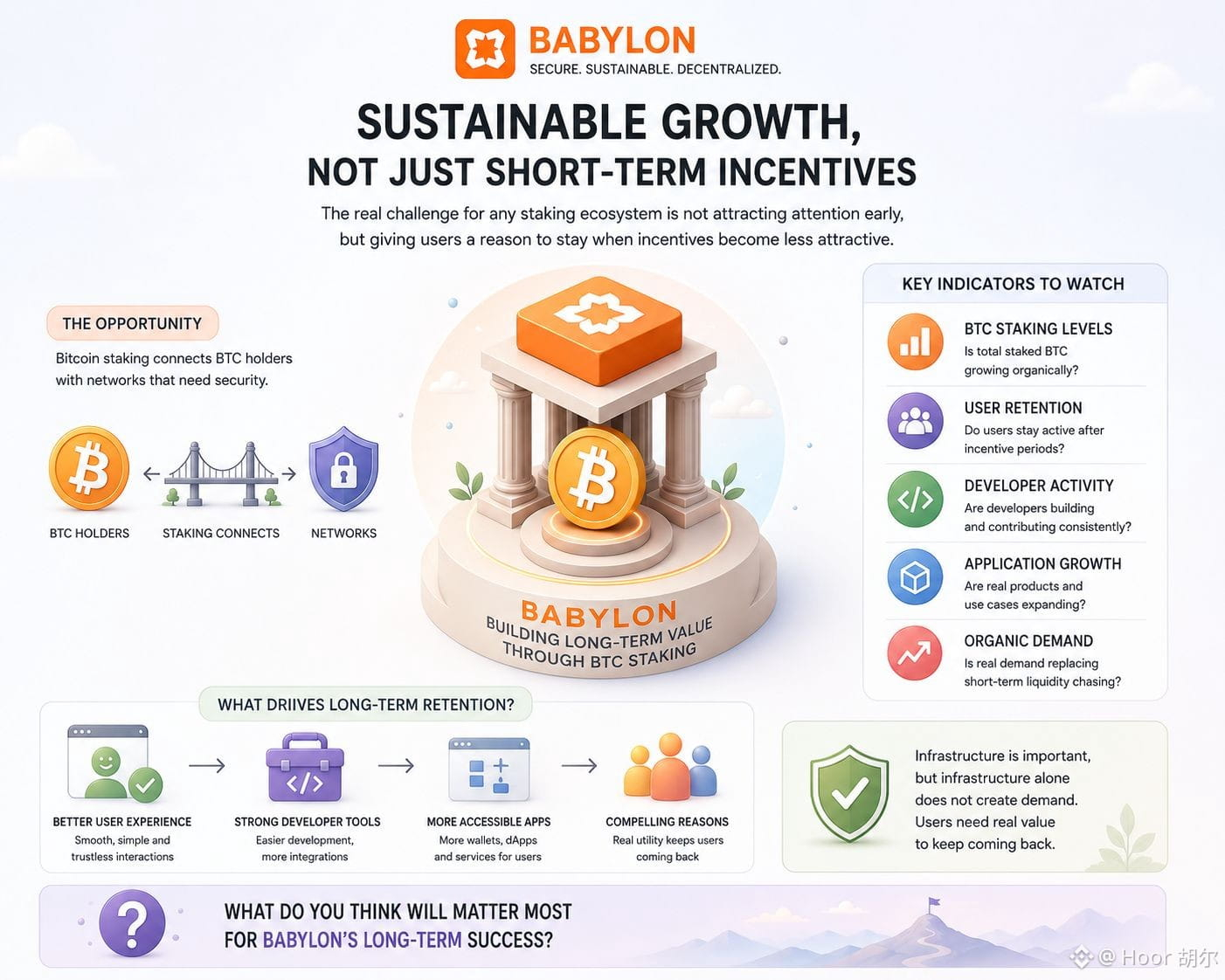
I noticed that the hardest challenge for any staking ecosystem is not attracting attention during the early phase but creating a reason for users to stay when incentives become less attractive.
I have been watching Babylon through this lens. Bitcoin staking introduces an interesting market dynamic because it connects BTC holders with networks that need additional security. The opportunity is clear: turning idle Bitcoin liquidity into an active economic resource. But the real test is whether participation becomes driven by long-term utility rather than temporary rewards.
Many cycles have shown that incentive programs can create fast growth but retention reveals the strength of the underlying product. For Babylon I think the important question is whether users continue staking because they see value in supporting applications and earning sustainable returns or whether activity slows when external incentives decrease.
One factor that can improve long-term retention is a better user experience which depends heavily on the tools available to developers.
The frontend monorepo is an important piece of this equation because better developer tools can help create smoother staking experiences and more accessible applications. However infrastructure alone does not create demand. Users still need compelling reasons to interact with the ecosystem again and again.
Before I become more confident in this thesis these are the indicators I will be watching closely because they offer valuable insight into Babylon's long-term ecosystem growth.
What do you think will matter most for Babylon's long-term success? Drop your comments below 👇
#baby @BabylonLabs_io $BABY
I have been watching Babylon through this lens. Bitcoin staking introduces an interesting market dynamic because it connects BTC holders with networks that need additional security. The opportunity is clear: turning idle Bitcoin liquidity into an active economic resource. But the real test is whether participation becomes driven by long-term utility rather than temporary rewards.
Many cycles have shown that incentive programs can create fast growth but retention reveals the strength of the underlying product. For Babylon I think the important question is whether users continue staking because they see value in supporting applications and earning sustainable returns or whether activity slows when external incentives decrease.
One factor that can improve long-term retention is a better user experience which depends heavily on the tools available to developers.
The frontend monorepo is an important piece of this equation because better developer tools can help create smoother staking experiences and more accessible applications. However infrastructure alone does not create demand. Users still need compelling reasons to interact with the ecosystem again and again.
Before I become more confident in this thesis these are the indicators I will be watching closely because they offer valuable insight into Babylon's long-term ecosystem growth.
What do you think will matter most for Babylon's long-term success? Drop your comments below 👇
#baby @BabylonLabs_io $BABY
Проверено
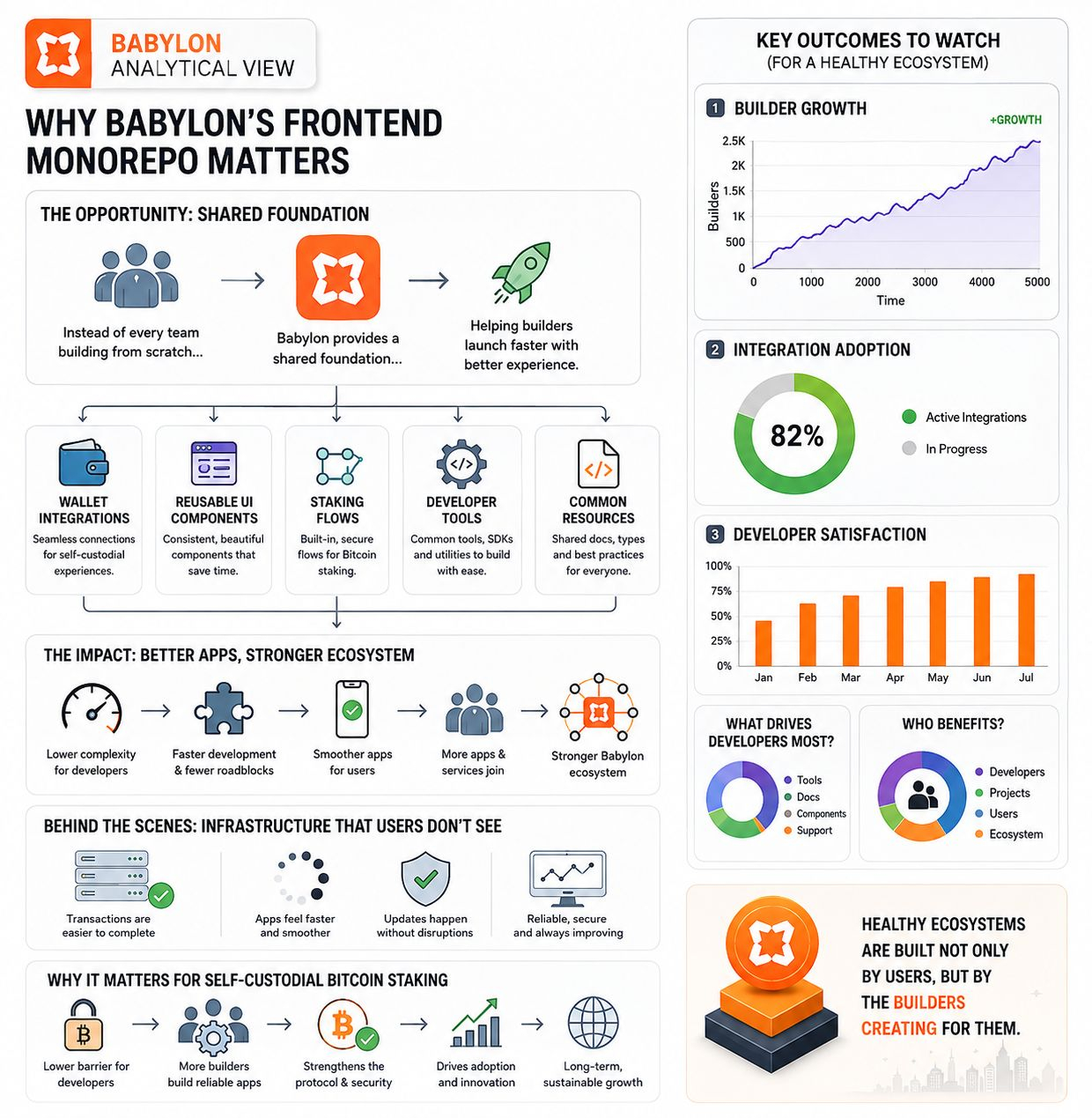
#baby $BABY i will be honest I spend as much time looking at developer infrastructure as I do token charts because that is often where the next wave of adoption begins. Babylon's frontend monorepo caught my attention for exactly that reason.
Instead of asking every team to build a Bitcoin staking interface from the ground up Babylon provides a shared foundation with wallet integrations, reusable UI components staking flows and common developer tools. That approach reduces unnecessary work and helps builders launch faster while maintaining a consistent user experience.
What I find interesting is that good infrastructure is not always visible to end users. They simply notice that applications feel smoother transactions are easier to complete and updates arrive without major disruptions. Behind the scenes a well-designed monorepo makes all of that more achievable.
For an ecosystem centered on self-custodial Bitcoin staking lowering the barrier for developers is just as important as strengthening the protocol itself. The easier it is to build reliable applications the more likely new wallets, services and projects are to join the ecosystem. #baby
In the long run strong developer tooling may prove to be one of Babylon's biggest advantages because healthy ecosystems are built not only by users but by the builders creating for them.
What is currently the biggest bottleneck holding back native BTC DeFi adoption? Drop your comments below 👇
@BabylonLabs_io #baby $BABY
Instead of asking every team to build a Bitcoin staking interface from the ground up Babylon provides a shared foundation with wallet integrations, reusable UI components staking flows and common developer tools. That approach reduces unnecessary work and helps builders launch faster while maintaining a consistent user experience.
What I find interesting is that good infrastructure is not always visible to end users. They simply notice that applications feel smoother transactions are easier to complete and updates arrive without major disruptions. Behind the scenes a well-designed monorepo makes all of that more achievable.
For an ecosystem centered on self-custodial Bitcoin staking lowering the barrier for developers is just as important as strengthening the protocol itself. The easier it is to build reliable applications the more likely new wallets, services and projects are to join the ecosystem. #baby
In the long run strong developer tooling may prove to be one of Babylon's biggest advantages because healthy ecosystems are built not only by users but by the builders creating for them.
What is currently the biggest bottleneck holding back native BTC DeFi adoption? Drop your comments below 👇
@BabylonLabs_io #baby $BABY
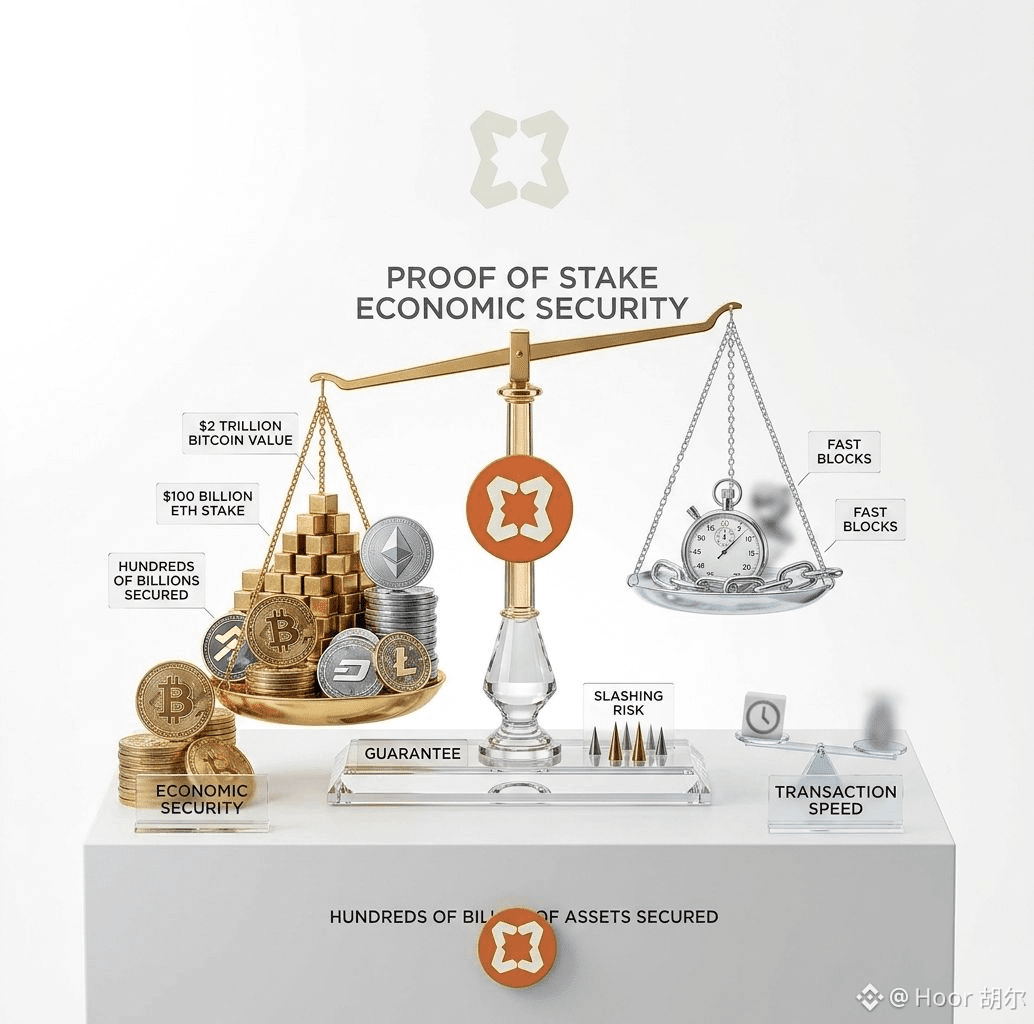
I've been looking closely at what actually makes Proof of Stake secure and I keep coming back to one conclusion: economic security matters more than raw transaction speed.
In a PoS network validators lock capital as collateral before they can participate in consensus. That stake is more than a source of rewards it is a financial guarantee of honest behavior. If validators attempt to rewrite history or sign conflicting blocks they risk losing part or all of their stake through slashing. So this is create a direct economic cost for attacking the network.
Today, hundreds of billions of dollars in digital assets are secured by PoS blockchains. Ethereum alone has tens of millions of ETH stake representing well over $100 billion in economic security depending on market prices. The higher the value at stake, the more expensive it becomes for an attacker to compromise the network.
I've also been looking at how new designs are expanding this model. Instead of relying only on a chain's native token some protocols are exploring ways to use Bitcoin's roughly $2 trillion market capitalization as an additional source of economic security. If executed safely this could significantly strengthen PoS ecosystems without requiring Bitcoin holders to give up self custody.
For me, the future of Proof of Stake won't be defined by faster blocks alone. It will be defined by how much honest behavior is worth and how costly dishonesty becomes.#baby $BABY @BabylonLabs_io
In a PoS network validators lock capital as collateral before they can participate in consensus. That stake is more than a source of rewards it is a financial guarantee of honest behavior. If validators attempt to rewrite history or sign conflicting blocks they risk losing part or all of their stake through slashing. So this is create a direct economic cost for attacking the network.
Today, hundreds of billions of dollars in digital assets are secured by PoS blockchains. Ethereum alone has tens of millions of ETH stake representing well over $100 billion in economic security depending on market prices. The higher the value at stake, the more expensive it becomes for an attacker to compromise the network.
I've also been looking at how new designs are expanding this model. Instead of relying only on a chain's native token some protocols are exploring ways to use Bitcoin's roughly $2 trillion market capitalization as an additional source of economic security. If executed safely this could significantly strengthen PoS ecosystems without requiring Bitcoin holders to give up self custody.
For me, the future of Proof of Stake won't be defined by faster blocks alone. It will be defined by how much honest behavior is worth and how costly dishonesty becomes.#baby $BABY @BabylonLabs_io
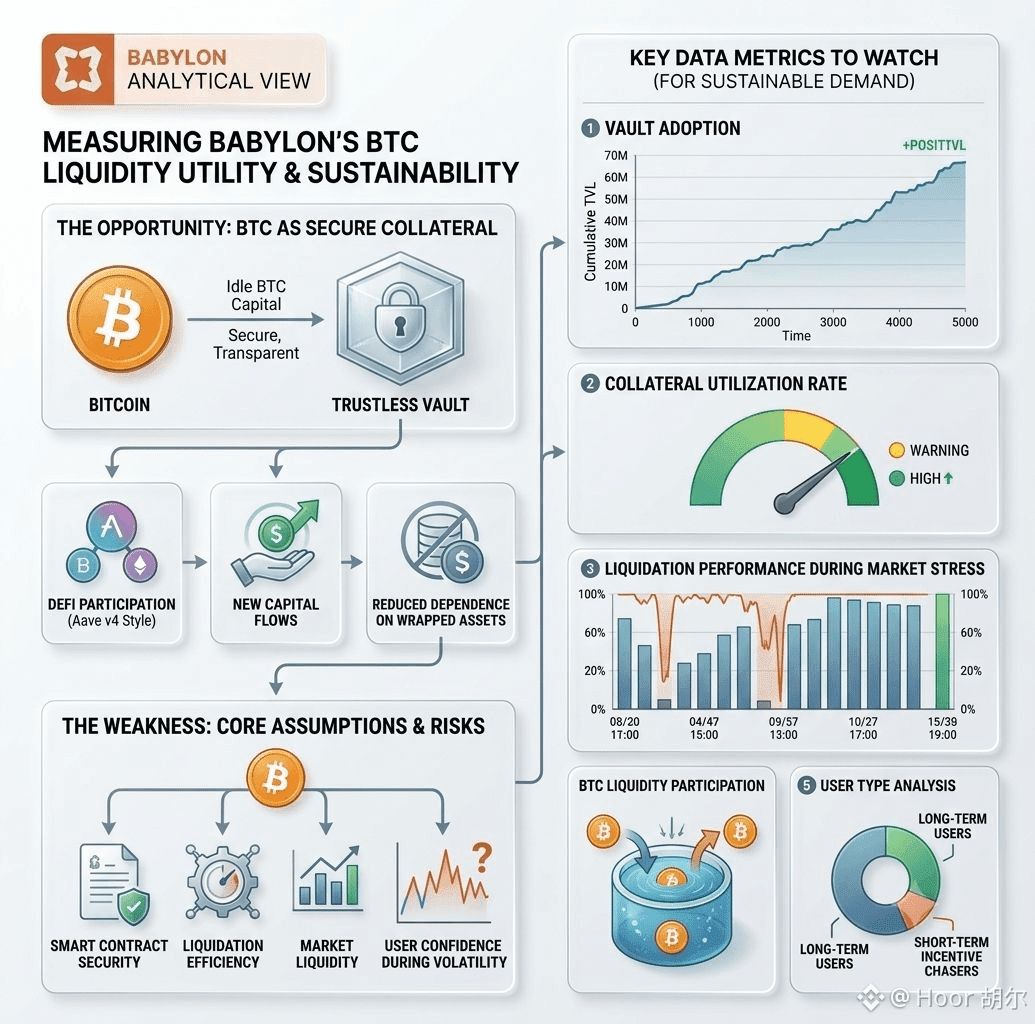
I have noticed that the strongest crypto opportunities often appear when idle capital starts finding new utility but the difficult part is measuring whether that utility creates sustainable demand.
I’ve been looking at Babylon from the perspective of Bitcoin liquidity efficiency. Many traders focus on BTC price movement but I find myself paying more attention to how much productive use Bitcoin can generate without sacrificing its core security properties.
Babylon’s Trustless Vault approach is interesting because it explores a path where Bitcoin can become collateral for DeFi activity while reducing dependence on wrapped assets and external custody assumptions. Aave v4-style arbitrage and liquidation testing around these positions highlights an important market question: can Bitcoin-backed lending markets develop the same liquidity depth and risk management standards seen in established DeFi?
The opportunity is clear: unlocking more utility from Bitcoin could attract new capital flows. But the weakness is also clear. These systems depend heavily on smart contract security, liquidation efficiency, market liquidity, and user confidence during extreme volatility.
I am not looking for narratives, I am watching the data. Before becoming more confident in this thesis I would monitor vault adoption, collateral utilization rates, liquidation performance during market stress, BTC liquidity participation and whether real users are choosing these products beyond short-term incentives.#baby $BABY @BabylonLabs_io
I’ve been looking at Babylon from the perspective of Bitcoin liquidity efficiency. Many traders focus on BTC price movement but I find myself paying more attention to how much productive use Bitcoin can generate without sacrificing its core security properties.
Babylon’s Trustless Vault approach is interesting because it explores a path where Bitcoin can become collateral for DeFi activity while reducing dependence on wrapped assets and external custody assumptions. Aave v4-style arbitrage and liquidation testing around these positions highlights an important market question: can Bitcoin-backed lending markets develop the same liquidity depth and risk management standards seen in established DeFi?
The opportunity is clear: unlocking more utility from Bitcoin could attract new capital flows. But the weakness is also clear. These systems depend heavily on smart contract security, liquidation efficiency, market liquidity, and user confidence during extreme volatility.
I am not looking for narratives, I am watching the data. Before becoming more confident in this thesis I would monitor vault adoption, collateral utilization rates, liquidation performance during market stress, BTC liquidity participation and whether real users are choosing these products beyond short-term incentives.#baby $BABY @BabylonLabs_io
Войдите, чтобы посмотреть больше материала