#newt $NEWT @NewtonProtocol
This afternoon at the office, I was reading Newton Protocol’s technical docs, and one part really grabbed me: the “TEE + ZKP dual-track pipeline.” On paper, it looks genuinely smart.
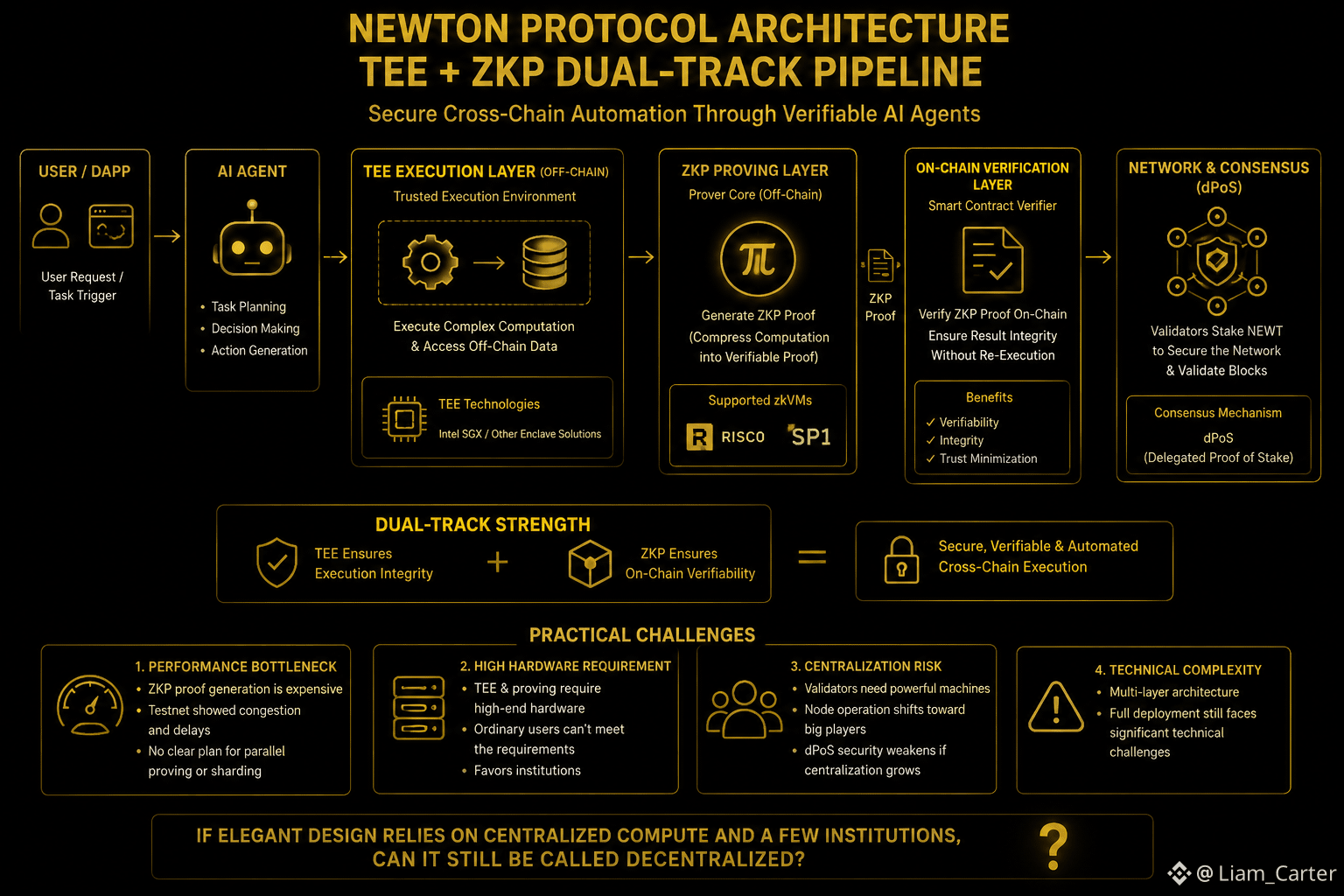
The basic idea makes sense. TEE is meant to handle fast execution off-chain, while ZKP turns the result into a proof that can be verified on-chain. So instead of asking people to just trust the computation, the system tries to turn it into something mathematically verifiable. That part is elegant, and I can see why the design gets attention.
But once you look past the concept and into the practical limits, some concerns start to show up.
The biggest issue is proof generation. ZKP proofs are not cheap to produce, and that alone can slow things down. HTX Research also notes that the TEE + ZKP model may run into performance bottlenecks and hardware dependence. Newton’s Prover Core supports zkVMs like Risc0 and SP1, but that does not erase the fact that proving is still resource-heavy. If many agents are running at the same time, congestion and delays feel almost inevitable. Yet the whitepaper does not clearly explain how the system plans to handle large-scale parallel proving.
Then there is the hardware question. TEEs depend on secure enclave hardware, and validator or verification work often needs strong machines. That means the bar is not really low. Over time, this can push participation toward institutions instead of ordinary users. Gat also points out that the protocol’s stack is complex and that stable deployment still faces real technical challenges.
So yes, the architecture is elegant. But if decentralization depends on expensive hardware and a small set of powerful operators, how decentralized is it really in practice?
Just my personal view, not investment advice.
$LAB
This afternoon at the office, I was reading Newton Protocol’s technical docs, and one part really grabbed me: the “TEE + ZKP dual-track pipeline.” On paper, it looks genuinely smart.
The basic idea makes sense. TEE is meant to handle fast execution off-chain, while ZKP turns the result into a proof that can be verified on-chain. So instead of asking people to just trust the computation, the system tries to turn it into something mathematically verifiable. That part is elegant, and I can see why the design gets attention.
But once you look past the concept and into the practical limits, some concerns start to show up.
The biggest issue is proof generation. ZKP proofs are not cheap to produce, and that alone can slow things down. HTX Research also notes that the TEE + ZKP model may run into performance bottlenecks and hardware dependence. Newton’s Prover Core supports zkVMs like Risc0 and SP1, but that does not erase the fact that proving is still resource-heavy. If many agents are running at the same time, congestion and delays feel almost inevitable. Yet the whitepaper does not clearly explain how the system plans to handle large-scale parallel proving.
Then there is the hardware question. TEEs depend on secure enclave hardware, and validator or verification work often needs strong machines. That means the bar is not really low. Over time, this can push participation toward institutions instead of ordinary users. Gat also points out that the protocol’s stack is complex and that stable deployment still faces real technical challenges.
So yes, the architecture is elegant. But if decentralization depends on expensive hardware and a small set of powerful operators, how decentralized is it really in practice?
Just my personal view, not investment advice.
$LAB