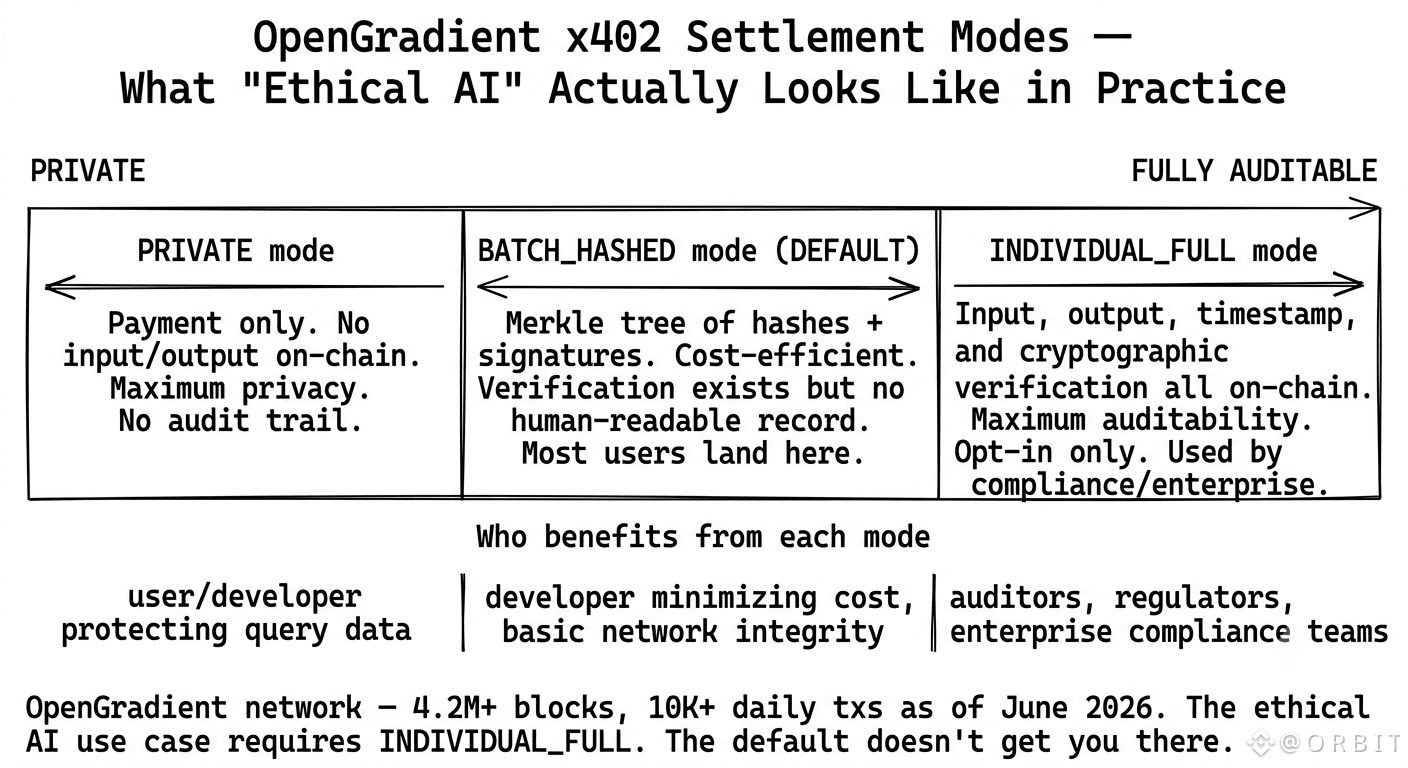
That detail from the SDK docs is what lodged in my head. @OpenGradient built three settlement modes into their x402 payment protocol: PRIVATE, BATCH_HASHED, and INDIVIDUAL_FULL. That last one — records the input, output, timestamp, and verification on-chain, maximum auditability — is what ethical AI infrastructure would need to actually prove anything to anyone. And it's not the default. $OPG #OPG
The default is BATCH_HASHED. Most cost-efficient. Aggregates inferences into a Merkle tree with hashes and signatures. Real verification exists, but the full audit trail is opt-in. Meanwhile the network is holding above 4.2 million blocks produced, 10,000+ daily transactions, and the Upbit listing on June 15 pushed 24-hour volume to $357M without anyone scrutinizing settlement modes.
I tried INDIVIDUAL_FULL in the SDK during the task. It works. You get a transaction hash back alongside the AI response. On-chain. Timestamped. That's a genuinely different artifact than any output from GPT-5 or Gemini — those give you no provenance at all. OpenGradient gives you a receipt.
But here's the thing that made me pause… the people most likely to use INDIVIDUAL_FULL are compliance teams, auditors, enterprises — not everyday users. The societal impact of ethical AI lands first on institutions. Regular users get the default, and the default is still mostly opaque to them.
So when we say verifiable AI, who exactly is doing the verifying?
The default is BATCH_HASHED. Most cost-efficient. Aggregates inferences into a Merkle tree with hashes and signatures. Real verification exists, but the full audit trail is opt-in. Meanwhile the network is holding above 4.2 million blocks produced, 10,000+ daily transactions, and the Upbit listing on June 15 pushed 24-hour volume to $357M without anyone scrutinizing settlement modes.
I tried INDIVIDUAL_FULL in the SDK during the task. It works. You get a transaction hash back alongside the AI response. On-chain. Timestamped. That's a genuinely different artifact than any output from GPT-5 or Gemini — those give you no provenance at all. OpenGradient gives you a receipt.
But here's the thing that made me pause… the people most likely to use INDIVIDUAL_FULL are compliance teams, auditors, enterprises — not everyday users. The societal impact of ethical AI lands first on institutions. Regular users get the default, and the default is still mostly opaque to them.
So when we say verifiable AI, who exactly is doing the verifying?