Something slid into focus during the task that I wasn't expecting to find — and it reframes the whole compliance angle.
OpenGradient $OPG @OpenGradient #OPG positions itself as compliance-friendly AI through cryptographic proof of every inference: what model ran, what data touched it, immutable trace on-chain. For regulated industries — financial services, healthcare, anywhere an AI decision needs an audit trail — that's a genuinely compelling structure.
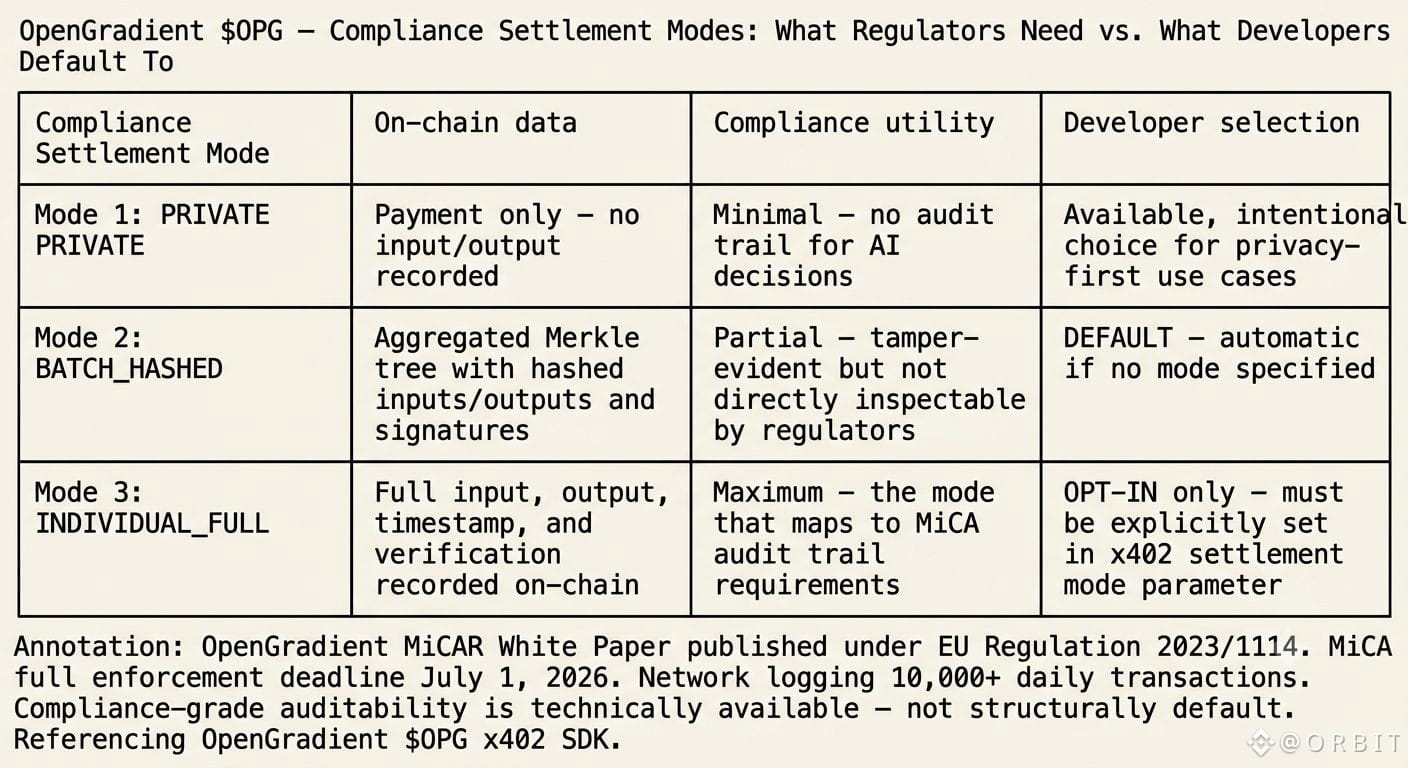
But dig into the actual x402 settlement SDK and there are three modes. PRIVATE: payment only, zero data on-chain. BATCH_HASHED: hashed aggregates in a Merkle tree, cost-efficient — and the default. INDIVIDUAL_FULL: full input, output, timestamp, and verification recorded on-chain. That last one is the compliance trail regulators would actually want. It's not the default. A developer building a compliant app has to consciously opt into it.
I kept thinking about this. OpenGradient's MiCA whitepaper exists — full regulatory tagging under EU Regulation 2023/1114 — which shows they're thinking seriously about the compliance market right as the MiCA transitional period ends July 1, 2026 and enforcement hardens across EU member states. The chain logged 10,000+ daily transactions this week against that backdrop. But the network-level compliance story and the developer-level default behavior are still pulling in different directions.
Does compliance actually require infrastructure that makes auditability the default rather than a selectable mode?
OpenGradient $OPG @OpenGradient #OPG positions itself as compliance-friendly AI through cryptographic proof of every inference: what model ran, what data touched it, immutable trace on-chain. For regulated industries — financial services, healthcare, anywhere an AI decision needs an audit trail — that's a genuinely compelling structure.
But dig into the actual x402 settlement SDK and there are three modes. PRIVATE: payment only, zero data on-chain. BATCH_HASHED: hashed aggregates in a Merkle tree, cost-efficient — and the default. INDIVIDUAL_FULL: full input, output, timestamp, and verification recorded on-chain. That last one is the compliance trail regulators would actually want. It's not the default. A developer building a compliant app has to consciously opt into it.
I kept thinking about this. OpenGradient's MiCA whitepaper exists — full regulatory tagging under EU Regulation 2023/1114 — which shows they're thinking seriously about the compliance market right as the MiCA transitional period ends July 1, 2026 and enforcement hardens across EU member states. The chain logged 10,000+ daily transactions this week against that backdrop. But the network-level compliance story and the developer-level default behavior are still pulling in different directions.
Does compliance actually require infrastructure that makes auditability the default rather than a selectable mode?