
Evelyn__
5.6k Публикации

Evelyn__
Crypto Trader | Blockchain Enthusiast | X:- @Richard_Wolfee
Открытая сделка
Трейдер с регулярными сделками
2.6 г
263 подписок(и/а)
15.2K+ подписчиков(а)
12.6K+ понравилось
Посты
Портфель
Все
Цитирования
Видео
Активно
PINNED
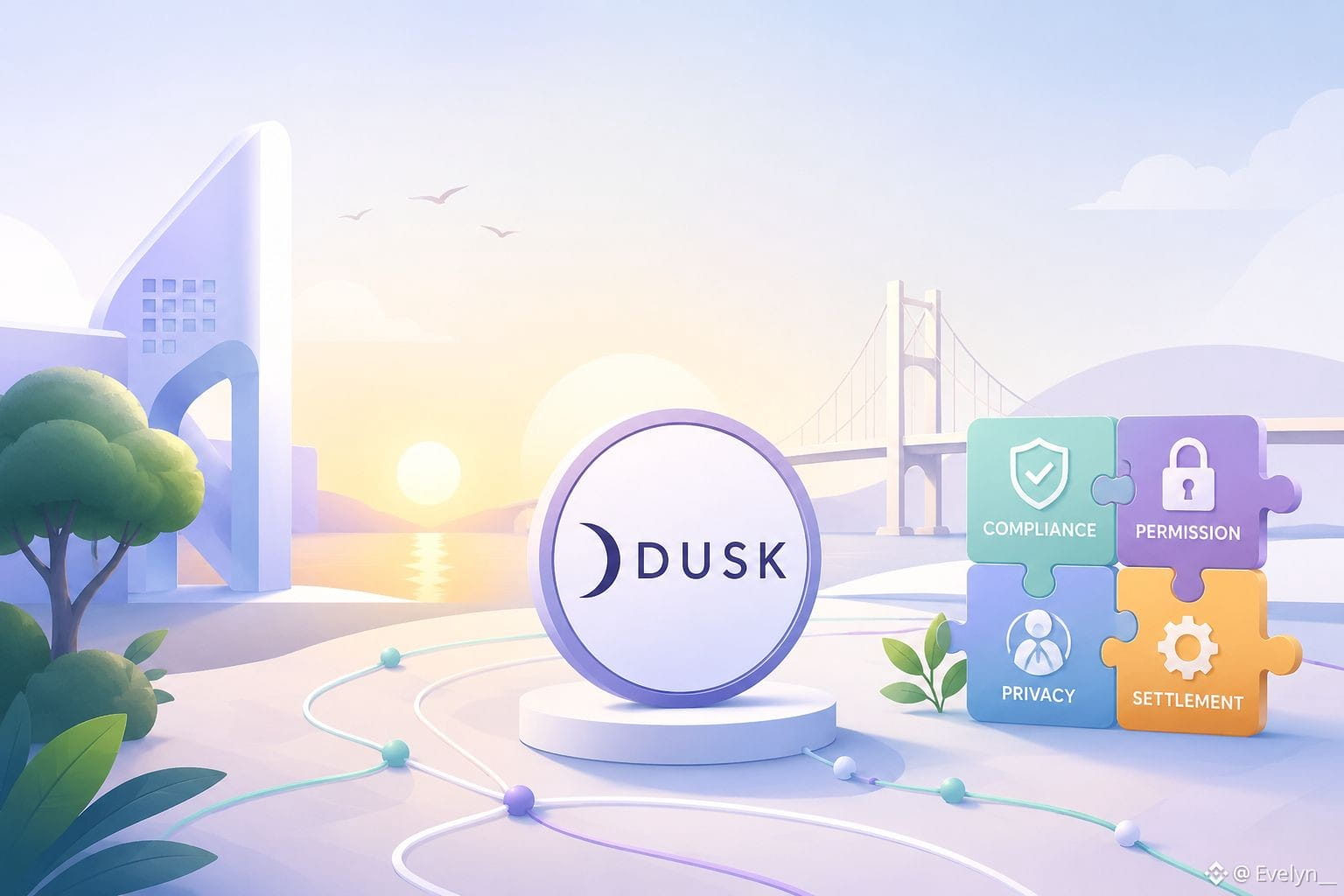
#dusk $DUSK @Dusk @Dusk Liquidity Isn’t the Whole Story
For a long time, I looked at exchange listings almost like a shortcut for measuring a crypto project.
New listing. More liquidity. Bigger volume. More attention.
It worked often enough that I started treating it as a signal of value. But experience has made me question that assumption. Volume can arrive fast, and disappear just as fast.
What I find more interesting about $DUSK is the possibility of infrastructure becoming reusable.
Imagine a developer building a permission system, compliance layer, privacy component or settlement logic once, then allowing other applications to build on top of it. Similar to how open-source software saves developers from writing the same basic tools again and again.
That changes the retention question.
When the initial hype is gone, why would users return? Hopefully because the application is still solving a real financial problem, not because someone is pushing another narrative.
For developers, the incentive could be even stronger. A useful module doesn't have to earn value from one application only. If other builders reuse it, the original work can keep producing utility.
And operators have a different responsibility. Verification can't just be a checkbox. If incentives reward honest verification, the system has a chance to remain trustworthy. If they reward shortcuts, everything built on top becomes questionable.
I'm still cautious though.
RWA narratives can create fake demand. Reported activity doesn't always mean new economic activity. Some transactions could simply be recycled. Weak verification is another risk, and token unlocks can create selling pressure even when the technology keeps improving.
So I’m not looking at $DUSK and saying “this is proven.”
I’m watching closely to see whether the infrastructure creates real recurring usage after the attention moves somewhere else.
That, to me, is the part worth watching.
For a long time, I looked at exchange listings almost like a shortcut for measuring a crypto project.
New listing. More liquidity. Bigger volume. More attention.
It worked often enough that I started treating it as a signal of value. But experience has made me question that assumption. Volume can arrive fast, and disappear just as fast.
What I find more interesting about $DUSK is the possibility of infrastructure becoming reusable.
Imagine a developer building a permission system, compliance layer, privacy component or settlement logic once, then allowing other applications to build on top of it. Similar to how open-source software saves developers from writing the same basic tools again and again.
That changes the retention question.
When the initial hype is gone, why would users return? Hopefully because the application is still solving a real financial problem, not because someone is pushing another narrative.
For developers, the incentive could be even stronger. A useful module doesn't have to earn value from one application only. If other builders reuse it, the original work can keep producing utility.
And operators have a different responsibility. Verification can't just be a checkbox. If incentives reward honest verification, the system has a chance to remain trustworthy. If they reward shortcuts, everything built on top becomes questionable.
I'm still cautious though.
RWA narratives can create fake demand. Reported activity doesn't always mean new economic activity. Some transactions could simply be recycled. Weak verification is another risk, and token unlocks can create selling pressure even when the technology keeps improving.
So I’m not looking at $DUSK and saying “this is proven.”
I’m watching closely to see whether the infrastructure creates real recurring usage after the attention moves somewhere else.
That, to me, is the part worth watching.
PINNED
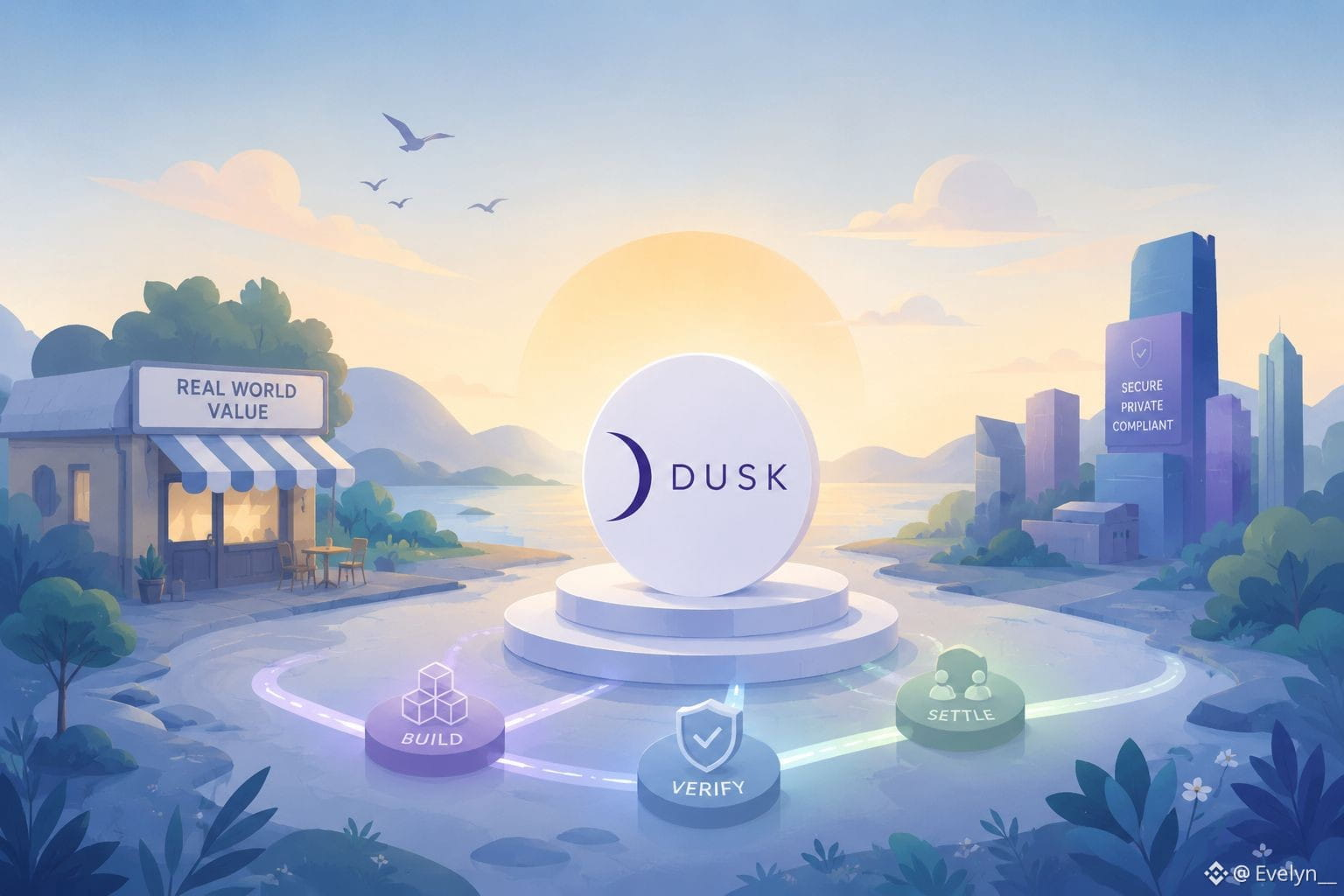
#dusk $DUSK @Dusk @Dusk The Part I’m Watching
For a long time, I treated liquidity as the easiest proof that a crypto project was working. More exchanges, thicker books, bigger volume... it all looked like progress.
But after watching enough launches, I’m less convinced.
A crowded market doesn’t automatically mean people have a reason to stay.
That’s why I’m looking at $DUSK from a slightly different angle. The interesting part, for me, is the possibility of turning financial rules into reusable building blocks.
Think about software libraries. A developer doesn’t rewrite the same authentication system every time. The useful part is being able to take something proven, plug it in, and build the next thing faster.
Financial infrastructure could work in a similar way. Permission logic, compliance checks, identity rules or settlement components could become modules that other applications build around.
But then comes the harder question: what keeps everyone coming back?
Users need something beyond launch incentives. Developers need a reason to maintain and improve modules, with the possibility of earning from repeated usage rather than chasing another short-lived narrative. And operators need incentives to verify activity honestly, because bad verification can make an ecosystem look healthy when it really isn’t.
I’m still skeptical here.
A lot of “activity” in crypto can be recycled capital. Incentives can create temporary users. Weak verification can inflate numbers. And token unlocks can put pressure on an otherwise interesting network.
So I’m not looking at $DUSK and saying the thesis is proven.
I’m asking a simpler question: does the infrastructure create behaviour people actually want to repeat?
If the answer eventually becomes yes, then I think the story gets much more interesting. For now, I’m watching closely, not celebrating early.
For a long time, I treated liquidity as the easiest proof that a crypto project was working. More exchanges, thicker books, bigger volume... it all looked like progress.
But after watching enough launches, I’m less convinced.
A crowded market doesn’t automatically mean people have a reason to stay.
That’s why I’m looking at $DUSK from a slightly different angle. The interesting part, for me, is the possibility of turning financial rules into reusable building blocks.
Think about software libraries. A developer doesn’t rewrite the same authentication system every time. The useful part is being able to take something proven, plug it in, and build the next thing faster.
Financial infrastructure could work in a similar way. Permission logic, compliance checks, identity rules or settlement components could become modules that other applications build around.
But then comes the harder question: what keeps everyone coming back?
Users need something beyond launch incentives. Developers need a reason to maintain and improve modules, with the possibility of earning from repeated usage rather than chasing another short-lived narrative. And operators need incentives to verify activity honestly, because bad verification can make an ecosystem look healthy when it really isn’t.
I’m still skeptical here.
A lot of “activity” in crypto can be recycled capital. Incentives can create temporary users. Weak verification can inflate numbers. And token unlocks can put pressure on an otherwise interesting network.
So I’m not looking at $DUSK and saying the thesis is proven.
I’m asking a simpler question: does the infrastructure create behaviour people actually want to repeat?
If the answer eventually becomes yes, then I think the story gets much more interesting. For now, I’m watching closely, not celebrating early.

$BTC Bitcoin Has One Date Left to Watch
Bitcoin has already made a move most traders didn't expect. From the low-$60K area, BTC pushed above $80,000 and recently reached around $81,272. Now it is sitting near $78K–$79K, and suddenly the market has a new question:
What happens when Kevin Warsh speaks?
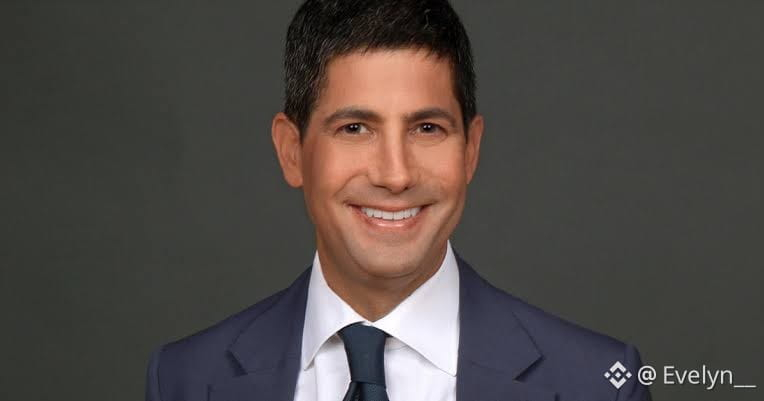
Warsh, the new Federal Reserve Chair, is preparing for his first major Jackson Hole speech on Friday, August 28. And this isn't just another Fed speech. This year's Jackson Hole theme is “Financial Innovation: Implications for Payments and Policy” — a topic unusually close to the world of digital assets and stablecoins.
That is why crypto traders are watching.
Bitcoin is still up roughly 23% over the past week despite today's pullback, while other major cryptocurrencies have also posted strong gains.
But here's where things get interesting.
The Fed has kept rates at 3.50%–3.75%, while inflation remains above the 2% target. Markets therefore want to know whether Warsh will sound more concerned about inflation or more comfortable with current financial conditions.
A hawkish message could push yields higher and put pressure on Bitcoin after its huge rally.
A softer message could have the opposite effect: lower rate expectations, stronger risk appetite and potentially another attempt at $81K.
And there is a historical reason traders are nervous. In 2022, a hawkish Jackson Hole speech helped trigger a sharp Bitcoin sell-off. But historical data also shows that 2022 was more of an outlier than the normal reaction.
So the real trade isn't simply “bullish or bearish.”
It is this:
Will Warsh give Bitcoin another reason to rally — or give the market a reason to take profits?
Friday could answer that.
#TrendingTopic
Bitcoin has already made a move most traders didn't expect. From the low-$60K area, BTC pushed above $80,000 and recently reached around $81,272. Now it is sitting near $78K–$79K, and suddenly the market has a new question:
What happens when Kevin Warsh speaks?
Warsh, the new Federal Reserve Chair, is preparing for his first major Jackson Hole speech on Friday, August 28. And this isn't just another Fed speech. This year's Jackson Hole theme is “Financial Innovation: Implications for Payments and Policy” — a topic unusually close to the world of digital assets and stablecoins.
That is why crypto traders are watching.
Bitcoin is still up roughly 23% over the past week despite today's pullback, while other major cryptocurrencies have also posted strong gains.
But here's where things get interesting.
The Fed has kept rates at 3.50%–3.75%, while inflation remains above the 2% target. Markets therefore want to know whether Warsh will sound more concerned about inflation or more comfortable with current financial conditions.
A hawkish message could push yields higher and put pressure on Bitcoin after its huge rally.
A softer message could have the opposite effect: lower rate expectations, stronger risk appetite and potentially another attempt at $81K.
And there is a historical reason traders are nervous. In 2022, a hawkish Jackson Hole speech helped trigger a sharp Bitcoin sell-off. But historical data also shows that 2022 was more of an outlier than the normal reaction.
So the real trade isn't simply “bullish or bearish.”
It is this:
Will Warsh give Bitcoin another reason to rally — or give the market a reason to take profits?
Friday could answer that.
#TrendingTopic
Bitcoin’s Big Move Has Entered a Cooling Phase
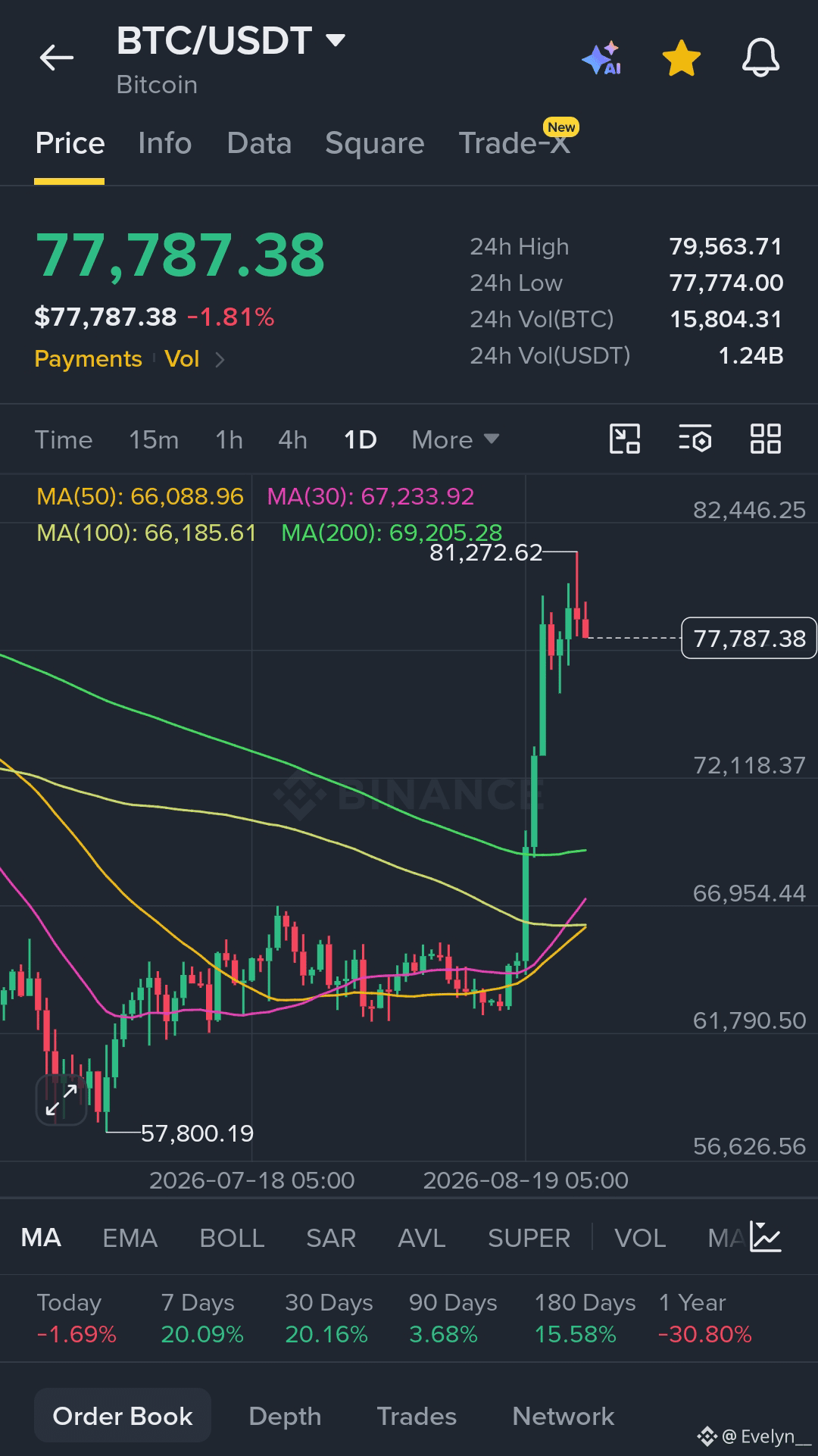
Bitcoin is trading around $77,787 after making a sharp move from the low-$60K area to a recent high near $81,272. Now the interesting part is seeing whether BTC can hold those gains.
The daily chart shows price sitting well above all four moving averages. The 30-day MA is around $67,234, the 50-day near $66,089, the 100-day around $66,186, and the 200-day near $69,205. That separation shows how strongly the broader trend has improved.
But there is another side to the chart. After touching $81,272, BTC failed to continue higher and has started moving sideways to lower around $77K–$78K. Short-term traders are now watching whether buyers can defend this area.
The first level I would watch is around $77K–$78K. Holding it could give Bitcoin another chance to retest $81,272. A clean breakout above that high would put BTC back into price-discovery territory and could bring another wave of momentum.
If BTC loses the current support, the $72K region becomes important. Below that, the moving-average cluster around $66K–$69K represents a much deeper support zone.
What stands out to me is that Bitcoin has already made the hard move. Now the market has to prove that it can consolidate those gains instead of giving them back.
I would not judge this chart simply by one red day. The bigger question is whether BTC can stay above its major moving averages while buyers prepare for another attempt at $81,272. That reaction could define the next major move.$BTC #USStocksCloseHigherNvidiaGains2%
Bitcoin is trading around $77,787 after making a sharp move from the low-$60K area to a recent high near $81,272. Now the interesting part is seeing whether BTC can hold those gains.
The daily chart shows price sitting well above all four moving averages. The 30-day MA is around $67,234, the 50-day near $66,089, the 100-day around $66,186, and the 200-day near $69,205. That separation shows how strongly the broader trend has improved.
But there is another side to the chart. After touching $81,272, BTC failed to continue higher and has started moving sideways to lower around $77K–$78K. Short-term traders are now watching whether buyers can defend this area.
The first level I would watch is around $77K–$78K. Holding it could give Bitcoin another chance to retest $81,272. A clean breakout above that high would put BTC back into price-discovery territory and could bring another wave of momentum.
If BTC loses the current support, the $72K region becomes important. Below that, the moving-average cluster around $66K–$69K represents a much deeper support zone.
What stands out to me is that Bitcoin has already made the hard move. Now the market has to prove that it can consolidate those gains instead of giving them back.
I would not judge this chart simply by one red day. The bigger question is whether BTC can stay above its major moving averages while buyers prepare for another attempt at $81,272. That reaction could define the next major move.$BTC #USStocksCloseHigherNvidiaGains2%
NVIDIA Is at a Decision Point
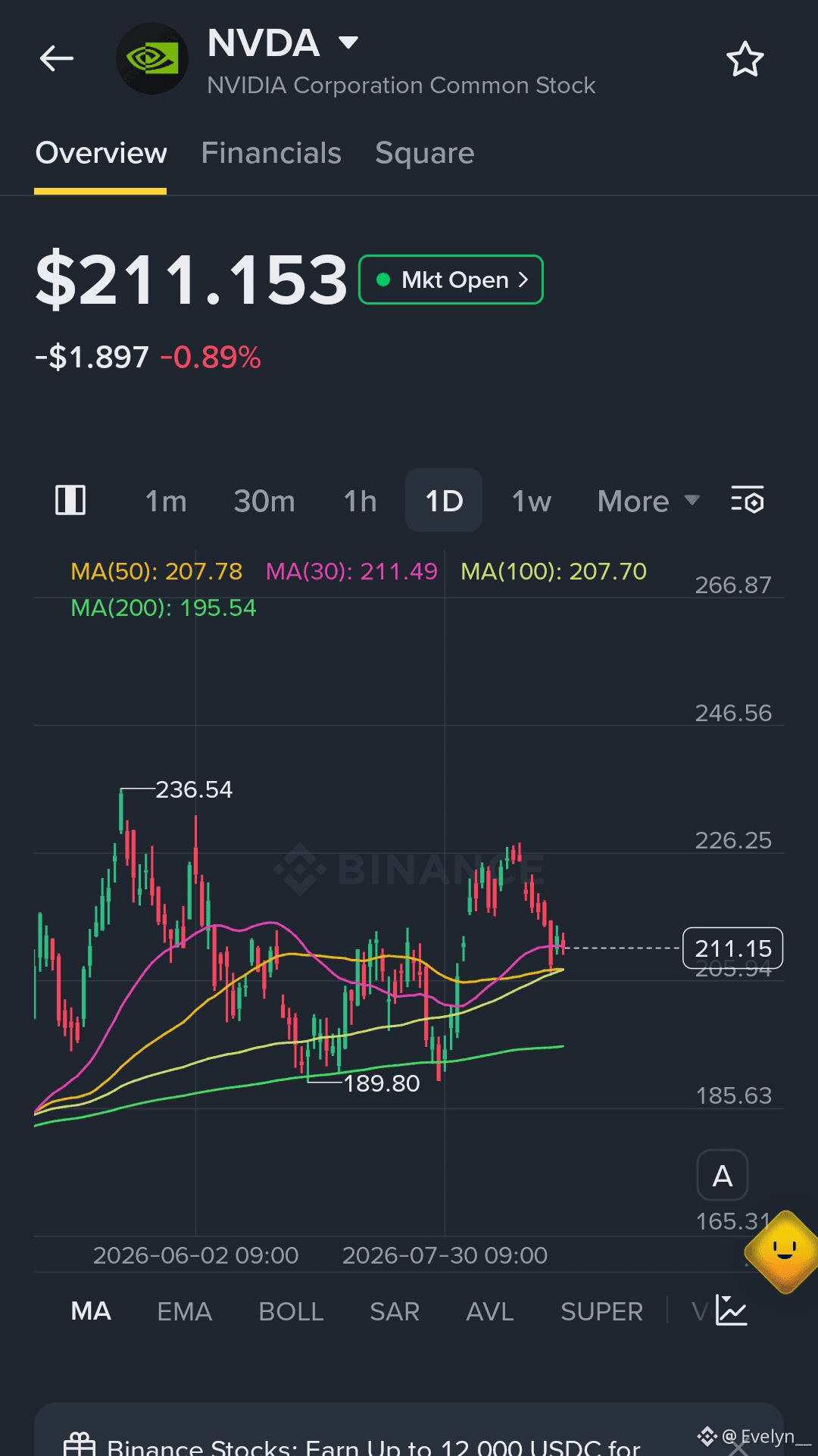
NVIDIA is sitting around $211.15, and what caught my attention is how price has moved into an area where several moving averages are starting to meet.
The 30-day MA is around $211.49, almost exactly where the stock is trading. The 50-day and 100-day averages are near $207.7–$207.8, while the 200-day MA sits around $195.54. The longer-term structure still looks relatively strong, but short-term momentum has become less convincing.
After reaching about $236.54, NVDA pulled back and is now hovering around the $205–$212 zone. This area could become important. If buyers defend $205–$208 and price moves back above the 30-day average with strength, the chart could turn constructive again. A recovery toward $226 would then become an important level, followed by the previous high near $236.54.
On the other hand, losing $205 could increase selling pressure and push the stock toward deeper support. The 200-day average around $195.54 is especially important because it represents a major trend-support level.
What I like about this chart is that it is not giving an obvious “chase the move” signal. NVDA looks more like it is testing whether buyers still have enough strength to turn this pullback into another move higher.
For me, the key levels are simple: $205–$208 for support, $211–$212 for the immediate trend decision, and $226–$236 for the upside zone. The reaction around these levels should tell the story better than any single indicator.$NVDAB #OpenAIReportedlyCompletesBelModelPretraining
NVIDIA is sitting around $211.15, and what caught my attention is how price has moved into an area where several moving averages are starting to meet.
The 30-day MA is around $211.49, almost exactly where the stock is trading. The 50-day and 100-day averages are near $207.7–$207.8, while the 200-day MA sits around $195.54. The longer-term structure still looks relatively strong, but short-term momentum has become less convincing.
After reaching about $236.54, NVDA pulled back and is now hovering around the $205–$212 zone. This area could become important. If buyers defend $205–$208 and price moves back above the 30-day average with strength, the chart could turn constructive again. A recovery toward $226 would then become an important level, followed by the previous high near $236.54.
On the other hand, losing $205 could increase selling pressure and push the stock toward deeper support. The 200-day average around $195.54 is especially important because it represents a major trend-support level.
What I like about this chart is that it is not giving an obvious “chase the move” signal. NVDA looks more like it is testing whether buyers still have enough strength to turn this pullback into another move higher.
For me, the key levels are simple: $205–$208 for support, $211–$212 for the immediate trend decision, and $226–$236 for the upside zone. The reaction around these levels should tell the story better than any single indicator.$NVDAB #OpenAIReportedlyCompletesBelModelPretraining
$BTC
R I C H A R D B L O C K
·
--
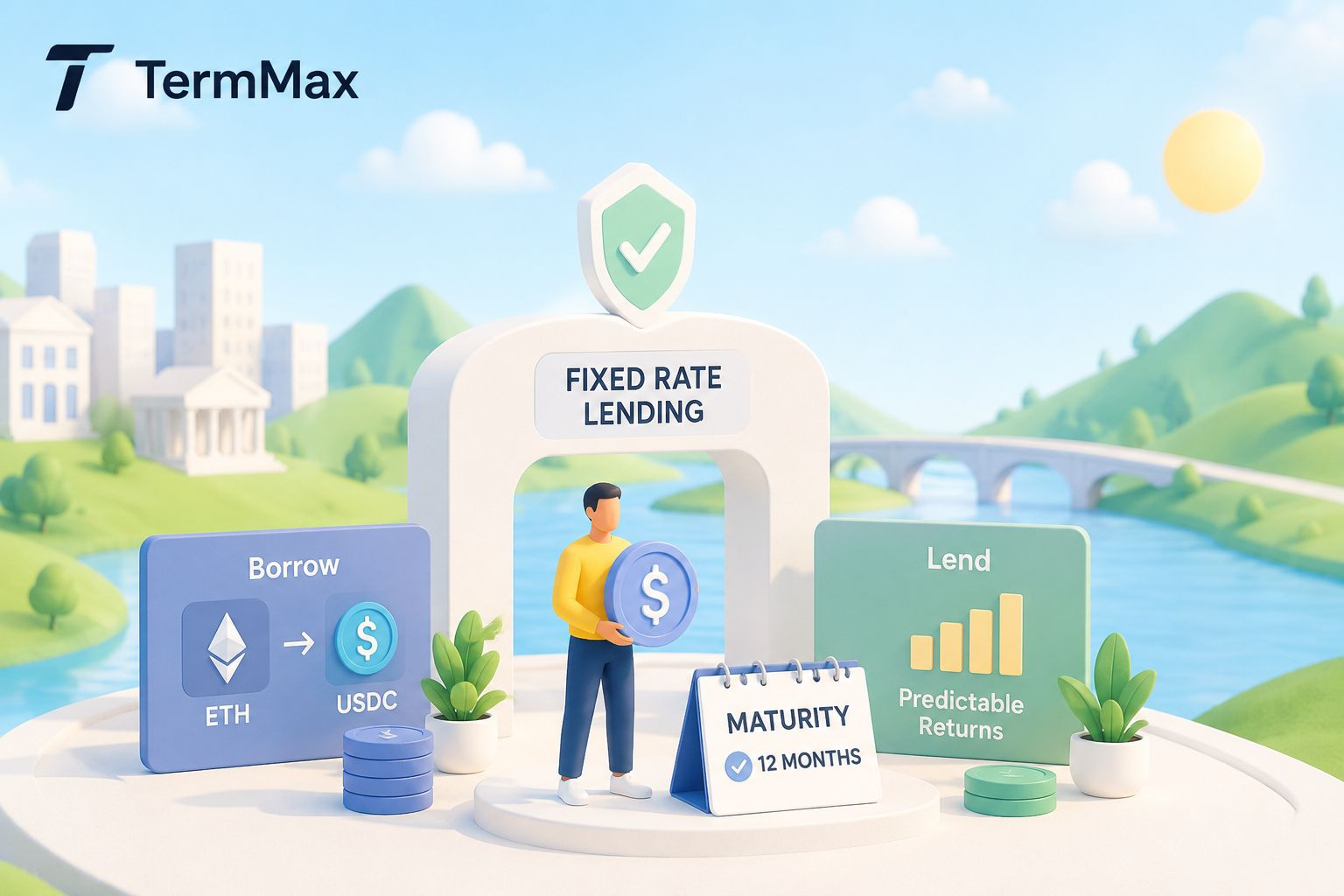
#termmax @TermMax @TermMax Beyond Liquidity
For a long time, I looked at crypto value in a pretty simple way.
A good exchange listing, deeper liquidity, more volume... that usually felt like the signal that a project was becoming real.
But after watching enough launches, I’m less convinced.
Liquidity can create attention. It doesn’t automatically create a reason to come back.
That’s why TermMax has caught my attention lately.
What I find interesting isn’t just another lending market. It’s the idea of turning financial logic into reusable infrastructure. Kind of like open-source software. Instead of every developer rebuilding permission, compliance, risk or settlement logic from zero, the same modules could potentially be reused across different financial applications.
And this is where I think the real test starts.
Why would users return after the initial hype disappears?
Maybe because the infrastructure is actually useful, not because incentives are temporarily high.
Can developers earn from modules that other applications repeatedly use? If yes, the value loop becomes much more interesting than simple token speculation.
And operators have an even harder job. They need incentives to verify honestly, because weak verification can make an impressive-looking system almost meaningless.
Still, I’m not blindly bullish.
Fake demand is always possible. Volume can be recycled. Activity can look impressive while very little genuine economic value is moving. Then there’s token unlock pressure around $TMX, which can change incentives pretty quickly.
So I keep coming back to one question:
Are people actually using the infrastructure, or are we just watching capital move in circles?
That answer matters more to me than another listing or short-term volume spike.
For now, TermMax is a watching closely thesis for me. The architecture is interesting, but real retention and organic usage still have to prove the story.
That’s where I’ll be looking. $TMX
For a long time, I looked at crypto value in a pretty simple way.
A good exchange listing, deeper liquidity, more volume... that usually felt like the signal that a project was becoming real.
But after watching enough launches, I’m less convinced.
Liquidity can create attention. It doesn’t automatically create a reason to come back.
That’s why TermMax has caught my attention lately.
What I find interesting isn’t just another lending market. It’s the idea of turning financial logic into reusable infrastructure. Kind of like open-source software. Instead of every developer rebuilding permission, compliance, risk or settlement logic from zero, the same modules could potentially be reused across different financial applications.
And this is where I think the real test starts.
Why would users return after the initial hype disappears?
Maybe because the infrastructure is actually useful, not because incentives are temporarily high.
Can developers earn from modules that other applications repeatedly use? If yes, the value loop becomes much more interesting than simple token speculation.
And operators have an even harder job. They need incentives to verify honestly, because weak verification can make an impressive-looking system almost meaningless.
Still, I’m not blindly bullish.
Fake demand is always possible. Volume can be recycled. Activity can look impressive while very little genuine economic value is moving. Then there’s token unlock pressure around $TMX, which can change incentives pretty quickly.
So I keep coming back to one question:
Are people actually using the infrastructure, or are we just watching capital move in circles?
That answer matters more to me than another listing or short-term volume spike.
For now, TermMax is a watching closely thesis for me. The architecture is interesting, but real retention and organic usage still have to prove the story.
That’s where I’ll be looking. $TMX
$BTC

Riley Monroe
·
--
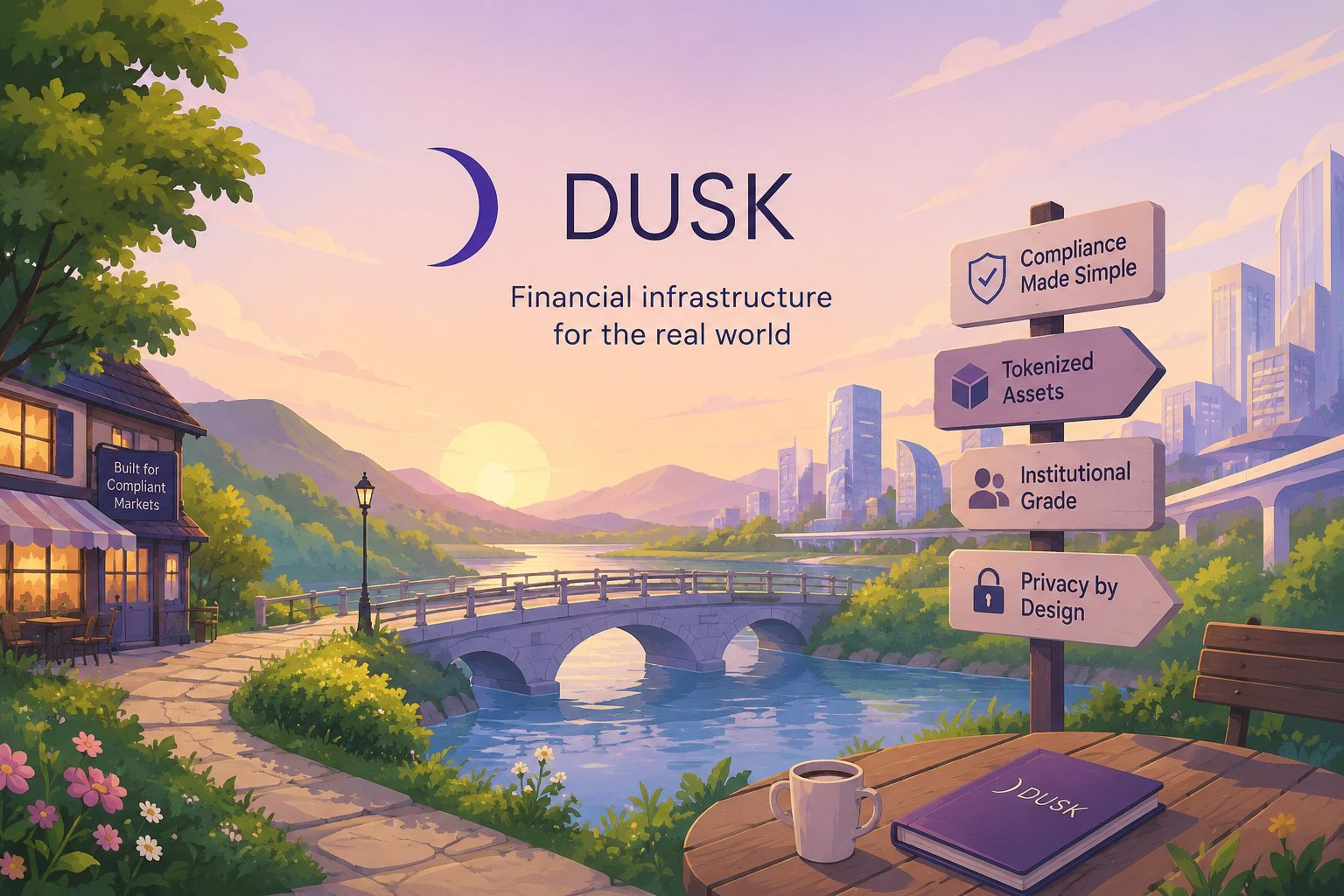
#dusk $DUSK @Dusk @Dusk The Part I’m Still Unsure About
There was a time when I judged crypto projects almost entirely by market signals.
A new listing. Bigger volume. More liquidity. Price going up.
It was easy to assume that if the market was paying attention, the project must be creating value.
I don’t think it’s that simple anymore.
What interests me about Dusk is something less visible: whether financial applications can share useful building blocks instead of every team creating the same machinery again.
Think about permissions, identity checks, compliance rules, settlement conditions. If developers can create these once and other applications can actually reuse them, that starts looking more like infrastructure than another temporary crypto narrative.
And honestly, the retention question is more important to me than the launch-day excitement.
A user has to have a reason to return when the timeline gets quiet.
A developer needs a reason to keep maintaining a module if other teams are using it. There has to be some economic upside there, otherwise reusable infrastructure sounds nice but doesn't last.
Then there are the operators. Verification only matters if they have something to lose by doing it badly. If incentives reward meaningless throughput, we could end up measuring activity instead of trust.
That’s where my skepticism kicks in.
Are transactions coming from real demand, or are we just watching the same value move around? Is verification actually useful? And how much pressure could future token unlocks put on the economics?
Dusk is interesting to me precisely because these questions aren't fully answered yet.
I’m not calling it a winner.
I’m watching to see whether the infrastructure becomes something people actually depend on after the excitement wears off.
That’s a much harder test for $DUSK than simply getting attention.
And probably a more useful one too. $DUSK
There was a time when I judged crypto projects almost entirely by market signals.
A new listing. Bigger volume. More liquidity. Price going up.
It was easy to assume that if the market was paying attention, the project must be creating value.
I don’t think it’s that simple anymore.
What interests me about Dusk is something less visible: whether financial applications can share useful building blocks instead of every team creating the same machinery again.
Think about permissions, identity checks, compliance rules, settlement conditions. If developers can create these once and other applications can actually reuse them, that starts looking more like infrastructure than another temporary crypto narrative.
And honestly, the retention question is more important to me than the launch-day excitement.
A user has to have a reason to return when the timeline gets quiet.
A developer needs a reason to keep maintaining a module if other teams are using it. There has to be some economic upside there, otherwise reusable infrastructure sounds nice but doesn't last.
Then there are the operators. Verification only matters if they have something to lose by doing it badly. If incentives reward meaningless throughput, we could end up measuring activity instead of trust.
That’s where my skepticism kicks in.
Are transactions coming from real demand, or are we just watching the same value move around? Is verification actually useful? And how much pressure could future token unlocks put on the economics?
Dusk is interesting to me precisely because these questions aren't fully answered yet.
I’m not calling it a winner.
I’m watching to see whether the infrastructure becomes something people actually depend on after the excitement wears off.
That’s a much harder test for $DUSK than simply getting attention.
And probably a more useful one too. $DUSK

$NVDAB
R I C H A R D B L O C K
·
--
#dusk $DUSK @Dusk @Dusk The Signal I Care About Now
I used to watch new listings almost like a scoreboard. More exchanges, deeper liquidity, bigger volume. It was easy to believe that was where a project’s value came from.
After seeing enough launches, I’m not so sure.
The harder question is what remains useful once attention moves somewhere else.
That’s the part of Dusk I’m trying to understand. Its bigger bet seems to be turning complicated financial processes into infrastructure that can be used again and again. Instead of every application creating its own rules for permissions, compliance or settlement, developers could build those pieces once and let other products plug into them.
That changes the reason people might stick around.
A user returns because the application still solves a real financial problem, not because a token is trending. A developer can potentially earn from infrastructure that keeps getting reused, rather than constantly chasing the next launch. And network operators have a reason to verify activity properly if their rewards depend on useful, trustworthy work.
But I’d still keep one eyebrow raised.
A growing transaction count doesn't automatically mean growing demand. Some activity can be recycled. Verification can be weak. And token unlocks can create pressure even when the underlying technology is improving.
So I’m watching the behavior more than the headline numbers.
Dusk has reported 210M+ $DUSK staked and €300M+ in confirmed institutional issuance, which is worth paying attention to, but I don't think those figures alone settle the thesis.
For me, the interesting question is much simpler: when the narrative gets quiet, does the infrastructure still have a reason to be used?
That answer is still being earned. $DUSK
I used to watch new listings almost like a scoreboard. More exchanges, deeper liquidity, bigger volume. It was easy to believe that was where a project’s value came from.
After seeing enough launches, I’m not so sure.
The harder question is what remains useful once attention moves somewhere else.
That’s the part of Dusk I’m trying to understand. Its bigger bet seems to be turning complicated financial processes into infrastructure that can be used again and again. Instead of every application creating its own rules for permissions, compliance or settlement, developers could build those pieces once and let other products plug into them.
That changes the reason people might stick around.
A user returns because the application still solves a real financial problem, not because a token is trending. A developer can potentially earn from infrastructure that keeps getting reused, rather than constantly chasing the next launch. And network operators have a reason to verify activity properly if their rewards depend on useful, trustworthy work.
But I’d still keep one eyebrow raised.
A growing transaction count doesn't automatically mean growing demand. Some activity can be recycled. Verification can be weak. And token unlocks can create pressure even when the underlying technology is improving.
So I’m watching the behavior more than the headline numbers.
Dusk has reported 210M+ $DUSK staked and €300M+ in confirmed institutional issuance, which is worth paying attention to, but I don't think those figures alone settle the thesis.
For me, the interesting question is much simpler: when the narrative gets quiet, does the infrastructure still have a reason to be used?
That answer is still being earned. $DUSK

$ETH
Riley Monroe
·
--
#dusk $DUSK @Dusk @Dusk The Part I’m Still Not Sure About
For a long time, I treated exchange activity as the easiest way to judge a crypto project.
More listings. More liquidity. More volume.
It looked like progress.
But eventually I realised there’s a problem with that metric. A market can look busy without actually becoming more useful.
That changed how I look at projects like Dusk.
What interests me now is less about the token moving around and more about whether the network can make complicated financial processes easier to repeat.
That sounds boring compared with a new listing, but maybe boring is actually the point.
If someone has already figured out how an asset should be issued, who can access it, what conditions apply to transfers and how the process stays within a particular rule set, the next application shouldn't have to invent all of that again.
It could plug into existing infrastructure.
And that's where I think the real retention test begins.
Do investors still have a reason to use it six months after the narrative cools down?
Do developers benefit when something they build becomes useful to other applications?
And can the people responsible for checking activity make more by being accurate than by simply approving everything?
Those questions matter more to me than raw transaction counts.
Because even a growing network can have weak fundamentals if demand is manufactured, transactions mostly circulate between the same users, verification is treated casually, or token unlocks create selling pressure.
I’m still not convinced Dusk has proven the whole thesis.
But $DUSK is interesting enough for me to keep watching, especially as the network moves from an infrastructure idea toward actual financial use.
For now, that's where I’m comfortable putting it: watching closely, not calling victory.
What metric would make you believe the usage is genuinely organic?
For a long time, I treated exchange activity as the easiest way to judge a crypto project.
More listings. More liquidity. More volume.
It looked like progress.
But eventually I realised there’s a problem with that metric. A market can look busy without actually becoming more useful.
That changed how I look at projects like Dusk.
What interests me now is less about the token moving around and more about whether the network can make complicated financial processes easier to repeat.
That sounds boring compared with a new listing, but maybe boring is actually the point.
If someone has already figured out how an asset should be issued, who can access it, what conditions apply to transfers and how the process stays within a particular rule set, the next application shouldn't have to invent all of that again.
It could plug into existing infrastructure.
And that's where I think the real retention test begins.
Do investors still have a reason to use it six months after the narrative cools down?
Do developers benefit when something they build becomes useful to other applications?
And can the people responsible for checking activity make more by being accurate than by simply approving everything?
Those questions matter more to me than raw transaction counts.
Because even a growing network can have weak fundamentals if demand is manufactured, transactions mostly circulate between the same users, verification is treated casually, or token unlocks create selling pressure.
I’m still not convinced Dusk has proven the whole thesis.
But $DUSK is interesting enough for me to keep watching, especially as the network moves from an infrastructure idea toward actual financial use.
For now, that's where I’m comfortable putting it: watching closely, not calling victory.
What metric would make you believe the usage is genuinely organic?
$BTC
R I C H A R D B L O C K
·
--
#dusk $DUSK @Dusk @Dusk What Actually Sticks?
For a long time, I looked at exchange listings almost like a shortcut to understanding value.
More listings meant more liquidity. More liquidity meant more attention. And more attention usually made a project feel important.
Experience changed that view for me.
The harder question is what remains when nobody is talking about it.
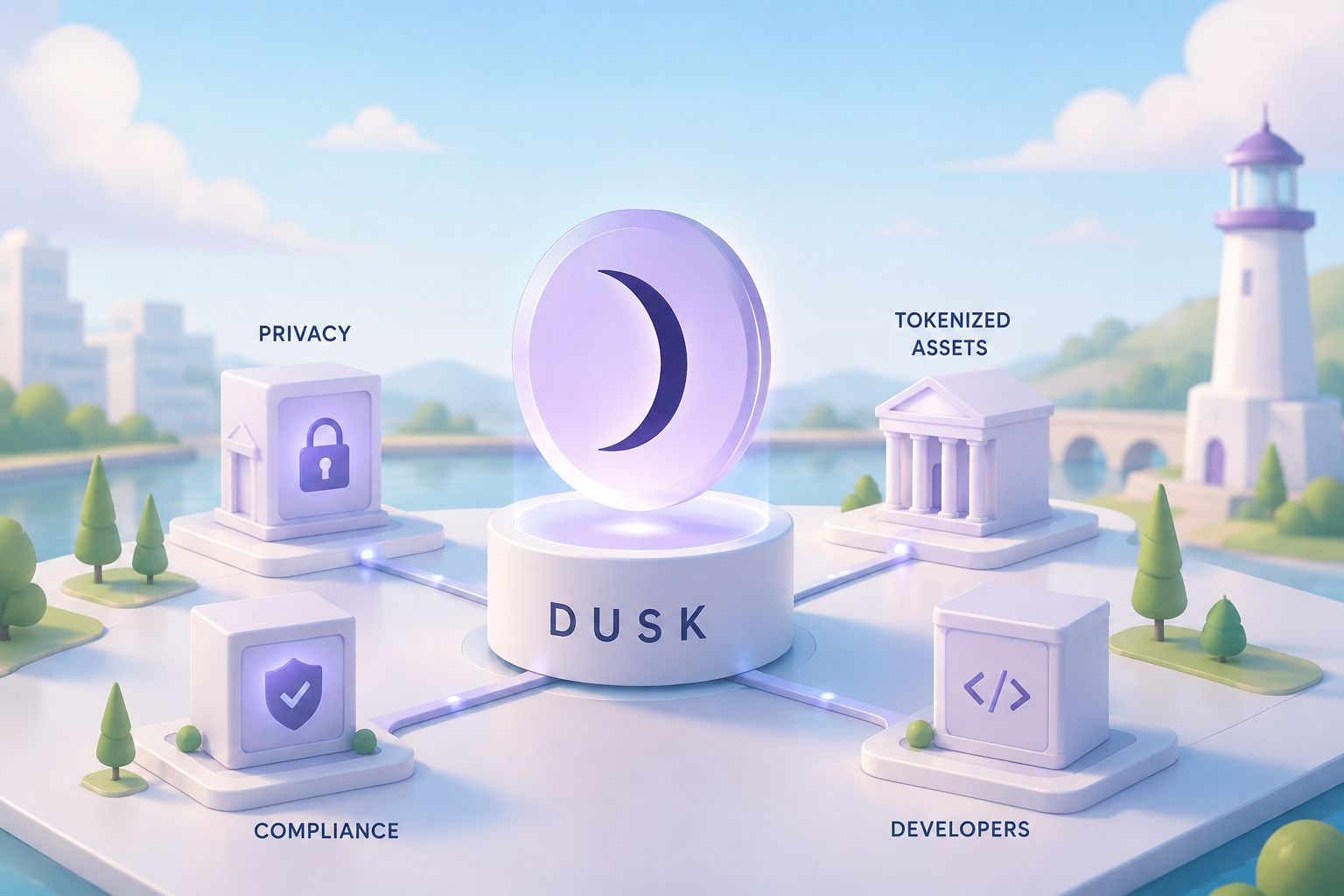
That’s one reason I keep looking at $DUSK differently. The interesting part isn’t just another blockchain trying to attract capital. It’s the possibility of turning financial rules into reusable infrastructure.
Imagine a developer building a permission or compliance module once, then another application using the same logic instead of spending months recreating it. That’s where the open-source comparison starts making sense.
But the real test is what happens afterwards.
Do users actually return because the system solves something they need?
Can developers earn from modules that keep getting reused rather than chasing a new launch every few weeks?
And for operators, is there enough economic reason to verify information honestly when nobody is watching?
Those questions matter more to me than raw transaction counts.
Because activity can be misleading. A network can show impressive numbers while the same capital simply moves around between connected wallets. Demand can be manufactured. Verification can be weak. And token unlocks can create selling pressure even while the underlying infrastructure improves.
So I’m watching for something harder to fake: repeated, useful behaviour from different participants.
If Dusk can create that loop between developers, users and regulated financial applications, the infrastructure thesis gets much stronger.
But I’m not there yet.
For me, $DUSK remains a watching closely thesis — interesting enough to follow, but still needing real usage to prove the story.
For a long time, I looked at exchange listings almost like a shortcut to understanding value.
More listings meant more liquidity. More liquidity meant more attention. And more attention usually made a project feel important.
Experience changed that view for me.
The harder question is what remains when nobody is talking about it.
That’s one reason I keep looking at $DUSK differently. The interesting part isn’t just another blockchain trying to attract capital. It’s the possibility of turning financial rules into reusable infrastructure.
Imagine a developer building a permission or compliance module once, then another application using the same logic instead of spending months recreating it. That’s where the open-source comparison starts making sense.
But the real test is what happens afterwards.
Do users actually return because the system solves something they need?
Can developers earn from modules that keep getting reused rather than chasing a new launch every few weeks?
And for operators, is there enough economic reason to verify information honestly when nobody is watching?
Those questions matter more to me than raw transaction counts.
Because activity can be misleading. A network can show impressive numbers while the same capital simply moves around between connected wallets. Demand can be manufactured. Verification can be weak. And token unlocks can create selling pressure even while the underlying infrastructure improves.
So I’m watching for something harder to fake: repeated, useful behaviour from different participants.
If Dusk can create that loop between developers, users and regulated financial applications, the infrastructure thesis gets much stronger.
But I’m not there yet.
For me, $DUSK remains a watching closely thesis — interesting enough to follow, but still needing real usage to prove the story.
$BTC
Riley Monroe
·
--
#dusk $DUSK @Dusk @Dusk What Actually Sticks?
I used to read a lot into the visible stuff.
New listing. Bigger volume. More wallets showing up. It was easy to assume that if the numbers were moving, the network itself must be getting stronger.
Now I’m a bit more careful with that.
What interests me about Dusk is a quieter question: can financial infrastructure become something other products actually build around?
That’s a different kind of value.
Instead of every developer creating the same checks, permissions and compliance logic again and again, the useful pieces could be built once and plugged into different applications. Almost like shared software, but for regulated onchain finance.
And this is where I think the retention question gets interesting.
A user doesn’t return because a token had a good week. They return because something they need is still there.
A developer has a reason to stay if a module they built keeps getting used and can generate value beyond one application.
An operator has a reason to behave honestly if verification itself is economically useful, not just another box to tick.
That sounds good on paper. Crypto has plenty of ideas that sound good on paper.
The harder part is proving the activity isn’t manufactured. A growing transaction count can still be the same capital taking different routes. Verification can become weak if incentives are wrong. And supply dynamics can still create pressure even when the product story looks stronger.
So I’m not treating $DUSK as a finished success story.
I’m more interested in what happens when the attention moves elsewhere.
If people still build, transact and reuse the infrastructure then, that tells me much more than a temporary volume spike ever could.
That’s the part of Dusk I’m watching closely. $DUSK
I used to read a lot into the visible stuff.
New listing. Bigger volume. More wallets showing up. It was easy to assume that if the numbers were moving, the network itself must be getting stronger.
Now I’m a bit more careful with that.
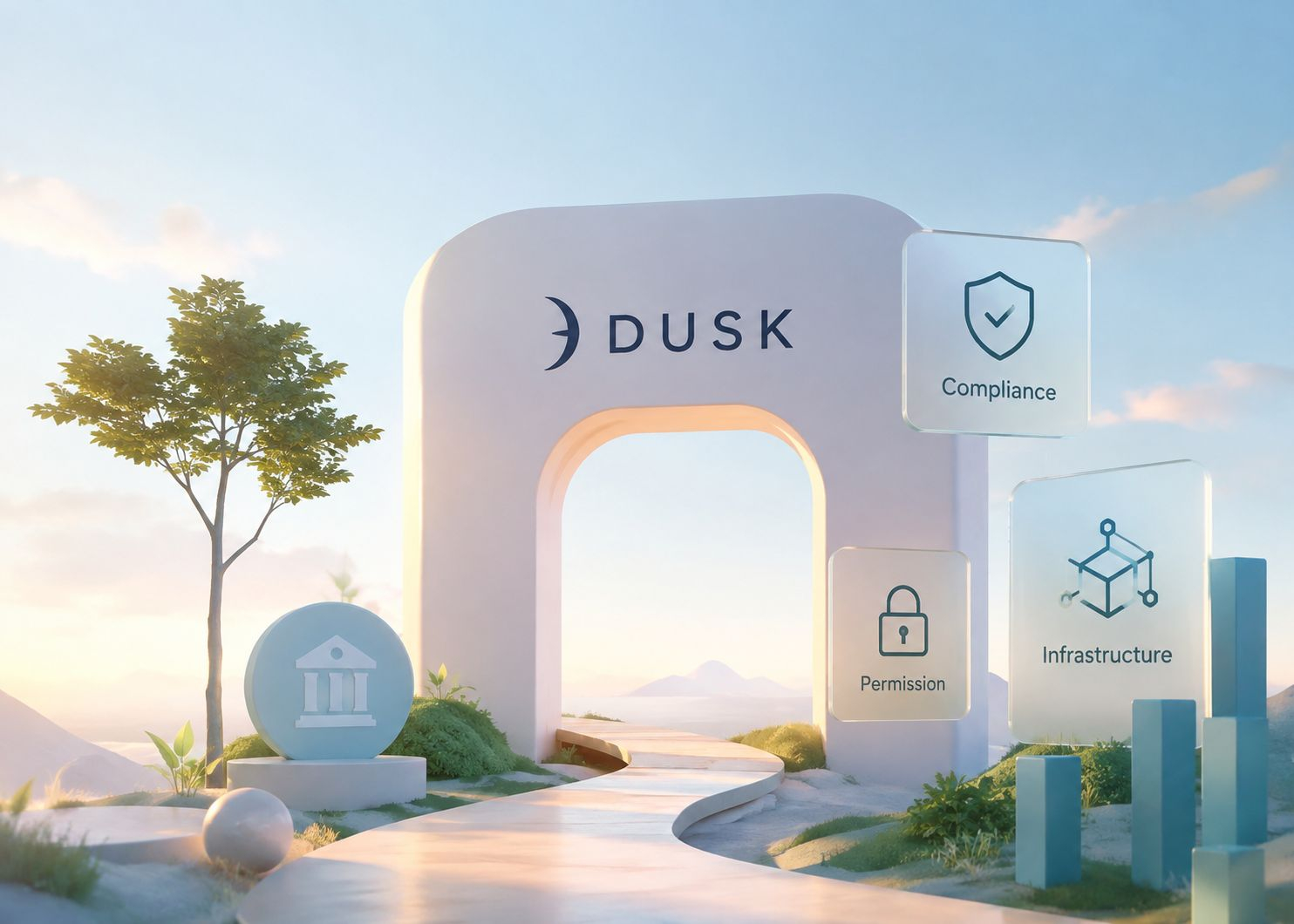
What interests me about Dusk is a quieter question: can financial infrastructure become something other products actually build around?
That’s a different kind of value.
Instead of every developer creating the same checks, permissions and compliance logic again and again, the useful pieces could be built once and plugged into different applications. Almost like shared software, but for regulated onchain finance.
And this is where I think the retention question gets interesting.
A user doesn’t return because a token had a good week. They return because something they need is still there.
A developer has a reason to stay if a module they built keeps getting used and can generate value beyond one application.
An operator has a reason to behave honestly if verification itself is economically useful, not just another box to tick.
That sounds good on paper. Crypto has plenty of ideas that sound good on paper.
The harder part is proving the activity isn’t manufactured. A growing transaction count can still be the same capital taking different routes. Verification can become weak if incentives are wrong. And supply dynamics can still create pressure even when the product story looks stronger.
So I’m not treating $DUSK as a finished success story.
I’m more interested in what happens when the attention moves elsewhere.
If people still build, transact and reuse the infrastructure then, that tells me much more than a temporary volume spike ever could.
That’s the part of Dusk I’m watching closely. $DUSK
$NVDAB
R I C H A R D B L O C K
·
--
#dusk $DUSK @Dusk @Dusk What Happens After The Noise?
For a long time, I judged a crypto project by the things everyone could see first: exchange support, rising volume, deeper liquidity. It was easy to believe that if the market was busy, the product must be working.
Experience made me slow down on that idea.
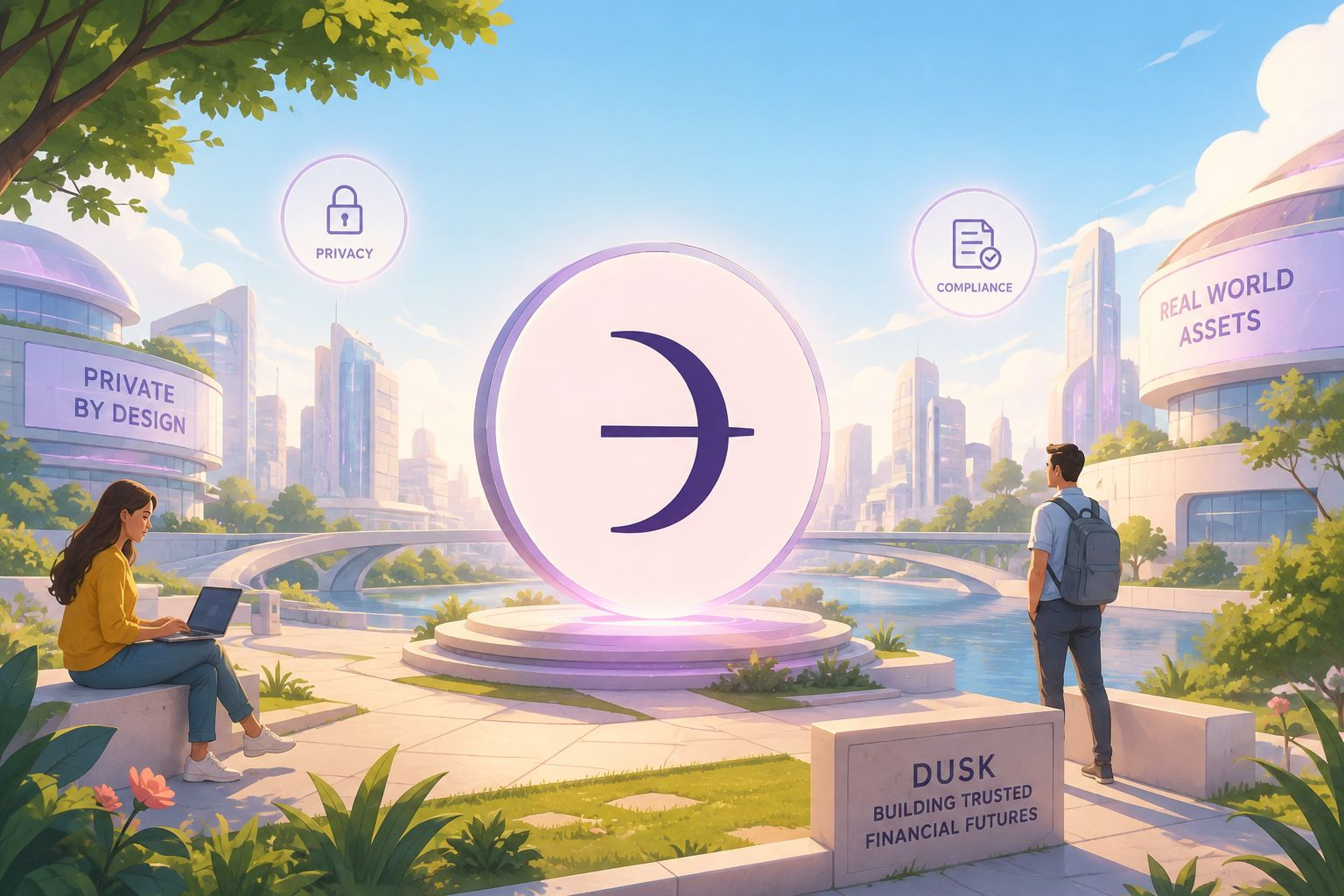
With $DUSK, I’m more interested in something less visible: can useful financial infrastructure be built once and then used again by completely different applications?
That sounds a lot like open-source software to me.
A developer could create a compliance, permission or verification component, and another team could build on top of it instead of spending months recreating the same machinery. If that works, the developer has a reason to maintain the module because other users can create value around it too.
But the real test is retention.
When the launch excitement disappears, what brings the user back?
Not incentives alone. There has to be something the application makes easier, safer or faster.
Developers also need a reason to stay. Reusable modules could give them an economic path beyond getting attention for one launch.
And network operators have an even harder job. Verification only matters if the incentives reward honest work. Otherwise, crypto can manufacture activity that looks impressive on a dashboard but means very little underneath.
I still have questions. Fake demand, recycled transactions and token unlock pressure can distort the picture quickly.
So I’m not treating $DUSK as a proven winner.
I’m watching one thing closely: does usage keep returning when nobody is being paid to pretend it matters?
That answer will tell me much more than a temporary volume spike.
For a long time, I judged a crypto project by the things everyone could see first: exchange support, rising volume, deeper liquidity. It was easy to believe that if the market was busy, the product must be working.
Experience made me slow down on that idea.
With $DUSK, I’m more interested in something less visible: can useful financial infrastructure be built once and then used again by completely different applications?
That sounds a lot like open-source software to me.
A developer could create a compliance, permission or verification component, and another team could build on top of it instead of spending months recreating the same machinery. If that works, the developer has a reason to maintain the module because other users can create value around it too.
But the real test is retention.
When the launch excitement disappears, what brings the user back?
Not incentives alone. There has to be something the application makes easier, safer or faster.
Developers also need a reason to stay. Reusable modules could give them an economic path beyond getting attention for one launch.
And network operators have an even harder job. Verification only matters if the incentives reward honest work. Otherwise, crypto can manufacture activity that looks impressive on a dashboard but means very little underneath.
I still have questions. Fake demand, recycled transactions and token unlock pressure can distort the picture quickly.
So I’m not treating $DUSK as a proven winner.
I’m watching one thing closely: does usage keep returning when nobody is being paid to pretend it matters?
That answer will tell me much more than a temporary volume spike.
#dusk $DUSK @Dusk @Dusk The Part I’m Watching Now
For a long time, I looked at exchange listings and liquidity almost like a shortcut for judging a crypto project.
More markets, more volume, more attention — it felt like progress.
But experience changed that for me. I’ve seen liquidity show up, create excitement, and then leave without leaving much behind.
With $DUSK , the question feels a little different.
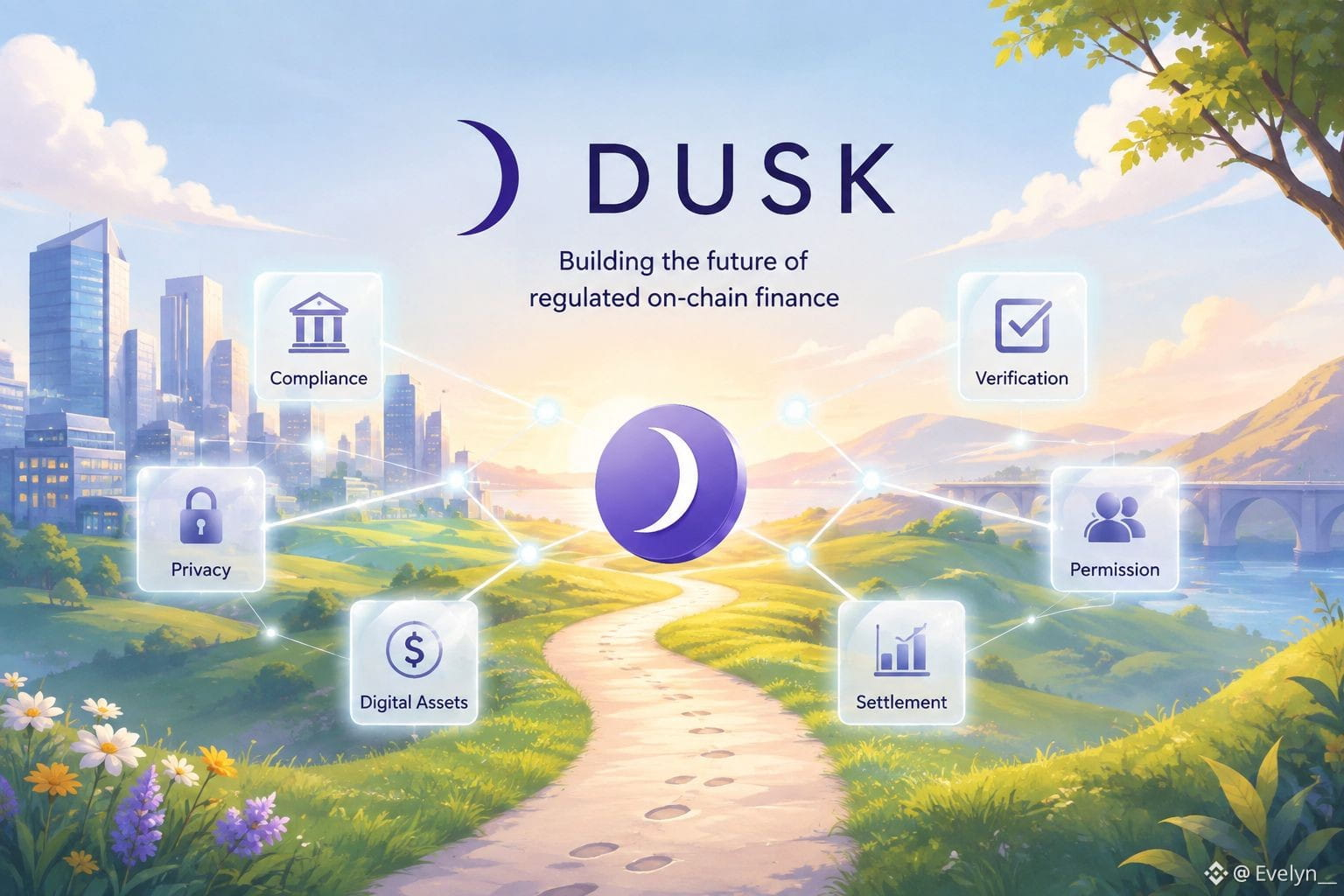
What if the valuable part of financial infrastructure isn’t the chain itself, but the logic built on top of it?
A developer could create a compliance check, permission layer or privacy component once, then another team could plug it into their own product instead of starting from zero. That’s closer to open-source software than the usual “launch, list, hype” cycle.
And this is where retention becomes interesting.
Users have a reason to return when an application solves something they actually need, not because the token is trending.
Developers have a reason to keep building when their modules can be reused and generate value beyond one deployment.
Operators have a different responsibility. Verification has to be worth doing properly. If bad data gets rewarded, the whole system can look active while becoming less trustworthy underneath.
I’m still skeptical, though.
How much activity is genuinely new? How much is recycled between the same wallets? Are people using the infrastructure because it’s useful, or because incentives temporarily make it profitable? And token unlock pressure can change the picture quickly.
That’s why I’m not treating $DUSK as a confirmed winner.
I’m watching one thing instead:
Can the infrastructure create reasons to come back when the hype is gone?
If yes, that matters to me far more than another exchange listing.
For a long time, I looked at exchange listings and liquidity almost like a shortcut for judging a crypto project.
More markets, more volume, more attention — it felt like progress.
But experience changed that for me. I’ve seen liquidity show up, create excitement, and then leave without leaving much behind.
With $DUSK , the question feels a little different.
What if the valuable part of financial infrastructure isn’t the chain itself, but the logic built on top of it?
A developer could create a compliance check, permission layer or privacy component once, then another team could plug it into their own product instead of starting from zero. That’s closer to open-source software than the usual “launch, list, hype” cycle.
And this is where retention becomes interesting.
Users have a reason to return when an application solves something they actually need, not because the token is trending.
Developers have a reason to keep building when their modules can be reused and generate value beyond one deployment.
Operators have a different responsibility. Verification has to be worth doing properly. If bad data gets rewarded, the whole system can look active while becoming less trustworthy underneath.
I’m still skeptical, though.
How much activity is genuinely new? How much is recycled between the same wallets? Are people using the infrastructure because it’s useful, or because incentives temporarily make it profitable? And token unlock pressure can change the picture quickly.
That’s why I’m not treating $DUSK as a confirmed winner.
I’m watching one thing instead:
Can the infrastructure create reasons to come back when the hype is gone?
If yes, that matters to me far more than another exchange listing.
$BTC
Riley Monroe
·
--
#dusk $DUSK @Dusk @Dusk What Stays After The Hype?
I remember a time when I looked at a new token and the first things I cared about were listings, volume and liquidity. If the order book looked healthy and bigger exchanges were involved, it felt like the project had already proved something.
Experience changed that for me.
Now I’m more interested in what people actually keep using once the attention moves somewhere else.
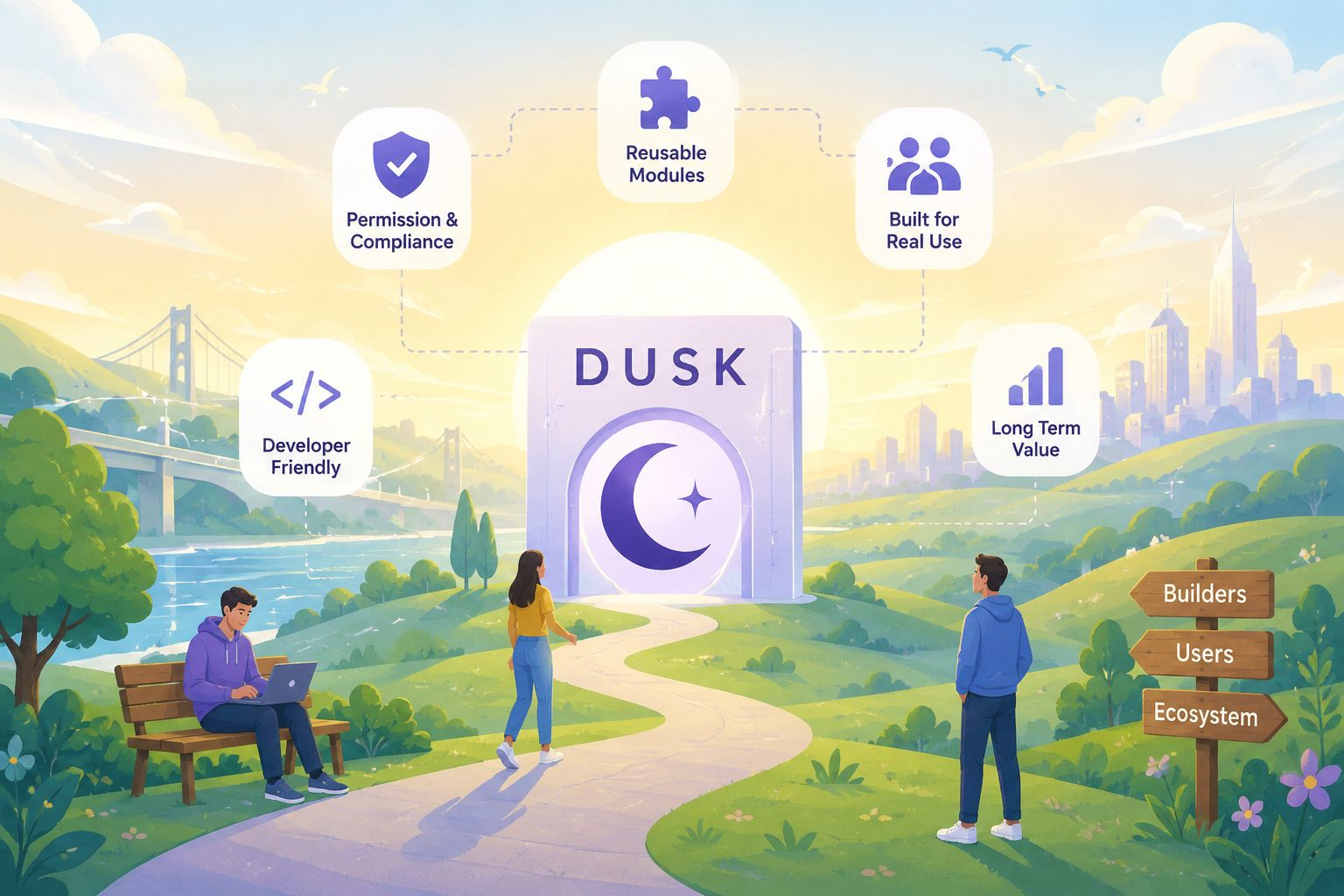
That’s where Dusk has caught my attention recently. The DuskEVM testnet opened another route for developers, with familiar Solidity and Hardhat tools. But honestly, the tooling itself isn’t what would convince me.
The real test is what gets built on top of it, and whether people have a reason to return.
I keep coming back to one idea here: reusable financial logic.
Instead of every team creating its own permission rules, compliance checks or verification systems from scratch, useful modules could become building blocks that other applications plug into. Similar to how open-source software saves developers from solving the same problem again and again.
That could create a much healthier loop.
A developer makes something useful → others reuse it → the developer has a reason to maintain it → users get applications that become more useful over time.
But there’s a weak point I can’t ignore.
Usage can be manufactured. Verification can be poorly designed. And token unlocks can create selling pressure even when the underlying technology is improving.
Even growing transaction numbers need a second look. Are new users arriving, or are the same wallets just generating more activity?
That’s what I’m watching with $DUSK.
I’m interested, but I’m not calling it a success yet. For me, the bigger signal will be whether activity survives after the narrative gets quieter.
If it does, $DUSK becomes much more interesting.
If it doesn’t, at least the numbers will tell us the story was mostly hype.
I remember a time when I looked at a new token and the first things I cared about were listings, volume and liquidity. If the order book looked healthy and bigger exchanges were involved, it felt like the project had already proved something.
Experience changed that for me.
Now I’m more interested in what people actually keep using once the attention moves somewhere else.
That’s where Dusk has caught my attention recently. The DuskEVM testnet opened another route for developers, with familiar Solidity and Hardhat tools. But honestly, the tooling itself isn’t what would convince me.
The real test is what gets built on top of it, and whether people have a reason to return.
I keep coming back to one idea here: reusable financial logic.
Instead of every team creating its own permission rules, compliance checks or verification systems from scratch, useful modules could become building blocks that other applications plug into. Similar to how open-source software saves developers from solving the same problem again and again.
That could create a much healthier loop.
A developer makes something useful → others reuse it → the developer has a reason to maintain it → users get applications that become more useful over time.
But there’s a weak point I can’t ignore.
Usage can be manufactured. Verification can be poorly designed. And token unlocks can create selling pressure even when the underlying technology is improving.
Even growing transaction numbers need a second look. Are new users arriving, or are the same wallets just generating more activity?
That’s what I’m watching with $DUSK.
I’m interested, but I’m not calling it a success yet. For me, the bigger signal will be whether activity survives after the narrative gets quieter.
If it does, $DUSK becomes much more interesting.
If it doesn’t, at least the numbers will tell us the story was mostly hype.
$NVDAB
R I C H A R D B L O C K
·
--
#dusk $DUSK @Dusk @Dusk The Part I’m Watching
I’ve started paying less attention to what makes a crypto project look busy, and more attention to what makes people actually need it.
That sounds obvious, but markets have a funny way of making activity look like progress. A token can get attention, volume can spike, and suddenly the whole thing feels bigger than it really is.
With Dusk, the part I keep coming back to is the infrastructure underneath the headlines.
Imagine a developer building a financial app. Instead of creating every permission rule, identity check or compliance process from zero, they could plug into logic that already exists and adapt it to their own product. That’s a much more useful kind of infrastructure to me. Build once, use many times.
But then comes the harder question: what keeps the system alive six months later?
If users return because the application still does something they need, that matters more than a temporary campaign. If developers can earn whenever their modules are used elsewhere, there’s a reason for them to keep improving them too.
And the operators have to play their part. Verification only has value if there’s a real incentive to get it right. Otherwise, a network can look active while the underlying information is barely trustworthy.
That’s where my skepticism kicks in with $DUSK.
How much of the activity is genuine? How much could simply be incentives, repeated transactions, or users moving around because rewards are available? And when token supply changes, do those incentives still hold up?
Those questions matter more to me than another big narrative.
If Dusk can turn its infrastructure into something developers repeatedly rely on, while users have real reasons to stay, then $DUSK becomes a much more interesting case.
For now, I’m not convinced either way. I’m watching what happens after the excitement wears off. That’s usually where the real signal starts.
I’ve started paying less attention to what makes a crypto project look busy, and more attention to what makes people actually need it.
That sounds obvious, but markets have a funny way of making activity look like progress. A token can get attention, volume can spike, and suddenly the whole thing feels bigger than it really is.
With Dusk, the part I keep coming back to is the infrastructure underneath the headlines.
Imagine a developer building a financial app. Instead of creating every permission rule, identity check or compliance process from zero, they could plug into logic that already exists and adapt it to their own product. That’s a much more useful kind of infrastructure to me. Build once, use many times.
But then comes the harder question: what keeps the system alive six months later?
If users return because the application still does something they need, that matters more than a temporary campaign. If developers can earn whenever their modules are used elsewhere, there’s a reason for them to keep improving them too.
And the operators have to play their part. Verification only has value if there’s a real incentive to get it right. Otherwise, a network can look active while the underlying information is barely trustworthy.
That’s where my skepticism kicks in with $DUSK.
How much of the activity is genuine? How much could simply be incentives, repeated transactions, or users moving around because rewards are available? And when token supply changes, do those incentives still hold up?
Those questions matter more to me than another big narrative.
If Dusk can turn its infrastructure into something developers repeatedly rely on, while users have real reasons to stay, then $DUSK becomes a much more interesting case.
For now, I’m not convinced either way. I’m watching what happens after the excitement wears off. That’s usually where the real signal starts.

#dusk $DUSK @Dusk @Dusk Listings Used To Fool Me
For a long time, I thought crypto value was mostly about listings and liquidity.
Get listed on bigger exchanges, volume comes in, price moves, attention follows. Simple.
But after watching enough cycles, I started questioning that idea. Liquidity can arrive in a day and disappear just as fast.
What interests me more now is reusable financial logic.
That’s where Dusk keeps getting my attention.
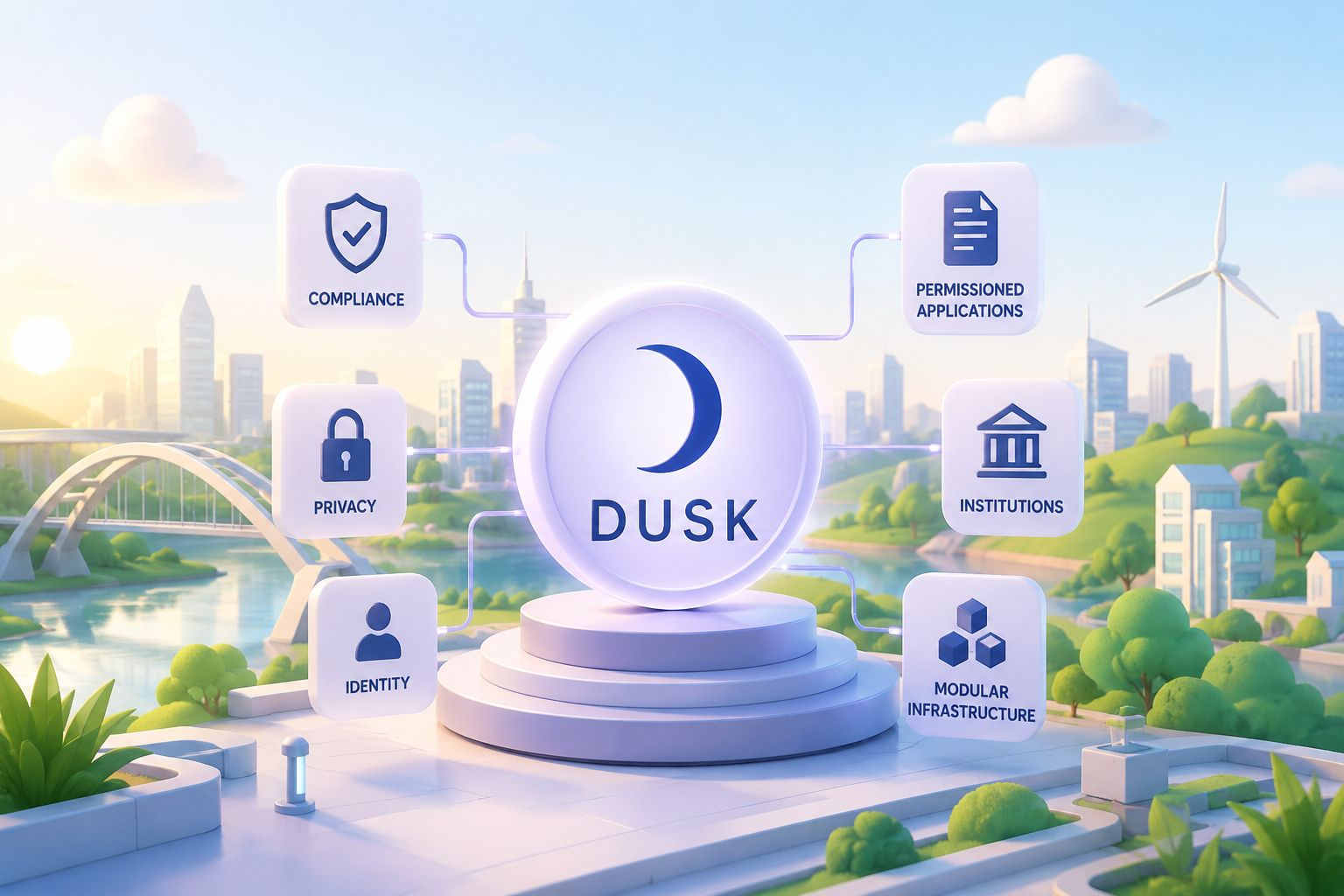
The interesting part isn't just another chain or another token. It’s the possibility of developers building permission, compliance and verification modules once, then letting others reuse that logic instead of rebuilding the same financial plumbing from zero.
That creates a different retention loop.
Why would users come back after the hype disappears?
Not because everyone is talking about $DUSK , but because the applications they actually use still need the underlying infrastructure.
And developers could potentially earn from modules that keep getting reused. Build once, improve it, let others integrate it. That feels much closer to open-source software than the usual “launch, farm, dump” cycle.
But I’m not completely sold.
Who verifies the verification layer? Operators need honest incentives, otherwise “compliance” can become another marketing word.
And there are obvious risks: fake demand, weak verification, recycled transactions, and token unlock pressure.
So I’m watching one thing closely: is activity actually growing because people need the infrastructure, or are we just seeing the same liquidity move around again?
For me, Dusk is still a watching-closely thesis, not a confirmed success.
The infrastructure idea is interesting. Now the usage has to prove it.
For a long time, I thought crypto value was mostly about listings and liquidity.
Get listed on bigger exchanges, volume comes in, price moves, attention follows. Simple.
But after watching enough cycles, I started questioning that idea. Liquidity can arrive in a day and disappear just as fast.
What interests me more now is reusable financial logic.
That’s where Dusk keeps getting my attention.
The interesting part isn't just another chain or another token. It’s the possibility of developers building permission, compliance and verification modules once, then letting others reuse that logic instead of rebuilding the same financial plumbing from zero.
That creates a different retention loop.
Why would users come back after the hype disappears?
Not because everyone is talking about $DUSK , but because the applications they actually use still need the underlying infrastructure.
And developers could potentially earn from modules that keep getting reused. Build once, improve it, let others integrate it. That feels much closer to open-source software than the usual “launch, farm, dump” cycle.
But I’m not completely sold.
Who verifies the verification layer? Operators need honest incentives, otherwise “compliance” can become another marketing word.
And there are obvious risks: fake demand, weak verification, recycled transactions, and token unlock pressure.
So I’m watching one thing closely: is activity actually growing because people need the infrastructure, or are we just seeing the same liquidity move around again?
For me, Dusk is still a watching-closely thesis, not a confirmed success.
The infrastructure idea is interesting. Now the usage has to prove it.
$NVDAB
Riley Monroe
·
--
#dusk $DUSK @Dusk @Dusk Liquidity Wasn’t the Whole Story
For a long time, I honestly thought the biggest sign of a crypto project’s value was pretty simple: get listed, attract liquidity, watch the volume grow.
Then I watched enough launches to become a little less convinced.
A token can have liquidity and still have very little reason for people to stay.
That’s why Dusk has caught my attention from a different angle. The interesting part isn’t just another chain or another tokenized asset story. It’s the idea of making financial rules reusable.
Think about open-source software. A developer builds something once, other people use it, improve it, and build on top of it. Financial infrastructure could work in a similar way.
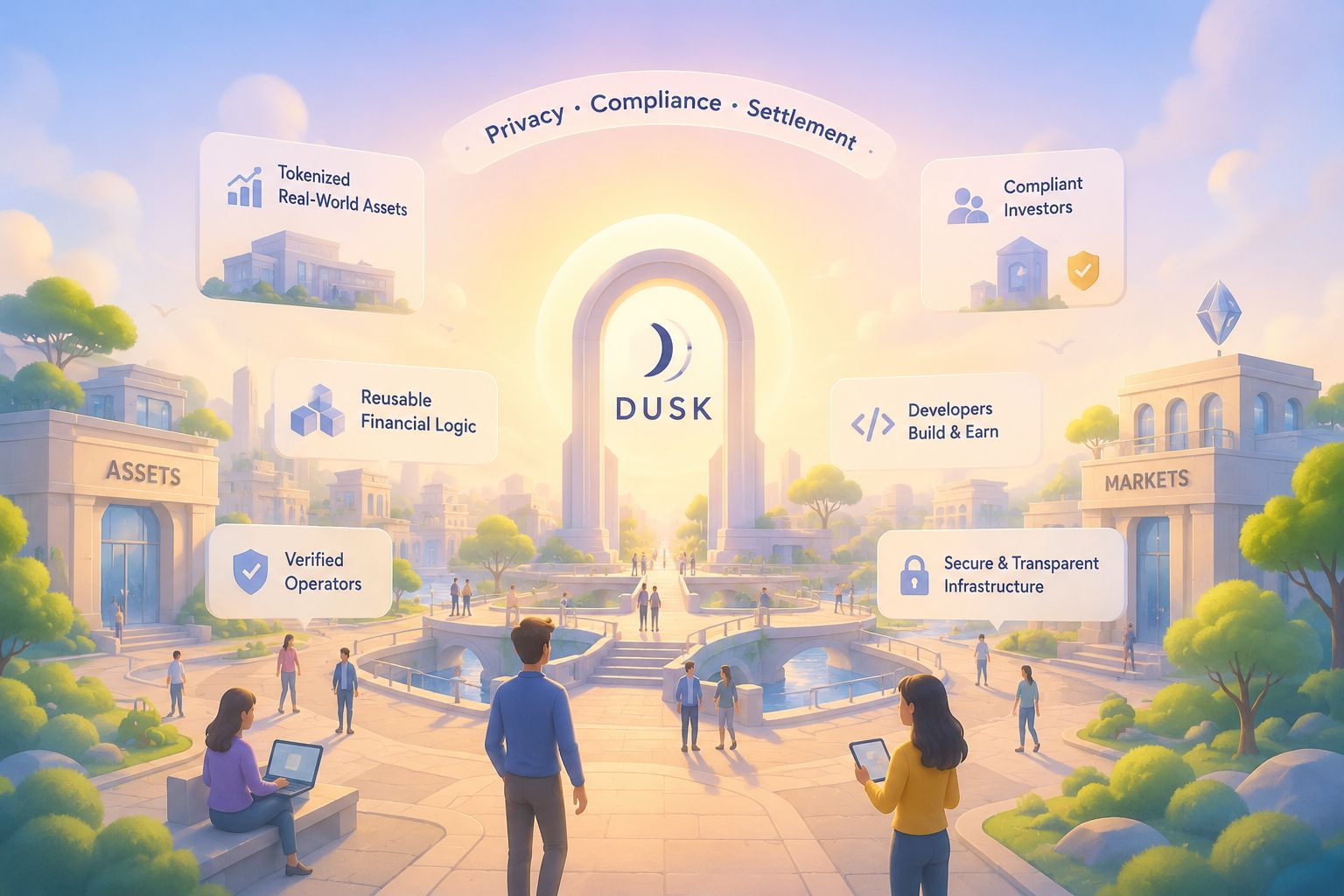
A developer could create a compliance, permission, or eligibility module once, and other applications could reuse that logic instead of rebuilding the same system every time.
But here’s where I think the real test begins.
Why would users come back after the initial hype?
Maybe because the infrastructure keeps doing something useful in the background.
Why would developers keep building?
If reusable modules can actually create value or revenue, there’s a reason to maintain them instead of chasing the next narrative.
And operators? They need incentives to verify things honestly. Otherwise “verification” can quickly become another box people tick without much meaning.
I’m still skeptical, though. Fake demand is possible. Weak verification is possible. Token unlock pressure can distort incentives too.
And I’d want to know whether growing activity represents genuinely new usage or just the same transactions being recycled around the ecosystem.
That’s why I’m not calling $DUSK a success yet.
For me, it’s a watching-closely thesis. If the reusable financial logic actually creates retention, then the $DUSK story gets much more interesting.
What matters is what remains when the hype disappears.
For a long time, I honestly thought the biggest sign of a crypto project’s value was pretty simple: get listed, attract liquidity, watch the volume grow.
Then I watched enough launches to become a little less convinced.
A token can have liquidity and still have very little reason for people to stay.
That’s why Dusk has caught my attention from a different angle. The interesting part isn’t just another chain or another tokenized asset story. It’s the idea of making financial rules reusable.
Think about open-source software. A developer builds something once, other people use it, improve it, and build on top of it. Financial infrastructure could work in a similar way.
A developer could create a compliance, permission, or eligibility module once, and other applications could reuse that logic instead of rebuilding the same system every time.
But here’s where I think the real test begins.
Why would users come back after the initial hype?
Maybe because the infrastructure keeps doing something useful in the background.
Why would developers keep building?
If reusable modules can actually create value or revenue, there’s a reason to maintain them instead of chasing the next narrative.
And operators? They need incentives to verify things honestly. Otherwise “verification” can quickly become another box people tick without much meaning.
I’m still skeptical, though. Fake demand is possible. Weak verification is possible. Token unlock pressure can distort incentives too.
And I’d want to know whether growing activity represents genuinely new usage or just the same transactions being recycled around the ecosystem.
That’s why I’m not calling $DUSK a success yet.
For me, it’s a watching-closely thesis. If the reusable financial logic actually creates retention, then the $DUSK story gets much more interesting.
What matters is what remains when the hype disappears.
$BTC
R I C H A R D B L O C K
·
--
#dusk $DUSK @Dusk @Dusk What Actually Brings People Back?
I used to pay way more attention to listings and liquidity.
A project would get listed, volume would jump, everyone would start talking about it, and honestly... it was easy to mistake that attention for real value.
But after watching a few cycles, I started questioning it.
Volume can disappear. Hype definitely does.
What I find more interesting now is what happens after all that is gone.
That’s where Dusk caught my attention.
Not just because of privacy or RWAs, but because of the financial logic being built around the network. I keep thinking about open-source software here. Developers don’t need to build the same basic tools again and again. Someone builds a useful piece once, others improve it, reuse it, and eventually it becomes part of a much bigger system.
Financial infrastructure could work in a similar way.
A developer builds a permission system, compliance module, investor verification tool or settlement component. Another project can reuse it instead of starting from zero.
And that changes the retention question for me.
Why does a user come back when the hype is gone?
Maybe because the application actually became useful.
Why would developers keep building?
Because a good module could potentially be reused across different financial products instead of living inside one project.
And operators? They need a reason to verify things properly. If verification becomes cheap or dishonest, the whole system starts filling with garbage activity.
That’s also where I’d stay cautious.
Crypto has plenty of “usage” that looks impressive until you ask who is actually using it. Are transactions coming from real demand, or are the same assets just being moved around? Then there’s weak verification and, of course, token unlock pressure.
So I’m not calling $DUSK a success.
I’m just watching the idea closely.
If on-chain finance really needs reusable, compliant infrastructure,
I used to pay way more attention to listings and liquidity.
A project would get listed, volume would jump, everyone would start talking about it, and honestly... it was easy to mistake that attention for real value.
But after watching a few cycles, I started questioning it.
Volume can disappear. Hype definitely does.
What I find more interesting now is what happens after all that is gone.
That’s where Dusk caught my attention.
Not just because of privacy or RWAs, but because of the financial logic being built around the network. I keep thinking about open-source software here. Developers don’t need to build the same basic tools again and again. Someone builds a useful piece once, others improve it, reuse it, and eventually it becomes part of a much bigger system.
Financial infrastructure could work in a similar way.
A developer builds a permission system, compliance module, investor verification tool or settlement component. Another project can reuse it instead of starting from zero.
And that changes the retention question for me.
Why does a user come back when the hype is gone?
Maybe because the application actually became useful.
Why would developers keep building?
Because a good module could potentially be reused across different financial products instead of living inside one project.
And operators? They need a reason to verify things properly. If verification becomes cheap or dishonest, the whole system starts filling with garbage activity.
That’s also where I’d stay cautious.
Crypto has plenty of “usage” that looks impressive until you ask who is actually using it. Are transactions coming from real demand, or are the same assets just being moved around? Then there’s weak verification and, of course, token unlock pressure.
So I’m not calling $DUSK a success.
I’m just watching the idea closely.
If on-chain finance really needs reusable, compliant infrastructure,
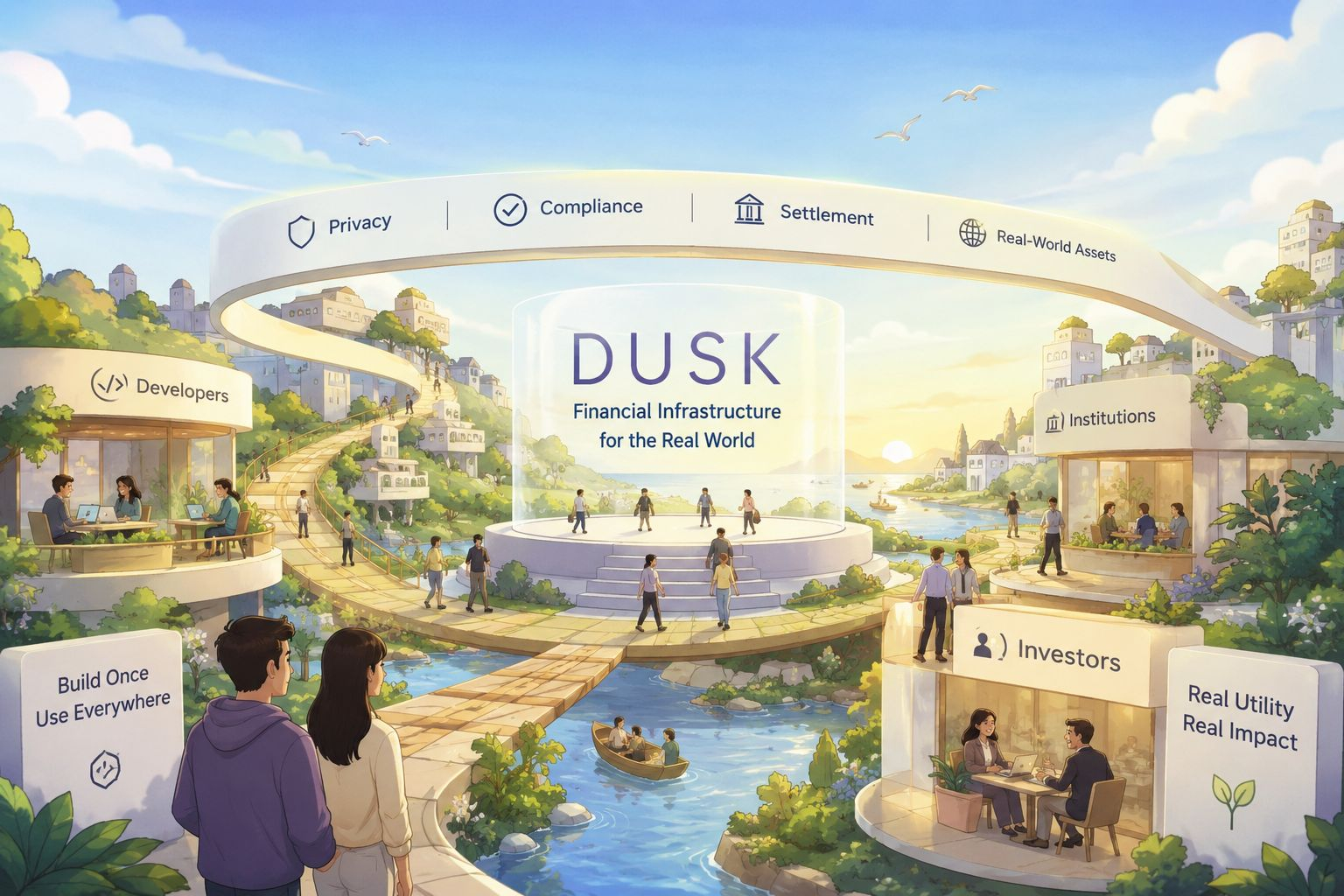
Войдите, чтобы посмотреть больше материала