The line that stopped me during this task was buried in the Genius Terminal docs, almost offhand: "Bridges become pipes. Vaults become config options."
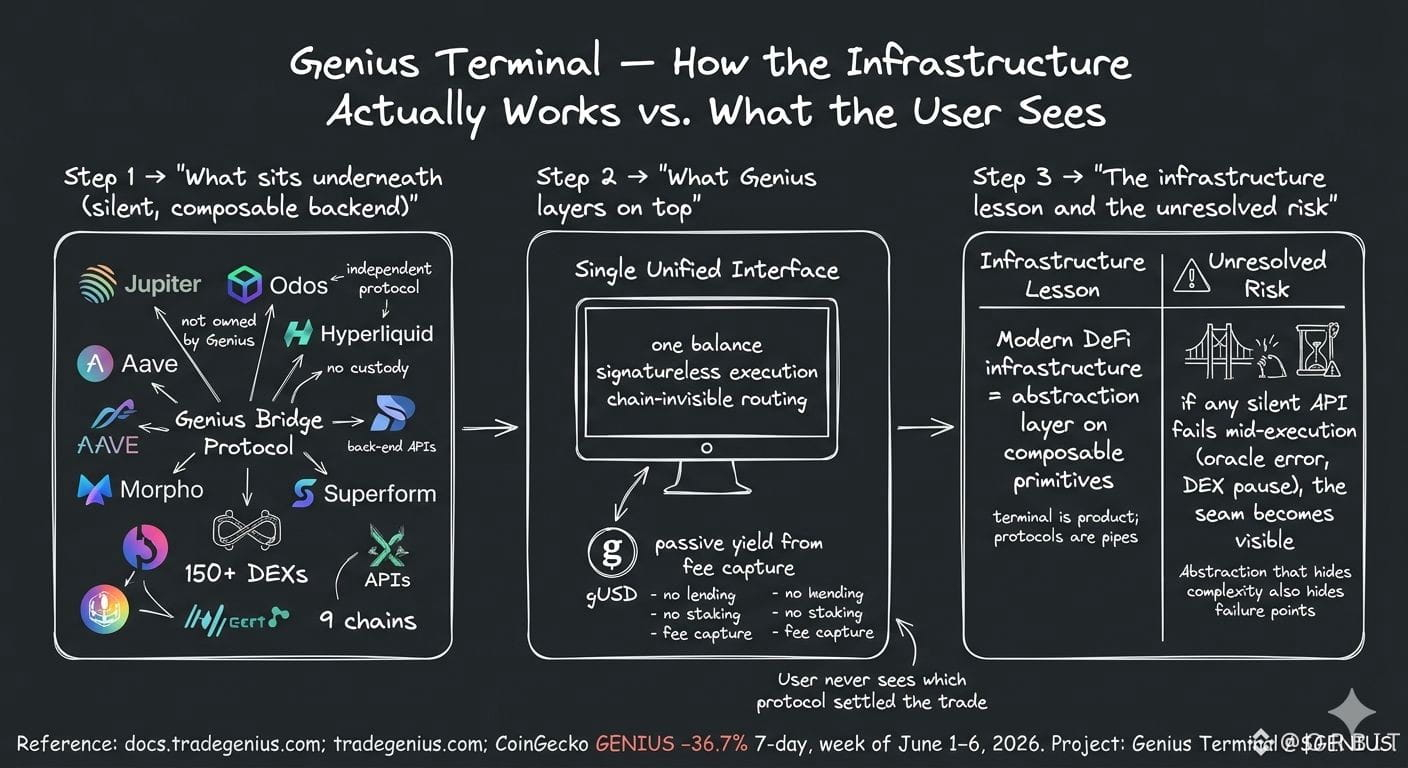
Genius Terminal, $GENIUS , @GeniusOfficial teaches something specific about where modern DeFi infrastructure is actually heading — not through what it builds from scratch, but through what it refuses to expose to the user. The platform doesn't own the liquidity on Jupiter or Odos. It doesn't custody assets. It doesn't run the DEXs it routes through. It just sits on top, treats every underlying protocol as a silent API, and presents one interface.
That's the infrastructure lesson. The gUSD stablecoin earns yield directly from the Genius Bridge Protocol's cross-chain swap fees — no lending, no rehypothecation, just fee capture piped back to holders passively. That design is quiet. With $GENIUS down ~37% over the past 7 days per CoinGecko, and Season 2 GP still running through August 10, the volume that generates those swap fees is real even when the token price isn't cooperating.
I kept thinking about how different that is from the composability stacks most people point to as DeFi infrastructure. Those are protocol-to-protocol. This is terminal-to-protocol. The user never sees the seams.
Hmm… whether that abstraction becomes a moat or a fragility — what happens when one of those silent APIs breaks mid-execution — that's the question I didn't find an answer to.
#genius
Genius Terminal, $GENIUS , @GeniusOfficial teaches something specific about where modern DeFi infrastructure is actually heading — not through what it builds from scratch, but through what it refuses to expose to the user. The platform doesn't own the liquidity on Jupiter or Odos. It doesn't custody assets. It doesn't run the DEXs it routes through. It just sits on top, treats every underlying protocol as a silent API, and presents one interface.
That's the infrastructure lesson. The gUSD stablecoin earns yield directly from the Genius Bridge Protocol's cross-chain swap fees — no lending, no rehypothecation, just fee capture piped back to holders passively. That design is quiet. With $GENIUS down ~37% over the past 7 days per CoinGecko, and Season 2 GP still running through August 10, the volume that generates those swap fees is real even when the token price isn't cooperating.
I kept thinking about how different that is from the composability stacks most people point to as DeFi infrastructure. Those are protocol-to-protocol. This is terminal-to-protocol. The user never sees the seams.
Hmm… whether that abstraction becomes a moat or a fragility — what happens when one of those silent APIs breaks mid-execution — that's the question I didn't find an answer to.
#genius