
One of the earliest airdrops I participated in still sticks with me—and not in a good way.
It wasn’t about the money. It was about how little sense the outcome made.
I had been actively using the protocol well before it gained traction—testing features, interacting regularly, and spending time understanding how it worked. Like many early users, I assumed that kind of engagement would be reflected somehow when tokens were eventually distributed.
It wasn’t.
The allocation I received was negligible. No explanation, no transparency—just a number that felt arbitrary.
What made it worse was seeing others receive significantly more, including people who had barely interacted with the product. One of them was a friend. When we compared notes, the difference came down to something surprisingly simple: he had spread his activity across multiple wallets. Not as part of some calculated exploit—just because that’s how many people operate in crypto today.
That was the moment it stopped feeling like a one-off mistake and started looking like a deeper, systemic issue.
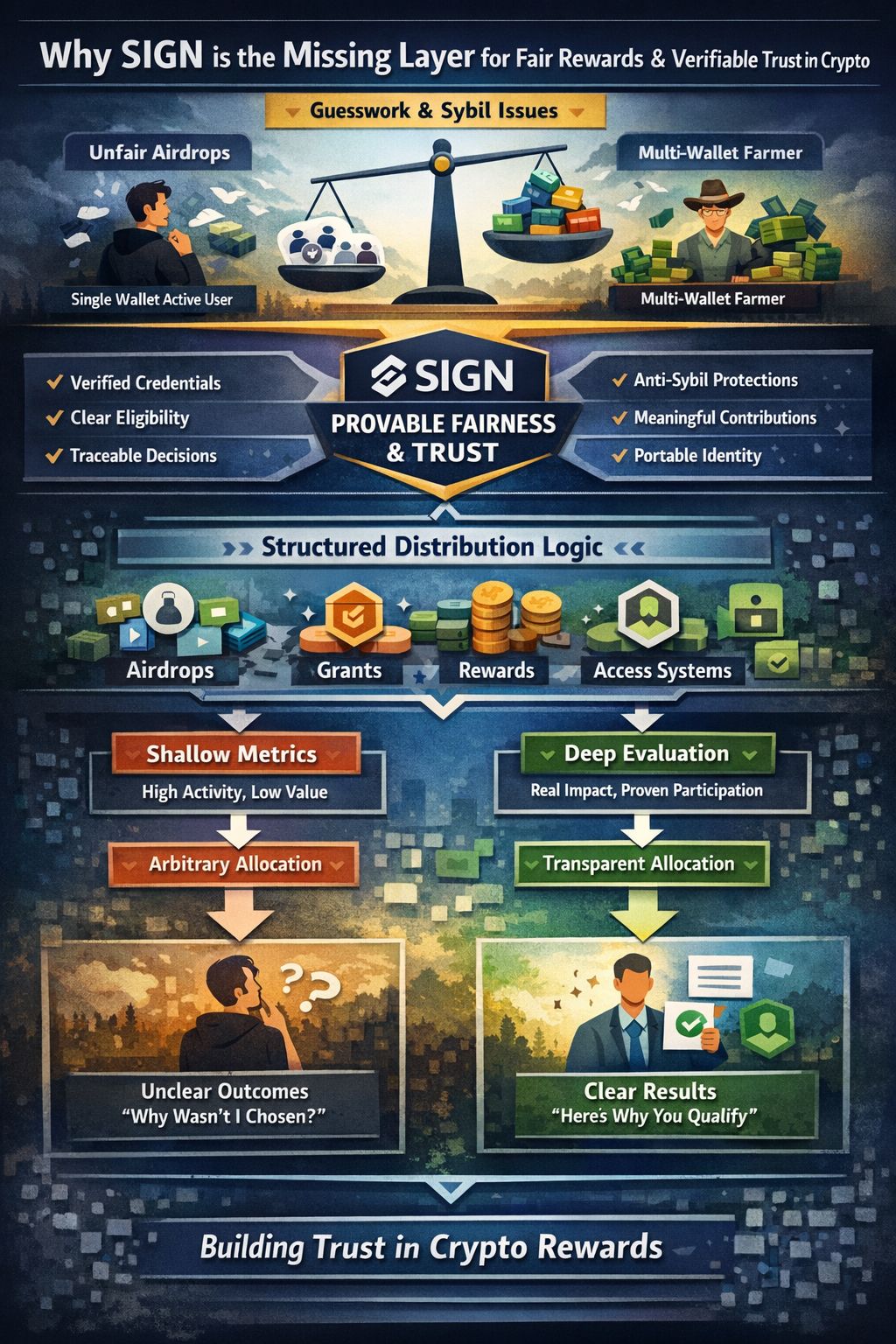
Because when you zoom out, a lot of token distributions still rely on guesswork. Projects claim they want to reward early adopters, real users, and meaningful contributors—but when it comes time to define who those people actually are, things quickly become unclear. Wallet activity, transaction counts, snapshots, spreadsheets, filters, last-minute changes—it all adds up to a process that feels more improvised than intentional.
Somewhere along the way, the idea of fairness gets diluted.
This is exactly the gap SIGN is trying to address—and it’s why it keeps drawing my attention.
It’s not chasing a trendy narrative or trying to repackage an existing idea. It’s tackling a problem crypto has consistently struggled with: how to clearly prove who deserves what, why they deserve it, and whether those decisions can stand up to scrutiny afterward.
That matters more than it seems.
Projects often talk about community and fairness, but when distribution time arrives, the process tends to become reactive. Teams second-guess their own criteria. Concerns about sybil behavior emerge. Edge cases appear. Rules get adjusted—sometimes repeatedly. What starts as a structured plan often ends up feeling like a patchwork of decisions made under pressure.
This isn’t always intentional. In many cases, it’s just a lack of structure.
The tools aren’t strong enough. The standards aren’t defined. The data doesn’t tell the full story. Teams are forced to make complex decisions with incomplete information—and then present the outcome as if it were objective and precise.
Users notice that gap, even if they can’t always articulate it.
They know when something feels off.
What makes SIGN compelling is its attempt to bring clarity and structure to this messy process.
At its core, the idea is straightforward: before distributing value, there should be a reliable way to verify eligibility, explain decisions, and trace how those decisions were made.
It sounds obvious—but crypto has a long history of overlooking obvious problems when they can be temporarily masked by hype or momentum.
The simplest way to understand SIGN is as an effort to build better trust infrastructure. Not the kind of trust based on branding or perception, but system-level trust—the kind that comes from verifiable claims, transparent logic, and traceable outcomes.
That’s why the focus is on credentials, attestations, and structured distribution logic, rather than just raw wallet activity. Instead of reducing participation to a handful of metrics, the goal is to introduce context, proof, and continuity.
Because one of crypto’s biggest weaknesses right now is its lack of meaningful memory.
Yes, actions are recorded on-chain. But those records often lack context. They don’t explain what an action meant, whether it mattered, or how it should influence future decisions. Participation is visible—but shallow.
SIGN is trying to make that participation more legible and reusable. And once you start thinking in those terms, it becomes clear this isn’t just about airdrops.
A major flaw in many crypto systems is the assumption that activity equals value.
It doesn’t.
A wallet can generate high levels of activity without contributing anything meaningful. Meanwhile, someone making fewer but more impactful contributions might go unnoticed. On-chain data provides signals—but not necessarily understanding.
That gap is where unfairness creeps in.
Projects end up rewarding what’s easy to measure, not what actually matters. And because those measurements are often superficial, the results feel superficial too.
SIGN’s approach shifts the model. Instead of asking how many transactions a wallet made, it asks what can be proven about a participant. Claims can be structured, verified, and contextualized. Eligibility becomes something that can be defined with nuance rather than guessed from surface-level data.
It doesn’t solve everything—but it’s a more intelligent starting point.
Of course, no discussion of distribution is complete without addressing sybil behavior.
At this stage, sybil farming isn’t an edge case—it’s part of the environment. Some participants treat airdrops like production systems, managing multiple wallets, distributing activity, and optimizing patterns to maximize returns.
That’s the reality projects are operating in.
So the question isn’t whether SIGN can eliminate sybils entirely. It can’t.
The real question is whether it can make it harder for fake participation to pass as real participation. Whether it can increase the cost of gaming the system. Whether it can force stronger evidence into processes that have historically relied on weak assumptions.
Even partial progress here would matter.
Because in crypto, improvement often comes from making exploitation less efficient—not from achieving perfection.
While airdrops are the most relatable use case, the deeper idea behind SIGN is about identity and portability.
Right now, your history in crypto doesn’t travel well. You can contribute meaningfully to one ecosystem, but when you move to another, that history doesn’t follow you in any structured way. There’s no continuity, no portable trust—just a fresh start every time.
It makes the space feel strangely forgetful.
SIGN is aiming for something different: a system where aspects of your participation can persist as verifiable credentials. Not just traces tied to a wallet, but structured attestations that carry meaning across contexts.
That’s powerful—but it also raises important questions.
Because the same mechanisms that make trust portable can also create exposure. There’s a fine line between useful reputation and invasive transparency. As systems begin to “remember” more, questions around access, control, and privacy become unavoidable.
That tension shouldn’t be ignored.
The benefits are real—but so are the risks.
What sets SIGN apart is that it isn’t just about improving token launches. It’s about building infrastructure for determining eligibility and managing how value is distributed once that eligibility is established.
That extends far beyond airdrops.
Grants, incentive programs, contributor rewards, treasury distributions, access systems—any scenario where value is allocated based on defined rules could benefit from this kind of structure.
That’s a much broader and more important category than it might initially seem.
As crypto matures, these operational challenges become harder to ignore. Over time, markets tend to shift their focus—from narratives to systems that solve recurring problems.
And verification, distribution, and trust are all recurring problems.
That’s why SIGN feels worth paying attention to.
That said, a strong idea doesn’t guarantee success.
Crypto is full of projects that correctly identified real problems but failed to gain traction. Sometimes they were too complex, too early, too difficult to integrate—or simply less convenient than existing, imperfect solutions.
Better design doesn’t automatically win.
People stick with familiar tools. Teams prioritize speed over precision. Convenience often outweighs ideal architecture.
So SIGN doesn’t just need to be conceptually right—it needs to work in practice. It needs to be simple enough for teams to adopt, even under pressure, instead of defaulting back to spreadsheets and manual judgment when things get messy.
That may be the hardest challenge of all.
The most effective infrastructure rarely gets attention. It doesn’t feel exciting. It doesn’t generate hype. It just operates quietly in the background, making everything else function more smoothly.
That’s likely the real goal here.
Not to stand out—but to become standard.
The more I think about SIGN, the more it feels like a project addressing a fundamental weakness in crypto’s foundation. Not price volatility, not narratives—just a basic structural issue: the space still struggles to clearly prove who deserves what.
Until that improves, trust around rewards and incentives will continue to feel fragile.
That’s why SIGN keeps holding my attention.
Not because success is guaranteed. Not because infrastructure is easy. But because the problem is real—and the direction of the solution makes sense.
In the end, the evaluation is simple:
Were the right people rewarded?
Did the process make sense?
And if someone was excluded, could the system clearly explain why?
If SIGN can help crypto answer those questions more reliably, it will matter more than most people expect.
If not, the market will do what it always does.
Move on.
#SignDigitalSovereignInfra @SignOfficial #sign $SIGN