I didn’t come across SIGN all at once. It showed up in small mentions—usually in conversations about verification or distribution that didn’t quite fit into the usual token narratives. Over time, it started to feel less like a product and more like a layer that sits quietly underneath other things.
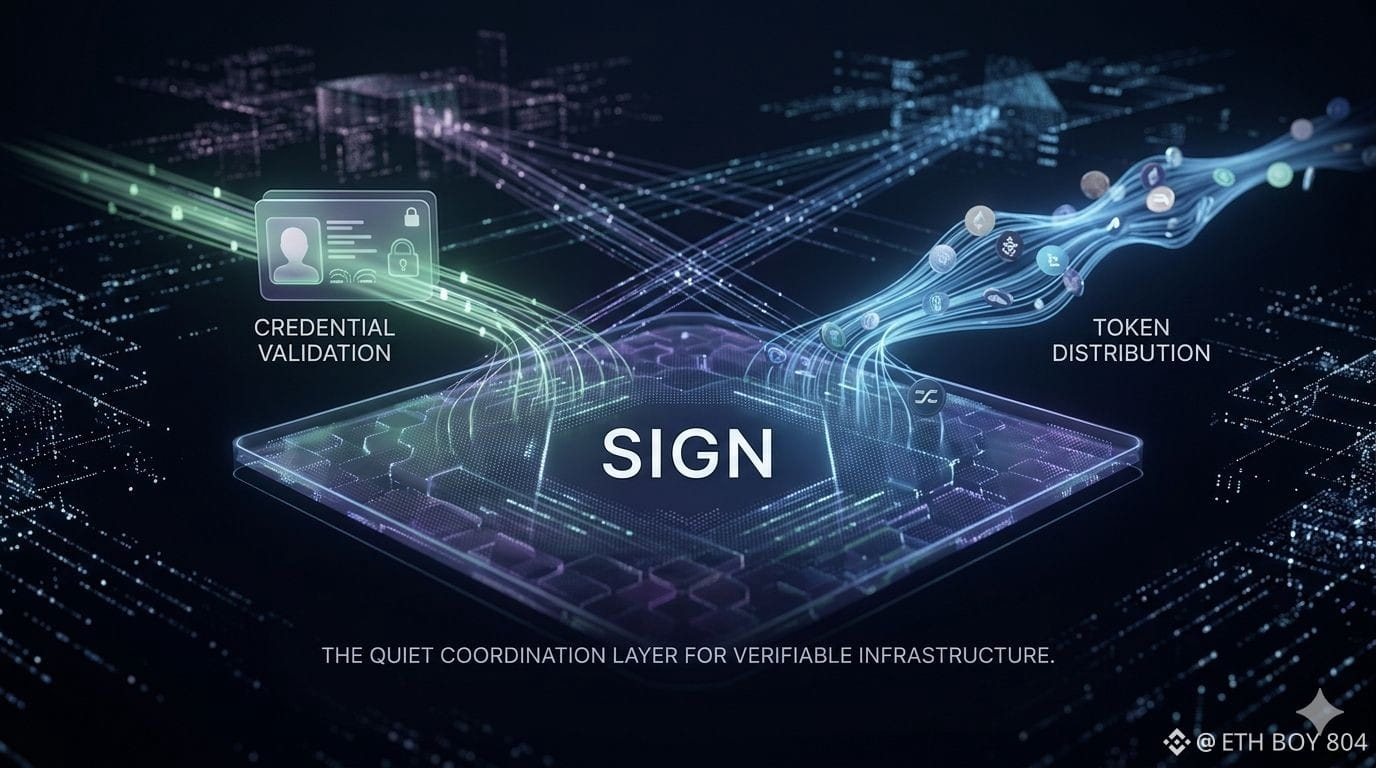
What stands out is how it approaches verification not as a feature, but as infrastructure. Credential validation and token distribution are often treated as separate problems, yet SIGN seems to bring them into the same frame. That creates a kind of coordination layer where identity, eligibility, and access can be handled with more structure than we’re used to seeing.
There’s a subtle strength in that approach. It doesn’t try to redefine trust, but it does try to make it more measurable and portable. Whether that holds up at scale is still an open question. Systems like this tend to reveal their limits only when they’re widely used.
For now, SIGN feels like one of those projects that might matter more over time than it does today—not because of what it promises, but because of the role it’s trying to quietly occupy.
@SignOfficial #SignDigitalSovereignInfra $SIGN
What stands out is how it approaches verification not as a feature, but as infrastructure. Credential validation and token distribution are often treated as separate problems, yet SIGN seems to bring them into the same frame. That creates a kind of coordination layer where identity, eligibility, and access can be handled with more structure than we’re used to seeing.
There’s a subtle strength in that approach. It doesn’t try to redefine trust, but it does try to make it more measurable and portable. Whether that holds up at scale is still an open question. Systems like this tend to reveal their limits only when they’re widely used.
For now, SIGN feels like one of those projects that might matter more over time than it does today—not because of what it promises, but because of the role it’s trying to quietly occupy.
@SignOfficial #SignDigitalSovereignInfra $SIGN