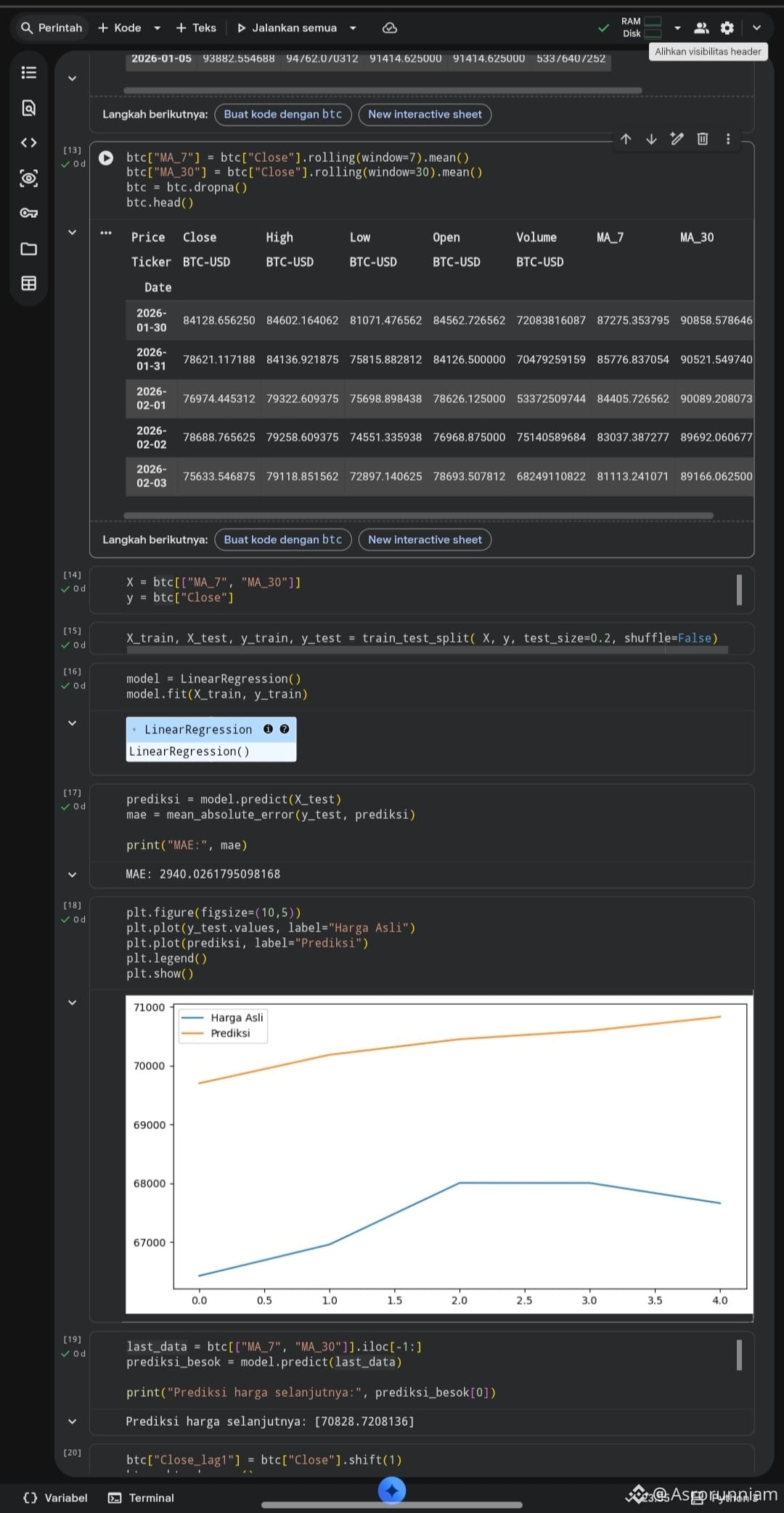
$BTC this analysis presents a structured quantitative approach to forecasting BTC price movements using technical indicators and a supervised machine learning model. the objective is to evaluate how effectively short- and medium-term trend indicators can explain and predict closing price behavior.
Methodology
the model utilizes two key trend-following indicators as predictive features:
MA(7) – 7-day Moving Average to capture short-term momentum
MA(30) – 30-day Moving Average to represent medium-term trend direction
the dataset was split into 80% training and 20% testing data without shuffling to preserve the integrity of the time-series structure. a linear regression model was then trained to predict the closing price based on these moving averages.
Model Performance
mean Absolute Error (MAE): ~2,940 USD
the model successfully tracks the general direction of the trend, indicating that moving averages contain meaningful predictive information. however, deviations between actual and predicted values highlight limitations in capturing high volatility and rapid market fluctuations.
the projected next closing price is approximately $70,828, based on the latest MA(7) and MA(30) values.
Market Interpretation
when MA(7) remains below MA(30), short-term momentum is weaker relative to the medium-term trend.
the regression model demonstrates that BTC price movements exhibit linear dependence on smoothed trend indicators to a certain degree.
however, crypto markets are inherently nonlinear and volatility-driven, meaning linear models may underperform during sharp expansions or corrections.
Potential model enhancements
to improve predictive robustness, future iterations may incorporate:
volume-based indicators
oscillators such as RSI or MACD
lag features (previous close values)
non-linear models such as random forest, gradient boosting, or LSTM neural networks
For educational and research purposes only. not financial advice.
#StrategyBTCPurchase #PredictionMarketsCFTCBacking