

#web3education
web3education
Просмотров: 57,971
857 обсуждают
Популярные
Новые

·
--
CaribDAO isn't chasing hype, it's building the foundation.
$CARIB fuels Web3 education, project incubation, and crowdfunding across a region long left out of tech.
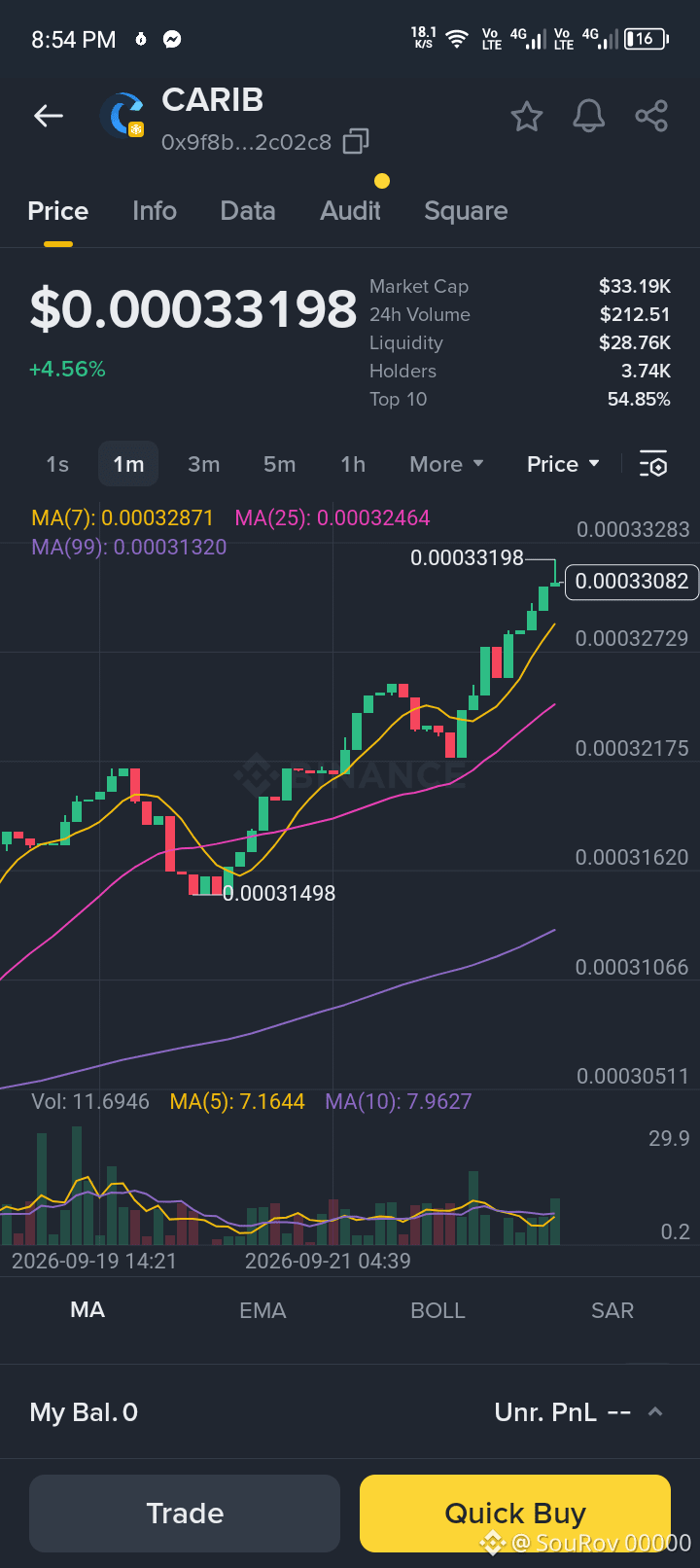
Chart backs the story too. Price up from 0.000298 to 0.000321, EMA 7 crossing back above EMA 25, 3.74K holders and growing.
Community wide awake across Square and X, engagement climbing daily.
This is what real utility looks like before the crowd notices.
#CARIB #web3education
CaribDAO isn't chasing hype, it's building the foundation.
$CARIB fuels Web3 education, project incubation, and crowdfunding across a region long left out of tech.
Chart backs the story too. Price up from 0.000298 to 0.000321, EMA 7 crossing back above EMA 25, 3.74K holders and growing.
Community wide awake across Square and X, engagement climbing daily.
This is what real utility looks like before the crowd notices.
#CARIB #web3education
$CARIB fuels Web3 education, project incubation, and crowdfunding across a region long left out of tech.
Chart backs the story too. Price up from 0.000298 to 0.000321, EMA 7 crossing back above EMA 25, 3.74K holders and growing.
Community wide awake across Square and X, engagement climbing daily.
This is what real utility looks like before the crowd notices.
#CARIB #web3education
2
117

·
--

Статья
An ojol's web3 journal - Part 11: How an Ojol Basecamp Explains Web3 Domain Royalties?Prologue: The Coffee, The Pangkalan (Basecamp), and The Franchise of Identity
Every day before the morning rush hour begins in Kendal Regency, my fellow drivers and I gather at our usual roadside shelter—that we usually called pangkalan (basecamp) in local language (as you can see in my roadside photo below). We sit on wooden benches, drink cheap black coffee, check our phone screens, and wait for the app's algorithm to drop orders.
In the physical world, a Pangkalan (basecamp) is our territory, our identity, and our starting point · But did you know that in the digital wilderness of Web3, you can actually build, own, and monetize your own virtual pangkalan (basecamp)?
· While sipping my hot coffee this morning, I dived into my BitDegree modules to study Freename Top-Level Domains (TLDs). It blew my mind how this Web3 protocol allows everyday people to act like digital land barons, earning passive income without paying recurring annual fees.
As always, I'm just an ojol driver writing down the key takeaways on my handlebars, then refining them into these journals at home. Let’s look at Web3 domains through the simple logic of our roadside pangkalan (basecamp).
What are TLDs and SLDs?
In the traditional internet, a TLD (Top-Level Domain) is the extension at the very end of a website address, like .com, .org, or .net. You don't own them; you just rent them from big centralized corporations.
Freename changes the game by letting you buy and mint your own custom TLDs (like .crypto, .sol, or even .ojol) as an NFT directly into your blockchain wallet. Once you own a TLD, you can issue SLDs (Second-Level Domains) under it, which are the individual names that come before the dot (e.g., learner.bitdegree or driver.ojol).
The Pangkalan Logic: Explaining Web3 Domains on the Asphalt
1. TLD vs. SLD (Basecamp name vs Individual driver name)
· The TLD Analogy: Imagine I legally buy a permanent plot of land in Kendal and set up a registered hub called Pangkalan (basecamp) .ojolkendal. I am the sole owner and governor of this brand extension.
· The SLD Analogy: Now, individual drivers want to join my hub. I give them customized uniform tags like era.ojolkendal, budi.ojolkendal, or agus.ojolkendal. These personalized tags are the Second-Level Domains (SLDs) tied to their specific identities (wallets).
2. Earning Royalties
One of the most powerful features of Freename is the ability to turn your domain namespace into a passive income stream.
· The Street Hustle Analogy: Because my Pangkalan (basecamp) .ojolkendal is located in a highly strategic area, it becomes very popular. Other drivers want to ride under my namespace.
· Freename allows me to turn on royalty rights. Every time a new driver registers an SLD under my TLD (e.g., buying the name delivery.ojolkendal), they pay a registration fee. 50% of that money goes straight into my crypto wallet instantly. It is like receiving a daily pangkalan (basecamp) rental deposit without me having to lift a finger or drive a single mile.
3. No Renewal Fees(Lifetime Ownership Without Security Deposit)
In the traditional web, if you forget to pay your annual domain renewal fee, corporations like GoDaddy will revoke your website and sell it to someone else.
· The Street Hustle Analogy: Usually, maintaining a physical pangkalan (basecamp) requires paying ongoing daily cash or annual space rentals to local land owners. If you stop paying, you get kicked out.
· Freename operates on a no-renewal fee policy. Once I buy my TLD NFT, the smart contract registers it as my permanent property. It is mine forever. No annual recurring charges, no extortion, and no fear of losing my digital storefront.
4. Web3 WHOIS & Trademarks (Member Registration Book & Official Permit Letter)
Freename provides a "WHOIS" explorer to track wallet addresses behind domains and legal worldwide trademark protections backed by Swiss authorities.
· The Street Hustle Analogy: At our pangkalan (basecamp), we keep a Master Registration Book (WHOIS) to verify exactly who owns which motorcycle plate number, preventing fake drivers or scammers from infiltrating our group.
· Furthermore, to stop wealthy commercial fleets from stealing my community brand, I submit my pangkalan (basecamp) name to the official transportation office for a Global Trademark. This grants me 6 months of absolute legal protection while my brand is verified, ensuring no big corporation can hijack my grassroots hustle.
Structural Breakdown: Roadside Basecamp vs. Freename Protocol
Feature
The Roadside Basecamp (Ojol)
Freename Web3 Domains
Top-Level Domain (TLD)
Establishing the core hub name (e.g., .ojolkendal).
Minting a unique baseline extension NFT (e.g., .metaverse).
Second-Level Domain (SLD)
Giving individual drivers custom name tags under the hub.
Creating specialized user names attached to a specific wallet.
Passive Income
Collecting a percentage of signup fees from new members.
Activating royalties to earn 50% from every SLD registration.
Maintenance
Paying annual rent or safety fees to keep the location.
Zero renewal fees. You pay once, and own the asset forever.
How to Mint a Domain on Freename
Minting your digital identity onto the blockchain is as simple as tuning a scooter engine:
· STEP 1: Search for your dream namespace on Freename.
· STEP 2: Add your chosen TLD or SLD to the cart.
· STEP 3: Complete the checkout using crypto or a credit card to log it into the database.
· STEP 4: Click the [mint] button in your portfolio to secure it as an NFT inside your personal Web3 wallet.
Conclusion: Define Your Space Before Someone Else Does
Sitting at the pangkalan (basecamp) this morning taught me that in both the physical world and the digital future, your name and your territory are everything. If you don't stake your claim on your digital identity today, someone with more capital will buy it tomorrow and rent it back to you. Freename gives everyday workers the tools to reverse that dynamic.
Day by day our material is getting heavier, right? It's okay buddy, let's keep going, because when the burden feels heavy and the road is steep and winding, believe me, it's a sign that we are heading towards the top.
📌 Author’s Note:
Thank you for reading my journey from the asphalt! Just a quick milestone: my Web3 Journal Part 2 was officially cited on MEXC News, and from Part 6 onwards, this grassroots series has been curated and published by Block Magnates and Coinmonks on Medium. If these roadside analogies helped your crypto literacy, please consider leaving a thumbs up or a nice tip below to keep this driver's engine running! 🏍️⛽ Every bit of appreciation counts!
special thanks to @CZ @richardteng @Binance_Academy for the great place to express my journal.
#web3education $USDC #freename #EducationalContent #blockchain
{future}(USDCUSDT)
An ojol's web3 journal - Part 11: How an Ojol Basecamp Explains Web3 Domain Royalties?
Prologue: The Coffee, The Pangkalan (Basecamp), and The Franchise of Identity
Every day before the morning rush hour begins in Kendal Regency, my fellow drivers and I gather at our usual roadside shelter—that we usually called pangkalan (basecamp) in local language (as you can see in my roadside photo below). We sit on wooden benches, drink cheap black coffee, check our phone screens, and wait for the app's algorithm to drop orders.
In the physical world, a Pangkalan (basecamp) is our territory, our identity, and our starting point · But did you know that in the digital wilderness of Web3, you can actually build, own, and monetize your own virtual pangkalan (basecamp)?
· While sipping my hot coffee this morning, I dived into my BitDegree modules to study Freename Top-Level Domains (TLDs). It blew my mind how this Web3 protocol allows everyday people to act like digital land barons, earning passive income without paying recurring annual fees.
As always, I'm just an ojol driver writing down the key takeaways on my handlebars, then refining them into these journals at home. Let’s look at Web3 domains through the simple logic of our roadside pangkalan (basecamp).
What are TLDs and SLDs?
In the traditional internet, a TLD (Top-Level Domain) is the extension at the very end of a website address, like .com, .org, or .net. You don't own them; you just rent them from big centralized corporations.
Freename changes the game by letting you buy and mint your own custom TLDs (like .crypto, .sol, or even .ojol) as an NFT directly into your blockchain wallet. Once you own a TLD, you can issue SLDs (Second-Level Domains) under it, which are the individual names that come before the dot (e.g., learner.bitdegree or driver.ojol).
The Pangkalan Logic: Explaining Web3 Domains on the Asphalt
1. TLD vs. SLD (Basecamp name vs Individual driver name)
· The TLD Analogy: Imagine I legally buy a permanent plot of land in Kendal and set up a registered hub called Pangkalan (basecamp) .ojolkendal. I am the sole owner and governor of this brand extension.
· The SLD Analogy: Now, individual drivers want to join my hub. I give them customized uniform tags like era.ojolkendal, budi.ojolkendal, or agus.ojolkendal. These personalized tags are the Second-Level Domains (SLDs) tied to their specific identities (wallets).
2. Earning Royalties
One of the most powerful features of Freename is the ability to turn your domain namespace into a passive income stream.
· The Street Hustle Analogy: Because my Pangkalan (basecamp) .ojolkendal is located in a highly strategic area, it becomes very popular. Other drivers want to ride under my namespace.
· Freename allows me to turn on royalty rights. Every time a new driver registers an SLD under my TLD (e.g., buying the name delivery.ojolkendal), they pay a registration fee. 50% of that money goes straight into my crypto wallet instantly. It is like receiving a daily pangkalan (basecamp) rental deposit without me having to lift a finger or drive a single mile.
3. No Renewal Fees(Lifetime Ownership Without Security Deposit)
In the traditional web, if you forget to pay your annual domain renewal fee, corporations like GoDaddy will revoke your website and sell it to someone else.
· The Street Hustle Analogy: Usually, maintaining a physical pangkalan (basecamp) requires paying ongoing daily cash or annual space rentals to local land owners. If you stop paying, you get kicked out.
· Freename operates on a no-renewal fee policy. Once I buy my TLD NFT, the smart contract registers it as my permanent property. It is mine forever. No annual recurring charges, no extortion, and no fear of losing my digital storefront.
4. Web3 WHOIS & Trademarks (Member Registration Book & Official Permit Letter)
Freename provides a "WHOIS" explorer to track wallet addresses behind domains and legal worldwide trademark protections backed by Swiss authorities.
· The Street Hustle Analogy: At our pangkalan (basecamp), we keep a Master Registration Book (WHOIS) to verify exactly who owns which motorcycle plate number, preventing fake drivers or scammers from infiltrating our group.
· Furthermore, to stop wealthy commercial fleets from stealing my community brand, I submit my pangkalan (basecamp) name to the official transportation office for a Global Trademark. This grants me 6 months of absolute legal protection while my brand is verified, ensuring no big corporation can hijack my grassroots hustle.
Structural Breakdown: Roadside Basecamp vs. Freename Protocol
Feature
The Roadside Basecamp (Ojol)
Freename Web3 Domains
Top-Level Domain (TLD)
Establishing the core hub name (e.g., .ojolkendal).
Minting a unique baseline extension NFT (e.g., .metaverse).
Second-Level Domain (SLD)
Giving individual drivers custom name tags under the hub.
Creating specialized user names attached to a specific wallet.
Passive Income
Collecting a percentage of signup fees from new members.
Activating royalties to earn 50% from every SLD registration.
Maintenance
Paying annual rent or safety fees to keep the location.
Zero renewal fees. You pay once, and own the asset forever.
How to Mint a Domain on Freename
Minting your digital identity onto the blockchain is as simple as tuning a scooter engine:
· STEP 1: Search for your dream namespace on Freename.
· STEP 2: Add your chosen TLD or SLD to the cart.
· STEP 3: Complete the checkout using crypto or a credit card to log it into the database.
· STEP 4: Click the [mint] button in your portfolio to secure it as an NFT inside your personal Web3 wallet.
Conclusion: Define Your Space Before Someone Else Does
Sitting at the pangkalan (basecamp) this morning taught me that in both the physical world and the digital future, your name and your territory are everything. If you don't stake your claim on your digital identity today, someone with more capital will buy it tomorrow and rent it back to you. Freename gives everyday workers the tools to reverse that dynamic.
Day by day our material is getting heavier, right? It's okay buddy, let's keep going, because when the burden feels heavy and the road is steep and winding, believe me, it's a sign that we are heading towards the top.
📌 Author’s Note:
Thank you for reading my journey from the asphalt! Just a quick milestone: my Web3 Journal Part 2 was officially cited on MEXC News, and from Part 6 onwards, this grassroots series has been curated and published by Block Magnates and Coinmonks on Medium. If these roadside analogies helped your crypto literacy, please consider leaving a thumbs up or a nice tip below to keep this driver's engine running! 🏍️⛽ Every bit of appreciation counts!
special thanks to @CZ @Richard Teng @Binance Academy for the great place to express my journal.
#web3education $USDC #freename #EducationalContent #blockchain
Every day before the morning rush hour begins in Kendal Regency, my fellow drivers and I gather at our usual roadside shelter—that we usually called pangkalan (basecamp) in local language (as you can see in my roadside photo below). We sit on wooden benches, drink cheap black coffee, check our phone screens, and wait for the app's algorithm to drop orders.
In the physical world, a Pangkalan (basecamp) is our territory, our identity, and our starting point · But did you know that in the digital wilderness of Web3, you can actually build, own, and monetize your own virtual pangkalan (basecamp)?
· While sipping my hot coffee this morning, I dived into my BitDegree modules to study Freename Top-Level Domains (TLDs). It blew my mind how this Web3 protocol allows everyday people to act like digital land barons, earning passive income without paying recurring annual fees.
As always, I'm just an ojol driver writing down the key takeaways on my handlebars, then refining them into these journals at home. Let’s look at Web3 domains through the simple logic of our roadside pangkalan (basecamp).
What are TLDs and SLDs?
In the traditional internet, a TLD (Top-Level Domain) is the extension at the very end of a website address, like .com, .org, or .net. You don't own them; you just rent them from big centralized corporations.
Freename changes the game by letting you buy and mint your own custom TLDs (like .crypto, .sol, or even .ojol) as an NFT directly into your blockchain wallet. Once you own a TLD, you can issue SLDs (Second-Level Domains) under it, which are the individual names that come before the dot (e.g., learner.bitdegree or driver.ojol).
The Pangkalan Logic: Explaining Web3 Domains on the Asphalt
1. TLD vs. SLD (Basecamp name vs Individual driver name)
· The TLD Analogy: Imagine I legally buy a permanent plot of land in Kendal and set up a registered hub called Pangkalan (basecamp) .ojolkendal. I am the sole owner and governor of this brand extension.
· The SLD Analogy: Now, individual drivers want to join my hub. I give them customized uniform tags like era.ojolkendal, budi.ojolkendal, or agus.ojolkendal. These personalized tags are the Second-Level Domains (SLDs) tied to their specific identities (wallets).
2. Earning Royalties
One of the most powerful features of Freename is the ability to turn your domain namespace into a passive income stream.
· The Street Hustle Analogy: Because my Pangkalan (basecamp) .ojolkendal is located in a highly strategic area, it becomes very popular. Other drivers want to ride under my namespace.
· Freename allows me to turn on royalty rights. Every time a new driver registers an SLD under my TLD (e.g., buying the name delivery.ojolkendal), they pay a registration fee. 50% of that money goes straight into my crypto wallet instantly. It is like receiving a daily pangkalan (basecamp) rental deposit without me having to lift a finger or drive a single mile.
3. No Renewal Fees(Lifetime Ownership Without Security Deposit)
In the traditional web, if you forget to pay your annual domain renewal fee, corporations like GoDaddy will revoke your website and sell it to someone else.
· The Street Hustle Analogy: Usually, maintaining a physical pangkalan (basecamp) requires paying ongoing daily cash or annual space rentals to local land owners. If you stop paying, you get kicked out.
· Freename operates on a no-renewal fee policy. Once I buy my TLD NFT, the smart contract registers it as my permanent property. It is mine forever. No annual recurring charges, no extortion, and no fear of losing my digital storefront.
4. Web3 WHOIS & Trademarks (Member Registration Book & Official Permit Letter)
Freename provides a "WHOIS" explorer to track wallet addresses behind domains and legal worldwide trademark protections backed by Swiss authorities.
· The Street Hustle Analogy: At our pangkalan (basecamp), we keep a Master Registration Book (WHOIS) to verify exactly who owns which motorcycle plate number, preventing fake drivers or scammers from infiltrating our group.
· Furthermore, to stop wealthy commercial fleets from stealing my community brand, I submit my pangkalan (basecamp) name to the official transportation office for a Global Trademark. This grants me 6 months of absolute legal protection while my brand is verified, ensuring no big corporation can hijack my grassroots hustle.
Structural Breakdown: Roadside Basecamp vs. Freename Protocol
Feature
The Roadside Basecamp (Ojol)
Freename Web3 Domains
Top-Level Domain (TLD)
Establishing the core hub name (e.g., .ojolkendal).
Minting a unique baseline extension NFT (e.g., .metaverse).
Second-Level Domain (SLD)
Giving individual drivers custom name tags under the hub.
Creating specialized user names attached to a specific wallet.
Passive Income
Collecting a percentage of signup fees from new members.
Activating royalties to earn 50% from every SLD registration.
Maintenance
Paying annual rent or safety fees to keep the location.
Zero renewal fees. You pay once, and own the asset forever.
How to Mint a Domain on Freename
Minting your digital identity onto the blockchain is as simple as tuning a scooter engine:
· STEP 1: Search for your dream namespace on Freename.
· STEP 2: Add your chosen TLD or SLD to the cart.
· STEP 3: Complete the checkout using crypto or a credit card to log it into the database.
· STEP 4: Click the [mint] button in your portfolio to secure it as an NFT inside your personal Web3 wallet.
Conclusion: Define Your Space Before Someone Else Does
Sitting at the pangkalan (basecamp) this morning taught me that in both the physical world and the digital future, your name and your territory are everything. If you don't stake your claim on your digital identity today, someone with more capital will buy it tomorrow and rent it back to you. Freename gives everyday workers the tools to reverse that dynamic.
Day by day our material is getting heavier, right? It's okay buddy, let's keep going, because when the burden feels heavy and the road is steep and winding, believe me, it's a sign that we are heading towards the top.
📌 Author’s Note:
Thank you for reading my journey from the asphalt! Just a quick milestone: my Web3 Journal Part 2 was officially cited on MEXC News, and from Part 6 onwards, this grassroots series has been curated and published by Block Magnates and Coinmonks on Medium. If these roadside analogies helped your crypto literacy, please consider leaving a thumbs up or a nice tip below to keep this driver's engine running! 🏍️⛽ Every bit of appreciation counts!
special thanks to @CZ @Richard Teng @Binance Academy for the great place to express my journal.
#web3education $USDC #freename #EducationalContent #blockchain
120


·
--
Why Education in Web3 is the Ultimate Game-Changer! 📚🚀
Tuning into today’s Binance TG Community panel discussion, and the topic couldn’t be more vital: Why is learning before investing more important today than ever?
In a market that moves at lightning speed, chasing hype without a solid foundation is a major risk. True success in the Web3 space isn’t about chasing the next green candle; it’s about understanding the technology and managing risks properly.
My top advice for anyone building their foundation:
1️⃣ Tech Over Price: Focus on learning how blockchain and decentralized networks work, not just watching price charts 📊
2️⃣ Leverage Free Resources: Platforms like #BinanceAcademy offer incredible, free educational materials use them 💡🔥
3️⃣ Risk Management First: Only invest what you can afford to lose while you’re still in your learning phase even pros stick to that rule ⚠️👀
Let’s transition from simple trading to active, educated participation in the global digital economy! 🌐✨
What is the single best piece of advice you’ve received in crypto? 🤔😁 Never revenge trade after a loss is the best one for me 😁
#DYOR
#BinanceTGCommunity #TGTalks
#Web3Education @BinanceTG
Why Education in Web3 is the Ultimate Game-Changer! 📚🚀
Tuning into today’s Binance TG Community panel discussion, and the topic couldn’t be more vital: Why is learning before investing more important today than ever?
In a market that moves at lightning speed, chasing hype without a solid foundation is a major risk. True success in the Web3 space isn’t about chasing the next green candle; it’s about understanding the technology and managing risks properly.
My top advice for anyone building their foundation:
1️⃣ Tech Over Price: Focus on learning how blockchain and decentralized networks work, not just watching price charts 📊
2️⃣ Leverage Free Resources: Platforms like #BinanceAcademy offer incredible, free educational materials use them 💡🔥
3️⃣ Risk Management First: Only invest what you can afford to lose while you’re still in your learning phase even pros stick to that rule ⚠️👀
Let’s transition from simple trading to active, educated participation in the global digital economy! 🌐✨
What is the single best piece of advice you’ve received in crypto? 🤔😁 Never revenge trade after a loss is the best one for me 😁
#DYOR
#BinanceTGCommunity #TGTalks
#Web3Education @Binance TG Community
Tuning into today’s Binance TG Community panel discussion, and the topic couldn’t be more vital: Why is learning before investing more important today than ever?
In a market that moves at lightning speed, chasing hype without a solid foundation is a major risk. True success in the Web3 space isn’t about chasing the next green candle; it’s about understanding the technology and managing risks properly.
My top advice for anyone building their foundation:
1️⃣ Tech Over Price: Focus on learning how blockchain and decentralized networks work, not just watching price charts 📊
2️⃣ Leverage Free Resources: Platforms like #BinanceAcademy offer incredible, free educational materials use them 💡🔥
3️⃣ Risk Management First: Only invest what you can afford to lose while you’re still in your learning phase even pros stick to that rule ⚠️👀
Let’s transition from simple trading to active, educated participation in the global digital economy! 🌐✨
What is the single best piece of advice you’ve received in crypto? 🤔😁 Never revenge trade after a loss is the best one for me 😁
#DYOR
#BinanceTGCommunity #TGTalks
#Web3Education @Binance TG Community

281

·
--
Knowledge is one of the most underappreciated forms of capital in Web3.
As decentralised finance continues to evolve, navigating the ecosystem requires more than access to protocols it demands a solid understanding of the infrastructure, market dynamics and mechanisms that drive on-chain finance.@ston_fi
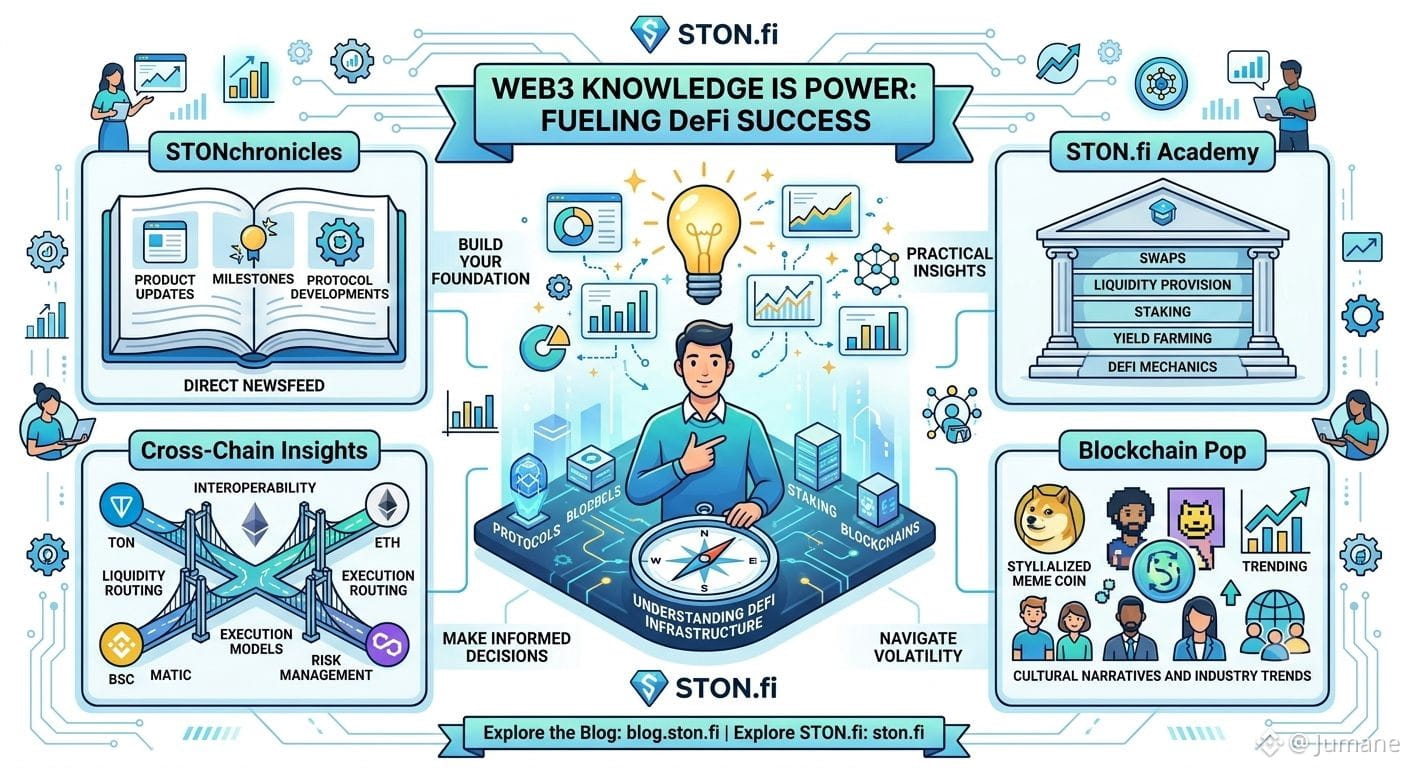
The STON.fi Blog serves as an educational hub designed to help users build that foundation through practical insights, technical explainers and ecosystem analysis.
📖 Explore the Blog: blog.ston.fi
Key content includes:
🔹 STONchronicles — Official product updates, ecosystem milestones and protocol developments directly from the STON.fi team.
🔹 STON.fi Academy — Structured educational content covering swaps, liquidity provision, staking, yield farming and the fundamental mechanics of DeFi in a clear and accessible format.
🔹 Cross-Chain Insights — Deep dives into interoperability, liquidity routing, execution models and risk management across multiple blockchain ecosystems.
🔹 Blockchain Pop — Perspectives on the cultural evolution of Web3, exploring the narratives and trends shaping the broader digital asset industry.
💡 Explore STON.fi: ston.fi
As blockchain infrastructure becomes increasingly sophisticated, education remains a critical driver of adoption. Users who understand protocol design, liquidity dynamics and cross-chain architecture are better positioned to navigate market volatility and make informed decisions.
The next generation of Web3 participants won't simply use DeFi they'll understand how it works.
#Web3 #DeFi #STONfi #TON #BlockchainEducation #CrossChain #OnChainFinance #CryptoResearch #Blockchain #Web3Education
Knowledge is one of the most underappreciated forms of capital in Web3.
As decentralised finance continues to evolve, navigating the ecosystem requires more than access to protocols it demands a solid understanding of the infrastructure, market dynamics and mechanisms that drive on-chain finance.@ston_fi
The STON.fi Blog serves as an educational hub designed to help users build that foundation through practical insights, technical explainers and ecosystem analysis.
📖 Explore the Blog: blog.ston.fi
Key content includes:
🔹 STONchronicles — Official product updates, ecosystem milestones and protocol developments directly from the STON.fi team.
🔹 STON.fi Academy — Structured educational content covering swaps, liquidity provision, staking, yield farming and the fundamental mechanics of DeFi in a clear and accessible format.
🔹 Cross-Chain Insights — Deep dives into interoperability, liquidity routing, execution models and risk management across multiple blockchain ecosystems.
🔹 Blockchain Pop — Perspectives on the cultural evolution of Web3, exploring the narratives and trends shaping the broader digital asset industry.
💡 Explore STON.fi: ston.fi
As blockchain infrastructure becomes increasingly sophisticated, education remains a critical driver of adoption. Users who understand protocol design, liquidity dynamics and cross-chain architecture are better positioned to navigate market volatility and make informed decisions.
The next generation of Web3 participants won't simply use DeFi they'll understand how it works.
#Web3 #DeFi #STONfi #TON #BlockchainEducation #CrossChain #OnChainFinance #CryptoResearch #Blockchain #Web3Education
As decentralised finance continues to evolve, navigating the ecosystem requires more than access to protocols it demands a solid understanding of the infrastructure, market dynamics and mechanisms that drive on-chain finance.@ston_fi
The STON.fi Blog serves as an educational hub designed to help users build that foundation through practical insights, technical explainers and ecosystem analysis.
📖 Explore the Blog: blog.ston.fi
Key content includes:
🔹 STONchronicles — Official product updates, ecosystem milestones and protocol developments directly from the STON.fi team.
🔹 STON.fi Academy — Structured educational content covering swaps, liquidity provision, staking, yield farming and the fundamental mechanics of DeFi in a clear and accessible format.
🔹 Cross-Chain Insights — Deep dives into interoperability, liquidity routing, execution models and risk management across multiple blockchain ecosystems.
🔹 Blockchain Pop — Perspectives on the cultural evolution of Web3, exploring the narratives and trends shaping the broader digital asset industry.
💡 Explore STON.fi: ston.fi
As blockchain infrastructure becomes increasingly sophisticated, education remains a critical driver of adoption. Users who understand protocol design, liquidity dynamics and cross-chain architecture are better positioned to navigate market volatility and make informed decisions.
The next generation of Web3 participants won't simply use DeFi they'll understand how it works.
#Web3 #DeFi #STONfi #TON #BlockchainEducation #CrossChain #OnChainFinance #CryptoResearch #Blockchain #Web3Education
1
88

·
--
#genius $GENIUS
🧠 Le savoir tokenisé entre dans une nouvelle ère avec @GeniusOfficial
Là où la plupart des projets se contentent de promesses, Genius construit un véritable pont entre l'éducation décentralisée et la création de valeur. Avec l'IA et la blockchain, Genius démocratise l'accès à des connaissances premium tout en récompensant activement les apprenants et les contributeurs.
L'écosystème repose sur le token $GENIUS : staking, accès aux cours exclusifs, gouvernance et récompenses pour la création de contenu éducatif. Contrairement aux simples "learn-to-earn" éphémères, Genius mise sur la qualité et la pérennité des savoirs.
L'équipe travaille actuellement sur un module de vérification des compétences via NFT, permettant à chaque utilisateur de certifier ses apprentissages sur la blockchain. Une avancée majeure pour l'employabilité Web3.
Ne sous-estimez pas le potentiel de ce projet. L'éducation est le véritable carburant de l'adoption massive. Et Genius est en train de poser les rails.
🔐 Staker, apprendre, contribuer, grandir – tout devient plus intelligent avec $GENIUS
#genius #Web3Education
#genius $GENIUS
🧠 Le savoir tokenisé entre dans une nouvelle ère avec @GeniusOfficial
Là où la plupart des projets se contentent de promesses, Genius construit un véritable pont entre l'éducation décentralisée et la création de valeur. Avec l'IA et la blockchain, Genius démocratise l'accès à des connaissances premium tout en récompensant activement les apprenants et les contributeurs.
L'écosystème repose sur le token $GENIUS : staking, accès aux cours exclusifs, gouvernance et récompenses pour la création de contenu éducatif. Contrairement aux simples "learn-to-earn" éphémères, Genius mise sur la qualité et la pérennité des savoirs.
L'équipe travaille actuellement sur un module de vérification des compétences via NFT, permettant à chaque utilisateur de certifier ses apprentissages sur la blockchain. Une avancée majeure pour l'employabilité Web3.
Ne sous-estimez pas le potentiel de ce projet. L'éducation est le véritable carburant de l'adoption massive. Et Genius est en train de poser les rails.
🔐 Staker, apprendre, contribuer, grandir – tout devient plus intelligent avec $GENIUS
#genius #Web3Education
🧠 Le savoir tokenisé entre dans une nouvelle ère avec @GeniusOfficial
Là où la plupart des projets se contentent de promesses, Genius construit un véritable pont entre l'éducation décentralisée et la création de valeur. Avec l'IA et la blockchain, Genius démocratise l'accès à des connaissances premium tout en récompensant activement les apprenants et les contributeurs.
L'écosystème repose sur le token $GENIUS : staking, accès aux cours exclusifs, gouvernance et récompenses pour la création de contenu éducatif. Contrairement aux simples "learn-to-earn" éphémères, Genius mise sur la qualité et la pérennité des savoirs.
L'équipe travaille actuellement sur un module de vérification des compétences via NFT, permettant à chaque utilisateur de certifier ses apprentissages sur la blockchain. Une avancée majeure pour l'employabilité Web3.
Ne sous-estimez pas le potentiel de ce projet. L'éducation est le véritable carburant de l'adoption massive. Et Genius est en train de poser les rails.
🔐 Staker, apprendre, contribuer, grandir – tout devient plus intelligent avec $GENIUS
#genius #Web3Education
1
183

·
--
Opn (EDU) – The Future of Web3 Education?
Open Campus (EDU) is making waves by bridging the gap between traditional education and the Web3 ecosystem. Here’s why it’s catching everyone's attention:
✅ Empowering educators to monetize their content through Web3.
✅ A truly decentralized educational platform.
✅ Massive potential as EdTech and Blockchain continue to converge.
How do you see the current market position of $EDU? Are you looking at this as a long-term play? Let’s discuss in the comments!
#BinanceSquare #EDU #Web3Education #CryptoAnalysis" $EDU
Opn (EDU) – The Future of Web3 Education?
Open Campus (EDU) is making waves by bridging the gap between traditional education and the Web3 ecosystem. Here’s why it’s catching everyone's attention:
✅ Empowering educators to monetize their content through Web3.
✅ A truly decentralized educational platform.
✅ Massive potential as EdTech and Blockchain continue to converge.
How do you see the current market position of $EDU ? Are you looking at this as a long-term play? Let’s discuss in the comments!
#BinanceSquare #EDU #Web3Education #CryptoAnalysis" $EDU
Open Campus (EDU) is making waves by bridging the gap between traditional education and the Web3 ecosystem. Here’s why it’s catching everyone's attention:
✅ Empowering educators to monetize their content through Web3.
✅ A truly decentralized educational platform.
✅ Massive potential as EdTech and Blockchain continue to converge.
How do you see the current market position of $EDU ? Are you looking at this as a long-term play? Let’s discuss in the comments!
#BinanceSquare #EDU #Web3Education #CryptoAnalysis" $EDU
200

·
--
Частичная правда
#BitcoinHits85K
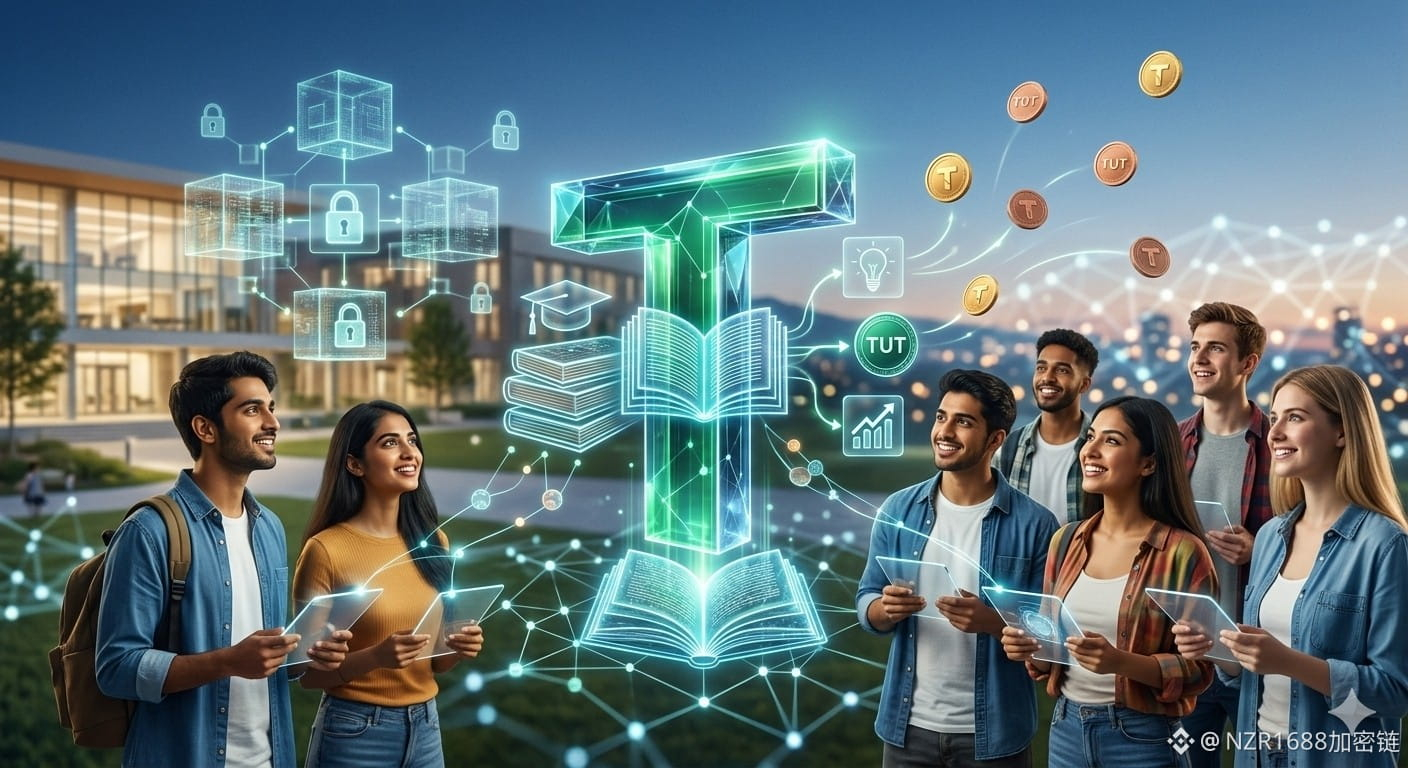
The EdTech Crypto Revolution is Here with Tutorial (TUT)! 🎓🚀The cryptocurrency market is witnessing massive action, and Tutorial ($TUT) is drawing intense trader focus across the BNB Chain ecosystem! Combining education with Web3 rewards, this asset is becoming one of the most volatile and watched low-cap tokens.What is happening with $TUT right now? Here are the key highlights: 👇1️⃣ Massive Trading Frenzy: After experiencing a sensational rally, $TUT recently triggered a historic $44 million in short and long futures liquidations within a 24-hour window, temporarily outpacing both Bitcoin and Ethereum combined in liquidation volume.2️⃣ Stabilization and Recovery: Following extreme price swings, the token has firmly held its key local support floor. The Tutorial Token News shows a solid recovery, rebounding over 14% within the past 7 days as buyers step back in to defend the baseline.3️⃣ Meme vs. Utility Narrative: Originally introduced as an educational and tutorial ecosystem token, $TUT is finding massive speculative interest during BNB Chain meme rallies, providing a blend of true tech utility and explosive trading volume.Are you trading the volatile waves of $TUT, or are you holding long for the #Web3 educational ecosystem? Share your moves below! 📊👇#TutorialToken #TUT #TUTcoin #BNBChain #Altcoins #CryptoNews #CryptoTrading #Web3Education
#BitcoinHits85K
The EdTech Crypto Revolution is Here with Tutorial (TUT)! 🎓🚀The cryptocurrency market is witnessing massive action, and Tutorial ($TUT ) is drawing intense trader focus across the BNB Chain ecosystem! Combining education with Web3 rewards, this asset is becoming one of the most volatile and watched low-cap tokens.What is happening with $TUT right now? Here are the key highlights: 👇1️⃣ Massive Trading Frenzy: After experiencing a sensational rally, $TUT recently triggered a historic $44 million in short and long futures liquidations within a 24-hour window, temporarily outpacing both Bitcoin and Ethereum combined in liquidation volume.2️⃣ Stabilization and Recovery: Following extreme price swings, the token has firmly held its key local support floor. The Tutorial Token News shows a solid recovery, rebounding over 14% within the past 7 days as buyers step back in to defend the baseline.3️⃣ Meme vs. Utility Narrative: Originally introduced as an educational and tutorial ecosystem token, $TUT is finding massive speculative interest during BNB Chain meme rallies, providing a blend of true tech utility and explosive trading volume.Are you trading the volatile waves of $TUT , or are you holding long for the #Web3 educational ecosystem? Share your moves below! 📊👇#TutorialToken #TUT #TUTcoin #BNBChain #Altcoins #CryptoNews #CryptoTrading #Web3Education
The EdTech Crypto Revolution is Here with Tutorial (TUT)! 🎓🚀The cryptocurrency market is witnessing massive action, and Tutorial ($TUT ) is drawing intense trader focus across the BNB Chain ecosystem! Combining education with Web3 rewards, this asset is becoming one of the most volatile and watched low-cap tokens.What is happening with $TUT right now? Here are the key highlights: 👇1️⃣ Massive Trading Frenzy: After experiencing a sensational rally, $TUT recently triggered a historic $44 million in short and long futures liquidations within a 24-hour window, temporarily outpacing both Bitcoin and Ethereum combined in liquidation volume.2️⃣ Stabilization and Recovery: Following extreme price swings, the token has firmly held its key local support floor. The Tutorial Token News shows a solid recovery, rebounding over 14% within the past 7 days as buyers step back in to defend the baseline.3️⃣ Meme vs. Utility Narrative: Originally introduced as an educational and tutorial ecosystem token, $TUT is finding massive speculative interest during BNB Chain meme rallies, providing a blend of true tech utility and explosive trading volume.Are you trading the volatile waves of $TUT , or are you holding long for the #Web3 educational ecosystem? Share your moves below! 📊👇#TutorialToken #TUT #TUTcoin #BNBChain #Altcoins #CryptoNews #CryptoTrading #Web3Education
1
1
4
589

$CARIB
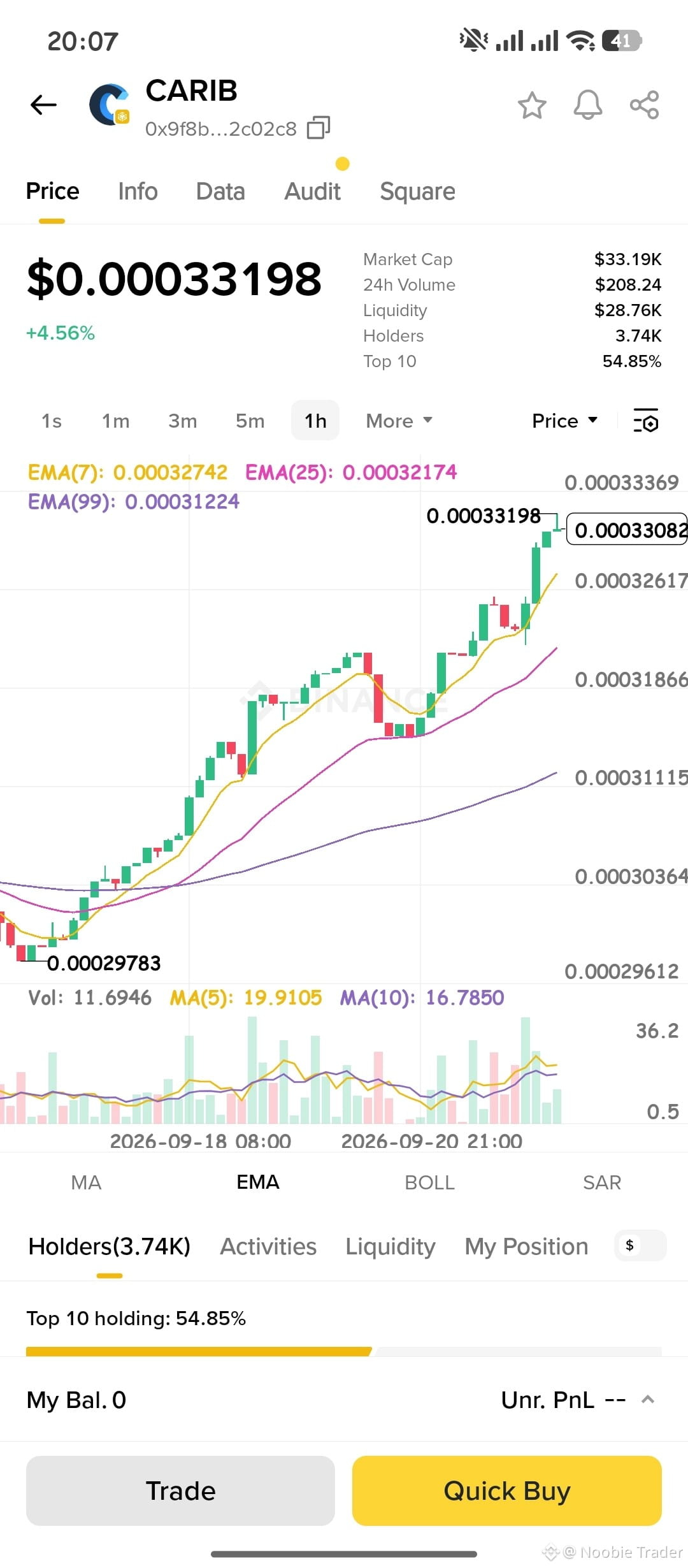
The chart shows everything.
Today $SUI made it 1. But do you know this is just the beginning.
$SUI is set for 10 or more.
If you're old enough in this space you know about it. If you don't know check ATH.
But today i'm talking about $CARIB
CaribDAO Web3 for the Caribbean.
$CARIB fuels it.
From $0.000298 to $0.000321 in one clean move.
It’s not just hype or bullpost. It’s actually a real project. You can keep an eye
@DP_Carib
#CaribDAO #Web3Education #Caribbean
$CARIB
The chart shows everything.
Today $SUI made it 1. But do you know this is just the beginning.
$SUI is set for 10 or more.
If you're old enough in this space you know about it. If you don't know check ATH.
But today i'm talking about $CARIB
CaribDAO Web3 for the Caribbean.
$CARIB fuels it.
From $0.000298 to $0.000321 in one clean move.
It’s not just hype or bullpost. It’s actually a real project. You can keep an eye
@DP_CARIB
#CaribDAO #Web3Education #Caribbean
The chart shows everything.
Today $SUI made it 1. But do you know this is just the beginning.
$SUI is set for 10 or more.
If you're old enough in this space you know about it. If you don't know check ATH.
But today i'm talking about $CARIB
CaribDAO Web3 for the Caribbean.
$CARIB fuels it.
From $0.000298 to $0.000321 in one clean move.
It’s not just hype or bullpost. It’s actually a real project. You can keep an eye
@DP_CARIB
#CaribDAO #Web3Education #Caribbean
1
5
361

·
--
Статья
The Agentic Economy: Why Crypto May Become the Default Payment Channel for Artificial IntelligenceArtificial intelligence is rapidly evolving from an information-providing tool into a system capable of taking action.
Meanwhile, blockchain technology is evolving from speculation into a programmable financial infrastructure capable of supporting entirely new forms of economic activity.
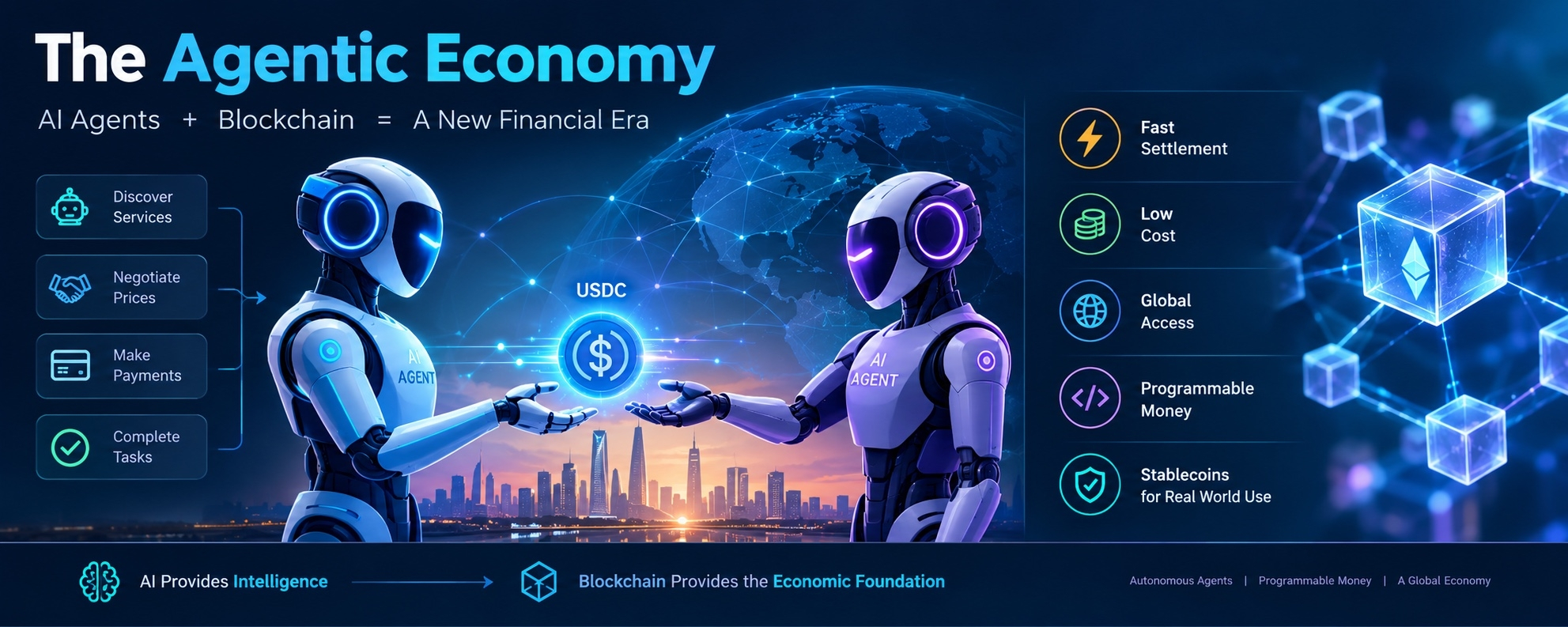
The combination of these two technologies is creating something unprecedented: an economic system composed of autonomous AI agents , in which AI agents can negotiate, trade, and settle value without human intervention.
Artificial intelligence provides the intelligence, while blockchain provides the economic foundation.
In the future, it may no longer be humans clicking the "Pay" button, but software agents trading with other software agents in real-time.
The Rise of the Agent Economy
Today's AI systems are already capable of performing tasks once thought to be uniquely human. The next step is achieving autonomous operation.
Modern AI agents are increasingly capable of the following:
Book travelContract negotiation and pricingProcure dataHire specialized agentsPay for compute resourcesSettle micropaymentsManage ongoing workflows
As these systems become increasingly automated, requiring manual approval for every trade becomes a major bottleneck.
Software runs at machine speed, whereas manual approval processes do not.
As a result, there is a growing demand for economic infrastructure specifically designed for autonomous agents.
Why Traditional Payment Methods Fail
Global payment systems are designed for people, not for software.
Credit cards, bank transfers, the ACH network, and traditional payment processing methods rely on human intervention at every step. While effective for consumer transactions, they fall short when applied to machine-to-machine transactions.
Traditional payment systems typically have the following characteristics:
Too slow, with settlement times ranging from a few seconds to several days.Too costly for high-frequency, low-value transactions.Dependent on account creation, identity verification, and manual approval processes.Optimized around human-machine interaction rather than autonomous execution.
Imagine an AI agent making hundreds of API calls, data purchases, or service requests per minute.
Under traditional payment systems, transaction fees can quickly exceed the transaction value, while settlement delays undermine agents' ability to operate in real-time.
This economic model simply does not work.
Enter Agentic Payments
Agent payments represent a new paradigm where AI agents can initiate and execute transactions within predefined rules set by humans or organizations.
May include:
Spending LimitsBudget AllocationApproval ThresholdsUsage RestrictionsCompliance Requirements
Within these boundaries, agents can operate independently.
Each agent is assigned a wallet, enabling it to discover services, negotiate prices, complete payments, and proceed with tasks without having to wait for human approval at every step.
This transforms the payment process from manual operation to programmable operation.
Why Cryptocurrency Is a Natural Fit
Blockchain-based payment systems address many of the challenges faced by autonomous agents.
Programmable Money
Smart contracts allow payments to be directly linked to outcomes and conditions.
Agents can:
Make payment only after delivery of goods is confirmed.Make continuous streaming payments based on resource consumptionAutomatically execute escrow agreementsExecute contract conditions without intermediaries
Money itself has also become part of the software logic.
Internet-Scale Micropayments
Modern blockchains and Layer 2 networks provide:
Near real-time settlementExtremely low transaction costsSub-cent payment capability
This makes entirely new business models possible.
Agents only need to pay fractions of a cent to access an API call, a piece of data, or a moment of compute power—something that is economically impractical in traditional payment systems.
Global License-Free Access
Autonomous agents are not constrained by geographic location.
Blockchain networks enable cross-border transactions without the need for local banking relationships or complex payment integrations.
An AI agent in one country can seamlessly trade with service providers anywhere in the world.
Stablecoins Make Spending More Convenient
Volatility has always been seen as a challenge facing cryptocurrency payments.
Stablecoins (such as USDC) help solve this problem by providing predictable value while retaining the benefits of blockchain infrastructure.
For agents, stablecoins provide a practical medium of exchange, acting more like digital cash rather than speculative assets.
Infrastructure Has Taken Shape
While the vision of autonomous economic agents may sound like futuristic technology, its underlying infrastructure is already being built.
Several key developments are accelerating this transition:
Coinbase's x402 standard is reviving HTTP 402 ("Payment Required") to enable native internet payments.AI Agents can increasingly pay directly for API access permissions, content, and digital services.AWS Bedrock integration is supporting transactional AI workflows.Embedded wallets on Base simplify agent ownership and spending.Protocols like Circle Nanopayments and Nevermined are creating machine-to-machine commerce frameworks.Major fintech and payment companies are actively exploring AI-native wallet experiences.
Once-experimental infrastructure is steadily moving toward production deployment.
Economic Opportunities
The emergence of autonomous agents may create entirely new markets and business models.
Everything Based on Usage
In addition to fixed subscription models, services can also monetize through the following methods:
Pay-per-searchPay-per-inferencePay-per-API requestPay-per-data retrieval
Every interaction can be measured using economic indicators.
Agent-to-Agent Market
Specialized AI agents may begin purchasing services from one another.
An agent responsible for research can hire another agent for data collection. Customer service representatives can purchase translation services from language agent agencies.
These interactions create self-organizing digital markets that operate continuously without human intervention.
Immense Economic Scalability
Unlike human employees, autonomous agents can operate 24 hours a day, 7 days a week.
Millions (or even eventually billions) of traders can trade simultaneously, thereby creating an entirely new layer of economic activity.
Composable Financial Workflows
Blockchain infrastructure enables agents to combine multiple financial primitives into an automated workflow.
agents can seamlessly integrate:
PaymentsEscrow systemsLending protocolsGovernance mechanismsFinancial managementDecentralized organizations
In this paradigm, the blockchain becomes the trustless execution layer for AI-driven decisions.
Challenges Remain
Despite the strong momentum, significant challenges remain to be addressed before agentic commerce sees widespread adoption.
Key areas include:
Security and spending controlsAgent identity and accountabilityRegulatory clarity and liability frameworksFiat-to-crypto deposits and withdrawalsCross-chain interoperability
Encouragingly, some solutions have already emerged through the following approaches:
Permissioned and tiered wallet architecturesProgrammatic compliance systemsHybrid fiat-crypto payment railsCross-chain infrastructure and standards
This technology is still in its early stages, but the direction of its development is becoming increasingly clear.
The Big Picture
The agent economy needs a form of currency that circulates at machine speed.
As AI agents become independent economic actors, the financial infrastructure supporting them must possess the following characteristics:
InstantProgrammableGlobalAutonomous
This is precisely where the unique advantage of blockchain and stablecoins lies.
Cryptocurrency may not only become part of the rise of artificial intelligence, but could also serve as the settlement layer for an autonomous machine economy.
AI provides intelligence.
Blockchain provides the economic foundation.
In the future, it may not necessarily be humans clicking the "Pay" button.
It could be autonomous agents directly negotiating, trading, and settling value on-chain.
The remaining question is simple:
Will the number of AI agents surpass online human users first, or will the number of AI agent wallets surpass human wallets first?
#CryptoEducation #Web3Education #ArifAlpha
The Agentic Economy: Why Crypto May Become the Default Payment Channel for Artificial Intelligence
Artificial intelligence is rapidly evolving from an information-providing tool into a system capable of taking action.
Meanwhile, blockchain technology is evolving from speculation into a programmable financial infrastructure capable of supporting entirely new forms of economic activity.
The combination of these two technologies is creating something unprecedented: an economic system composed of autonomous AI agents , in which AI agents can negotiate, trade, and settle value without human intervention.
Artificial intelligence provides the intelligence, while blockchain provides the economic foundation.
In the future, it may no longer be humans clicking the "Pay" button, but software agents trading with other software agents in real-time.
The Rise of the Agent Economy
Today's AI systems are already capable of performing tasks once thought to be uniquely human. The next step is achieving autonomous operation.
Modern AI agents are increasingly capable of the following:
Book travelContract negotiation and pricingProcure dataHire specialized agentsPay for compute resourcesSettle micropaymentsManage ongoing workflows
As these systems become increasingly automated, requiring manual approval for every trade becomes a major bottleneck.
Software runs at machine speed, whereas manual approval processes do not.
As a result, there is a growing demand for economic infrastructure specifically designed for autonomous agents.
Why Traditional Payment Methods Fail
Global payment systems are designed for people, not for software.
Credit cards, bank transfers, the ACH network, and traditional payment processing methods rely on human intervention at every step. While effective for consumer transactions, they fall short when applied to machine-to-machine transactions.
Traditional payment systems typically have the following characteristics:
Too slow, with settlement times ranging from a few seconds to several days.Too costly for high-frequency, low-value transactions.Dependent on account creation, identity verification, and manual approval processes.Optimized around human-machine interaction rather than autonomous execution.
Imagine an AI agent making hundreds of API calls, data purchases, or service requests per minute.
Under traditional payment systems, transaction fees can quickly exceed the transaction value, while settlement delays undermine agents' ability to operate in real-time.
This economic model simply does not work.
Enter Agentic Payments
Agent payments represent a new paradigm where AI agents can initiate and execute transactions within predefined rules set by humans or organizations.
May include:
Spending LimitsBudget AllocationApproval ThresholdsUsage RestrictionsCompliance Requirements
Within these boundaries, agents can operate independently.
Each agent is assigned a wallet, enabling it to discover services, negotiate prices, complete payments, and proceed with tasks without having to wait for human approval at every step.
This transforms the payment process from manual operation to programmable operation.
Why Cryptocurrency Is a Natural Fit
Blockchain-based payment systems address many of the challenges faced by autonomous agents.
Programmable Money
Smart contracts allow payments to be directly linked to outcomes and conditions.
Agents can:
Make payment only after delivery of goods is confirmed.Make continuous streaming payments based on resource consumptionAutomatically execute escrow agreementsExecute contract conditions without intermediaries
Money itself has also become part of the software logic.
Internet-Scale Micropayments
Modern blockchains and Layer 2 networks provide:
Near real-time settlementExtremely low transaction costsSub-cent payment capability
This makes entirely new business models possible.
Agents only need to pay fractions of a cent to access an API call, a piece of data, or a moment of compute power—something that is economically impractical in traditional payment systems.
Global License-Free Access
Autonomous agents are not constrained by geographic location.
Blockchain networks enable cross-border transactions without the need for local banking relationships or complex payment integrations.
An AI agent in one country can seamlessly trade with service providers anywhere in the world.
Stablecoins Make Spending More Convenient
Volatility has always been seen as a challenge facing cryptocurrency payments.
Stablecoins (such as USDC) help solve this problem by providing predictable value while retaining the benefits of blockchain infrastructure.
For agents, stablecoins provide a practical medium of exchange, acting more like digital cash rather than speculative assets.
Infrastructure Has Taken Shape
While the vision of autonomous economic agents may sound like futuristic technology, its underlying infrastructure is already being built.
Several key developments are accelerating this transition:
Coinbase's x402 standard is reviving HTTP 402 ("Payment Required") to enable native internet payments.AI Agents can increasingly pay directly for API access permissions, content, and digital services.AWS Bedrock integration is supporting transactional AI workflows.Embedded wallets on Base simplify agent ownership and spending.Protocols like Circle Nanopayments and Nevermined are creating machine-to-machine commerce frameworks.Major fintech and payment companies are actively exploring AI-native wallet experiences.
Once-experimental infrastructure is steadily moving toward production deployment.
Economic Opportunities
The emergence of autonomous agents may create entirely new markets and business models.
Everything Based on Usage
In addition to fixed subscription models, services can also monetize through the following methods:
Pay-per-searchPay-per-inferencePay-per-API requestPay-per-data retrieval
Every interaction can be measured using economic indicators.
Agent-to-Agent Market
Specialized AI agents may begin purchasing services from one another.
An agent responsible for research can hire another agent for data collection. Customer service representatives can purchase translation services from language agent agencies.
These interactions create self-organizing digital markets that operate continuously without human intervention.
Immense Economic Scalability
Unlike human employees, autonomous agents can operate 24 hours a day, 7 days a week.
Millions (or even eventually billions) of traders can trade simultaneously, thereby creating an entirely new layer of economic activity.
Composable Financial Workflows
Blockchain infrastructure enables agents to combine multiple financial primitives into an automated workflow.
agents can seamlessly integrate:
PaymentsEscrow systemsLending protocolsGovernance mechanismsFinancial managementDecentralized organizations
In this paradigm, the blockchain becomes the trustless execution layer for AI-driven decisions.
Challenges Remain
Despite the strong momentum, significant challenges remain to be addressed before agentic commerce sees widespread adoption.
Key areas include:
Security and spending controlsAgent identity and accountabilityRegulatory clarity and liability frameworksFiat-to-crypto deposits and withdrawalsCross-chain interoperability
Encouragingly, some solutions have already emerged through the following approaches:
Permissioned and tiered wallet architecturesProgrammatic compliance systemsHybrid fiat-crypto payment railsCross-chain infrastructure and standards
This technology is still in its early stages, but the direction of its development is becoming increasingly clear.
The Big Picture
The agent economy needs a form of currency that circulates at machine speed.
As AI agents become independent economic actors, the financial infrastructure supporting them must possess the following characteristics:
InstantProgrammableGlobalAutonomous
This is precisely where the unique advantage of blockchain and stablecoins lies.
Cryptocurrency may not only become part of the rise of artificial intelligence, but could also serve as the settlement layer for an autonomous machine economy.
AI provides intelligence.
Blockchain provides the economic foundation.
In the future, it may not necessarily be humans clicking the "Pay" button.
It could be autonomous agents directly negotiating, trading, and settling value on-chain.
The remaining question is simple:
Will the number of AI agents surpass online human users first, or will the number of AI agent wallets surpass human wallets first?
#CryptoEducation #Web3Education #ArifAlpha
Meanwhile, blockchain technology is evolving from speculation into a programmable financial infrastructure capable of supporting entirely new forms of economic activity.
The combination of these two technologies is creating something unprecedented: an economic system composed of autonomous AI agents , in which AI agents can negotiate, trade, and settle value without human intervention.
Artificial intelligence provides the intelligence, while blockchain provides the economic foundation.
In the future, it may no longer be humans clicking the "Pay" button, but software agents trading with other software agents in real-time.
The Rise of the Agent Economy
Today's AI systems are already capable of performing tasks once thought to be uniquely human. The next step is achieving autonomous operation.
Modern AI agents are increasingly capable of the following:
Book travelContract negotiation and pricingProcure dataHire specialized agentsPay for compute resourcesSettle micropaymentsManage ongoing workflows
As these systems become increasingly automated, requiring manual approval for every trade becomes a major bottleneck.
Software runs at machine speed, whereas manual approval processes do not.
As a result, there is a growing demand for economic infrastructure specifically designed for autonomous agents.
Why Traditional Payment Methods Fail
Global payment systems are designed for people, not for software.
Credit cards, bank transfers, the ACH network, and traditional payment processing methods rely on human intervention at every step. While effective for consumer transactions, they fall short when applied to machine-to-machine transactions.
Traditional payment systems typically have the following characteristics:
Too slow, with settlement times ranging from a few seconds to several days.Too costly for high-frequency, low-value transactions.Dependent on account creation, identity verification, and manual approval processes.Optimized around human-machine interaction rather than autonomous execution.
Imagine an AI agent making hundreds of API calls, data purchases, or service requests per minute.
Under traditional payment systems, transaction fees can quickly exceed the transaction value, while settlement delays undermine agents' ability to operate in real-time.
This economic model simply does not work.
Enter Agentic Payments
Agent payments represent a new paradigm where AI agents can initiate and execute transactions within predefined rules set by humans or organizations.
May include:
Spending LimitsBudget AllocationApproval ThresholdsUsage RestrictionsCompliance Requirements
Within these boundaries, agents can operate independently.
Each agent is assigned a wallet, enabling it to discover services, negotiate prices, complete payments, and proceed with tasks without having to wait for human approval at every step.
This transforms the payment process from manual operation to programmable operation.
Why Cryptocurrency Is a Natural Fit
Blockchain-based payment systems address many of the challenges faced by autonomous agents.
Programmable Money
Smart contracts allow payments to be directly linked to outcomes and conditions.
Agents can:
Make payment only after delivery of goods is confirmed.Make continuous streaming payments based on resource consumptionAutomatically execute escrow agreementsExecute contract conditions without intermediaries
Money itself has also become part of the software logic.
Internet-Scale Micropayments
Modern blockchains and Layer 2 networks provide:
Near real-time settlementExtremely low transaction costsSub-cent payment capability
This makes entirely new business models possible.
Agents only need to pay fractions of a cent to access an API call, a piece of data, or a moment of compute power—something that is economically impractical in traditional payment systems.
Global License-Free Access
Autonomous agents are not constrained by geographic location.
Blockchain networks enable cross-border transactions without the need for local banking relationships or complex payment integrations.
An AI agent in one country can seamlessly trade with service providers anywhere in the world.
Stablecoins Make Spending More Convenient
Volatility has always been seen as a challenge facing cryptocurrency payments.
Stablecoins (such as USDC) help solve this problem by providing predictable value while retaining the benefits of blockchain infrastructure.
For agents, stablecoins provide a practical medium of exchange, acting more like digital cash rather than speculative assets.
Infrastructure Has Taken Shape
While the vision of autonomous economic agents may sound like futuristic technology, its underlying infrastructure is already being built.
Several key developments are accelerating this transition:
Coinbase's x402 standard is reviving HTTP 402 ("Payment Required") to enable native internet payments.AI Agents can increasingly pay directly for API access permissions, content, and digital services.AWS Bedrock integration is supporting transactional AI workflows.Embedded wallets on Base simplify agent ownership and spending.Protocols like Circle Nanopayments and Nevermined are creating machine-to-machine commerce frameworks.Major fintech and payment companies are actively exploring AI-native wallet experiences.
Once-experimental infrastructure is steadily moving toward production deployment.
Economic Opportunities
The emergence of autonomous agents may create entirely new markets and business models.
Everything Based on Usage
In addition to fixed subscription models, services can also monetize through the following methods:
Pay-per-searchPay-per-inferencePay-per-API requestPay-per-data retrieval
Every interaction can be measured using economic indicators.
Agent-to-Agent Market
Specialized AI agents may begin purchasing services from one another.
An agent responsible for research can hire another agent for data collection. Customer service representatives can purchase translation services from language agent agencies.
These interactions create self-organizing digital markets that operate continuously without human intervention.
Immense Economic Scalability
Unlike human employees, autonomous agents can operate 24 hours a day, 7 days a week.
Millions (or even eventually billions) of traders can trade simultaneously, thereby creating an entirely new layer of economic activity.
Composable Financial Workflows
Blockchain infrastructure enables agents to combine multiple financial primitives into an automated workflow.
agents can seamlessly integrate:
PaymentsEscrow systemsLending protocolsGovernance mechanismsFinancial managementDecentralized organizations
In this paradigm, the blockchain becomes the trustless execution layer for AI-driven decisions.
Challenges Remain
Despite the strong momentum, significant challenges remain to be addressed before agentic commerce sees widespread adoption.
Key areas include:
Security and spending controlsAgent identity and accountabilityRegulatory clarity and liability frameworksFiat-to-crypto deposits and withdrawalsCross-chain interoperability
Encouragingly, some solutions have already emerged through the following approaches:
Permissioned and tiered wallet architecturesProgrammatic compliance systemsHybrid fiat-crypto payment railsCross-chain infrastructure and standards
This technology is still in its early stages, but the direction of its development is becoming increasingly clear.
The Big Picture
The agent economy needs a form of currency that circulates at machine speed.
As AI agents become independent economic actors, the financial infrastructure supporting them must possess the following characteristics:
InstantProgrammableGlobalAutonomous
This is precisely where the unique advantage of blockchain and stablecoins lies.
Cryptocurrency may not only become part of the rise of artificial intelligence, but could also serve as the settlement layer for an autonomous machine economy.
AI provides intelligence.
Blockchain provides the economic foundation.
In the future, it may not necessarily be humans clicking the "Pay" button.
It could be autonomous agents directly negotiating, trading, and settling value on-chain.
The remaining question is simple:
Will the number of AI agents surpass online human users first, or will the number of AI agent wallets surpass human wallets first?
#CryptoEducation #Web3Education #ArifAlpha
75

·
--
🪂 Some People Earned More From Airdrops Than Trading
When most people hear about crypto profits, they think about buying low and selling high.
But some of the biggest rewards in crypto came from something completely different:
Airdrops.$BTC
An airdrop is when a blockchain project rewards early users with free tokens for participating in its ecosystem.
Over the years, several major projects have distributed tokens worth hundreds — and sometimes thousands — of dollars to eligible users.
Why do projects do this?
✅ Reward early supporters
✅ Grow their communities
✅ Encourage ecosystem adoption
✅ Increase network activity
However, it's important to understand that not every project will launch a valuable token, and there are no guarantees of rewards.
The smartest participants focus on learning, exploring new ecosystems, and using products they genuinely find interesting.
In crypto, sometimes being early can be just as valuable as being right.$BNB
💬 Question:
Have you ever received a crypto airdrop?
🔹 Yes, multiple times
🔹 Only once
🔹 Not yet
Let us know below! 👇
#Airdrop #Crypto #Bitcoin #Blockchain #Web3 #BinanceSquare #DeFi #Investing #CryptoCommunity #Web3Education
🪂 Some People Earned More From Airdrops Than Trading
When most people hear about crypto profits, they think about buying low and selling high.
But some of the biggest rewards in crypto came from something completely different:
Airdrops.$BTC
An airdrop is when a blockchain project rewards early users with free tokens for participating in its ecosystem.
Over the years, several major projects have distributed tokens worth hundreds — and sometimes thousands — of dollars to eligible users.
Why do projects do this?
✅ Reward early supporters
✅ Grow their communities
✅ Encourage ecosystem adoption
✅ Increase network activity
However, it's important to understand that not every project will launch a valuable token, and there are no guarantees of rewards.
The smartest participants focus on learning, exploring new ecosystems, and using products they genuinely find interesting.
In crypto, sometimes being early can be just as valuable as being right.$BNB
💬 Question:
Have you ever received a crypto airdrop?
🔹 Yes, multiple times
🔹 Only once
🔹 Not yet
Let us know below! 👇
#Airdrop #Crypto #Bitcoin #Blockchain #Web3 #BinanceSquare #DeFi #Investing #CryptoCommunity #Web3Education
When most people hear about crypto profits, they think about buying low and selling high.
But some of the biggest rewards in crypto came from something completely different:
Airdrops.$BTC
An airdrop is when a blockchain project rewards early users with free tokens for participating in its ecosystem.
Over the years, several major projects have distributed tokens worth hundreds — and sometimes thousands — of dollars to eligible users.
Why do projects do this?
✅ Reward early supporters
✅ Grow their communities
✅ Encourage ecosystem adoption
✅ Increase network activity
However, it's important to understand that not every project will launch a valuable token, and there are no guarantees of rewards.
The smartest participants focus on learning, exploring new ecosystems, and using products they genuinely find interesting.
In crypto, sometimes being early can be just as valuable as being right.$BNB
💬 Question:
Have you ever received a crypto airdrop?
🔹 Yes, multiple times
🔹 Only once
🔹 Not yet
Let us know below! 👇
#Airdrop #Crypto #Bitcoin #Blockchain #Web3 #BinanceSquare #DeFi #Investing #CryptoCommunity #Web3Education

71

How to Instantly Spot Fake Emails: Set Up Your Anti-Phishing Code 🔒
Phishing attacks often copy official brand logos and layouts to trick users into clicking harmful links. While bad actors can easily clone email designs, they cannot access your personal account security settings.
An Anti-Phishing Code is a unique, user-defined phrase configured within your security settings. Once activated, Binance automatically embeds this code at the top of every genuine notification email sent to you. If an email claiming to be official lacks your code, it is fraudulent.
3 Steps to Secure Your Account:
1. Create Your Code: Go to Account > Security > Anti-Phishing Code > Select Create Code (minimum 8 characters).
2. Verify Incoming Emails: Always check that your personal code is present before clicking any buttons or links.
3. Cross-Check Links: Use the official Binance Verify tool to verify unfamiliar links, domain names, or support handles.
Stay proactive about your account security. Set up your verification code today.
#CryptoSecurity #BinanceSquare #Web3Education
How to Instantly Spot Fake Emails: Set Up Your Anti-Phishing Code 🔒
Phishing attacks often copy official brand logos and layouts to trick users into clicking harmful links. While bad actors can easily clone email designs, they cannot access your personal account security settings.
An Anti-Phishing Code is a unique, user-defined phrase configured within your security settings. Once activated, Binance automatically embeds this code at the top of every genuine notification email sent to you. If an email claiming to be official lacks your code, it is fraudulent.
3 Steps to Secure Your Account:
1. Create Your Code: Go to Account > Security > Anti-Phishing Code > Select Create Code (minimum 8 characters).
2. Verify Incoming Emails: Always check that your personal code is present before clicking any buttons or links.
3. Cross-Check Links: Use the official Binance Verify tool to verify unfamiliar links, domain names, or support handles.
Stay proactive about your account security. Set up your verification code today.
#CryptoSecurity #BinanceSquare #Web3Education
Phishing attacks often copy official brand logos and layouts to trick users into clicking harmful links. While bad actors can easily clone email designs, they cannot access your personal account security settings.
An Anti-Phishing Code is a unique, user-defined phrase configured within your security settings. Once activated, Binance automatically embeds this code at the top of every genuine notification email sent to you. If an email claiming to be official lacks your code, it is fraudulent.
3 Steps to Secure Your Account:
1. Create Your Code: Go to Account > Security > Anti-Phishing Code > Select Create Code (minimum 8 characters).
2. Verify Incoming Emails: Always check that your personal code is present before clicking any buttons or links.
3. Cross-Check Links: Use the official Binance Verify tool to verify unfamiliar links, domain names, or support handles.
Stay proactive about your account security. Set up your verification code today.
#CryptoSecurity #BinanceSquare #Web3Education

70

·
--
Рост
🎓 EDU/USDT: Approaching Major Support Floor for Potential Double-Bottom
EDU is trading at $0.04609, experiencing a mild pullback of -3.44% over the last 6 hours. As a prominent player in the decentralized education sector, EDU often behaves as a lower-liquidity altcoin that experiences sudden shifts in momentum based on ecosystem announcements and educational launchpads.
Technically, EDU is trapped in a grinding downtrend on the lower timeframes, but it is fast approaching a significant historical support level at $0.04200. The 4-hour RSI is sitting at 38, hovering near the oversold threshold. The MACD shows a bearish crossover that is losing its downward intensity, suggesting a potential seller exhaustion phase. The trading volume has dropped significantly during this minor correction, which is a classic indicator that sellers are running out of steam and that the downward move lacks institutional backing. Aggressive buyers will look for signs of a double-bottom structure to form around the $0.04300 zone before committing heavy capital.
A successful defense of this level could set up an explosive relief rally back toward the local distribution range.
$EDU
{future}(EDUUSDT)
📊 EXACT TRADING SIGNAL
Direction: LONG (Support Bounce Setup)
Entry Zone: $0.04350 – $0.04610
Take Profit Targets:
TP1: $0.05200 (Immediate EMA resistance)
TP2: $0.05800 (Previous breakdown point)
TP3: $0.06500 (Range high liquidity)
Stop Loss: $0.04100 (Below key historical support)
Leverage: 2x – 3x (Isolated)
#OpenCampus #EDU #educational_post Tech #Web3Education #BinanceSquare
🎓 EDU/USDT: Approaching Major Support Floor for Potential Double-Bottom
EDU is trading at $0.04609, experiencing a mild pullback of -3.44% over the last 6 hours. As a prominent player in the decentralized education sector, EDU often behaves as a lower-liquidity altcoin that experiences sudden shifts in momentum based on ecosystem announcements and educational launchpads.
Technically, EDU is trapped in a grinding downtrend on the lower timeframes, but it is fast approaching a significant historical support level at $0.04200. The 4-hour RSI is sitting at 38, hovering near the oversold threshold. The MACD shows a bearish crossover that is losing its downward intensity, suggesting a potential seller exhaustion phase. The trading volume has dropped significantly during this minor correction, which is a classic indicator that sellers are running out of steam and that the downward move lacks institutional backing. Aggressive buyers will look for signs of a double-bottom structure to form around the $0.04300 zone before committing heavy capital.
A successful defense of this level could set up an explosive relief rally back toward the local distribution range.
$EDU
📊 EXACT TRADING SIGNAL
Direction: LONG (Support Bounce Setup)
Entry Zone: $0.04350 – $0.04610
Take Profit Targets:
TP1: $0.05200 (Immediate EMA resistance)
TP2: $0.05800 (Previous breakdown point)
TP3: $0.06500 (Range high liquidity)
Stop Loss: $0.04100 (Below key historical support)
Leverage: 2x – 3x (Isolated)
#OpenCampus #EDU #educational_post Tech #Web3Education #BinanceSquare
EDU is trading at $0.04609, experiencing a mild pullback of -3.44% over the last 6 hours. As a prominent player in the decentralized education sector, EDU often behaves as a lower-liquidity altcoin that experiences sudden shifts in momentum based on ecosystem announcements and educational launchpads.
Technically, EDU is trapped in a grinding downtrend on the lower timeframes, but it is fast approaching a significant historical support level at $0.04200. The 4-hour RSI is sitting at 38, hovering near the oversold threshold. The MACD shows a bearish crossover that is losing its downward intensity, suggesting a potential seller exhaustion phase. The trading volume has dropped significantly during this minor correction, which is a classic indicator that sellers are running out of steam and that the downward move lacks institutional backing. Aggressive buyers will look for signs of a double-bottom structure to form around the $0.04300 zone before committing heavy capital.
A successful defense of this level could set up an explosive relief rally back toward the local distribution range.
$EDU
📊 EXACT TRADING SIGNAL
Direction: LONG (Support Bounce Setup)
Entry Zone: $0.04350 – $0.04610
Take Profit Targets:
TP1: $0.05200 (Immediate EMA resistance)
TP2: $0.05800 (Previous breakdown point)
TP3: $0.06500 (Range high liquidity)
Stop Loss: $0.04100 (Below key historical support)
Leverage: 2x – 3x (Isolated)
#OpenCampus #EDU #educational_post Tech #Web3Education #BinanceSquare
2
247

·
--
EDU (Open Campus)
$EDU Rockets Higher: The Future of Decentralized Education!
Open Campus ($EDU) is showing strong upward momentum, driven by increased capital attention toward Web3 education protocols. As a community-led protocol, its goal to decentralize education and reward creators is gaining traction among long-term investors. Recent price action suggests a breakout from a long consolidation phase, fueled by marginal inflows and a broader rally in the altcoin market. With its unique position in the "EdTech" crypto sector, EDU offers a rare opportunity for traders looking for projects with real-world social impact. Keep a close eye on the volume—this could be just the beginning!
Question: Will Web3 education protocols like $EDU replace traditional learning models?❓❓❓❓❓❓
👉👉👉Trade Hare👇👇👇
#OpenCampus #Web3Education #AltcoinSeason #TradingSignals💹💬
{spot}(EDUUSDT)
EDU (Open Campus)
$EDU Rockets Higher: The Future of Decentralized Education!
Open Campus ($EDU ) is showing strong upward momentum, driven by increased capital attention toward Web3 education protocols. As a community-led protocol, its goal to decentralize education and reward creators is gaining traction among long-term investors. Recent price action suggests a breakout from a long consolidation phase, fueled by marginal inflows and a broader rally in the altcoin market. With its unique position in the "EdTech" crypto sector, EDU offers a rare opportunity for traders looking for projects with real-world social impact. Keep a close eye on the volume—this could be just the beginning!
Question: Will Web3 education protocols like $EDU replace traditional learning models?❓❓❓❓❓❓
👉👉👉Trade Hare👇👇👇
#OpenCampus #Web3Education #AltcoinSeason #TradingSignals💹💬
$EDU Rockets Higher: The Future of Decentralized Education!
Open Campus ($EDU ) is showing strong upward momentum, driven by increased capital attention toward Web3 education protocols. As a community-led protocol, its goal to decentralize education and reward creators is gaining traction among long-term investors. Recent price action suggests a breakout from a long consolidation phase, fueled by marginal inflows and a broader rally in the altcoin market. With its unique position in the "EdTech" crypto sector, EDU offers a rare opportunity for traders looking for projects with real-world social impact. Keep a close eye on the volume—this could be just the beginning!
Question: Will Web3 education protocols like $EDU replace traditional learning models?❓❓❓❓❓❓
👉👉👉Trade Hare👇👇👇
#OpenCampus #Web3Education #AltcoinSeason #TradingSignals💹💬

159

·
--
$EDU : The Web3 Education Breakout**
In **May 2026**, **Open Campus ($EDU)** is showing strong signs of a recovery. After a volatile April, the token is stabilizing and attracting "smart money" interested in the future of decentralized education.
### **Quick Highlights:**
* **Key Support:** Holding strong between **$0.047 – $0.05**.
* **Bullish Signal:** The RSI shows a **bullish divergence**, suggesting a potential price reversal is near.
* **Real Utility:** With **Publisher NFTs** now live, educators are earning directly on the EDU Chain, shifting the project from speculation to real-world adoption.
**The Move:** If $EDU breaks above **$0.062**, we could see a fast rally toward **$0.12**. For long-term holders, the goal of decentralizing the $5 trillion education market remains the big play.
#EDU #OpenCampus #Web3Education #BinanceSquareFamily #CryptoUpdate
{future}(EDUUSDT)
$EDU : The Web3 Education Breakout**
In **May 2026**, **Open Campus ($EDU )** is showing strong signs of a recovery. After a volatile April, the token is stabilizing and attracting "smart money" interested in the future of decentralized education.
### **Quick Highlights:**
* **Key Support:** Holding strong between **$0.047 – $0.05**.
* **Bullish Signal:** The RSI shows a **bullish divergence**, suggesting a potential price reversal is near.
* **Real Utility:** With **Publisher NFTs** now live, educators are earning directly on the EDU Chain, shifting the project from speculation to real-world adoption.
**The Move:** If $EDU breaks above **$0.062**, we could see a fast rally toward **$0.12**. For long-term holders, the goal of decentralizing the $5 trillion education market remains the big play.
#EDU #OpenCampus #Web3Education #BinanceSquareFamily #CryptoUpdate
In **May 2026**, **Open Campus ($EDU )** is showing strong signs of a recovery. After a volatile April, the token is stabilizing and attracting "smart money" interested in the future of decentralized education.
### **Quick Highlights:**
* **Key Support:** Holding strong between **$0.047 – $0.05**.
* **Bullish Signal:** The RSI shows a **bullish divergence**, suggesting a potential price reversal is near.
* **Real Utility:** With **Publisher NFTs** now live, educators are earning directly on the EDU Chain, shifting the project from speculation to real-world adoption.
**The Move:** If $EDU breaks above **$0.062**, we could see a fast rally toward **$0.12**. For long-term holders, the goal of decentralizing the $5 trillion education market remains the big play.
#EDU #OpenCampus #Web3Education #BinanceSquareFamily #CryptoUpdate
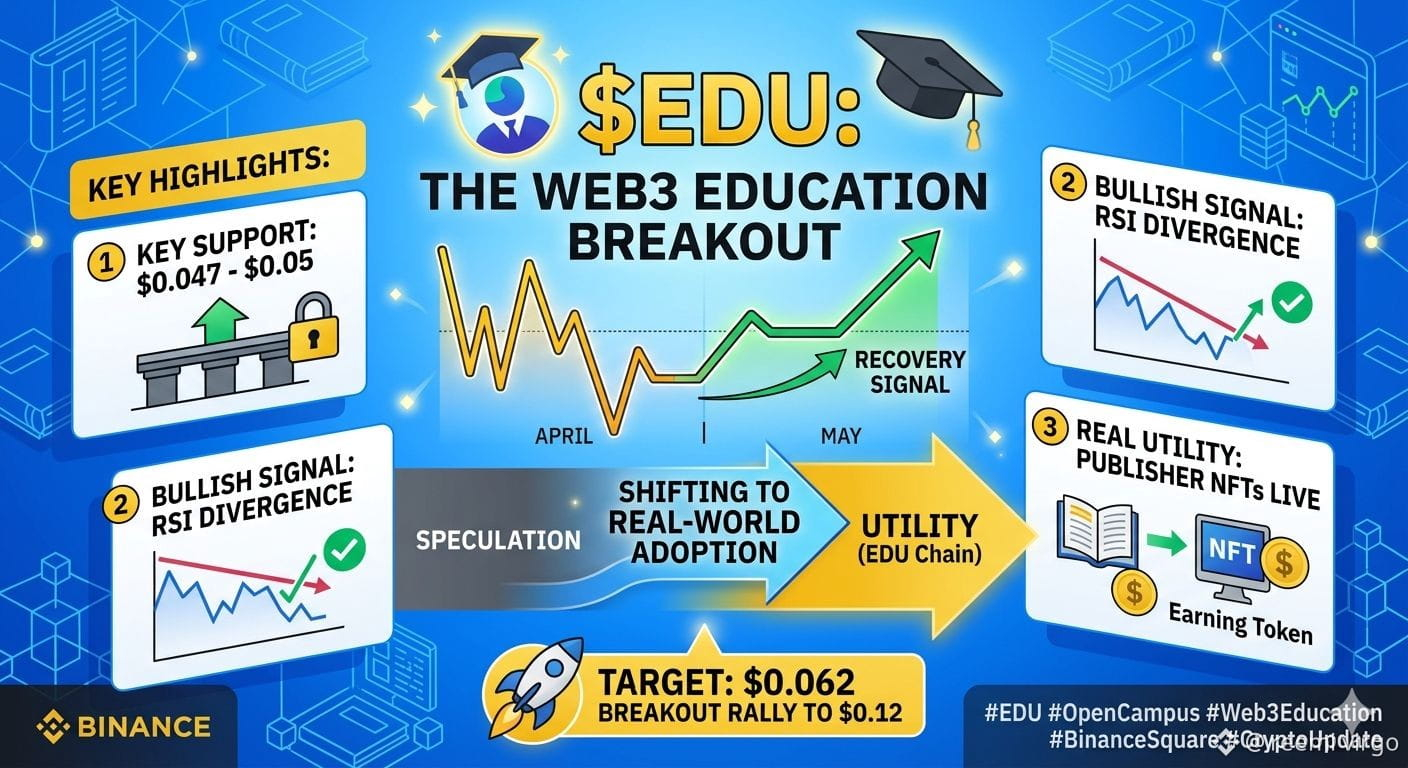
1
252

·
--

Статья
Tutorial (TUT) at $0.044: A 15% Jump – Is This a Fresh Start?The Numbers Right Now:
Price: $0.04424h Change: +15.3%ATH: $0.24224h High: $0.059624h Low: $0.0347Market Cap: $36.6M24h Volume: $208.7MCirculating Supply: 832.2M (83.22% of max)Buyer/Seller Ratio: 55.1% Buyers / 44.9% Sellers
What Is Tutorial?
Tutorial is a project that, like many newer tokens, is still defining its place in the crypto ecosystem. It's part of a growing category of platforms focused on Web3 education and onboarding.
The idea is simple: make crypto easier to understand.
As the industry grows, the need for quality education increases. Tutorial aims to bridge the gap between complex blockchain technology and everyday users.
At its peak, TUT reached $0.242. Now it sits at $0.044.
What's Happened?
Tutorial launched with significant momentum. The narrative around Web3 education has been strong, and TUT attracted attention.
But like many newer projects:
Initial hype faded as attention shifted elsewhereThe broader market has been quietThe project is still in its early stages of development
Today's 15% surge could be driven by:
Increased awareness of the projectNew partnerships or integrationsGeneral market sentiment toward educational platforms
Now, TUT sits at $0.044, about 82% below its all-time high.
Where Is Price Right Now?
Current price: $0.044. The 24h range is wide: $0.0347 to $0.0596 — about 72% from low to high.
The buyer/seller ratio shows 55.1% buyers vs 44.9% sellers — a clear edge to buyers.
At $0.044, TUT is about 82% below its all-time high of $0.242.
The question is: Is this a reversal, or just a short-term spike?
What Makes Tutorial Different?
Education is a long-term play. Unlike DeFi or gaming, it's not about quick returns. It's about building a foundation.
Platforms like Tutorial have the potential to grow as crypto becomes more mainstream. More users means more need for education.
But education-focused tokens face a challenge: adoption takes time. Building a user base and establishing credibility doesn't happen overnight.
Questions to Think About
If you're holding TUT, what made you buy — the education narrative, the community, or the hope for a return to $0.242?Education is a necessary part of crypto growth. But will Tutorial be the platform that wins, or will larger players dominate?The project has a $36.6M market cap. Does that feel like an opportunity or a risk?If price stays around $0.04 for another year, will you hold or move on?What would convince you that Tutorial has a future?
One Reflection
From $0.242 to $0.044. That's an 82% drop.Tutorial is still building. Education is still necessary. The market for Web3 learning is still growing.The question is: Does $0.044 represent value for a project that could help onboard the next generation of crypto users? Or is it still too early to tell?
Who's been watching Tutorial? Share your story. 👇
$ONDO $RENDER $TUT
#cryptoeducation #Tutorial #TUT #Web3Education #tradingpsychology
Tutorial (TUT) at $0.044: A 15% Jump – Is This a Fresh Start?
The Numbers Right Now:
Price: $0.04424h Change: +15.3%ATH: $0.24224h High: $0.059624h Low: $0.0347Market Cap: $36.6M24h Volume: $208.7MCirculating Supply: 832.2M (83.22% of max)Buyer/Seller Ratio: 55.1% Buyers / 44.9% Sellers
What Is Tutorial?
Tutorial is a project that, like many newer tokens, is still defining its place in the crypto ecosystem. It's part of a growing category of platforms focused on Web3 education and onboarding.
The idea is simple: make crypto easier to understand.
As the industry grows, the need for quality education increases. Tutorial aims to bridge the gap between complex blockchain technology and everyday users.
At its peak, TUT reached $0.242. Now it sits at $0.044.
What's Happened?
Tutorial launched with significant momentum. The narrative around Web3 education has been strong, and TUT attracted attention.
But like many newer projects:
Initial hype faded as attention shifted elsewhereThe broader market has been quietThe project is still in its early stages of development
Today's 15% surge could be driven by:
Increased awareness of the projectNew partnerships or integrationsGeneral market sentiment toward educational platforms
Now, TUT sits at $0.044, about 82% below its all-time high.
Where Is Price Right Now?
Current price: $0.044. The 24h range is wide: $0.0347 to $0.0596 — about 72% from low to high.
The buyer/seller ratio shows 55.1% buyers vs 44.9% sellers — a clear edge to buyers.
At $0.044, TUT is about 82% below its all-time high of $0.242.
The question is: Is this a reversal, or just a short-term spike?
What Makes Tutorial Different?
Education is a long-term play. Unlike DeFi or gaming, it's not about quick returns. It's about building a foundation.
Platforms like Tutorial have the potential to grow as crypto becomes more mainstream. More users means more need for education.
But education-focused tokens face a challenge: adoption takes time. Building a user base and establishing credibility doesn't happen overnight.
Questions to Think About
If you're holding TUT, what made you buy — the education narrative, the community, or the hope for a return to $0.242?Education is a necessary part of crypto growth. But will Tutorial be the platform that wins, or will larger players dominate?The project has a $36.6M market cap. Does that feel like an opportunity or a risk?If price stays around $0.04 for another year, will you hold or move on?What would convince you that Tutorial has a future?
One Reflection
From $0.242 to $0.044. That's an 82% drop.Tutorial is still building. Education is still necessary. The market for Web3 learning is still growing.The question is: Does $0.044 represent value for a project that could help onboard the next generation of crypto users? Or is it still too early to tell?
Who's been watching Tutorial? Share your story. 👇
$ONDO $RENDER $TUT
#cryptoeducation #Tutorial #TUT #Web3Education #tradingpsychology
Price: $0.04424h Change: +15.3%ATH: $0.24224h High: $0.059624h Low: $0.0347Market Cap: $36.6M24h Volume: $208.7MCirculating Supply: 832.2M (83.22% of max)Buyer/Seller Ratio: 55.1% Buyers / 44.9% Sellers
What Is Tutorial?
Tutorial is a project that, like many newer tokens, is still defining its place in the crypto ecosystem. It's part of a growing category of platforms focused on Web3 education and onboarding.
The idea is simple: make crypto easier to understand.
As the industry grows, the need for quality education increases. Tutorial aims to bridge the gap between complex blockchain technology and everyday users.
At its peak, TUT reached $0.242. Now it sits at $0.044.
What's Happened?
Tutorial launched with significant momentum. The narrative around Web3 education has been strong, and TUT attracted attention.
But like many newer projects:
Initial hype faded as attention shifted elsewhereThe broader market has been quietThe project is still in its early stages of development
Today's 15% surge could be driven by:
Increased awareness of the projectNew partnerships or integrationsGeneral market sentiment toward educational platforms
Now, TUT sits at $0.044, about 82% below its all-time high.
Where Is Price Right Now?
Current price: $0.044. The 24h range is wide: $0.0347 to $0.0596 — about 72% from low to high.
The buyer/seller ratio shows 55.1% buyers vs 44.9% sellers — a clear edge to buyers.
At $0.044, TUT is about 82% below its all-time high of $0.242.
The question is: Is this a reversal, or just a short-term spike?
What Makes Tutorial Different?
Education is a long-term play. Unlike DeFi or gaming, it's not about quick returns. It's about building a foundation.
Platforms like Tutorial have the potential to grow as crypto becomes more mainstream. More users means more need for education.
But education-focused tokens face a challenge: adoption takes time. Building a user base and establishing credibility doesn't happen overnight.
Questions to Think About
If you're holding TUT, what made you buy — the education narrative, the community, or the hope for a return to $0.242?Education is a necessary part of crypto growth. But will Tutorial be the platform that wins, or will larger players dominate?The project has a $36.6M market cap. Does that feel like an opportunity or a risk?If price stays around $0.04 for another year, will you hold or move on?What would convince you that Tutorial has a future?
One Reflection
From $0.242 to $0.044. That's an 82% drop.Tutorial is still building. Education is still necessary. The market for Web3 learning is still growing.The question is: Does $0.044 represent value for a project that could help onboard the next generation of crypto users? Or is it still too early to tell?
Who's been watching Tutorial? Share your story. 👇
$ONDO $RENDER $TUT
#cryptoeducation #Tutorial #TUT #Web3Education #tradingpsychology
86

·
--
Рост
Impact Beyond Trading: Our commitment to Corporate Social Responsibility
At Binance, we believe in the power of blockchain to build a better future. It’s not just about financial innovation; it’s about making a positive and lasting impact on the world. Our Corporate Social Responsibility (CSR) initiatives are core to our mission, and we are incredibly proud of the progress we have made across four key pillars:
🌱 Binance Green Initiative: Protecting our planet for future generations is paramount. We have successfully planted over 1 million trees, contributing to vital reforestation efforts worldwide. Together, we can create a greener tomorrow.
🎓 Binance Charity: Education unlocks opportunity. Our charity efforts have raised over $10 million dedicated to improving access to quality education globally. We are committed to empowering individuals and communities through learning.
🤝 Community Support: We believe in the strength of connection. We have hosted over 50+ Global Workshops, engaging directly with our users and partners to understand their needs and provide support. We are dedicated to fostering a strong and inclusive community.
🚀 Binance Lab 2.0: Innovation drives progress. Our Binance Lab 2.0 program provides vital mentorship for Web3.0 startups, equipping the next generation of entrepreneurs with the tools and knowledge they need to succeed.
This image, with its professional and modern setting, reflects our forward-thinking approach. The wall art showcasing a world map and blockchain concepts symbolizes our global reach and technological innovation, which underpins all our CSR efforts.
Thank you to our amazing global community for your continued support! Together, we are not only building the future of finance but also creating a more sustainable and equitable world.
#BinanceCSR #Sustainability #CryptoForGood #Web3Education #InnovationWithPurpose
{future}(BTCUSDT)
{future}(BNBUSDT)
{future}(ETHUSDT)
Impact Beyond Trading: Our commitment to Corporate Social Responsibility
At Binance, we believe in the power of blockchain to build a better future. It’s not just about financial innovation; it’s about making a positive and lasting impact on the world. Our Corporate Social Responsibility (CSR) initiatives are core to our mission, and we are incredibly proud of the progress we have made across four key pillars:
🌱 Binance Green Initiative: Protecting our planet for future generations is paramount. We have successfully planted over 1 million trees, contributing to vital reforestation efforts worldwide. Together, we can create a greener tomorrow.
🎓 Binance Charity: Education unlocks opportunity. Our charity efforts have raised over $10 million dedicated to improving access to quality education globally. We are committed to empowering individuals and communities through learning.
🤝 Community Support: We believe in the strength of connection. We have hosted over 50+ Global Workshops, engaging directly with our users and partners to understand their needs and provide support. We are dedicated to fostering a strong and inclusive community.
🚀 Binance Lab 2.0: Innovation drives progress. Our Binance Lab 2.0 program provides vital mentorship for Web3.0 startups, equipping the next generation of entrepreneurs with the tools and knowledge they need to succeed.
This image, with its professional and modern setting, reflects our forward-thinking approach. The wall art showcasing a world map and blockchain concepts symbolizes our global reach and technological innovation, which underpins all our CSR efforts.
Thank you to our amazing global community for your continued support! Together, we are not only building the future of finance but also creating a more sustainable and equitable world.
#BinanceCSR #Sustainability #CryptoForGood #Web3Education #InnovationWithPurpose
At Binance, we believe in the power of blockchain to build a better future. It’s not just about financial innovation; it’s about making a positive and lasting impact on the world. Our Corporate Social Responsibility (CSR) initiatives are core to our mission, and we are incredibly proud of the progress we have made across four key pillars:
🌱 Binance Green Initiative: Protecting our planet for future generations is paramount. We have successfully planted over 1 million trees, contributing to vital reforestation efforts worldwide. Together, we can create a greener tomorrow.
🎓 Binance Charity: Education unlocks opportunity. Our charity efforts have raised over $10 million dedicated to improving access to quality education globally. We are committed to empowering individuals and communities through learning.
🤝 Community Support: We believe in the strength of connection. We have hosted over 50+ Global Workshops, engaging directly with our users and partners to understand their needs and provide support. We are dedicated to fostering a strong and inclusive community.
🚀 Binance Lab 2.0: Innovation drives progress. Our Binance Lab 2.0 program provides vital mentorship for Web3.0 startups, equipping the next generation of entrepreneurs with the tools and knowledge they need to succeed.
This image, with its professional and modern setting, reflects our forward-thinking approach. The wall art showcasing a world map and blockchain concepts symbolizes our global reach and technological innovation, which underpins all our CSR efforts.
Thank you to our amazing global community for your continued support! Together, we are not only building the future of finance but also creating a more sustainable and equitable world.
#BinanceCSR #Sustainability #CryptoForGood #Web3Education #InnovationWithPurpose

8
514
·
--
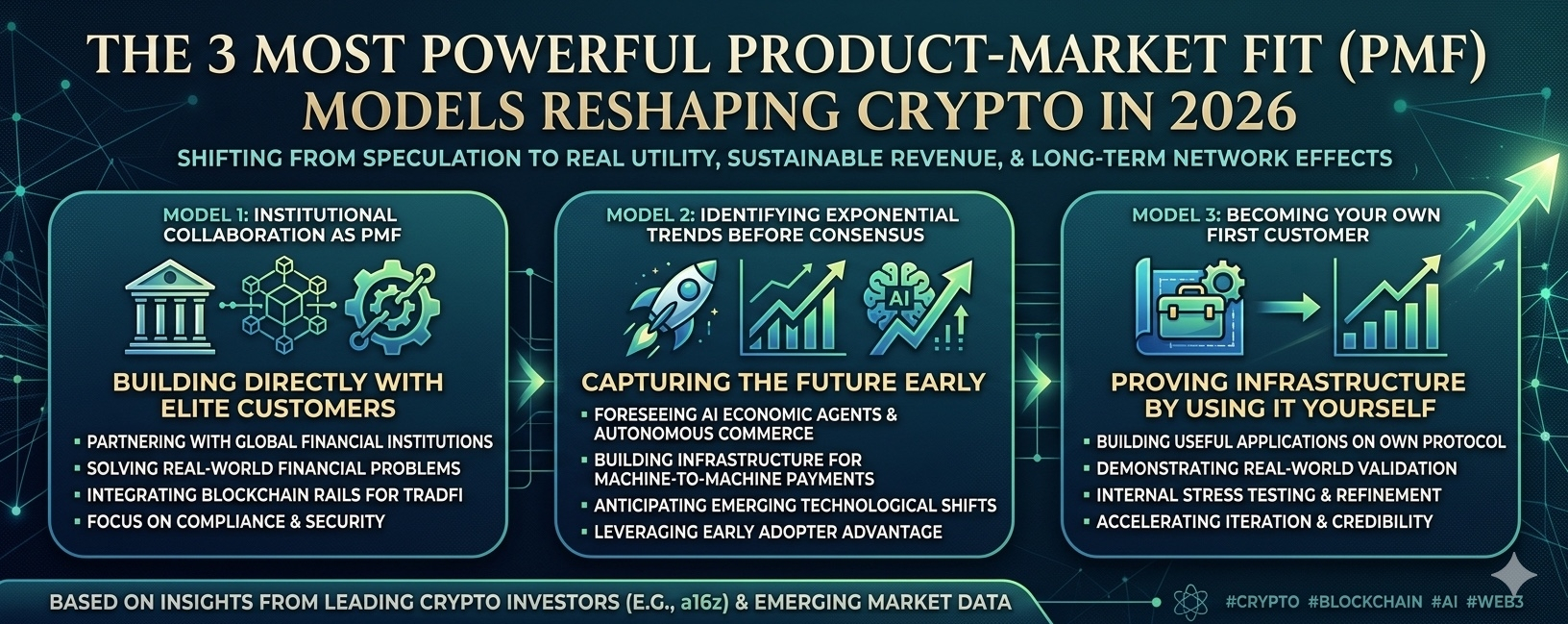
Статья
The 3 Most Powerful Product-Market Fit (PMF) Models Reshaping Crypto in 2026Product-Market Fit (PMF) has always been the defining factor between crypto projects that survive and those that disappear. In previous cycles, many startups temporarily masked weak fundamentals through aggressive token incentives, airdrops, inflated Total Value Locked (TVL), and speculative hype. But the 2026 crypto market is different.
Capital alone is no longer enough.
Today’s market increasingly rewards projects that solve real problems, attract institutional demand, and build sustainable ecosystems. According to insights shared by Andreessen Horowitz (a16z), three PMF patterns are currently emerging as the strongest and most credible models in the crypto industry.
These models are not theory alone — they are already shaping the next generation of blockchain infrastructure, AI commerce, stablecoin adoption, and institutional finance.
Why PMF Matters More Than Ever in Crypto
In traditional startups, PMF means customers genuinely need and repeatedly use your product.
In crypto, however, PMF became distorted during previous bull markets because token speculation often created artificial demand. A project could attract millions in liquidity without proving actual utility.
That era is fading.
Today, investors, institutions, and users increasingly focus on:
▪ Sustainable revenue
▪ Real adoption
▪ Institutional integration
▪ Infrastructure utility
▪ Long-term network effects
▪ Regulatory compatibility
The market now punishes unsustainable growth models faster than ever.
This shift explains why the industry is moving toward more practical and infrastructure-driven PMF strategies.
Model 1 — Building Directly With Elite Customers
“Institutional Collaboration as PMF”
The first and perhaps most powerful PMF model involves partnering directly with highly sophisticated clients and building products around their needs.
Instead of launching blindly to retail markets, startups collaborate with major financial institutions, enterprise clients, or high-volume market participants.
This approach is slower initially, but the validation quality is dramatically higher.
If a product successfully serves institutions moving trillions of dollars daily, that validation becomes exponentially more valuable than temporary retail hype.
Why This Model Works
Institutional clients bring:
▪ Clear operational pain points
▪ Large transaction volume
▪ Long-term contracts
▪ Regulatory insight
▪ Enterprise credibility
▪ Stronger retention
These clients effectively become co-designers of the product.
Rather than guessing what the market wants, crypto companies receive direct feedback from the largest and most demanding users.
How TradFi Is Quietly Adopting Blockchain
One of the most important signals in crypto today is the growing collaboration between blockchain startups and traditional finance institutions.
This trend shows something critical:
Blockchain is increasingly becoming invisible infrastructure powering modern finance.
The narrative is shifting away from “crypto replacing banks” toward “banks integrating blockchain rails.”
Examples include:
▪ Stablecoin settlement systems
▪ Tokenized deposits
▪ Cross-border payment rails
▪ On-chain treasury systems
▪ Institutional custody solutions
▪ Real-world asset tokenization
The winners in this category are often infrastructure providers rather than retail-facing meme projects.
Key Strategic Insight
Projects pursuing this PMF model should prioritize:
▪ Compliance
▪ Reliability
▪ Scalability
▪ Security
▪ Enterprise integrations
▪ Institutional trust
This is less about hype and more about becoming part of the global financial operating system.
Model 2 — Identifying Exponential Trends Before Consensus
“Capture the Future Before Everyone Notices”
The second PMF model focuses on identifying transformational market shifts early and building infrastructure before mainstream adoption arrives.
This strategy requires conviction, speed, and vision.
Right now, the largest exponential trend emerging is the convergence of:
▪ AI
▪ Autonomous agents
▪ Crypto payments
▪ Machine-to-machine commerce
The Rise of AI Economic Agents
AI systems are rapidly evolving beyond assistants.
They are becoming autonomous economic participants capable of:
▪ Executing trades
▪ Paying for services
▪ Accessing APIs
▪ Deploying capital
▪ Managing workflows
▪ Interacting with financial systems automatically
This creates an entirely new economic layer where machines transact with machines.
Traditional payment systems were not designed for this future.
Crypto infrastructure is.
Why Crypto Fits the AI Economy
Autonomous AI agents require:
▪ Instant settlement
▪ Borderless payments
▪ Programmable money
▪ Low transaction friction
▪ API-native financial rails
▪ 24/7 availability
Blockchain networks naturally solve many of these requirements.
This is why many analysts believe crypto payments may become foundational infrastructure for AI commerce.
Agentic Commerce Could Become a Massive Market
Companies like AgentCash are building systems where AI agents can independently pay for API access and digital services using cryptocurrency.
This concept may sound futuristic today, but it represents a potentially enormous future market:
Machine-driven commerce.
In this world:
▪ AI bots negotiate services
▪ Agents execute financial operations
▪ APIs become monetized autonomously
▪ Software interacts economically without human involvement
The infrastructure layer powering these interactions could become extremely valuable.
Strategic Lesson From This Model
The biggest winners often emerge before consensus forms.
By the time the market fully understands the opportunity:
▪ Valuations rise
▪ Competition increases
▪ Market share becomes harder to capture
Projects identifying exponential curves early gain enormous strategic advantages.
Model 3 — Becoming Your Own First Customer
“Prove Your Infrastructure by Using It Yourself”
The third PMF model is one of the most underrated but effective approaches in technology history.
Instead of waiting for external adoption, companies first build applications on top of their own infrastructure.
This validates the system internally before external expansion.
AWS: The Classic Example
Amazon did not initially build AWS for startups.
They first created infrastructure for their own massive e-commerce operations.
Only after proving scalability internally did AWS become a global cloud platform.
This created:
▪ Real-world validation
▪ Operational reliability
▪ Product maturity
▪ Internal stress testing
▪ Immediate utility
Crypto infrastructure companies are increasingly adopting this same strategy.
The ZKsync Example
Matter Labs and ZKsync are applying this model through tokenized banking infrastructure.
Rather than marketing abstract blockchain technology, they focused on solving a specific institutional problem:
Instant transfer of tokenized bank deposits between regulated institutions.
This approach transforms infrastructure from a theoretical platform into a working financial product.
The key difference is enormous.
Instead of saying:
“Developers should build on us someday.”
They demonstrate:
“We already built something valuable ourselves.”
Why This Model Is Powerful
Being your own first customer allows teams to:
▪ Discover weaknesses early
▪ Improve developer experience
▪ Stress-test scalability
▪ Build practical use cases
▪ Accelerate iteration
▪ Increase credibility
It also signals confidence.
If the creators themselves are unwilling to rely on their infrastructure, external developers likely will not trust it either.
The Deeper Trend Behind All Three Models
Although these PMF strategies appear different, they share one common principle:
Real utility now matters more than speculative attention.
The crypto industry is maturing.
The market increasingly rewards:
▪ Revenue-generating systems
▪ Financial infrastructure
▪ Enterprise-grade products
▪ AI-integrated networks
▪ Stablecoin ecosystems
▪ Real-world blockchain applications
Meanwhile, projects relying only on hype cycles struggle to maintain long-term relevance.
What This Means for Crypto Builders and Investors
For builders:
The fastest route to PMF is no longer endless experimentation without direction.
Success increasingly comes from:
▪ Solving meaningful problems
▪ Targeting high-value users
▪ Building around irreversible trends
▪ Demonstrating practical utility
▪ Creating products people genuinely need
For investors and traders:
The strongest long-term opportunities may increasingly come from sectors such as:
▪ Stablecoin infrastructure
▪ Tokenized finance
▪ AI-agent payments
▪ Institutional blockchain rails
▪ Real-world asset tokenization
▪ Enterprise crypto services
▪ Layer-2 scalability solutions
These sectors align more closely with sustainable adoption rather than temporary speculation.
Final Thoughts
Crypto is entering a new phase.
The industry is gradually shifting away from purely speculative narratives toward infrastructure, utility, automation, and institutional integration.
The three PMF models highlighted by a16z reveal where the market is likely heading:
1. Build with powerful institutional customers
2. Capture exponential technological shifts early
3. Become your own first successful use case
The projects mastering these strategies may define the next decade of blockchain adoption.
In 2026, the market is no longer asking:
“Can this token pump?”
It is asking:
“Does this system solve a real problem at global scale?”
And that question changes everything.
#Crypto #Blockchain #AI #Web3Education #ArifAlpha
The 3 Most Powerful Product-Market Fit (PMF) Models Reshaping Crypto in 2026
Product-Market Fit (PMF) has always been the defining factor between crypto projects that survive and those that disappear. In previous cycles, many startups temporarily masked weak fundamentals through aggressive token incentives, airdrops, inflated Total Value Locked (TVL), and speculative hype. But the 2026 crypto market is different.
Capital alone is no longer enough.
Today’s market increasingly rewards projects that solve real problems, attract institutional demand, and build sustainable ecosystems. According to insights shared by Andreessen Horowitz (a16z), three PMF patterns are currently emerging as the strongest and most credible models in the crypto industry.
These models are not theory alone — they are already shaping the next generation of blockchain infrastructure, AI commerce, stablecoin adoption, and institutional finance.
Why PMF Matters More Than Ever in Crypto
In traditional startups, PMF means customers genuinely need and repeatedly use your product.
In crypto, however, PMF became distorted during previous bull markets because token speculation often created artificial demand. A project could attract millions in liquidity without proving actual utility.
That era is fading.
Today, investors, institutions, and users increasingly focus on:
▪ Sustainable revenue
▪ Real adoption
▪ Institutional integration
▪ Infrastructure utility
▪ Long-term network effects
▪ Regulatory compatibility
The market now punishes unsustainable growth models faster than ever.
This shift explains why the industry is moving toward more practical and infrastructure-driven PMF strategies.
Model 1 — Building Directly With Elite Customers
“Institutional Collaboration as PMF”
The first and perhaps most powerful PMF model involves partnering directly with highly sophisticated clients and building products around their needs.
Instead of launching blindly to retail markets, startups collaborate with major financial institutions, enterprise clients, or high-volume market participants.
This approach is slower initially, but the validation quality is dramatically higher.
If a product successfully serves institutions moving trillions of dollars daily, that validation becomes exponentially more valuable than temporary retail hype.
Why This Model Works
Institutional clients bring:
▪ Clear operational pain points
▪ Large transaction volume
▪ Long-term contracts
▪ Regulatory insight
▪ Enterprise credibility
▪ Stronger retention
These clients effectively become co-designers of the product.
Rather than guessing what the market wants, crypto companies receive direct feedback from the largest and most demanding users.
How TradFi Is Quietly Adopting Blockchain
One of the most important signals in crypto today is the growing collaboration between blockchain startups and traditional finance institutions.
This trend shows something critical:
Blockchain is increasingly becoming invisible infrastructure powering modern finance.
The narrative is shifting away from “crypto replacing banks” toward “banks integrating blockchain rails.”
Examples include:
▪ Stablecoin settlement systems
▪ Tokenized deposits
▪ Cross-border payment rails
▪ On-chain treasury systems
▪ Institutional custody solutions
▪ Real-world asset tokenization
The winners in this category are often infrastructure providers rather than retail-facing meme projects.
Key Strategic Insight
Projects pursuing this PMF model should prioritize:
▪ Compliance
▪ Reliability
▪ Scalability
▪ Security
▪ Enterprise integrations
▪ Institutional trust
This is less about hype and more about becoming part of the global financial operating system.
Model 2 — Identifying Exponential Trends Before Consensus
“Capture the Future Before Everyone Notices”
The second PMF model focuses on identifying transformational market shifts early and building infrastructure before mainstream adoption arrives.
This strategy requires conviction, speed, and vision.
Right now, the largest exponential trend emerging is the convergence of:
▪ AI
▪ Autonomous agents
▪ Crypto payments
▪ Machine-to-machine commerce
The Rise of AI Economic Agents
AI systems are rapidly evolving beyond assistants.
They are becoming autonomous economic participants capable of:
▪ Executing trades
▪ Paying for services
▪ Accessing APIs
▪ Deploying capital
▪ Managing workflows
▪ Interacting with financial systems automatically
This creates an entirely new economic layer where machines transact with machines.
Traditional payment systems were not designed for this future.
Crypto infrastructure is.
Why Crypto Fits the AI Economy
Autonomous AI agents require:
▪ Instant settlement
▪ Borderless payments
▪ Programmable money
▪ Low transaction friction
▪ API-native financial rails
▪ 24/7 availability
Blockchain networks naturally solve many of these requirements.
This is why many analysts believe crypto payments may become foundational infrastructure for AI commerce.
Agentic Commerce Could Become a Massive Market
Companies like AgentCash are building systems where AI agents can independently pay for API access and digital services using cryptocurrency.
This concept may sound futuristic today, but it represents a potentially enormous future market:
Machine-driven commerce.
In this world:
▪ AI bots negotiate services
▪ Agents execute financial operations
▪ APIs become monetized autonomously
▪ Software interacts economically without human involvement
The infrastructure layer powering these interactions could become extremely valuable.
Strategic Lesson From This Model
The biggest winners often emerge before consensus forms.
By the time the market fully understands the opportunity:
▪ Valuations rise
▪ Competition increases
▪ Market share becomes harder to capture
Projects identifying exponential curves early gain enormous strategic advantages.
Model 3 — Becoming Your Own First Customer
“Prove Your Infrastructure by Using It Yourself”
The third PMF model is one of the most underrated but effective approaches in technology history.
Instead of waiting for external adoption, companies first build applications on top of their own infrastructure.
This validates the system internally before external expansion.
AWS: The Classic Example
Amazon did not initially build AWS for startups.
They first created infrastructure for their own massive e-commerce operations.
Only after proving scalability internally did AWS become a global cloud platform.
This created:
▪ Real-world validation
▪ Operational reliability
▪ Product maturity
▪ Internal stress testing
▪ Immediate utility
Crypto infrastructure companies are increasingly adopting this same strategy.
The ZKsync Example
Matter Labs and ZKsync are applying this model through tokenized banking infrastructure.
Rather than marketing abstract blockchain technology, they focused on solving a specific institutional problem:
Instant transfer of tokenized bank deposits between regulated institutions.
This approach transforms infrastructure from a theoretical platform into a working financial product.
The key difference is enormous.
Instead of saying:
“Developers should build on us someday.”
They demonstrate:
“We already built something valuable ourselves.”
Why This Model Is Powerful
Being your own first customer allows teams to:
▪ Discover weaknesses early
▪ Improve developer experience
▪ Stress-test scalability
▪ Build practical use cases
▪ Accelerate iteration
▪ Increase credibility
It also signals confidence.
If the creators themselves are unwilling to rely on their infrastructure, external developers likely will not trust it either.
The Deeper Trend Behind All Three Models
Although these PMF strategies appear different, they share one common principle:
Real utility now matters more than speculative attention.
The crypto industry is maturing.
The market increasingly rewards:
▪ Revenue-generating systems
▪ Financial infrastructure
▪ Enterprise-grade products
▪ AI-integrated networks
▪ Stablecoin ecosystems
▪ Real-world blockchain applications
Meanwhile, projects relying only on hype cycles struggle to maintain long-term relevance.
What This Means for Crypto Builders and Investors
For builders:
The fastest route to PMF is no longer endless experimentation without direction.
Success increasingly comes from:
▪ Solving meaningful problems
▪ Targeting high-value users
▪ Building around irreversible trends
▪ Demonstrating practical utility
▪ Creating products people genuinely need
For investors and traders:
The strongest long-term opportunities may increasingly come from sectors such as:
▪ Stablecoin infrastructure
▪ Tokenized finance
▪ AI-agent payments
▪ Institutional blockchain rails
▪ Real-world asset tokenization
▪ Enterprise crypto services
▪ Layer-2 scalability solutions
These sectors align more closely with sustainable adoption rather than temporary speculation.
Final Thoughts
Crypto is entering a new phase.
The industry is gradually shifting away from purely speculative narratives toward infrastructure, utility, automation, and institutional integration.
The three PMF models highlighted by a16z reveal where the market is likely heading:
1. Build with powerful institutional customers
2. Capture exponential technological shifts early
3. Become your own first successful use case
The projects mastering these strategies may define the next decade of blockchain adoption.
In 2026, the market is no longer asking:
“Can this token pump?”
It is asking:
“Does this system solve a real problem at global scale?”
And that question changes everything.
#Crypto #Blockchain #AI #Web3Education #ArifAlpha
Capital alone is no longer enough.
Today’s market increasingly rewards projects that solve real problems, attract institutional demand, and build sustainable ecosystems. According to insights shared by Andreessen Horowitz (a16z), three PMF patterns are currently emerging as the strongest and most credible models in the crypto industry.
These models are not theory alone — they are already shaping the next generation of blockchain infrastructure, AI commerce, stablecoin adoption, and institutional finance.
Why PMF Matters More Than Ever in Crypto
In traditional startups, PMF means customers genuinely need and repeatedly use your product.
In crypto, however, PMF became distorted during previous bull markets because token speculation often created artificial demand. A project could attract millions in liquidity without proving actual utility.
That era is fading.
Today, investors, institutions, and users increasingly focus on:
▪ Sustainable revenue
▪ Real adoption
▪ Institutional integration
▪ Infrastructure utility
▪ Long-term network effects
▪ Regulatory compatibility
The market now punishes unsustainable growth models faster than ever.
This shift explains why the industry is moving toward more practical and infrastructure-driven PMF strategies.
Model 1 — Building Directly With Elite Customers
“Institutional Collaboration as PMF”
The first and perhaps most powerful PMF model involves partnering directly with highly sophisticated clients and building products around their needs.
Instead of launching blindly to retail markets, startups collaborate with major financial institutions, enterprise clients, or high-volume market participants.
This approach is slower initially, but the validation quality is dramatically higher.
If a product successfully serves institutions moving trillions of dollars daily, that validation becomes exponentially more valuable than temporary retail hype.
Why This Model Works
Institutional clients bring:
▪ Clear operational pain points
▪ Large transaction volume
▪ Long-term contracts
▪ Regulatory insight
▪ Enterprise credibility
▪ Stronger retention
These clients effectively become co-designers of the product.
Rather than guessing what the market wants, crypto companies receive direct feedback from the largest and most demanding users.
How TradFi Is Quietly Adopting Blockchain
One of the most important signals in crypto today is the growing collaboration between blockchain startups and traditional finance institutions.
This trend shows something critical:
Blockchain is increasingly becoming invisible infrastructure powering modern finance.
The narrative is shifting away from “crypto replacing banks” toward “banks integrating blockchain rails.”
Examples include:
▪ Stablecoin settlement systems
▪ Tokenized deposits
▪ Cross-border payment rails
▪ On-chain treasury systems
▪ Institutional custody solutions
▪ Real-world asset tokenization
The winners in this category are often infrastructure providers rather than retail-facing meme projects.
Key Strategic Insight
Projects pursuing this PMF model should prioritize:
▪ Compliance
▪ Reliability
▪ Scalability
▪ Security
▪ Enterprise integrations
▪ Institutional trust
This is less about hype and more about becoming part of the global financial operating system.
Model 2 — Identifying Exponential Trends Before Consensus
“Capture the Future Before Everyone Notices”
The second PMF model focuses on identifying transformational market shifts early and building infrastructure before mainstream adoption arrives.
This strategy requires conviction, speed, and vision.
Right now, the largest exponential trend emerging is the convergence of:
▪ AI
▪ Autonomous agents
▪ Crypto payments
▪ Machine-to-machine commerce
The Rise of AI Economic Agents
AI systems are rapidly evolving beyond assistants.
They are becoming autonomous economic participants capable of:
▪ Executing trades
▪ Paying for services
▪ Accessing APIs
▪ Deploying capital
▪ Managing workflows
▪ Interacting with financial systems automatically
This creates an entirely new economic layer where machines transact with machines.
Traditional payment systems were not designed for this future.
Crypto infrastructure is.
Why Crypto Fits the AI Economy
Autonomous AI agents require:
▪ Instant settlement
▪ Borderless payments
▪ Programmable money
▪ Low transaction friction
▪ API-native financial rails
▪ 24/7 availability
Blockchain networks naturally solve many of these requirements.
This is why many analysts believe crypto payments may become foundational infrastructure for AI commerce.
Agentic Commerce Could Become a Massive Market
Companies like AgentCash are building systems where AI agents can independently pay for API access and digital services using cryptocurrency.
This concept may sound futuristic today, but it represents a potentially enormous future market:
Machine-driven commerce.
In this world:
▪ AI bots negotiate services
▪ Agents execute financial operations
▪ APIs become monetized autonomously
▪ Software interacts economically without human involvement
The infrastructure layer powering these interactions could become extremely valuable.
Strategic Lesson From This Model
The biggest winners often emerge before consensus forms.
By the time the market fully understands the opportunity:
▪ Valuations rise
▪ Competition increases
▪ Market share becomes harder to capture
Projects identifying exponential curves early gain enormous strategic advantages.
Model 3 — Becoming Your Own First Customer
“Prove Your Infrastructure by Using It Yourself”
The third PMF model is one of the most underrated but effective approaches in technology history.
Instead of waiting for external adoption, companies first build applications on top of their own infrastructure.
This validates the system internally before external expansion.
AWS: The Classic Example
Amazon did not initially build AWS for startups.
They first created infrastructure for their own massive e-commerce operations.
Only after proving scalability internally did AWS become a global cloud platform.
This created:
▪ Real-world validation
▪ Operational reliability
▪ Product maturity
▪ Internal stress testing
▪ Immediate utility
Crypto infrastructure companies are increasingly adopting this same strategy.
The ZKsync Example
Matter Labs and ZKsync are applying this model through tokenized banking infrastructure.
Rather than marketing abstract blockchain technology, they focused on solving a specific institutional problem:
Instant transfer of tokenized bank deposits between regulated institutions.
This approach transforms infrastructure from a theoretical platform into a working financial product.
The key difference is enormous.
Instead of saying:
“Developers should build on us someday.”
They demonstrate:
“We already built something valuable ourselves.”
Why This Model Is Powerful
Being your own first customer allows teams to:
▪ Discover weaknesses early
▪ Improve developer experience
▪ Stress-test scalability
▪ Build practical use cases
▪ Accelerate iteration
▪ Increase credibility
It also signals confidence.
If the creators themselves are unwilling to rely on their infrastructure, external developers likely will not trust it either.
The Deeper Trend Behind All Three Models
Although these PMF strategies appear different, they share one common principle:
Real utility now matters more than speculative attention.
The crypto industry is maturing.
The market increasingly rewards:
▪ Revenue-generating systems
▪ Financial infrastructure
▪ Enterprise-grade products
▪ AI-integrated networks
▪ Stablecoin ecosystems
▪ Real-world blockchain applications
Meanwhile, projects relying only on hype cycles struggle to maintain long-term relevance.
What This Means for Crypto Builders and Investors
For builders:
The fastest route to PMF is no longer endless experimentation without direction.
Success increasingly comes from:
▪ Solving meaningful problems
▪ Targeting high-value users
▪ Building around irreversible trends
▪ Demonstrating practical utility
▪ Creating products people genuinely need
For investors and traders:
The strongest long-term opportunities may increasingly come from sectors such as:
▪ Stablecoin infrastructure
▪ Tokenized finance
▪ AI-agent payments
▪ Institutional blockchain rails
▪ Real-world asset tokenization
▪ Enterprise crypto services
▪ Layer-2 scalability solutions
These sectors align more closely with sustainable adoption rather than temporary speculation.
Final Thoughts
Crypto is entering a new phase.
The industry is gradually shifting away from purely speculative narratives toward infrastructure, utility, automation, and institutional integration.
The three PMF models highlighted by a16z reveal where the market is likely heading:
1. Build with powerful institutional customers
2. Capture exponential technological shifts early
3. Become your own first successful use case
The projects mastering these strategies may define the next decade of blockchain adoption.
In 2026, the market is no longer asking:
“Can this token pump?”
It is asking:
“Does this system solve a real problem at global scale?”
And that question changes everything.
#Crypto #Blockchain #AI #Web3Education #ArifAlpha
123

·
--
Рост
I used to think crypto was only about trading.
Then I discovered smarter ways to learn and grow.
What was your first crypto lesson?
#CryptoJourney
#Web3Education
#BeyondTrading
#BlockchainInnovation
#CryptoCommunity
I used to think crypto was only about trading.
Then I discovered smarter ways to learn and grow.
What was your first crypto lesson?
#CryptoJourney
#Web3Education
#BeyondTrading
#BlockchainInnovation
#CryptoCommunity
Then I discovered smarter ways to learn and grow.
What was your first crypto lesson?
#CryptoJourney
#Web3Education
#BeyondTrading
#BlockchainInnovation
#CryptoCommunity

139
·
--
Рост
You don’t always need money to start in crypto.
Sometimes learning becomes your first investment.
That’s the smartest beginning.
True?
#CryptoLearning #CryptoEducation #SmartInvestment #CryptoBeginner #Web3Education
You don’t always need money to start in crypto.
Sometimes learning becomes your first investment.
That’s the smartest beginning.
True?
#CryptoLearning #CryptoEducation #SmartInvestment #CryptoBeginner #Web3Education
Sometimes learning becomes your first investment.
That’s the smartest beginning.
True?
#CryptoLearning #CryptoEducation #SmartInvestment #CryptoBeginner #Web3Education

1
89

#OCT Stop Chasing Green Candles: 3 Metrics to Check BEFORE Your Next Crypto Trade 🚨
When the market pumps, FOMO makes it easy to jump in blind. Successful trading is not about guessing. It is about managing risk.Before you hit buy on any token today, check these 3 vital metrics:
1. Volume Profile vs. Price Action: If the price is rising but trading volume is dropping, the move lacks strength. Watch out for a potential trap. Look for volume confirming the breakout.
2. Funding Rates (For Futures Traders) Are funding rates deeply positive? Long positions are paying short positions. This means the market is overcrowded with buyers. A sudden leverage flush could be next.
3. Inflow/Outflow Data: Are whales moving tokens onto exchanges? Large exchange inflows usually signal an intent to sell. Keep an eye on on-chain data before committing capital.
What metric do you rely on most before entering a trade? Let me know below! 👇
#cryptotrading #TechnicalAnalysis #Web3Education $BTC ETH BNB
Disclaimer: This content is for educational purposes only and does not constitute financial advice. Always do your own research (DYOR).
#OCT Stop Chasing Green Candles: 3 Metrics to Check BEFORE Your Next Crypto Trade 🚨
When the market pumps, FOMO makes it easy to jump in blind. Successful trading is not about guessing. It is about managing risk.Before you hit buy on any token today, check these 3 vital metrics:
1. Volume Profile vs. Price Action: If the price is rising but trading volume is dropping, the move lacks strength. Watch out for a potential trap. Look for volume confirming the breakout.
2. Funding Rates (For Futures Traders) Are funding rates deeply positive? Long positions are paying short positions. This means the market is overcrowded with buyers. A sudden leverage flush could be next.
3. Inflow/Outflow Data: Are whales moving tokens onto exchanges? Large exchange inflows usually signal an intent to sell. Keep an eye on on-chain data before committing capital.
What metric do you rely on most before entering a trade? Let me know below! 👇
#cryptotrading #TechnicalAnalysis #Web3Education $BTC ETH BNB
Disclaimer: This content is for educational purposes only and does not constitute financial advice. Always do your own research (DYOR).
When the market pumps, FOMO makes it easy to jump in blind. Successful trading is not about guessing. It is about managing risk.Before you hit buy on any token today, check these 3 vital metrics:
1. Volume Profile vs. Price Action: If the price is rising but trading volume is dropping, the move lacks strength. Watch out for a potential trap. Look for volume confirming the breakout.
2. Funding Rates (For Futures Traders) Are funding rates deeply positive? Long positions are paying short positions. This means the market is overcrowded with buyers. A sudden leverage flush could be next.
3. Inflow/Outflow Data: Are whales moving tokens onto exchanges? Large exchange inflows usually signal an intent to sell. Keep an eye on on-chain data before committing capital.
What metric do you rely on most before entering a trade? Let me know below! 👇
#cryptotrading #TechnicalAnalysis #Web3Education $BTC ETH BNB
Disclaimer: This content is for educational purposes only and does not constitute financial advice. Always do your own research (DYOR).
132
Войдите, чтобы посмотреть больше материала
Присоединяйтесь к пользователям криптовалют по всему миру на Binance Square
⚡️ Получайте новейшую и полезную информацию о криптоактивах.
💬 Нам доверяет крупнейшая в мире криптобиржа.
👍 Получите достоверные аналитические данные от верифицированных создателей контента.
Эл. почта/номер телефона
В тренде
1
#BinanceKZ
Просмотров: 9,049
50 обсуждают
2
#UKFCAWinsCourtOrderToRecover851400Pounds
Просмотров: 37,747
823 обсуждают
3
#ChainlinkLaunchesCCIP2WithEnterpriseVerification
Просмотров: 50,041
990 обсуждают
4
#GoldFallsTo$4144
Просмотров: 17,260
167 обсуждают
5
#QNTFallsOver40%FromMorningHigh
Просмотров: 97,543
1,384 обсуждают
6
#USDTAdds845900HoldersInPast7Days
Просмотров: 21,333
442 обсуждают
7
#KospiFalls2.7%SamsungSKHynixDropOver5%
Просмотров: 33,872
614 обсуждают
8
#BitgetCEOConfirms$388MStolenInHack
Просмотров: 5,628
43 обсуждают
9
#BTCFallsBelow$83000
Просмотров: 34,845
170 обсуждают
10
#BitgetDetailsSecurityIncidentTimeline
Просмотров: 55,498
763 обсуждают