
#nfp
nfp
Просмотров: 38.8M
268,996 обсуждают
Популярные
Новые

Imagine a coin that fell off a cliff, and everyone expects it to keep falling. But the ground is closer than it looks.
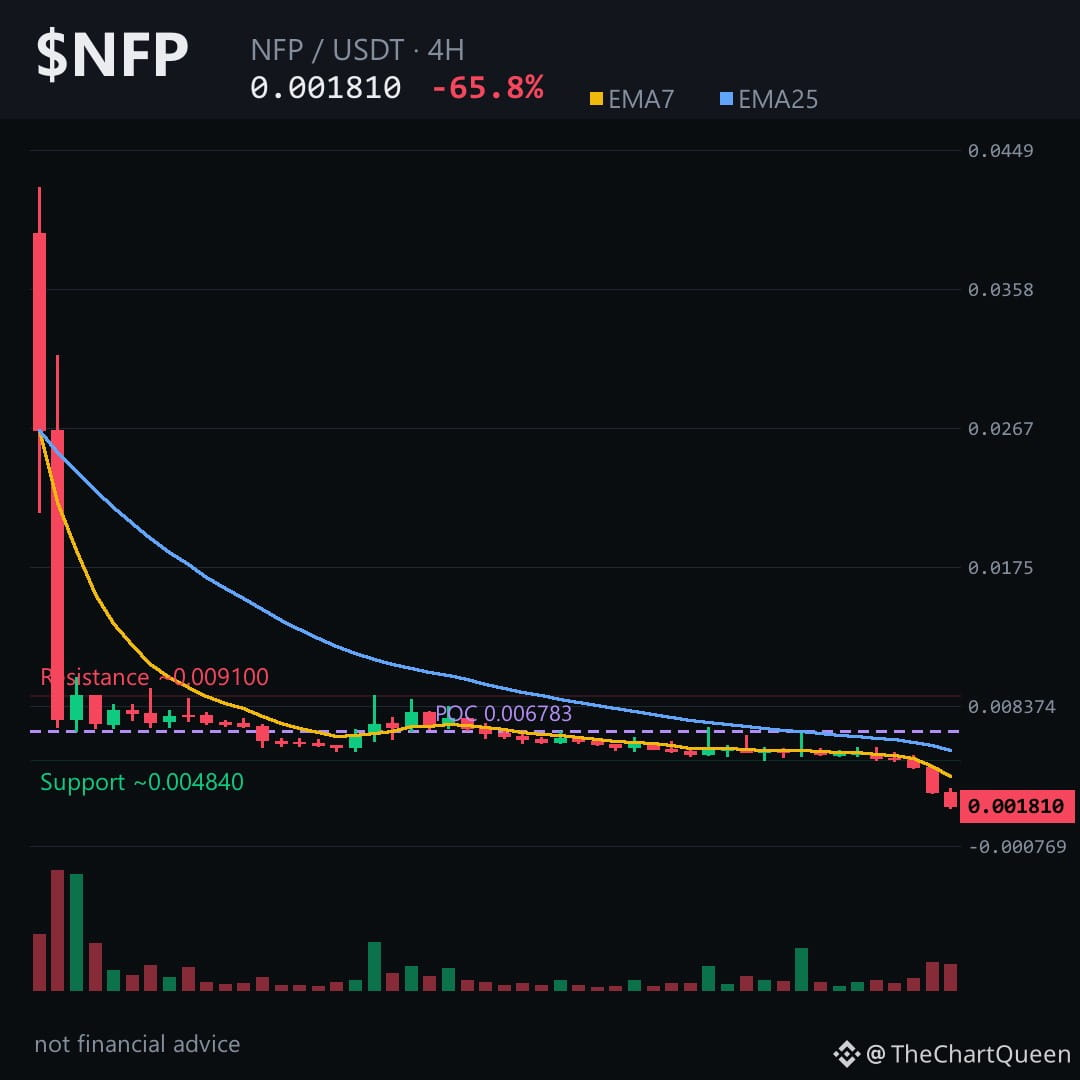
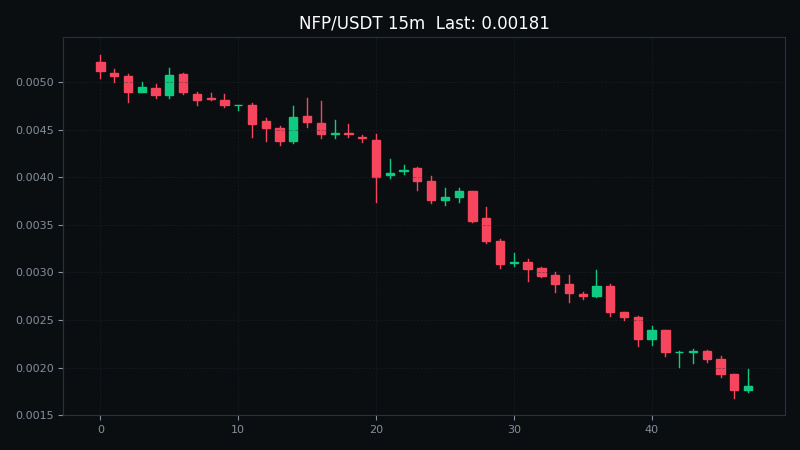
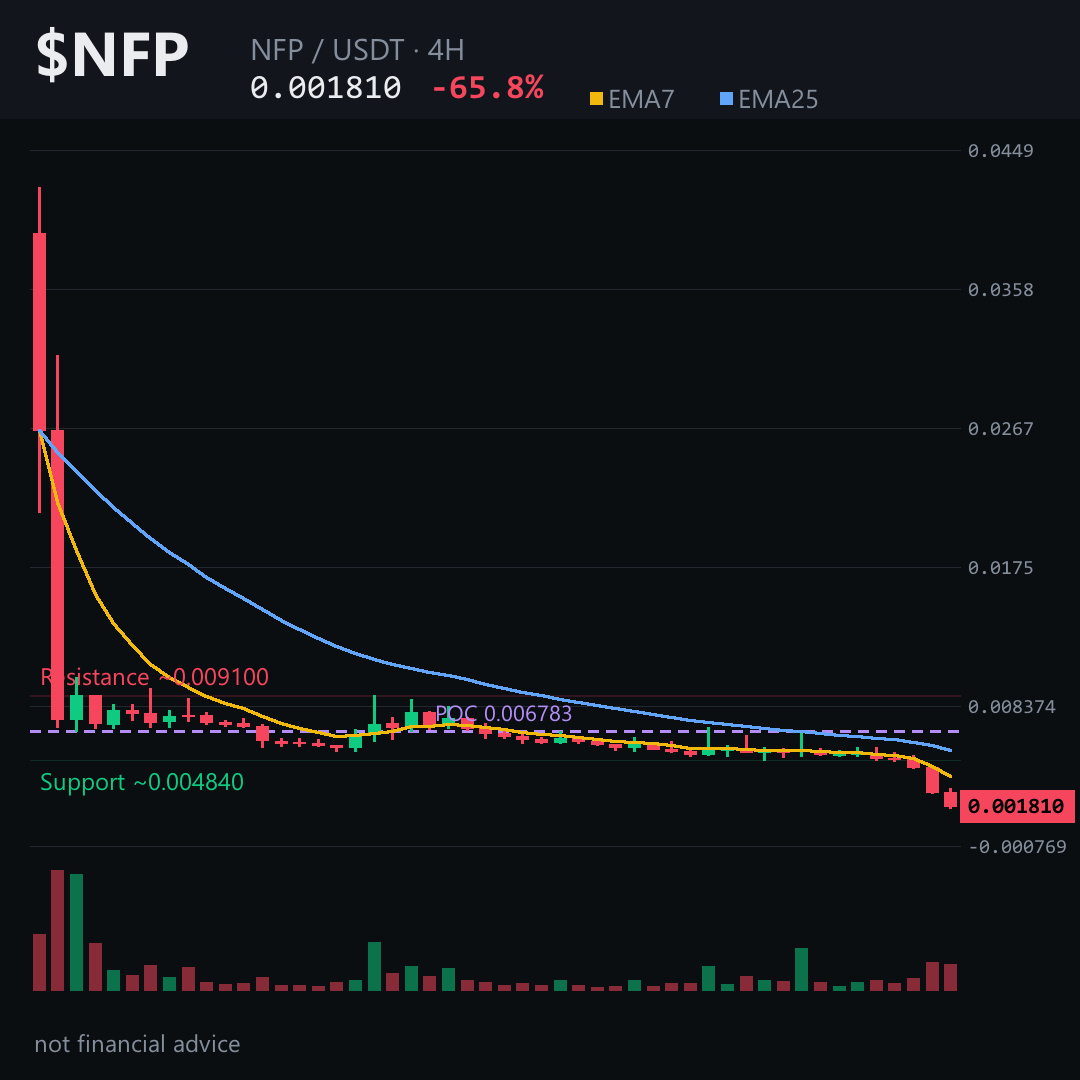
$NFP just printed a -65.85% day. Price went from 0.0057 down to 0.00168 in 24 hours. That's not a correction—that's a liquidation cascade. The 4H RSI is sitting at 12.89. That's not oversold; that's practically flatlined. Volume is just 3.83M USDT. Thin air.
The 4H chart tells the clearest story. Price is pinned near 0.00181, with an unfilled bearish gap overhead between 0.00445 and 0.00479—a zone that screams "dead cat bounce territory" if anything recovers. But every bounce attempt gets sold. The key invalidation sits around 0.00191. If $NFP can't reclaim that area, the path of least resistance points toward the 0.00165 zone, then possibly lower.
My read: this is a falling knife with no hands to catch it yet. The real risk isn't more downside—it's trying to bottom-fish too early. The gap above is a trap, not a target, until price proves otherwise.
Tap $NFP to pull up the chart and see the exhaustion yourself.
I'll be watching whether that 0.00165 area holds or folds—follow along so you don't miss the update. What level are you watching on NFP? 👇
⚠️ Not financial advice. DYOR.
#NFP #Crypto #BinanceSquare #MarketAnalysis
9

·
--
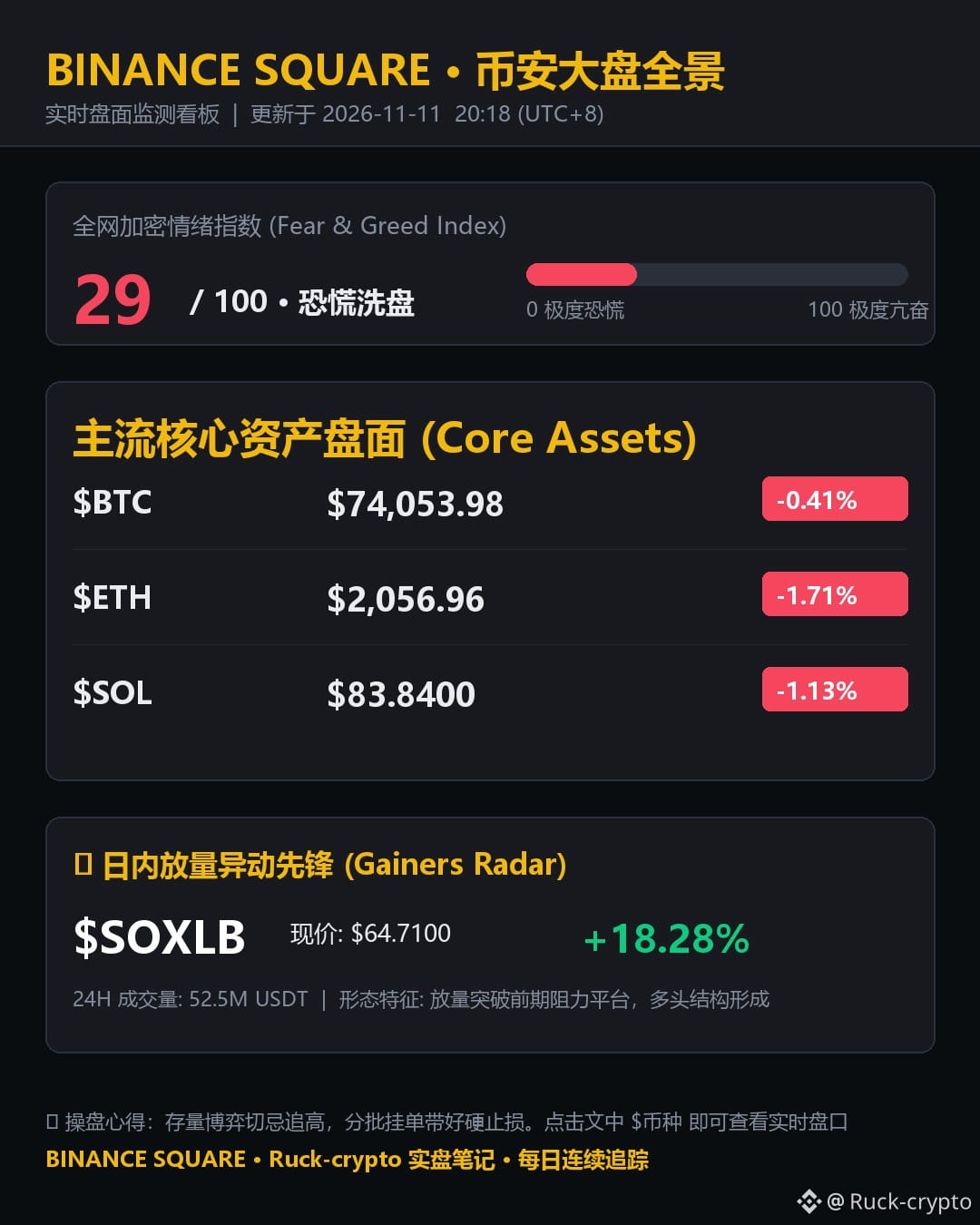
急跌不言底!$NFP 24小时深度回撤 -65.85%,现价回落至 $0.001810,盲目左侧抄底正面临巨大风险。
⚠️ 【弱势标的与回撤警示】
• 预警标的:$NFP
• 实时现价:$0.001810 | 24H 跌幅:-65.85%
• 24H 成交量:约 3.8M USDT(参照 $BTC 现价 $74,053.98)
📉 【多空破位与支撑测试】
• 行情定性:空头主导下杀,短期下行通道尚未企稳
• 关键防守:上方阻力 $0.001919 | 极限支撑 $0.001665 | 止损参考 $0.001557
• 防守策略:弱势币种严禁在下行途中补仓拉低成本,反弹遇阻 $0.001919 应减仓避险,跌破 $0.001557 坚决执行防守。
🛑 【左侧盲动与防御策略】
1. 市场永远不缺赚钱机会,但本金亏完就再无翻盘可能;
2. 急跌往往伴随流动性断崖,切勿用有限的本金去测试深不可测的底线。
面对 $NFP 的连续下杀,你觉得哪个价位才是真正的止跌承接位?欢迎在评论区探讨!
⚠️ 免责声明:以上仅为个人盘面研判,不构成任何投资或理财依据。加密市场波动巨大,请严格做好仓位风控,盈亏自负。
#NFP #行情预警 #币安广场
326
65.85% 24h plunge left $NFP barely above its 4‑hour pivot – a fragile spot you can’t ignore. 👀
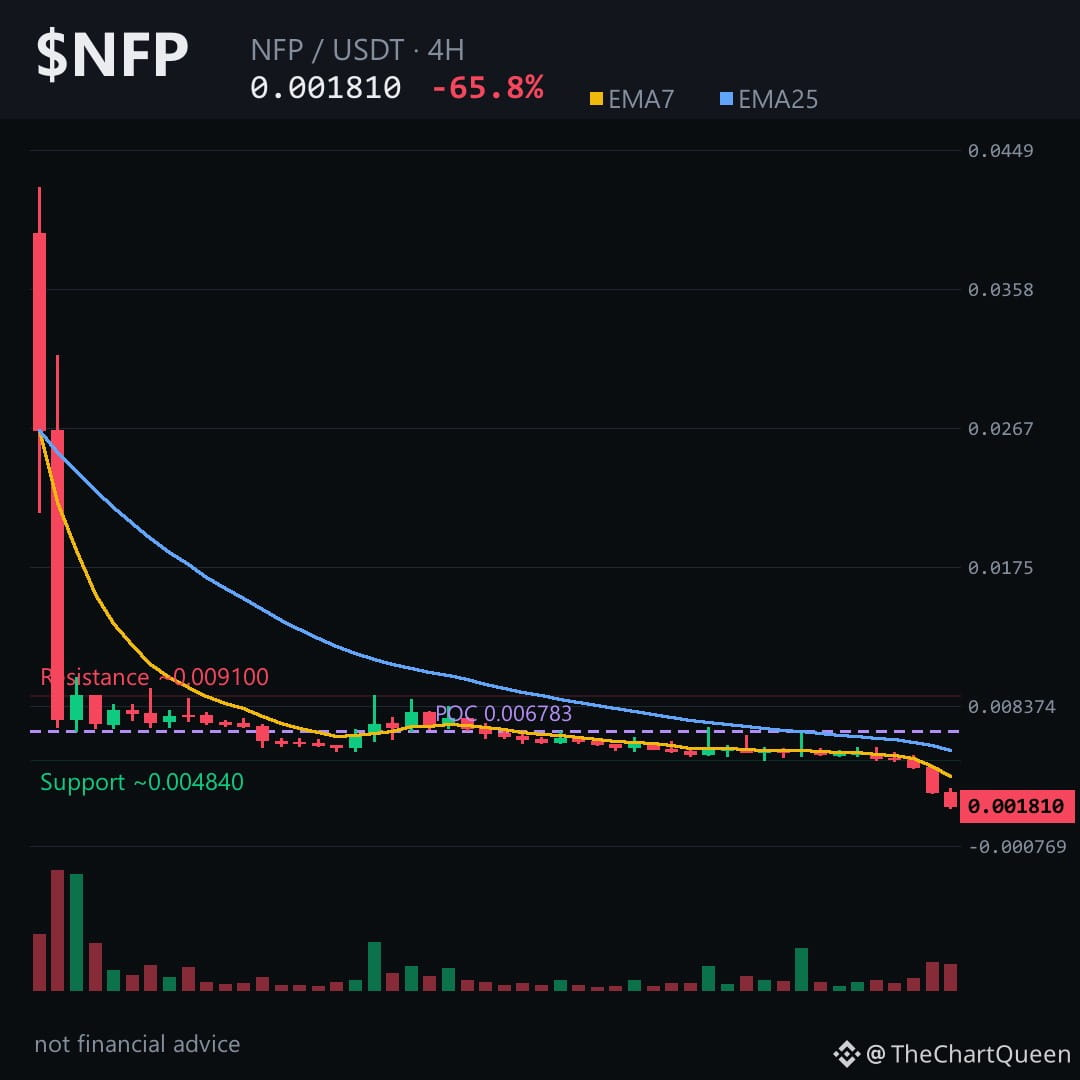
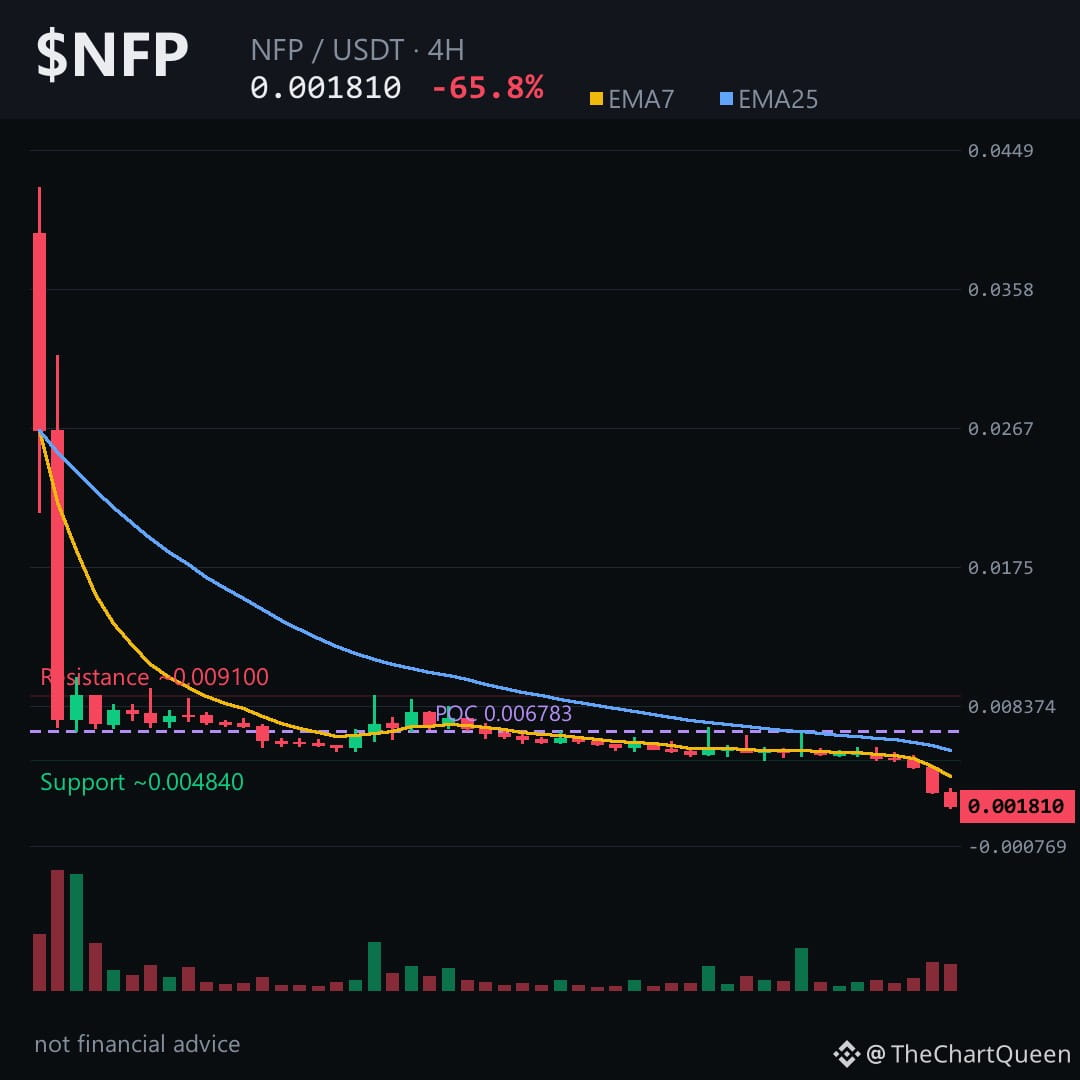
Price is entrenched in bearish territory: EMA7 sits under EMA25, RSI is at a deep 12.9, and a clear bearish FVG sits between 0.00479 and 0.00445. The volume‑profile POC sits higher than the market, hinting that buying pressure has already been exhausted.
On the 4‑hour chart the key zones line up: the current pivot hovers around 0.00182; a break above ~0.00191 would nullify the bearish case, while a slide toward the ~0.00166 area could become the next demand pocket. If $NFP slips below the ~0.00166 zone, the downtrend gains a stronger foothold. Tap $NFP to pull up the chart and see these levels yourself.
My read: the market is testing the ~0.00166 demand zone; a decisive close below it would reinforce the bearish outlook, whereas a clean close above ~0.00191 would force a reassessment.
Follow me for the next update when NFP finally confirms which side of the zone it respects. Which level are you watching for NFP? 👇
⚠️ Not financial advice. DYOR.
#NFP #Crypto #BinanceSquare #TopLoser
1
What does a 66% single-day collapse actually leave behind?
That’s the question hanging over $NFP right now — and the answer isn’t just “a lower price.” It’s a chart with almost no buyers left, and a structure that’s still bleeding.
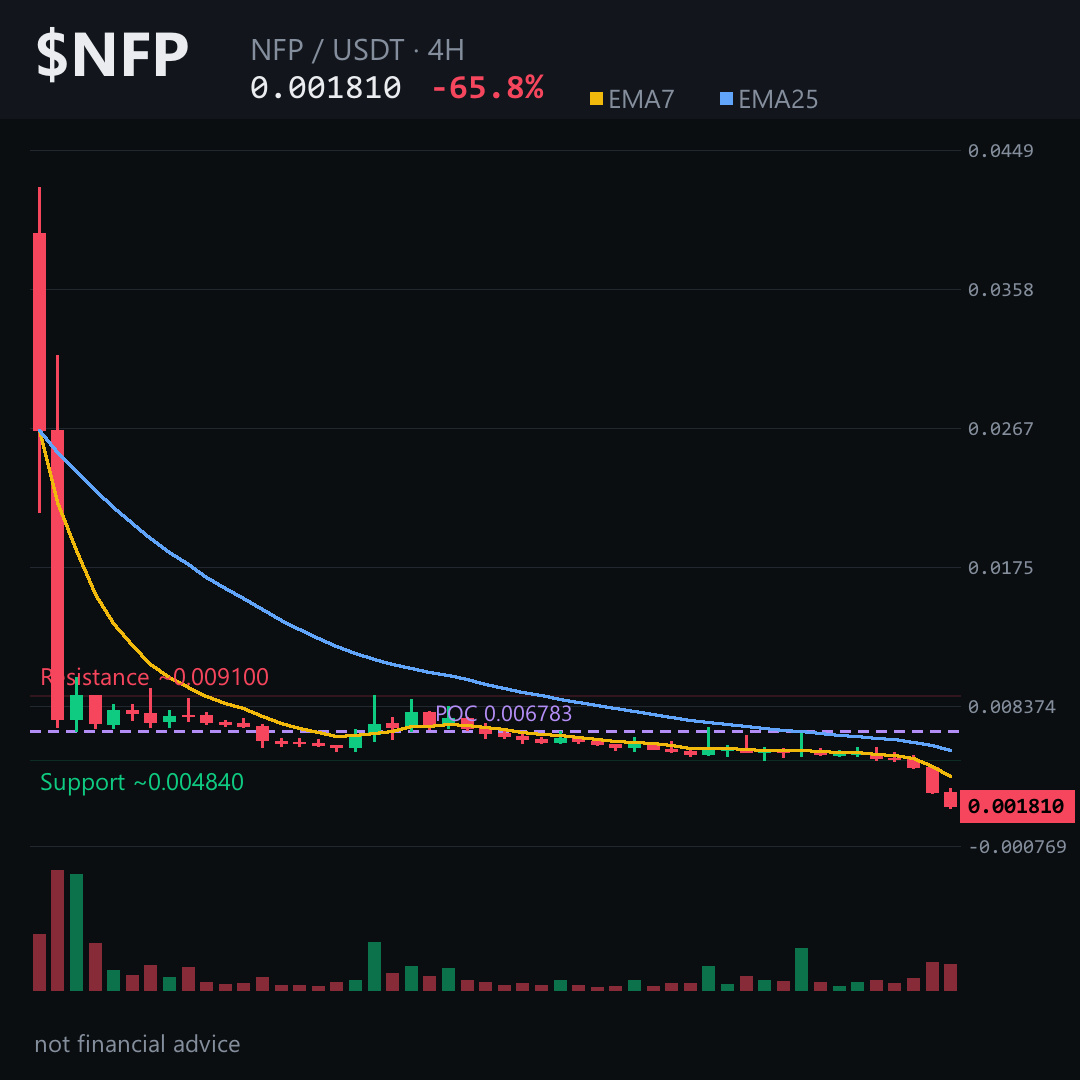
The 4-hour candles tell it plainly: eight red, four green. But the real damage came in two brutal waves — a 37% flush, then 34% right after. That’s not normal volatility. That’s a liquidation cascade with no bid stepping in.
Price is now near 0.00181. Moving averages are stacked far above, sloping down hard. RSI is pinned near 13 on the 4-hour — oversold is under 30. This isn’t sold; it’s been thrown away.
But oversold doesn’t mean bottom.
There’s an unfilled gap above, roughly 0.00445–0.00479. Gaps often act like magnets on a bounce. But any push toward it must first reclaim 0.00191 — and that’s the line that matters. As long as $NFP stays below that zone on the 4-hour, the path of least resistance still points lower.
The next natural floor sits near 0.00165, around the recent low. If that breaks, the weekly chart suggests 0.00114 could come into view — the next shelf where historic volume once traded.
My read: a falling knife with no futures market behind it. Open interest is effectively zero, funding flat — no leveraged longs getting squeezed. This is pure spot panic, not a rebound signal. An asset searching for a real buyer.
Tap $NFP to pull up the chart and trace these levels yourself — the gap above, the floor below, and the 0.00191 line separating them.
I’ll keep tracking whether that floor holds or folds — follow along so you don’t miss the next read.
Which zone are you watching more closely on NFP — the gap above or the floor below? 👇
⚠️ Not financial advice. DYOR.
#NFP #Crypto #Altcoins #BinanceSquare
99

·
--
量比观察:$NFP 24h 下跌 65.8%,成交额 3,834,192 USDT。
把今天的成交额和过去一周的均值比一下:如果放大两三倍,说明有增量资金进场;如果差不多,那这波 下跌 65.8% 可能只是存量博弈。增量和存量的区别,决定了行情能走多远。
这个对比方法你用过吗?#NFP
内容仅供交流,不构成投资建议。
量比观察:$NFP 24h 下跌 65.8%,成交额 3,834,192 USDT。
把今天的成交额和过去一周的均值比一下:如果放大两三倍,说明有增量资金进场;如果差不多,那这波 下跌 65.8% 可能只是存量博弈。增量和存量的区别,决定了行情能走多远。
这个对比方法你用过吗?#NFP
内容仅供交流,不构成投资建议。
把今天的成交额和过去一周的均值比一下:如果放大两三倍,说明有增量资金进场;如果差不多,那这波 下跌 65.8% 可能只是存量博弈。增量和存量的区别,决定了行情能走多远。
这个对比方法你用过吗?#NFP
内容仅供交流,不构成投资建议。
28
-65.85% in 24 hours.
That's not a correction. That's a structural break.
$NFP didn't just dip — it fell through every meaningful support like they weren't there.
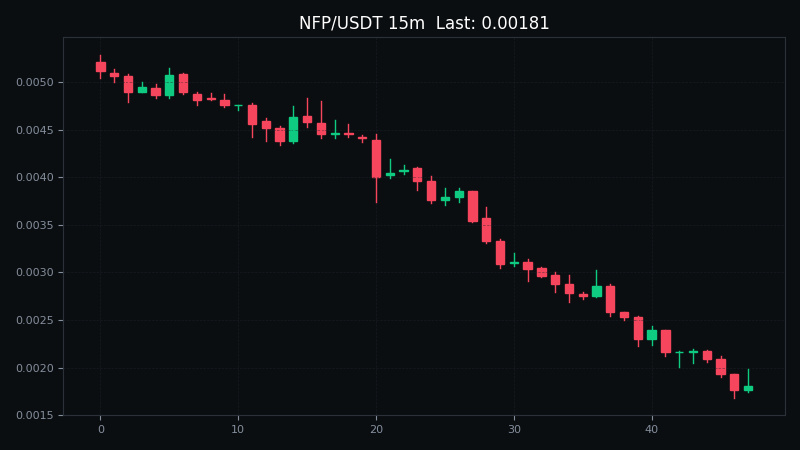
Two 4H candles alone did the damage: one down 37%, the next down 34%. Back-to-back. That's not normal selling pressure. That's a liquidity vacuum.
RSI on the 4H is near 13. That's not "oversold" in the bounce-hunting sense — it's when the bid has simply disappeared. EMA structure is in freefall on every timeframe.
The unfilled gap above, around 0.00445–0.00479, ripped through so fast it never filled. Gaps like that often act as a magnet later — but in a -66% day, "later" can mean after more downside first.
The levels that matter right now, on the 4H:
Current price is hovering near 0.00181.
If that fails, the next structural floor is around 0.00165.
The read flips only if price reclaims and holds above roughly 0.00191 on a 4H close. Below that, every bounce is suspect.
Tap $NFP to pull up the chart.
My read: a falling knife with no visible floor yet. 0.00165 is the only nearby level with historical weight. Until price proves it can hold a 4H close above 0.00191, the path of least resistance stays lower.
I'll be watching whether that unfilled gap gets tested from below — the real tell for whether this is capitulation or just the first leg down. Follow for that update.
How are you reading the 0.00165 level on $NFP — real support or just a pause on the way down? 👇
⚠️ Not financial advice. DYOR.
#NFP #Crypto #Altcoins #BinanceSquare
6
·
--
信息差科普:$NFP 24h 下跌 65.8%,你看到消息的时候,第几手了?
行情里永远有人先知道:链上数据、资金流向、异动榜单,都是公开信息,拼的是谁看得早、看得懂。每天盯一遍异动榜,就是在缩小信息差。0.00181 这波,异动榜提前给了信号,你抓住了吗?
你平时从哪获取第一手信息?#NFP
内容仅供交流,不构成投资建议。
信息差科普:$NFP 24h 下跌 65.8%,你看到消息的时候,第几手了?
行情里永远有人先知道:链上数据、资金流向、异动榜单,都是公开信息,拼的是谁看得早、看得懂。每天盯一遍异动榜,就是在缩小信息差。0.00181 这波,异动榜提前给了信号,你抓住了吗?
你平时从哪获取第一手信息?#NFP
内容仅供交流,不构成投资建议。
行情里永远有人先知道:链上数据、资金流向、异动榜单,都是公开信息,拼的是谁看得早、看得懂。每天盯一遍异动榜,就是在缩小信息差。0.00181 这波,异动榜提前给了信号,你抓住了吗?
你平时从哪获取第一手信息?#NFP
内容仅供交流,不构成投资建议。
1

·
--
جاءت بيانات الوظائف الأمريكية غير الزراعية (NFP) لشهر أكتوبر عند 165 ألف وظيفة، أي أكثر من ضعف التوقعات البالغة 65 ألف وظيفة! 🔥
قوة سوق العمل رفعت احتمالات زيادة الفائدة في ديسمبر إلى نحو 85%.
📈 مؤشر الدولار (DXY) يحافظ على قوته.
🥇 الذهب تحت الضغط.
📊 الأسهم تشهد تقلبات.
₿ البيتكوين يتحرك ضمن نطاق سعري محدود.
#NFP #USJobsData📉
قوة سوق العمل رفعت احتمالات زيادة الفائدة في ديسمبر إلى نحو 85%.
📈 مؤشر الدولار (DXY) يحافظ على قوته.
🥇 الذهب تحت الضغط.
📊 الأسهم تشهد تقلبات.
₿ البيتكوين يتحرك ضمن نطاق سعري محدود.
#NFP #USJobsData📉

196
A 65% haircut in one day isn't a dip. It's a verdict. And the chart hasn't finished speaking yet.
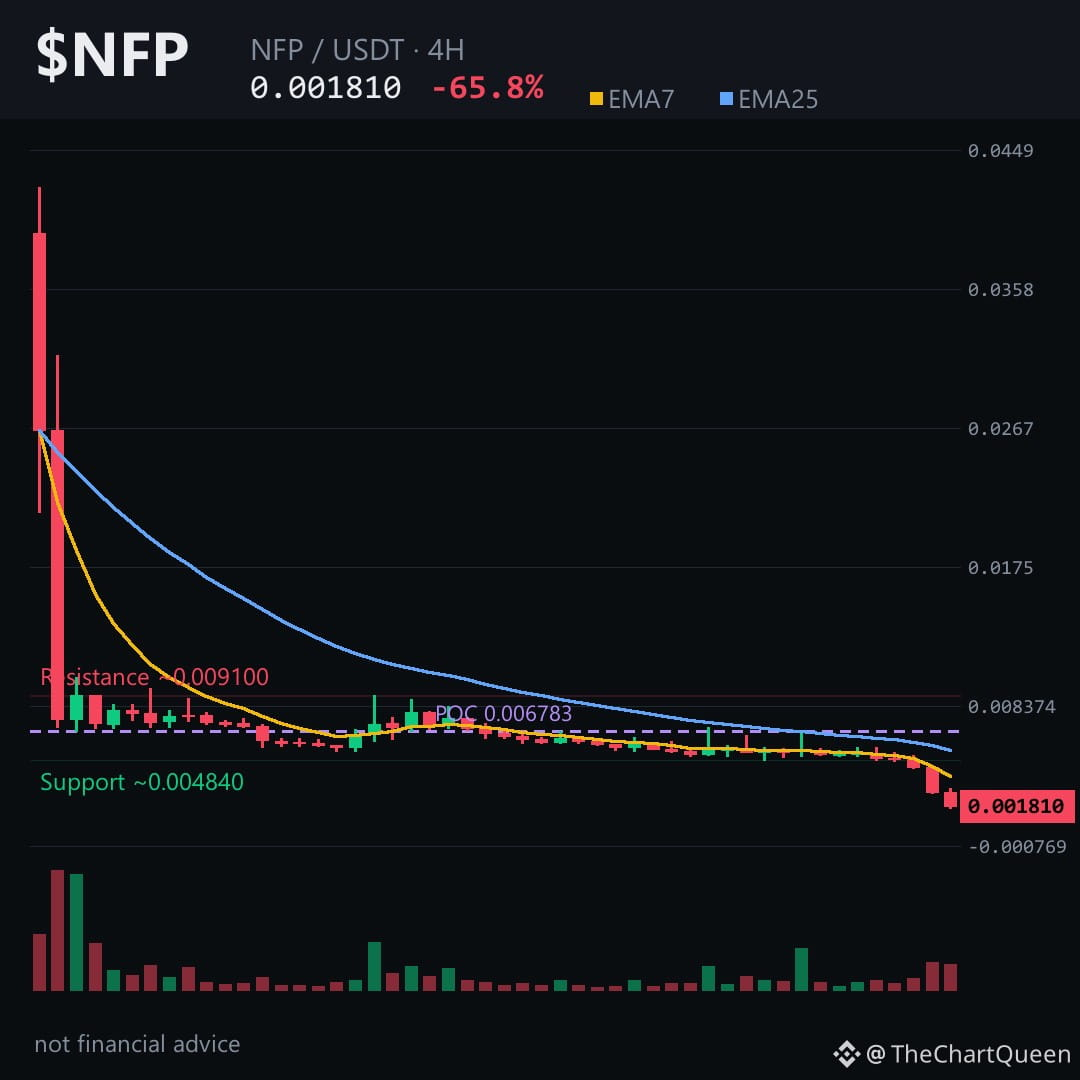
$NFP didn't just bleed — it collapsed through every level that mattered, slicing clean through a bearish gap between 0.00479 and 0.00445 like it wasn't there. That gap now sits overhead, unfilled — a ceiling, not a floor.
Price is at roughly 0.00181, 4H RSI buried near 13. Oversold? Yes. But in a downtrend this violent, oversold is a condition, not a catalyst.
Funding is flat, open interest essentially zero. No crowded longs to squeeze. This is pure spot capitulation — no narrative needed to keep falling, just an absence of buyers.
The level that matters: 0.00191. No 4H close back above that, and the path stays pointed toward 0.00165. Lose that, and the weekly floor near 0.00114 comes into play.
My read: a falling knife with no hands underneath it. The bounce will come — RSI at 13 doesn't last forever — but catching the exact turn is a fool's errand. The risk isn't being too late. It's being too early.
The real question is whether 0.00165 holds or the market tests the weekly lows instead. Tap $NFP to pull up the chart and see which side you trust more. 👇
Not financial advice. DYOR.
Follow for the next read on this chart.
#NFP #Crypto #Altcoins #BinanceSquare
7

·
--
$NFP is trending after a sharp 65.85% drop in 24h, currently at $0.0018 with $3.8M volume. This steep pullback may present a potential bounce play worth watching. Stay informed and analyze risk before jumping in. #NFP #Crypto #Altcoins #CryptoTrading #Trending
$NFP is trending after a sharp 65.85% drop in 24h, currently at $0.0018 with $3.8M volume. This steep pullback may present a potential bounce play worth watching. Stay informed and analyze risk before jumping in. #NFP #Crypto #Altcoins #CryptoTrading #Trending

·
--
Рост
🚨 $NFP $NFP
{future}(NFLXUSDT)
CRASHES NEARLY 66% — ONE OF TODAY'S BIGGEST MARKET DECLINES!
A dramatic red candle has put NFPrompt (NFP) at the top of today's Binance Spot losers list.
The token has fallen 65.849% in the last 24 hours.
📊 Market Statistics:
Price: $0.001810
24H Change: -65.849%
24H Trading Volume: $3.83M
🔍 What is NFPrompt?
NFPrompt is an AI-powered user-generated content platform that combines artificial intelligence with Web3 and digital content creation.
Such a sharp decline deserves serious attention. However, price movement alone does not establish the reason behind the drop.
💬 What do you think is the biggest risk when a cryptocurrency loses this much value in one day?
#NFP #NFPrompt #CryptoLosers #CryptoMarketMoves #BinanceSquare
🚨 $NFP $NFP
CRASHES NEARLY 66% — ONE OF TODAY'S BIGGEST MARKET DECLINES!
A dramatic red candle has put NFPrompt (NFP) at the top of today's Binance Spot losers list.
The token has fallen 65.849% in the last 24 hours.
📊 Market Statistics:
Price: $0.001810
24H Change: -65.849%
24H Trading Volume: $3.83M
🔍 What is NFPrompt?
NFPrompt is an AI-powered user-generated content platform that combines artificial intelligence with Web3 and digital content creation.
Such a sharp decline deserves serious attention. However, price movement alone does not establish the reason behind the drop.
💬 What do you think is the biggest risk when a cryptocurrency loses this much value in one day?
#NFP #NFPrompt #CryptoLosers #CryptoMarketMoves #BinanceSquare
1
A -66% single-day flush isn't a dip to buy — it's a falling knife with a map.
$NFP printed two consecutive 4H candles down ~37% and ~34%. Price collapsed from 0.0056 into the 0.0018 zone in under 24 hours. 4H RSI is near 13 — deeply stretched, but in a liquidation cascade, oversold can stay oversold.
Price sliced clean through the 4H bearish FVG between 0.00445–0.00479. EMAs are stacked bearish across every timeframe — any bounce into 0.00378 likely finds heavy resistance. Volume is thin at 3.8M USDT: a low-liquidity asset, and momentum is clearly down.
The level that matters most on the 4H is the invalidation zone around 0.00191. As long as $NFP stays below that area, the path of least resistance points toward 0.00165. A 4H close back above 0.00191 would suggest the flush is exhausting and this read is off the table. Tap $NFP to pull up the chart.
My read: momentum-driven breakdown in a thin market — the risk is chasing a bounce that hasn't been earned yet.
I'll post a follow-up if price reclaims that 0.00191 zone or consolidates above the lows — follow so you see it.
Which level are you watching more closely on NFP — the 0.00165 objective or the 0.00191 invalidation? 👇
⚠️ Not financial advice. DYOR.
#NFP #Crypto #Altcoins #BinanceSquare
91


Статья
🚨 الوظائف الأمريكية تفاجئ الأسواق… لماذا يهمّك الخبر كمتابع للكريبتو؟📅 السبت 7 نوفمبر 2026
🌍 نبض الاقتصاد العالمي
صدرت أمس بيانات الوظائف الأمريكية، وجاءت أقوى من المتوقع:
💼 الوظائف الجديدة: 165 ألف وظيفة، مقابل توقعات بنحو 65 ألفًا.
👥 البطالة: انخفضت إلى 4.1%، مقابل 4.2% سابقًا.
🔍 ماذا يعني ذلك؟
قوة التوظيف تمنح الاحتياطي الفيدرالي مساحة أكبر للتركيز على التضخم، وقد تدعم استمرار الفائدة المرتفعة أو زيادتها.
💵 ارتفع الدولار بعد التقرير.
🥇 وتعرّض الذهب للضغط مع ارتفاع الدولار وعوائد السندات.
₿ وماذا عن بيتكوين؟
هذه البيئة قد تضغط على شهية المخاطرة، لكن حركة بيتكوين تتأثر أيضًا بالتدفقات والسيولة وأخبار سوق العملات الرقمية.
قراءتي:
تقرير قوي للاقتصاد لا يعني تلقائيًا ارتفاع جميع الأصول. السوق يسأل: كيف سيؤثر الخبر في الفائدة والسيولة؟
💬 ما الذي تراقبه أولًا بعد البيانات؟
الدولار 💵 أم الذهب 🥇 أم بيتكوين ₿؟
#Binance #bitcoin #GOLD #NFP #CryptoMario101
🚨 الوظائف الأمريكية تفاجئ الأسواق… لماذا يهمّك الخبر كمتابع للكريبتو؟
📅 السبت 7 نوفمبر 2026
🌍 نبض الاقتصاد العالمي
صدرت أمس بيانات الوظائف الأمريكية، وجاءت أقوى من المتوقع:
💼 الوظائف الجديدة: 165 ألف وظيفة، مقابل توقعات بنحو 65 ألفًا.
👥 البطالة: انخفضت إلى 4.1%، مقابل 4.2% سابقًا.
🔍 ماذا يعني ذلك؟
قوة التوظيف تمنح الاحتياطي الفيدرالي مساحة أكبر للتركيز على التضخم، وقد تدعم استمرار الفائدة المرتفعة أو زيادتها.
💵 ارتفع الدولار بعد التقرير.
🥇 وتعرّض الذهب للضغط مع ارتفاع الدولار وعوائد السندات.
₿ وماذا عن بيتكوين؟
هذه البيئة قد تضغط على شهية المخاطرة، لكن حركة بيتكوين تتأثر أيضًا بالتدفقات والسيولة وأخبار سوق العملات الرقمية.
قراءتي:
تقرير قوي للاقتصاد لا يعني تلقائيًا ارتفاع جميع الأصول. السوق يسأل: كيف سيؤثر الخبر في الفائدة والسيولة؟
💬 ما الذي تراقبه أولًا بعد البيانات؟
الدولار 💵 أم الذهب 🥇 أم بيتكوين ₿؟
#Binance #bitcoin #GOLD #NFP #CryptoMario101
1
226

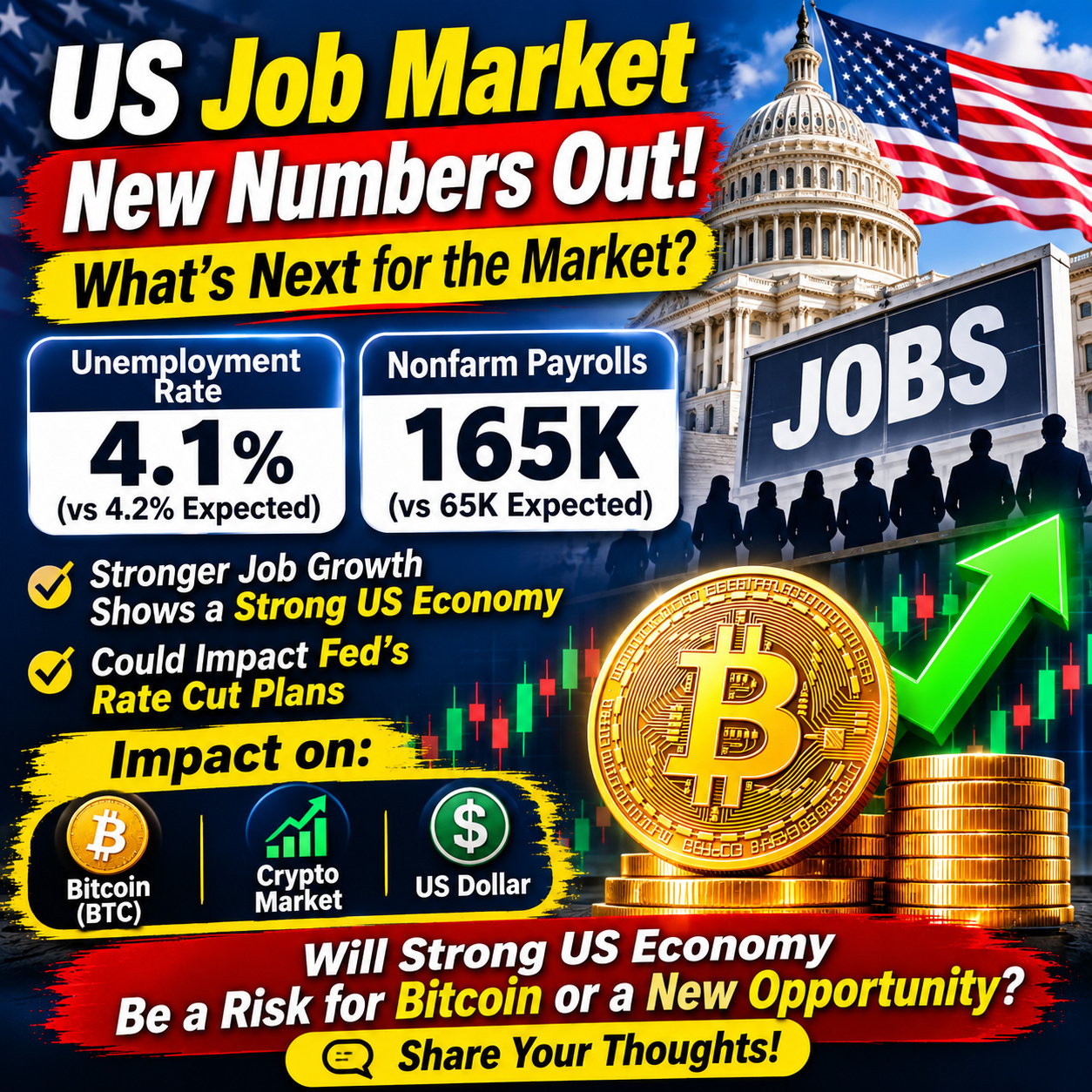
🚨 U.S. JOB MARKET DATA HAS CAUGHT EVERYONE'S ATTENTION! 🇺🇸
Important news from the U.S. economy has investors rethinking their market expectations.
📊 Latest Economic Data:
- Unemployment Rate: 4.1%
- Expected Rate: 4.2%
- New Jobs Added: 165,000
- Expected Jobs: Only 65,000
🔥 The U.S. created far more jobs than expected, showing that the labor market remains strong.
Why Is This News Important for the Crypto Market?
Strong U.S. jobs data can influence the Federal Reserve's interest rate decisions. If expectations for interest rate cuts decrease, Bitcoin and other cryptocurrencies could face additional pressure.
👀 Investors Are Now Watching Three Things:
₿ Bitcoin's Next Move
📈 The Overall Crypto Market Trend
💵 The Strength of the U.S. Dollar
The Big Question: Will a Strong U.S. Economy Become a Risk for Bitcoin or Create a New Opportunity for the Market?
Share your thoughts in the comments! 👇
#Bitcoin #BTC #CryptoNews #USJobs #NFP #CryptoMarket
4
137

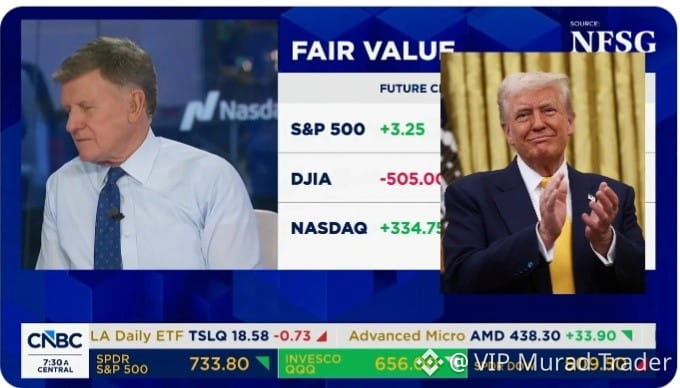
🚨 US JOBS DATA JUST CHANGED THE MARKET NARRATIVE! 🇺🇸📊
The latest US employment report delivered a surprise — and investors are paying attention!
🇺🇸 OCTOBER JOBS REPORT:
🟢 Jobs added: 165K vs. 65K expected
📉 Unemployment: 4.1%, down from 4.2%
🏦 December Fed rate hike expectations: Around 80%
🔥 WHY DOES THIS MATTER?
A stronger labor market could give the Federal Reserve more room to keep interest rates higher.
And that could create a chain reaction:
📈 Stronger jobs → Higher rate expectations
💵 Higher yields → Stronger dollar pressure
🪙 Stronger dollar → Potential headwinds for Gold and Crypto
👀 GOLD & CRYPTO: WHAT'S NEXT?
Gold came under pressure following the report, while crypto investors will be watching how the dollar and Treasury yields develop.
💡 MY TAKE:
The next big market move may depend on what the Fed does with interest rates. One economic report can change market expectations, but it doesn't determine the entire trend.
👇 What's your view?
Will the Fed stay aggressive, or could the next inflation report change everything?
Let's discuss! 🔥
#NFP #FederalReserve #bitcoin #BTC #BinanceSquare
⚠️ Crypto and financial markets are volatile. This post is for informational purposes only, not financial advice. Always do your own research (DYOR).
160

·
--
Статья
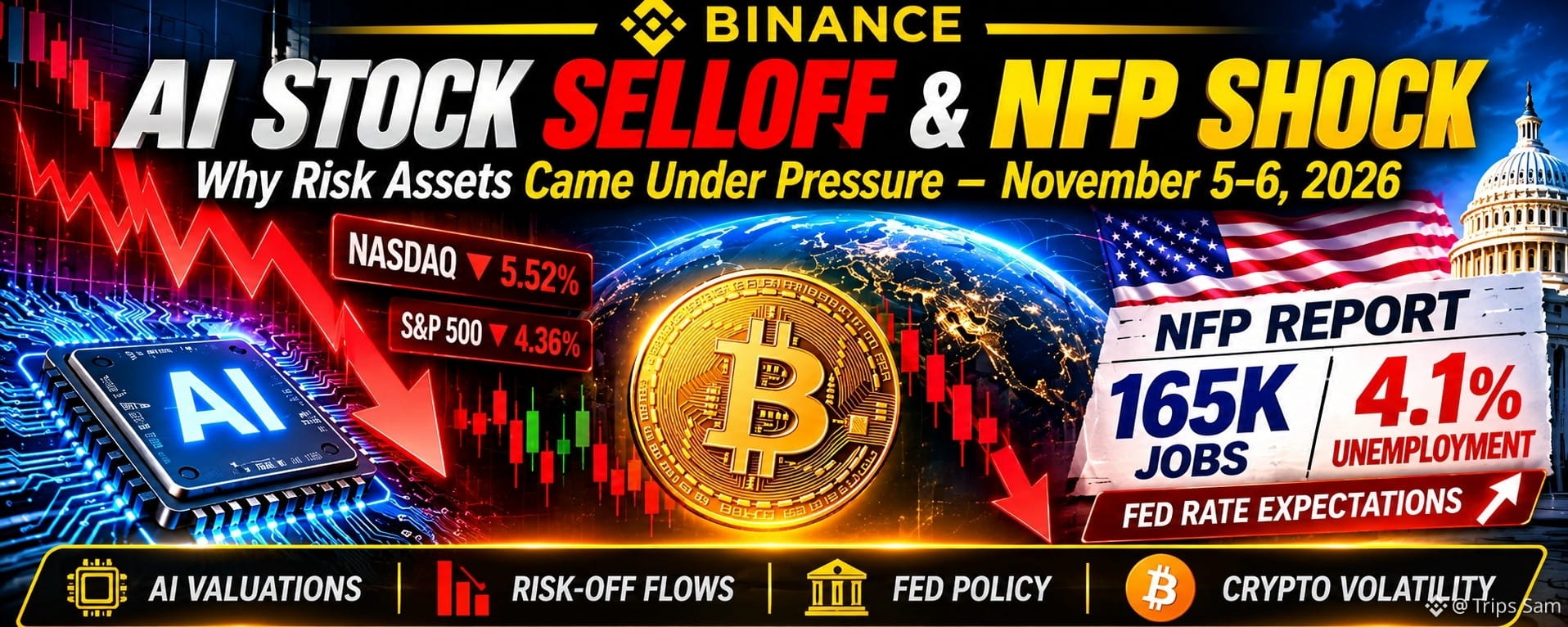
AI Stock Sell-Off & NFP Shock Why Global Markets and Cryptocurrencies Came Under Pressure
November 5–6, 2026 | Understanding the Connection Between Artificial Intelligence, US Employment Data, Federal Reserve Policy, and the Cryptocurrency Market
The latest market correction has delivered an important reminder: cryptocurrency markets do not operate independently of the global financial system. What began as a sharp sell-off in artificial intelligence and semiconductor stocks quickly developed into a broader risk-off movement, affecting technology shares, global equities, Bitcoin, and other digital assets. The situation became more complicated when the United States released its October Nonfarm Payrolls (NFP) report on November 6, showing considerably stronger employment growth than economists had anticipated.
These developments were not two versions of the same event. They were separate economic and financial catalysts that reinforced market uncertainty. Understanding how they interacted is essential for anyone investing in cryptocurrencies.
1. The AI Market Sell-Off: When Expectations Meet Reality
For much of 2026, artificial intelligence has been one of the strongest investment themes in global financial markets. Companies involved in AI chips, data centers, cloud computing, energy infrastructure, and advanced computing attracted enormous investor interest.
The investment thesis was straightforward: AI adoption would accelerate, demand for computing capacity would increase, and companies supplying the infrastructure would benefit from years of expanding investment.
However, markets eventually begin questioning whether expectations have moved too far ahead of actual financial returns.
On November 5, investors aggressively reassessed the valuations and future spending assumptions behind the AI industry. Concerns about infrastructure costs, financing requirements, potential regulatory restrictions, and the commercial return on enormous AI investments contributed to a sharp correction.
The Nasdaq Composite declined approximately 5.52%, while the S&P 500 lost 4.36%. Nvidia fell approximately 9.3%, and semiconductor companies experienced particularly heavy selling.
Approximately $3 trillion in market value was erased from the S&P 500 during the sell-off, according to market reporting.
This was not simply a correction in individual technology companies. It was a reassessment of an investment theme that had become deeply embedded in global market valuations.
The important question changed from how quickly AI can grow to how much investors are willing to pay for that growth.
2. Why AI Stocks Became Vulnerable
There were several factors behind the correction.
A. Excessive Valuation Expectations
Many AI-related companies had already experienced substantial increases in market capitalization. Their valuations reflected ambitious expectations about future revenue, profitability, and market dominance.
When investors begin questioning whether those expectations are achievable, even fundamentally strong companies can experience significant price declines.
B. The Cost of AI Infrastructure
Building AI infrastructure requires enormous capital expenditure. Data centers need advanced processors, cooling systems, electricity, networking equipment, and substantial financing.
The financial burden increases when borrowing costs remain elevated.
Investors are increasingly examining whether the revenue generated by AI services can justify the scale of investment.
C. Political and Regulatory Uncertainty
The November US midterm election results introduced additional uncertainty about the future regulatory environment for AI infrastructure.
Concerns emerged that increased political scrutiny could slow data-center construction, complicate permitting, and affect future investment decisions.
This does not mean AI development will stop. It means investors must reassess the pace, cost, and regulatory conditions under which the industry may expand.
D. Institutional De-Risking
When highly valued sectors begin declining, institutional investors may reduce exposure across multiple positions.
Funds using leverage may also sell assets to reduce portfolio risk or meet financing requirements.
This can create a chain reaction in which selling extends beyond the original sector that triggered the correction.
3. How the AI Sell-Off Reached Bitcoin and the Cryptocurrency Market
One of the most important observations from November 5 was that Bitcoin did not remain isolated from the technology market correction.
Bitcoin declined just over 5% during the AI-led sell-off, while more than $1 billion in leveraged cryptocurrency positions were liquidated, according to CoinShares.
This demonstrates the increasing relationship between digital assets and broader financial-market liquidity.
Why does this happen?
Because many institutional investors now hold exposure to multiple asset classes simultaneously. Their portfolios may include technology stocks, semiconductor companies, Bitcoin, Ethereum, and other digital assets.
When market volatility increases, portfolio managers may reduce exposure to risk assets collectively rather than evaluate each investment independently.
Furthermore, leveraged cryptocurrency traders face additional pressure when prices move sharply against their positions.
Forced liquidations can accelerate selling, increase volatility, and create temporary price dislocations.
A decline in technology stocks does not automatically mean Bitcoin's fundamentals have deteriorated. However, when liquidity contracts and investors reduce risk exposure, Bitcoin can become collateral damage in a broader financial-market correction.
4. The NFP Report: A Stronger US Labor Market Than Expected
On November 6, the US Bureau of Labor Statistics released its October employment report.
The headline figure surprised financial markets.
Actual nonfarm payroll growth: 165,000 jobsMarket expectation: approximately 65,000 jobsUnemployment rate: 4.1%, down from 4.2%Average hourly earnings: increased 0.4% month over monthAnnual wage growth: 3.1%
The employment result was substantially stronger than anticipated.
Additionally, previous employment figures were revised upward, with August and September together receiving an additional 84,000 jobs.
At first glance, stronger employment should be positive news. It suggests that businesses are still hiring and that the US economy retains considerable resilience.
However, financial markets do not evaluate employment figures in isolation.
They also examine what those figures mean for inflation, interest rates, Federal Reserve policy, and the cost of capital.
Good economic news can become challenging financial-market news when investors believe it reduces the possibility of interest-rate cuts.
5. Why Strong NFP Data Can Pressure Bitcoin and Other Cryptocurrencies
The relationship between employment data and cryptocurrency prices is particularly important.
When employment growth is stronger than expected, investors may conclude that the Federal Reserve has less urgency to reduce interest rates.
A resilient labor market can give policymakers additional flexibility to maintain restrictive monetary conditions while addressing inflation.
Higher interest rates can create several challenges for cryptocurrency markets:
1. Higher Cost of Capital
When interest rates remain elevated, borrowing becomes more expensive for businesses, investors, and financial institutions.
This can reduce the availability of capital for speculative investments.
2. Stronger Dollar Expectations
Higher US interest-rate expectations can support demand for dollar-denominated assets.
A stronger dollar can create additional pressure on assets such as Bitcoin and other cryptocurrencies.
3. Reduced Risk Appetite
Investors may prefer cash equivalents, Treasury securities, and other interest-bearing instruments when their returns become more attractive relative to volatile assets.
4. Lower Liquidity for Speculative Markets
Cryptocurrencies are sensitive to changes in global liquidity.
When financial conditions tighten, capital may leave speculative assets, putting pressure on prices and trading volumes.
The November 6 employment report therefore introduced another challenge for an already nervous market.
US Treasury yields increased following the release, reinforcing expectations that the Federal Reserve could maintain or increase interest rates.
The market's reaction illustrates why cryptocurrency investors must monitor employment data alongside traditional crypto indicators.
6. The Two Catalysts: AI Valuation Concerns and Monetary Policy
The sequence of events is particularly important.
On November 5, the AI and technology sell-off triggered a major risk-off movement across global markets.
On November 6, the stronger-than-expected NFP report complicated the recovery by reinforcing concerns about restrictive monetary policy.
The two developments affected markets through different channels:
AI sell-off: concerns about valuations, investment returns, infrastructure spending, and technology-sector exposure.NFP surprise: concerns about inflation, interest rates, Treasury yields, and future monetary policy.
Together, they created a difficult environment for risk assets.
The distinction matters because the solutions are different.
AI-related stocks may stabilize when valuations become more attractive and corporate investment expectations become clearer.
Cryptocurrency markets may recover when liquidity conditions improve, monetary expectations become less restrictive, and investors regain confidence.
One development does not automatically resolve the other.
7. Why the Cryptocurrency Market Is Becoming More Sensitive to Macroeconomic Data
Bitcoin was originally introduced as a decentralized monetary asset operating independently of traditional banking infrastructure.
However, its current market structure has evolved considerably.
Institutional participation, exchange-traded products, derivatives markets, and cross-asset investment strategies have increased the connection between cryptocurrencies and traditional financial markets.
This means Bitcoin is increasingly affected by:
Federal Reserve interest-rate decisions.US inflation and employment reports.Treasury yields and dollar movements.Institutional investment flows.Global liquidity conditions.Equity-market volatility.
This does not eliminate Bitcoin's unique monetary characteristics.
It simply means that short-term price movements are increasingly influenced by the financial environment in which Bitcoin trades.
Investors who focus exclusively on cryptocurrency news may therefore miss some of the most important catalysts affecting market direction.
Understanding macroeconomics is no longer optional for serious cryptocurrency investors.
8. Bitcoin: Is This a Fundamental Problem or a Liquidity Correction?
One of the most important questions following the recent decline is whether Bitcoin's weakness reflects a deterioration in its long-term fundamentals or a temporary reduction in risk appetite.
The distinction is critical.
If Bitcoin declines because of a broader institutional reduction in risk exposure, its price may recover when liquidity and investor confidence improve.
However, if the decline is accompanied by sustained institutional outflows, weakening demand, and deteriorating market structure, the correction may become more prolonged.
Investors should monitor:
Spot Bitcoin ETF net flows.Exchange inflows and outflows.Futures open interest.Funding rates and liquidation activity.Bitcoin dominance.Real yields and US dollar strength.Trading volume around major support and resistance zones.
A single market decline is insufficient to establish a new long-term bearish trend.
Likewise, a short-term recovery does not necessarily confirm that the correction has ended.
9. What About Ethereum, Solana, NEAR, and Other Altcoins?
Altcoins can experience greater volatility than Bitcoin during periods of market stress.
This is partly because they generally have smaller market capitalizations, different liquidity conditions, and higher sensitivity to speculative capital flows.
Ethereum (ETH): Its performance depends on institutional demand, network activity, staking economics, and broader cryptocurrency liquidity. A restrictive monetary environment can affect its valuation and investment flows.
Solana (SOL): Solana's ecosystem activity and strong participation in decentralized applications remain important fundamental considerations. Nevertheless, its market price can be particularly sensitive to changes in speculative risk appetite.
NEAR Protocol (NEAR): Its developments in Chain Abstraction, NEAR Intents, and AI-related infrastructure should be evaluated separately from short-term market volatility. However, technological progress does not make the token immune to liquidity-driven corrections.
Other Altcoins: Smaller projects can experience disproportionate declines when traders reduce exposure, especially when order-book liquidity is limited.
The important lesson is that a market-wide decline does not necessarily mean every blockchain project has experienced a deterioration in its fundamentals.
Investors should distinguish between a decline caused by external liquidity conditions and a decline caused by project-specific problems.
10. Why Forced Liquidations Can Make the Situation Worse
Cryptocurrency derivatives introduce another layer of risk.
When traders use leverage, relatively small price movements can produce substantial changes in account equity.
If market prices decline beyond certain thresholds, leveraged positions may be forcibly closed.
This creates additional selling pressure.
During the November 5 correction, more than $1 billion in leveraged crypto positions were liquidated.
These liquidations can produce a feedback loop:
Market prices decline.Leveraged positions approach liquidation thresholds.Forced closures increase selling pressure.Prices move further against remaining leveraged traders.Additional positions are liquidated.
This mechanism can exaggerate market movements beyond what underlying spot demand and supply alone might suggest.
For this reason, investors should distinguish between ordinary Spot market selling and forced selling associated with leveraged positions.
Leverage can turn a market correction into a much more aggressive liquidation event.
11. The Federal Reserve: The Next Major Market Driver
Following the October employment report, investors must reassess their expectations for Federal Reserve policy.
The stronger employment figures provide policymakers with additional evidence that the labor market remains resilient.
However, employment is only one component of the Federal Reserve's decision-making process.
Inflation, wage growth, consumer spending, financial conditions, and economic expectations also matter.
The next important question is whether inflation continues moderating or remains sufficiently persistent to justify restrictive monetary policy.
If inflation remains elevated while employment remains strong, interest-rate expectations could become more restrictive.
That would create additional challenges for speculative investments.
Conversely, if inflation moderates and employment gradually cools without a severe economic contraction, markets may regain confidence in the possibility of more accommodative monetary conditions.
Investors should avoid assuming that one employment report determines the Federal Reserve's next decision.
The direction of monetary policy depends on a broader series of economic indicators.
12. Three Possible Scenarios for Cryptocurrency Markets
Scenario A: Recovery and Stabilization
AI stocks stabilize, technology-sector valuations become more attractive, and institutional selling begins to slow. If inflation data also provides room for more accommodative monetary expectations, cryptocurrency markets could recover.
Under this scenario, Bitcoin may regain strength first, followed by selected altcoins as market confidence improves.
Scenario B: Extended Consolidation
Technology stocks remain volatile, employment data continues showing economic resilience, and the Federal Reserve maintains a restrictive position.
Cryptocurrency markets may experience sideways trading, repeated attempts to recover, and further corrections.
This environment would favor patience and disciplined capital management rather than aggressive positioning.
Scenario C: Further Market Correction
AI valuations continue adjusting, institutional investors reduce risk exposure, and inflation prevents a more accommodative monetary policy.
In this environment, Bitcoin and altcoins could experience additional downside pressure, particularly if leveraged liquidations increase.
These scenarios are analytical possibilities, not guaranteed forecasts.
13. How Should Spot Investors Respond?
Market corrections often create emotional pressure.
Investors may feel compelled to sell immediately, buy every decline, or attempt to predict the exact market bottom.
None of these reactions is necessarily appropriate.
A disciplined Spot investor should focus on capital allocation, asset quality, entry levels, and the ability to withstand volatility.
Several principles are worth considering:
Avoid Concentration: Do not allocate excessive capital to one cryptocurrency simply because its price has declined.
Use Staggered Entries: Dividing available investment capital into several planned purchases can reduce dependence on a single entry price.
Maintain Liquidity: Keeping some capital uncommitted provides flexibility if market conditions deteriorate.
Reassess Fundamentals: A lower price does not automatically make an asset undervalued.
Avoid Unnecessary Leverage: A temporary market decline should not become an irreversible financial loss because of forced liquidation.
Spot trading removes leverage-driven liquidation from fully funded purchases, but it does not protect against the possibility of substantial or total investment losses.
The objective is to preserve the ability to make rational decisions when markets become unpredictable.
14. What Investors Should Watch During the Coming Trading Sessions
Rather than reacting to every headline, I would concentrate on a small number of indicators:
US Inflation: The next CPI release will help determine whether stronger employment is accompanied by persistent inflationary pressure.
Treasury Yields: Continued increases may indicate that financial conditions are becoming more restrictive.
US Dollar Index: Dollar strength can create additional pressure on risk-sensitive assets.
Nasdaq and Semiconductor Stocks: Stabilization in these sectors could help improve broader risk sentiment.
Bitcoin Spot Demand: ETF flows, exchange activity, and trading volume can reveal whether buyers are returning.
Crypto Liquidations: A reduction in forced selling may help establish more stable market conditions.
Altcoin Relative Strength: The performance of ETH, SOL, and NEAR against BTC can help identify whether investors are returning to higher-risk digital assets.
These indicators should be assessed together rather than treated as independent trading signals.
15. My Perspective: Corrections Reveal the Difference Between Hype and Fundamentals
The recent market movement highlights an important reality about modern financial markets.
AI stocks, semiconductor companies, Bitcoin, and altcoins may belong to different industries, but they increasingly compete for the same global pool of investment capital.
When confidence deteriorates, investors can reduce exposure across all these markets simultaneously.
That does not mean artificial intelligence has lost its long-term importance.
It does not mean Bitcoin's long-term monetary thesis has disappeared.
And it does not mean every cryptocurrency project has suddenly become less valuable.
What it demonstrates is that valuations, liquidity, interest rates, and investor positioning remain powerful short-term market drivers.
The most important task for investors is to separate temporary market pressure from genuine deterioration in an asset's long-term prospects.
A correction should encourage better analysis, not blind optimism or panic.
Final Thoughts: The Market Is Bigger Than Crypto
The November 5–6 sell-off provides an important lesson for every cryptocurrency investor.
AI investment expectations triggered a major correction in technology stocks. The movement spread into broader financial markets and cryptocurrencies, while the stronger-than-expected NFP report subsequently reinforced concerns about restrictive monetary policy.
These developments demonstrate how interconnected modern financial markets have become.
For Bitcoin and other cryptocurrencies, the direction of global liquidity, Treasury yields, institutional positioning, and Federal Reserve expectations remains extremely important.
I believe investors should approach the current environment with discipline, patience, and a clear understanding of risk.
Do not confuse a market correction with the permanent failure of an investment thesis.
Equally, do not assume that every decline represents a buying opportunity.
The strongest investors are not necessarily those who predict every market movement correctly. They are those who understand why markets move, manage their exposure responsibly, and preserve the ability to participate when genuine opportunities emerge.
The AI revolution is not over. Bitcoin's story is not over. The cryptocurrency market is not over.
But the market is reminding us that expectations must eventually be supported by economic reality.
In the long run, fundamentals matter. In the short run, liquidity matters. And throughout every market cycle, risk management matters most.
Market analysis dated November 7, 2026. Figures reflect reported market data and economic releases from November 5–6, 2026. This article is for educational purposes and does not constitute financial.
{spot}(BTCUSDT)
{spot}(ETHUSDT)
{spot}(NEARUSDT)
$BTC $NEAR $ETH
#AIStocks #NFP #CryptoMarket #StockMarket #TripsSam
AI Stock Sell-Off & NFP Shock
Why Global Markets and Cryptocurrencies Came Under Pressure
November 5–6, 2026 | Understanding the Connection Between Artificial Intelligence, US Employment Data, Federal Reserve Policy, and the Cryptocurrency Market
The latest market correction has delivered an important reminder: cryptocurrency markets do not operate independently of the global financial system. What began as a sharp sell-off in artificial intelligence and semiconductor stocks quickly developed into a broader risk-off movement, affecting technology shares, global equities, Bitcoin, and other digital assets. The situation became more complicated when the United States released its October Nonfarm Payrolls (NFP) report on November 6, showing considerably stronger employment growth than economists had anticipated.
These developments were not two versions of the same event. They were separate economic and financial catalysts that reinforced market uncertainty. Understanding how they interacted is essential for anyone investing in cryptocurrencies.
1. The AI Market Sell-Off: When Expectations Meet Reality
For much of 2026, artificial intelligence has been one of the strongest investment themes in global financial markets. Companies involved in AI chips, data centers, cloud computing, energy infrastructure, and advanced computing attracted enormous investor interest.
The investment thesis was straightforward: AI adoption would accelerate, demand for computing capacity would increase, and companies supplying the infrastructure would benefit from years of expanding investment.
However, markets eventually begin questioning whether expectations have moved too far ahead of actual financial returns.
On November 5, investors aggressively reassessed the valuations and future spending assumptions behind the AI industry. Concerns about infrastructure costs, financing requirements, potential regulatory restrictions, and the commercial return on enormous AI investments contributed to a sharp correction.
The Nasdaq Composite declined approximately 5.52%, while the S&P 500 lost 4.36%. Nvidia fell approximately 9.3%, and semiconductor companies experienced particularly heavy selling.
Approximately $3 trillion in market value was erased from the S&P 500 during the sell-off, according to market reporting.
This was not simply a correction in individual technology companies. It was a reassessment of an investment theme that had become deeply embedded in global market valuations.
The important question changed from how quickly AI can grow to how much investors are willing to pay for that growth.
2. Why AI Stocks Became Vulnerable
There were several factors behind the correction.
A. Excessive Valuation Expectations
Many AI-related companies had already experienced substantial increases in market capitalization. Their valuations reflected ambitious expectations about future revenue, profitability, and market dominance.
When investors begin questioning whether those expectations are achievable, even fundamentally strong companies can experience significant price declines.
B. The Cost of AI Infrastructure
Building AI infrastructure requires enormous capital expenditure. Data centers need advanced processors, cooling systems, electricity, networking equipment, and substantial financing.
The financial burden increases when borrowing costs remain elevated.
Investors are increasingly examining whether the revenue generated by AI services can justify the scale of investment.
C. Political and Regulatory Uncertainty
The November US midterm election results introduced additional uncertainty about the future regulatory environment for AI infrastructure.
Concerns emerged that increased political scrutiny could slow data-center construction, complicate permitting, and affect future investment decisions.
This does not mean AI development will stop. It means investors must reassess the pace, cost, and regulatory conditions under which the industry may expand.
D. Institutional De-Risking
When highly valued sectors begin declining, institutional investors may reduce exposure across multiple positions.
Funds using leverage may also sell assets to reduce portfolio risk or meet financing requirements.
This can create a chain reaction in which selling extends beyond the original sector that triggered the correction.
3. How the AI Sell-Off Reached Bitcoin and the Cryptocurrency Market
One of the most important observations from November 5 was that Bitcoin did not remain isolated from the technology market correction.
Bitcoin declined just over 5% during the AI-led sell-off, while more than $1 billion in leveraged cryptocurrency positions were liquidated, according to CoinShares.
This demonstrates the increasing relationship between digital assets and broader financial-market liquidity.
Why does this happen?
Because many institutional investors now hold exposure to multiple asset classes simultaneously. Their portfolios may include technology stocks, semiconductor companies, Bitcoin, Ethereum, and other digital assets.
When market volatility increases, portfolio managers may reduce exposure to risk assets collectively rather than evaluate each investment independently.
Furthermore, leveraged cryptocurrency traders face additional pressure when prices move sharply against their positions.
Forced liquidations can accelerate selling, increase volatility, and create temporary price dislocations.
A decline in technology stocks does not automatically mean Bitcoin's fundamentals have deteriorated. However, when liquidity contracts and investors reduce risk exposure, Bitcoin can become collateral damage in a broader financial-market correction.
4. The NFP Report: A Stronger US Labor Market Than Expected
On November 6, the US Bureau of Labor Statistics released its October employment report.
The headline figure surprised financial markets.
Actual nonfarm payroll growth: 165,000 jobsMarket expectation: approximately 65,000 jobsUnemployment rate: 4.1%, down from 4.2%Average hourly earnings: increased 0.4% month over monthAnnual wage growth: 3.1%
The employment result was substantially stronger than anticipated.
Additionally, previous employment figures were revised upward, with August and September together receiving an additional 84,000 jobs.
At first glance, stronger employment should be positive news. It suggests that businesses are still hiring and that the US economy retains considerable resilience.
However, financial markets do not evaluate employment figures in isolation.
They also examine what those figures mean for inflation, interest rates, Federal Reserve policy, and the cost of capital.
Good economic news can become challenging financial-market news when investors believe it reduces the possibility of interest-rate cuts.
5. Why Strong NFP Data Can Pressure Bitcoin and Other Cryptocurrencies
The relationship between employment data and cryptocurrency prices is particularly important.
When employment growth is stronger than expected, investors may conclude that the Federal Reserve has less urgency to reduce interest rates.
A resilient labor market can give policymakers additional flexibility to maintain restrictive monetary conditions while addressing inflation.
Higher interest rates can create several challenges for cryptocurrency markets:
1. Higher Cost of Capital
When interest rates remain elevated, borrowing becomes more expensive for businesses, investors, and financial institutions.
This can reduce the availability of capital for speculative investments.
2. Stronger Dollar Expectations
Higher US interest-rate expectations can support demand for dollar-denominated assets.
A stronger dollar can create additional pressure on assets such as Bitcoin and other cryptocurrencies.
3. Reduced Risk Appetite
Investors may prefer cash equivalents, Treasury securities, and other interest-bearing instruments when their returns become more attractive relative to volatile assets.
4. Lower Liquidity for Speculative Markets
Cryptocurrencies are sensitive to changes in global liquidity.
When financial conditions tighten, capital may leave speculative assets, putting pressure on prices and trading volumes.
The November 6 employment report therefore introduced another challenge for an already nervous market.
US Treasury yields increased following the release, reinforcing expectations that the Federal Reserve could maintain or increase interest rates.
The market's reaction illustrates why cryptocurrency investors must monitor employment data alongside traditional crypto indicators.
6. The Two Catalysts: AI Valuation Concerns and Monetary Policy
The sequence of events is particularly important.
On November 5, the AI and technology sell-off triggered a major risk-off movement across global markets.
On November 6, the stronger-than-expected NFP report complicated the recovery by reinforcing concerns about restrictive monetary policy.
The two developments affected markets through different channels:
AI sell-off: concerns about valuations, investment returns, infrastructure spending, and technology-sector exposure.NFP surprise: concerns about inflation, interest rates, Treasury yields, and future monetary policy.
Together, they created a difficult environment for risk assets.
The distinction matters because the solutions are different.
AI-related stocks may stabilize when valuations become more attractive and corporate investment expectations become clearer.
Cryptocurrency markets may recover when liquidity conditions improve, monetary expectations become less restrictive, and investors regain confidence.
One development does not automatically resolve the other.
7. Why the Cryptocurrency Market Is Becoming More Sensitive to Macroeconomic Data
Bitcoin was originally introduced as a decentralized monetary asset operating independently of traditional banking infrastructure.
However, its current market structure has evolved considerably.
Institutional participation, exchange-traded products, derivatives markets, and cross-asset investment strategies have increased the connection between cryptocurrencies and traditional financial markets.
This means Bitcoin is increasingly affected by:
Federal Reserve interest-rate decisions.US inflation and employment reports.Treasury yields and dollar movements.Institutional investment flows.Global liquidity conditions.Equity-market volatility.
This does not eliminate Bitcoin's unique monetary characteristics.
It simply means that short-term price movements are increasingly influenced by the financial environment in which Bitcoin trades.
Investors who focus exclusively on cryptocurrency news may therefore miss some of the most important catalysts affecting market direction.
Understanding macroeconomics is no longer optional for serious cryptocurrency investors.
8. Bitcoin: Is This a Fundamental Problem or a Liquidity Correction?
One of the most important questions following the recent decline is whether Bitcoin's weakness reflects a deterioration in its long-term fundamentals or a temporary reduction in risk appetite.
The distinction is critical.
If Bitcoin declines because of a broader institutional reduction in risk exposure, its price may recover when liquidity and investor confidence improve.
However, if the decline is accompanied by sustained institutional outflows, weakening demand, and deteriorating market structure, the correction may become more prolonged.
Investors should monitor:
Spot Bitcoin ETF net flows.Exchange inflows and outflows.Futures open interest.Funding rates and liquidation activity.Bitcoin dominance.Real yields and US dollar strength.Trading volume around major support and resistance zones.
A single market decline is insufficient to establish a new long-term bearish trend.
Likewise, a short-term recovery does not necessarily confirm that the correction has ended.
9. What About Ethereum, Solana, NEAR, and Other Altcoins?
Altcoins can experience greater volatility than Bitcoin during periods of market stress.
This is partly because they generally have smaller market capitalizations, different liquidity conditions, and higher sensitivity to speculative capital flows.
Ethereum (ETH): Its performance depends on institutional demand, network activity, staking economics, and broader cryptocurrency liquidity. A restrictive monetary environment can affect its valuation and investment flows.
Solana (SOL): Solana's ecosystem activity and strong participation in decentralized applications remain important fundamental considerations. Nevertheless, its market price can be particularly sensitive to changes in speculative risk appetite.
NEAR Protocol (NEAR): Its developments in Chain Abstraction, NEAR Intents, and AI-related infrastructure should be evaluated separately from short-term market volatility. However, technological progress does not make the token immune to liquidity-driven corrections.
Other Altcoins: Smaller projects can experience disproportionate declines when traders reduce exposure, especially when order-book liquidity is limited.
The important lesson is that a market-wide decline does not necessarily mean every blockchain project has experienced a deterioration in its fundamentals.
Investors should distinguish between a decline caused by external liquidity conditions and a decline caused by project-specific problems.
10. Why Forced Liquidations Can Make the Situation Worse
Cryptocurrency derivatives introduce another layer of risk.
When traders use leverage, relatively small price movements can produce substantial changes in account equity.
If market prices decline beyond certain thresholds, leveraged positions may be forcibly closed.
This creates additional selling pressure.
During the November 5 correction, more than $1 billion in leveraged crypto positions were liquidated.
These liquidations can produce a feedback loop:
Market prices decline.Leveraged positions approach liquidation thresholds.Forced closures increase selling pressure.Prices move further against remaining leveraged traders.Additional positions are liquidated.
This mechanism can exaggerate market movements beyond what underlying spot demand and supply alone might suggest.
For this reason, investors should distinguish between ordinary Spot market selling and forced selling associated with leveraged positions.
Leverage can turn a market correction into a much more aggressive liquidation event.
11. The Federal Reserve: The Next Major Market Driver
Following the October employment report, investors must reassess their expectations for Federal Reserve policy.
The stronger employment figures provide policymakers with additional evidence that the labor market remains resilient.
However, employment is only one component of the Federal Reserve's decision-making process.
Inflation, wage growth, consumer spending, financial conditions, and economic expectations also matter.
The next important question is whether inflation continues moderating or remains sufficiently persistent to justify restrictive monetary policy.
If inflation remains elevated while employment remains strong, interest-rate expectations could become more restrictive.
That would create additional challenges for speculative investments.
Conversely, if inflation moderates and employment gradually cools without a severe economic contraction, markets may regain confidence in the possibility of more accommodative monetary conditions.
Investors should avoid assuming that one employment report determines the Federal Reserve's next decision.
The direction of monetary policy depends on a broader series of economic indicators.
12. Three Possible Scenarios for Cryptocurrency Markets
Scenario A: Recovery and Stabilization
AI stocks stabilize, technology-sector valuations become more attractive, and institutional selling begins to slow. If inflation data also provides room for more accommodative monetary expectations, cryptocurrency markets could recover.
Under this scenario, Bitcoin may regain strength first, followed by selected altcoins as market confidence improves.
Scenario B: Extended Consolidation
Technology stocks remain volatile, employment data continues showing economic resilience, and the Federal Reserve maintains a restrictive position.
Cryptocurrency markets may experience sideways trading, repeated attempts to recover, and further corrections.
This environment would favor patience and disciplined capital management rather than aggressive positioning.
Scenario C: Further Market Correction
AI valuations continue adjusting, institutional investors reduce risk exposure, and inflation prevents a more accommodative monetary policy.
In this environment, Bitcoin and altcoins could experience additional downside pressure, particularly if leveraged liquidations increase.
These scenarios are analytical possibilities, not guaranteed forecasts.
13. How Should Spot Investors Respond?
Market corrections often create emotional pressure.
Investors may feel compelled to sell immediately, buy every decline, or attempt to predict the exact market bottom.
None of these reactions is necessarily appropriate.
A disciplined Spot investor should focus on capital allocation, asset quality, entry levels, and the ability to withstand volatility.
Several principles are worth considering:
Avoid Concentration: Do not allocate excessive capital to one cryptocurrency simply because its price has declined.
Use Staggered Entries: Dividing available investment capital into several planned purchases can reduce dependence on a single entry price.
Maintain Liquidity: Keeping some capital uncommitted provides flexibility if market conditions deteriorate.
Reassess Fundamentals: A lower price does not automatically make an asset undervalued.
Avoid Unnecessary Leverage: A temporary market decline should not become an irreversible financial loss because of forced liquidation.
Spot trading removes leverage-driven liquidation from fully funded purchases, but it does not protect against the possibility of substantial or total investment losses.
The objective is to preserve the ability to make rational decisions when markets become unpredictable.
14. What Investors Should Watch During the Coming Trading Sessions
Rather than reacting to every headline, I would concentrate on a small number of indicators:
US Inflation: The next CPI release will help determine whether stronger employment is accompanied by persistent inflationary pressure.
Treasury Yields: Continued increases may indicate that financial conditions are becoming more restrictive.
US Dollar Index: Dollar strength can create additional pressure on risk-sensitive assets.
Nasdaq and Semiconductor Stocks: Stabilization in these sectors could help improve broader risk sentiment.
Bitcoin Spot Demand: ETF flows, exchange activity, and trading volume can reveal whether buyers are returning.
Crypto Liquidations: A reduction in forced selling may help establish more stable market conditions.
Altcoin Relative Strength: The performance of ETH, SOL, and NEAR against BTC can help identify whether investors are returning to higher-risk digital assets.
These indicators should be assessed together rather than treated as independent trading signals.
15. My Perspective: Corrections Reveal the Difference Between Hype and Fundamentals
The recent market movement highlights an important reality about modern financial markets.
AI stocks, semiconductor companies, Bitcoin, and altcoins may belong to different industries, but they increasingly compete for the same global pool of investment capital.
When confidence deteriorates, investors can reduce exposure across all these markets simultaneously.
That does not mean artificial intelligence has lost its long-term importance.
It does not mean Bitcoin's long-term monetary thesis has disappeared.
And it does not mean every cryptocurrency project has suddenly become less valuable.
What it demonstrates is that valuations, liquidity, interest rates, and investor positioning remain powerful short-term market drivers.
The most important task for investors is to separate temporary market pressure from genuine deterioration in an asset's long-term prospects.
A correction should encourage better analysis, not blind optimism or panic.
Final Thoughts: The Market Is Bigger Than Crypto
The November 5–6 sell-off provides an important lesson for every cryptocurrency investor.
AI investment expectations triggered a major correction in technology stocks. The movement spread into broader financial markets and cryptocurrencies, while the stronger-than-expected NFP report subsequently reinforced concerns about restrictive monetary policy.
These developments demonstrate how interconnected modern financial markets have become.
For Bitcoin and other cryptocurrencies, the direction of global liquidity, Treasury yields, institutional positioning, and Federal Reserve expectations remains extremely important.
I believe investors should approach the current environment with discipline, patience, and a clear understanding of risk.
Do not confuse a market correction with the permanent failure of an investment thesis.
Equally, do not assume that every decline represents a buying opportunity.
The strongest investors are not necessarily those who predict every market movement correctly. They are those who understand why markets move, manage their exposure responsibly, and preserve the ability to participate when genuine opportunities emerge.
The AI revolution is not over. Bitcoin's story is not over. The cryptocurrency market is not over.
But the market is reminding us that expectations must eventually be supported by economic reality.
In the long run, fundamentals matter. In the short run, liquidity matters. And throughout every market cycle, risk management matters most.
Market analysis dated November 7, 2026. Figures reflect reported market data and economic releases from November 5–6, 2026. This article is for educational purposes and does not constitute financial.
$BTC $NEAR $ETH
#AIStocks #NFP #CryptoMarket #StockMarket #TripsSam
216

·
--
先给结论:NFP 这一段是放量下杀,反弹还没确认,别急着抄。
盘面数据:现价 0.00181,24 小时-65.85%,成交额 0.04 亿 USDT,日内高 0.0057、低 0.00168,振幅 239.3%。
现价压在区间底部(3%),尾盘明显偏弱,这是最容易继续探底的位置。
价格跌破 7 日均线(0.00501714),位于 25 日均线(0.0070232)下方,短期结构已经转弱。
位置上看,距 30 日高点 0.04345 回撤 95.8%,30 日低点在 0.00168,7 日累计 -70.5%。
成交额只有近 7 日均值的 0.8 倍,缩量的走势持续性要打折扣。
关键位很清楚:上方 0.0057 是日内高点形成的压力,下方 0.00168 是短期防守位;破掉后者,下方空间才会真正打开。
接下来盯两件事:上方前高能不能被有效突破,否则仍按区间震荡处理;能否站回 7 日均线,是判断这波调整结束的第一个信号。
同样的位置,你会等突破还是等回踩?
(以上为盘面复盘记录,不构成任何投资建议,合约有风险)
#NFP #行情复盘 #合约交易
28

🚨 U.S. JOBS REPORT SHOCKS THE MARKET! 🇺🇸
The latest U.S. Nonfarm Payrolls data came in significantly stronger than expected!
📊 Expected: 65K
🔥 Actual: 165K
That's nearly 3 times higher than forecasts!
Why Does This Matter?
A stronger labor market could give the Federal Reserve more room to keep interest rates higher for longer, potentially reducing expectations of rate cuts.
📉 Market Impact:
- 🇺🇸 Dow Jones: Opened in the red.
- 📈 Nasdaq: Showing a recovery.
- ₿ Bitcoin: Little immediate reaction.
- 💵 U.S. Dollar: Could gain strength.
- 🥇 Gold: May face short-term selling pressure if yields and the dollar rise.
What's Next?
Strong employment data could be bearish for Gold and create uncertainty for Bitcoin in the short term. However, market reactions will also depend on inflation, Treasury yields, and the Fed's next move.
⚠️ Don't trade the headline. Watch the confirmation!
Stay Alert. Stay Smart. Trade Wisely.
#USJobs #NFP #FederalReserve #JobsReportRaisesHikeOdds #Earncommissions $NVDAB
{spot}(NVDABUSDT)
$BTC
{future}(BTCUSDT)
$ETH
{future}(ETHUSDT)
🚨 U.S. JOBS REPORT SHOCKS THE MARKET! 🇺🇸
The latest U.S. Nonfarm Payrolls data came in significantly stronger than expected!
📊 Expected: 65K
🔥 Actual: 165K
That's nearly 3 times higher than forecasts!
Why Does This Matter?
A stronger labor market could give the Federal Reserve more room to keep interest rates higher for longer, potentially reducing expectations of rate cuts.
📉 Market Impact:
- 🇺🇸 Dow Jones: Opened in the red.
- 📈 Nasdaq: Showing a recovery.
- ₿ Bitcoin: Little immediate reaction.
- 💵 U.S. Dollar: Could gain strength.
- 🥇 Gold: May face short-term selling pressure if yields and the dollar rise.
What's Next?
Strong employment data could be bearish for Gold and create uncertainty for Bitcoin in the short term. However, market reactions will also depend on inflation, Treasury yields, and the Fed's next move.
⚠️ Don't trade the headline. Watch the confirmation!
Stay Alert. Stay Smart. Trade Wisely.
#USJobs #NFP #FederalReserve #JobsReportRaisesHikeOdds #Earncommissions $NVDAB
$BTC
$ETH

146

·
--
Падение
😳 ماذا يحدث لـ $NFP ؟!
العملة سجلت تراجعًا بنحو 65.8% خلال 24 ساعة، في واحدة من أقوى موجات الهبوط اليوم.
بعد هذا النزول، هل نشاهد ارتدادًا أم يستمر ضغط البيع؟
راقبوا الحركة بحذر، فالهبوط الحاد لا يعني أن القاع قد وصل!
#NFP #Binance #BinanceSquare #WriteToEarn #Crypto
😳 ماذا يحدث لـ $NFP ؟!
العملة سجلت تراجعًا بنحو 65.8% خلال 24 ساعة، في واحدة من أقوى موجات الهبوط اليوم.
بعد هذا النزول، هل نشاهد ارتدادًا أم يستمر ضغط البيع؟
راقبوا الحركة بحذر، فالهبوط الحاد لا يعني أن القاع قد وصل!
#NFP #Binance #BinanceSquare #WriteToEarn #Crypto
العملة سجلت تراجعًا بنحو 65.8% خلال 24 ساعة، في واحدة من أقوى موجات الهبوط اليوم.
بعد هذا النزول، هل نشاهد ارتدادًا أم يستمر ضغط البيع؟
راقبوا الحركة بحذر، فالهبوط الحاد لا يعني أن القاع قد وصل!
#NFP #Binance #BinanceSquare #WriteToEarn #Crypto
3
127
Войдите, чтобы посмотреть больше материала
Присоединяйтесь к пользователям криптовалют по всему миру на Binance Square
⚡️ Получайте новейшую и полезную информацию о криптоактивах.
💬 Нам доверяет крупнейшая в мире криптобиржа.
👍 Получите достоверные аналитические данные от верифицированных создателей контента.
Эл. почта/номер телефона
В тренде
1
#HuangExitNvidiaStrategyInFocus
Просмотров: 99,683
1,095 обсуждают
2
#AnthropicRejectsIPODelayValuationinQuestion
Просмотров: 705,749
5,341 обсуждают
3
#HedgeFundsCMEBitcoinNetShortsFall89%
Просмотров: 0
8 обсуждают
4
#BitMineReports$6.3BNetLossForFiscal2026
Просмотров: 12,921
134 обсуждают
5
#AnthropicIPOAboutSixTimesOversubscribed
Просмотров: 0
6 обсуждают
6
#SoFiExpandsSoFiUSDStablecoinToPolygon
Просмотров: 1,256
39 обсуждают
7
#TetherGoldXAUTCompletesKPMGAudit
Просмотров: 655
33 обсуждают
8
#ChipStocksExtendLossesAfterNvidiaCEOChange
Просмотров: 40,063
485 обсуждают
9
#TrezorConfirmsMaliciousImplantsIn3Safe5Devices
Просмотров: 220
17 обсуждают
10
#TradFiForBeginners
Просмотров: 536,678
3,745 обсуждают